
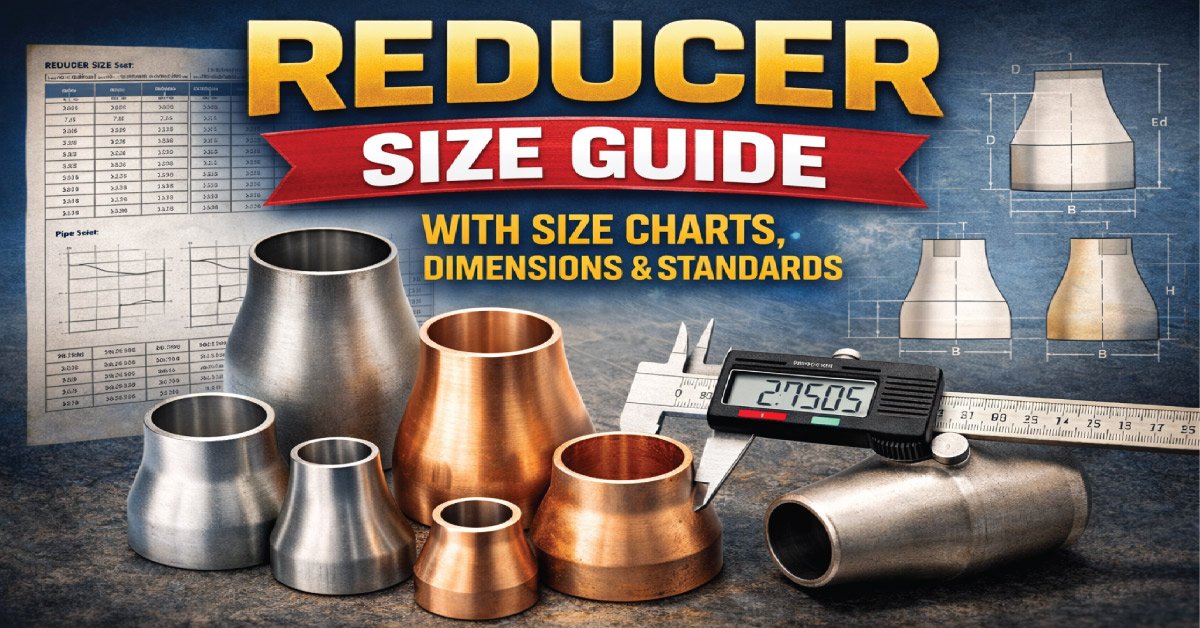
Selecting the correct reducer is critical in mechanical and industrial system design. Proper sizing boosts efficiency, extends equipment life, and ensures safe, reliable operation. Undersized reducers risk premature failure, while oversized units waste energy and raise costs. This Reducer Size Guide explains key concepts and sizing calculations to help you confidently choose the right reducer.
What Is a Reducer?
Why Proper Reducer Sizing Matters

Improper sizing can cause overheating, gear wear, vibration, noise, or catastrophic failure.
Common Types of Reducers
Before selecting the correct reducer size, it is important to understand the different types of reducers available and their typical applications. Each reducer type offers unique advantages, efficiencies, and limitations. Understanding these differences helps ensure proper sizing, optimal performance, long service life, and reliable operation under specific load and speed requirements.
1- Helical Gear Reducers
Helical gear reducers are known for their high efficiency, quiet operation, and smooth power transmission. Their angled gear teeth allow gradual engagement, reducing noise and vibration while increasing load-carrying capacity. They are widely used in continuous-duty applications such as conveyors, pumps, compressors, and material handling systems where efficiency and durability are critical.
2- Worm Gear Reducers
Worm gear reducers feature a compact design and provide very high reduction ratios in a single stage. They are commonly used in applications with limited space or where self-locking capability is beneficial. However, they typically have lower efficiency and generate more heat, making proper sizing and thermal consideration especially important.
3- Planetary Gear Reducers
Planetary gear reducers offer high torque density, compact size, and excellent positional accuracy. Their load-sharing design distributes forces evenly across multiple gears, allowing them to handle heavy loads with minimal backlash. These reducers are ideal for robotics, automation, CNC machinery, and applications requiring precision, high torque, and compact installation.
4- Bevel Gear Reducers
Bevel gear reducers are designed to change the direction of power transmission, typically at a right angle. They provide high efficiency and are commonly used in applications such as mixers, conveyors, and material handling equipment. Proper sizing ensures smooth operation, accurate torque transfer, and long gear life when directional changes are required.
Key Factors in Reducer Size Selection

Motor power (HP or kW)
Input speed (RPM)
Required output speed
Load torque
Duty cycle
Operating conditions
Ignoring any of these factors can lead to incorrect sizing.
Understand Input Power and Speed
Determining Required Output Speed
The required output speed is determined by the specific needs of the application. Different machines demand different speeds—for instance, conveyors may operate between 10–100 RPM, mixers between 20–60 RPM, and crushers from 50–200 RPM. The reduction ratio needed to achieve this output speed is calculated by dividing the input speed by the desired output speed.
Conveyors: 10–100 RPM
Mixers: 20–60 RPM
Crushers: 50–200 RPM
The required reduction ratio is calculated as:
Reduction Ratio = Input Speed ÷ Output Speed
Reduction Ratio and Its Impact on Size
Larger gear sets
More gear stages
Increased reducer size
Worm and planetary reducers can achieve higher ratios in a compact footprint compared to helical reducers.
Torque Requirements Explained
Torque is the rotational force needed to move a load, and reducers increase torque as speed decreases. Output torque can be calculated using the formula:
Output Torque (Nm) = (9550 × Power in kW) ÷ Output Speed (RPM).
Choosing a reducer with inadequate torque capacity is a frequent sizing error that can lead to premature wear, reduced efficiency, and potential system failure.

Service Factor and Load Conditions
Typical service factors:
Uniform load: 1.0 – 1.25
Moderate shock: 1.4 – 1.75
Heavy shock: 2.0 or higher
Always multiply required torque by the service factor when selecting reducer size.
Reducer Size vs Torque Capacity (Table)
Reducer size selection depends on the torque required for the application. Table 1 provides typical torque capacities for common reducer sizes along with example applications. These values serve as a general guideline, but actual torque ratings can vary depending on the manufacturer, reducer type, and specific design features, so always verify specifications before selecting a reducer.
| Reducer Size | Max Torque (Nm) | Typical Applications |
|---|---|---|
| Size 40 | 150 | Small conveyors, fans |
| Size 60 | 400 | Packaging machines |
| Size 80 | 950 | Mixers, elevators |
| Size 100 | 1800 | Crushers, heavy conveyors |
| Size 125 | 3200 | Mining and cement equipment |
Note: Torque values vary by manufacturer and reducer type.
Mounting Position and Space Constraints
Horizontal or vertical mounting
Shaft-mounted or foot-mounted design
Available installation space
A compact planetary reducer may be preferred where space is limited.
Shaft Size and Connection Considerations
When selecting a reducer, the output shaft must be compatible with the load’s shaft diameter, keyway or spline specifications, and coupling type. Choosing an oversized shaft can unnecessarily increase cost and weight, while an undersized shaft may fail under load. Proper matching ensures reliable power transmission, long service life, and safe operation of the system.
Load shaft diameter
Keyway or spline requirements
Coupling type
Oversized shafts increase cost, while undersized shafts risk failure.

Thermal Capacity and Heat Dissipation
Reducers generate heat during operation, and their ability to manage and dissipate this heat directly impacts performance, efficiency, and lifespan. Proper thermal management is crucial to prevent overheating, gear wear, and premature failure. In demanding applications, careful consideration of reducer size, cooling options, and operating conditions ensures reliable, long-term operation and consistent system performance.
1-High Ambient Temperatures
When a reducer operates in high ambient temperatures, the heat generated during normal operation can accumulate, reducing efficiency and shortening service life. Selecting a larger reducer with greater thermal capacity or incorporating additional cooling measures helps maintain safe operating temperatures, ensuring consistent torque delivery and reliable performance even under challenging environmental conditions.
2-Continuous Duty Cycles
Reducers running continuously for extended periods experience sustained heat buildup, which can impact lubrication, gear wear, and overall efficiency. To handle continuous duty cycles, a larger reducer or one with enhanced cooling features may be required. Proper sizing under these conditions ensures stable operation, reduces maintenance needs, and extends the reducer’s service life.
3-High Loads
Operating under high loads increases torque demand and generates additional heat within the reducer. If not properly accounted for, this can cause overheating, gear damage, or premature failure. Selecting a larger reducer or adding thermal management solutions ensures the unit can safely handle high loads while maintaining efficiency, reliability, and long-term operational stability.
You may need a larger size or additional cooling options.
Typical Reducer Sizes by Motor Power (Table)
| Motor Power (kW) | Recommended Reducer Size |
|---|---|
| 0.37 – 0.75 | Size 40 – 50 |
| 1.1 – 2.2 | Size 50 – 60 |
| 3 – 5.5 | Size 70 – 80 |
| 7.5 – 11 | Size 90 – 100 |
| 15 – 22 | Size 110 – 125 |
This table provides a general reference only. Always verify torque and service factor.
Efficiency and Its Role in Sizing
Reducer efficiency impacts power loss, heat generation, and overall system performance. Higher-efficiency reducers transmit more power with less energy wasted. Helical and planetary types typically achieve 94–98% and 95–97% efficiency, respectively, while worm reducers range from 50–90%. Lower-efficiency units may need to be upsized to compensate for energy losses.
Helical reducers: 94–98%
Planetary reducers: 95–97%
Worm reducers: 50–90%
Lower-efficiency reducers may require a larger size to compensate for losses.
Noise, Vibration, and Precision Requirements
In applications where low noise, high positioning accuracy, and minimal backlash are critical, planetary reducers are often preferred. Their precise gear arrangement and smooth operation not only reduce vibration and noise but can also allow the use of smaller reducer sizes compared to traditional helical or worm gear units, without compromising performance or reliability.
Low noise
High positioning accuracy
Minimal backlash
Often use planetary reducers, which may allow smaller sizes compared to traditional gear reducers.
Reducer Size Selection Step-by-Step
Selecting the correct reducer requires a structured, step-by-step approach to ensure optimal performance, reliability, and efficiency. By carefully evaluating motor specifications, output requirements, and operating conditions, you can choose a reducer that meets torque, speed, and load demands while minimizing wear, energy loss, and maintenance issues. Following a systematic process reduces the risk of sizing errors.
1. Identify Motor Power and Speed
Begin by determining the motor’s power rating, expressed in kW or HP, and its input speed in RPM. These parameters are the foundation for reducer selection, as they define the energy available to drive the load. Accurate identification ensures proper torque calculation and helps prevent undersizing or oversizing the reducer.
2. Define Required Output Speed
Determine the output speed needed for the application, based on the load and process requirements. For example, conveyors, mixers, and crushers each have different speed demands. Knowing the exact output speed allows accurate calculation of the reduction ratio, ensuring the system runs efficiently and meets operational requirements.
3. Calculate Reduction Ratio
The reduction ratio is calculated by dividing the motor input speed by the required output speed. This ratio determines how much the reducer slows the motor while increasing torque. Correctly calculating the ratio ensures the chosen reducer can deliver the necessary speed and torque without overloading or underutilizing the system.
4. Determine Required Output Torque
Calculate the torque needed at the output shaft to move the load, using the formula: Output Torque (Nm) = (9550 × Power in kW) ÷ Output Speed (RPM). This step ensures the reducer can handle the mechanical demands of the application and avoids common mistakes related to insufficient torque capacity.
5. Apply Service Factor
Multiply the calculated output torque by the service factor (SF) to account for shock loads, start-stop cycles, and operating conditions. Using the appropriate SF ensures the reducer can handle real-world stresses, extending its service life and maintaining reliable performance under varying load scenarios.
6. Select Reducer Type
Choose the reducer type—helical, worm, planetary, or bevel—based on application needs such as torque requirements, space constraints, efficiency, and precision. The correct type balances performance, size, cost, and operational reliability, ensuring optimal system design.
7. Choose Reducer Size with Sufficient Torque Capacity
Finally, select a reducer size that meets or exceeds the torque requirement after applying the service factor. Verify compatibility with mounting, shaft dimensions, and thermal capacity. Proper sizing ensures long service life, reliable operation, and efficient performance under all expected conditions.
This systematic approach minimizes errors.
Common Reducer Sizing Mistakes
Many sizing errors can reduce performance, efficiency, and equipment life. Common mistakes include ignoring the service factor, oversimplifying torque calculations, selecting a reducer based solely on physical size, neglecting duty cycle, and overlooking thermal limits. Avoiding these pitfalls ensures the reducer operates reliably, lasts longer, and maintains safe, efficient system performance.
Ignoring service factor
Oversimplifying torque calculations
Choosing based on size alone
Not considering duty cycle
Overlooking thermal limits
Avoiding these mistakes improves system reliability.

Reducer Size Comparison by Application (Table )
Reducer size selection varies depending on the type of application and the load conditions. This table provides typical reducer sizes for common equipment, ranging from light-duty packaging lines to heavy-duty hoists and mixers. It serves as a practical reference to help match reducer capacity to the demands of each specific application.
| Application Type | Load Condition | Typical Reducer Size |
|---|---|---|
| Belt Conveyor | Moderate | Size 60 – 80 |
| Screw Conveyor | Heavy | Size 80 – 100 |
| Mixer | Variable Load | Size 90 – 110 |
| Hoist / Lift | Shock Load | Size 100 – 125 |
| Packaging Line | Light | Size 40 – 60 |
Custom vs Standard Reducer Sizes
Standard reducers are widely available, cost-effective, and suitable for most applications. However, custom-sized reducers may be necessary when dealing with non-standard shafts, extremely high torque, tight installation spaces, or specialized industry requirements.
For complex or unique applications, consulting a reducer manufacturer ensures the right solution for performance, reliability, and safety.
Non-standard shafts
Extreme torque
Limited space
Specialized industries
Consulting a reducer manufacturer is recommended for complex applications.
Final Thoughts
Selecting the right reducer size requires balancing performance, reliability, and cost. By thoroughly assessing motor power, input and output speed, torque requirements, service factor, and operating conditions, you can achieve optimal performance and long-term durability. A properly sized reducer protects machinery while enhancing productivity, reducing energy consumption, and ensuring efficient operation across the entire system.
FAQs:
How to check reducer size?
To check a reducer size, measure the outer diameter or nominal pipe size of both the larger and smaller ends using a caliper or tape. Compare these measurements with standard size charts. Also note the reducer type (concentric or eccentric) and material, as standards can vary between piping systems.
What does reducer mean?
A reducer is a pipe fitting used to connect two pipes of different diameters. Its main purpose is to smoothly transition flow from a larger pipe to a smaller one or vice versa. Reducers help maintain system efficiency, reduce pressure loss, and ensure proper alignment in piping systems.
What is a reducer fitting?
A reducer fitting is a component installed in pipelines to join pipes of unequal sizes. It is commonly used in plumbing, HVAC, and industrial piping systems. Reducer fittings are available in various materials, sizes, and designs to support fluid flow, pressure control, and system compatibility.
What is a reducer used for?
A reducer is used to change pipe diameter within a piping system. It helps regulate flow rate, manage pressure changes, and connect equipment with different inlet or outlet sizes. Reducers are widely used in water supply lines, chemical processing, oil and gas pipelines, and mechanical systems.
How to calculate reducer size?
To calculate reducer size, identify the nominal size of the larger pipe and the smaller pipe it will connect to. Subtract the smaller diameter from the larger to determine the reduction. Always refer to standard reducer size charts to ensure compatibility with pressure ratings and industry standards.
What are the two types of reducers?
The two main types of reducers are concentric reducers and eccentric reducers. Concentric reducers have a common centerline and are typically used in vertical pipelines. Eccentric reducers have offset centerlines and are preferred in horizontal piping to prevent air pockets or fluid accumulation.
What is a PVC reducer?
A PVC reducer is a plastic pipe fitting made from polyvinyl chloride, used to connect PVC pipes of different sizes. It is lightweight, corrosion-resistant, and commonly used in plumbing, drainage, and irrigation systems. PVC reducers are cost-effective and easy to install in low-pressure applications.