
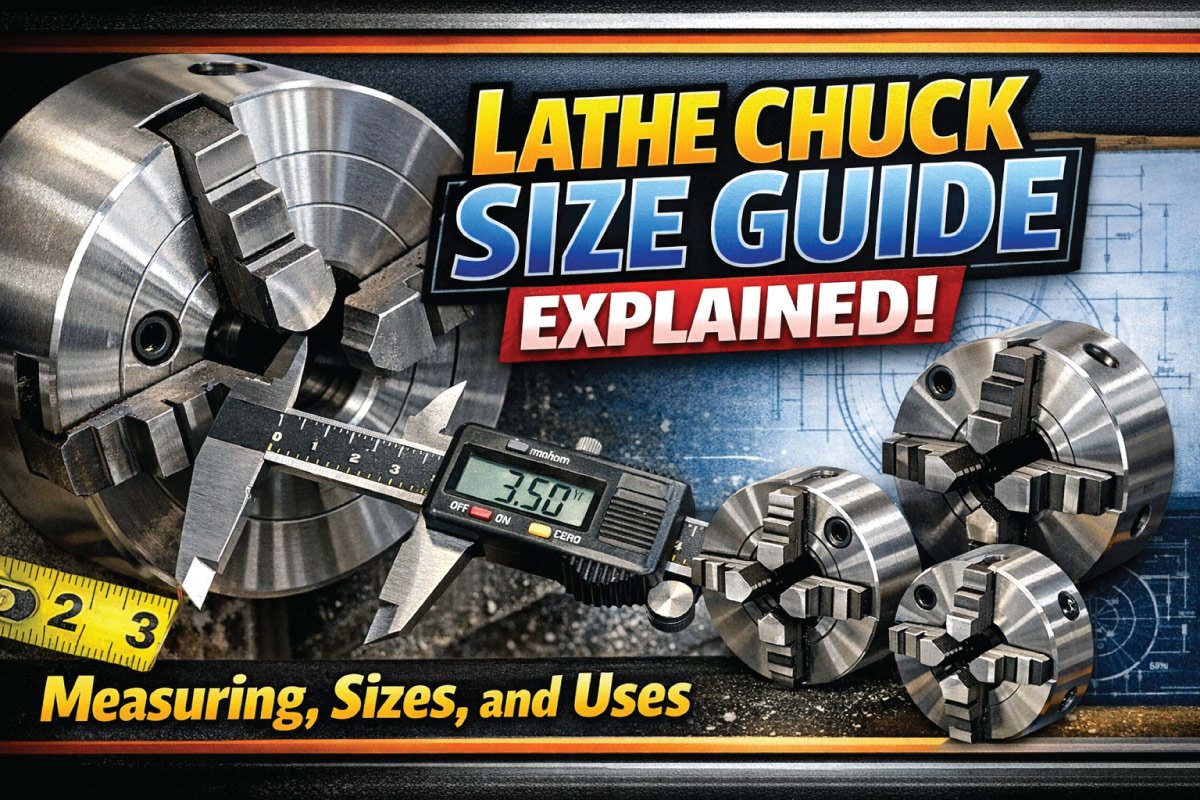
A lathe chuck is one of the most critical components of a lathe machine. It directly affects machining accuracy, workpiece stability, surface finish, and operator safety. Selecting the correct lathe chuck size ensures that the workpiece is held securely while allowing efficient and precise machining operations.
This Lathe Chuck Size Guide covers chuck types, standard sizes, mounting options, jaw capacity, applications, and selection tips to help you choose the right chuck for your lathe.
What Is a Lathe Chuck?

Why Lathe Chuck Size Matters
Selecting the correct lathe chuck size is critical for safe, accurate, and efficient machining. The chuck size determines how securely a workpiece can be held, how much load is placed on the spindle, and the range of workpiece diameters that can be machined.
An improperly sized chuck can reduce accuracy, increase wear, and create safety hazards.
1-Workpiece Holding Strength
Chuck size directly influences gripping force and jaw contact area. A properly sized chuck provides sufficient clamping strength to hold,
the workpiece securely under cutting forces, preventing slippage, vibration, or part ejection during machining operations.
2-Machining Accuracy and Runout
Using the correct chuck size helps minimize runout and improves concentricity. Oversized or undersized chucks can introduce misalignment,
leading to poor surface finish, dimensional inaccuracies, and increased tool wear. Proper sizing ensures stable, precise machining.
3-Maximum Workpiece Diameter
Each chuck size has a maximum workpiece diameter it can safely hold. Selecting an appropriately sized chuck allows the machinist to handle,
the required part dimensions without overextending the jaws or compromising grip stability.
4-Lathe Spindle Load
Larger chucks add more mass and inertia to the spindle. Choosing a chuck that is too large can overload the spindle bearings, reduce machine life,
and limit operating speeds. Correct sizing balances capacity with machine capability.
5-Operator Safety
Proper chuck sizing reduces the risk of workpiece slippage, jaw failure, or excessive vibration. A securely sized chuck enhances operator safety by ensuring stable rotation, controlled cutting forces,
and predictable machine behavior during operation. An incorrectly sized chuck can lead to vibration, slippage, poor surface finish, or equipment damage.
Understanding Lathe Chuck Size Terminology
Before selecting a lathe chuck, it is important to understand the key sizing terms used by manufacturers. These terms define the chuck’s physical dimensions, gripping range, mounting compatibility, and workholding capability.
Knowing this terminology helps ensure proper chuck selection, accurate machining, safe operation, and compatibility with your lathe and intended workpieces.

Chuck Diameter – Overall size of the chuck body
Jaw Capacity – Maximum and minimum gripping range
Through Hole / Bore Size – Opening for bar stock
Mount Type – Threaded, camlock, or bolt-on
Jaw Type – Internal, external, or reversible
How Lathe Chuck Sizes Are Measured
Understanding how lathe chuck sizes are measured is essential for selecting the right chuck for safe and accurate machining.
Chuck size affects compatibility, stability, and performance, but it is often misunderstood as jaw capacity, which it is not.
1. Outside Diameter of the Chuck Body
Lathe chuck size is primarily defined by the outside diameter of the chuck body. This measurement is taken across the widest part of the chuck, excluding the jaws.
It is usually expressed in inches or millimeters, such as 6-inch or 160 mm, and serves as the standard size reference.
2. Inches vs Millimeters Measurement
Chuck sizes are commonly listed in inches in the US market and millimeters in metric systems. For example, a 6-inch chuck is roughly equivalent to a 160 mm chuck.
Both represent the same concept—the overall chuck diameter—just expressed using different measurement systems.
3. What Chuck Size Actually Indicates
Chuck size does not describe how wide a workpiece the chuck can grip. Instead, it indicates the chuck’s mass, strength, and suitability for certain lathe sizes.
Larger chucks are heavier and more rigid, making them suitable for bigger lathes and heavier machining tasks.
4. Relationship Between Chuck Size and Lathe Compatibility
Lathe chuck size helps determine whether a chuck is compatible with a specific lathe spindle and swing capacity.
Installing an oversized chuck on a small lathe can cause imbalance or safety issues, while an undersized chuck may limit workpiece stability and holding power.
5. Chuck Size vs Jaw Capacity
A common mistake is confusing chuck size with jaw opening range. Jaw capacity depends on jaw design and travel, not chuck diameter.
Two chucks of the same size may have different gripping ranges, so jaw specifications should always be checked separately from chuck size.
Common Lathe Chuck Sizes
Lathe chucks are manufactured in a range of standard sizes to suit different machine capacities and workpiece dimensions. Smaller chucks are used on bench and toolroom lathes, while larger sizes are common on industrial machines.
Typical chuck sizes range from 3 inches (75 mm) up to 12 inches (315 mm), with heavy-duty industrial lathes using chucks 24 inches or larger.
3-inch (75 mm)
4-inch (100 mm)
5-inch (125 mm)
6-inch (160 mm)
8-inch (200 mm)
10-inch (250 mm)
12-inch (315 mm)
Larger industrial lathes may use chucks up to 24 inches or more.
Lathe Chuck Size vs Lathe Machine Size
Lathe chuck size must be carefully matched to the machine’s swing over bed, spindle bore, and motor power. An oversized chuck can overload the spindle bearings and motor, reduce safe operating speeds,
and shorten machine life, while an undersized chuck restricts workpiece diameter and limits machining capability and productivity.

Swing over bed
Spindle bore
Motor power
A chuck that is too large can overload the spindle and motor, while a small chuck limits workpiece size.
Lathe Chuck Size Chart by Lathe Swing (Table)
This chart provides general guidance for selecting an appropriate chuck size based on the lathe’s swing over bed. Matching chuck diameter to machine capacity ensures safe operation, proper spindle loading, and sufficient workpiece clearance.
Always verify manufacturer recommendations, spindle limits, and intended cutting forces before finalizing chuck size selection.
| Lathe Swing Over Bed | Recommended Chuck Size |
|---|---|
| 7 – 9 inches | 3″ – 4″ |
| 10 – 12 inches | 5″ – 6″ |
| 13 – 15 inches | 6″ – 8″ |
| 16 – 20 inches | 8″ – 10″ |
| 21 – 30 inches | 10″ – 12″ |
| 30″+ | 12″ – 20″+ |
Types of Lathe Chucks
Lathe chucks are available in several designs, each suited to specific workholding needs. Understanding the different chuck types helps machinists select the correct size and style for accuracy, efficiency,
and safety. Chuck choice affects centering ability, setup time, gripping strength, and the range of workpiece shapes that can be machined effectively.
1-Three-Jaw Self-Centering Chucks
Three-jaw self-centering chucks automatically center round or hexagonal workpieces when tightened. They are the most commonly used chuck type for general machining,
because of their fast setup, ease of use, and reliable repeatability in production and workshop environments.
2-Four-Jaw Independent Chucks
Four-jaw independent chucks allow each jaw to be adjusted separately, making them ideal for square, rectangular, or irregularly shaped workpieces.
They also provide precise centering control, making them suitable for high-accuracy work and offset turning operations.
3-Collet Chucks
Collet chucks offer excellent concentricity and high accuracy, especially for small-diameter workpieces. They grip the material evenly around its circumference, reducing runout and vibration,
which makes them ideal for precision machining, high-speed operations, and repetitive small-part production.
4-Combination Chucks
Combination chucks combine the features of self-centering and independent chucks. They can be used for quick centering like a three-jaw chuck or adjusted individually like a four-jaw chuck, providing versatility for workshops that handle a wide variety of workpiece shapes and sizes.
Three-Jaw Chuck Size Guide
Three-jaw chucks are best suited for repetitive machining of round materials where quick setup is important. They are commonly available in sizes ranging from 3 inches for small bench lathes to over 15 inches for large industrial machines, offering a balance of speed, convenience, and holding strength.
Three-Jaw Chuck Size Chart (Table )
This chart highlights common three-jaw chuck sizes along with their typical jaw capacity and applications. It serves as a practical reference for matching chuck size to workpiece diameter and machining requirements.
Selecting the appropriate three-jaw chuck ensures secure gripping, accurate centering, efficient setup, and safe operation across light, general, and heavy-duty turning tasks.
| Chuck Size | Typical Jaw Capacity | Common Applications |
|---|---|---|
| 4″ | 0.1″ – 2.5″ | Mini lathes, light work |
| 5″ | 0.2″ – 3.5″ | Bench lathes |
| 6″ | 0.3″ – 5″ | General machining |
| 8″ | 0.5″ – 7″ | Industrial lathes |
| 10″ | 1″ – 9″ | Heavy-duty turning |
Four-Jaw Chuck Size Guide
Four-jaw chucks offer greater flexibility and precision for holding square, rectangular, or irregularly shaped workpieces. Each jaw moves independently, allowing exact centering and alignment.
While they are generally heavier and require manual adjustment, four-jaw chucks are ideal for precision turning, offset work, and applications where accurate concentricity is critical.

Four-Jaw Chuck Size Chart (Table)
| Chuck Size | Max Workpiece Diameter | Typical Use |
|---|---|---|
| 5″ | Up to 4″ | Precision work |
| 6″ | Up to 5.5″ | Tool rooms |
| 8″ | Up to 7.5″ | Irregular shapes |
| 10″ | Up to 9″ | Heavy machining |
| 12″ | Up to 11″ | Large components |
Jaw Types and Their Effect on Size Selection
The type of jaws used in a lathe chuck influences gripping versatility, accuracy, and suitability for specific workpieces. While chuck diameter determines overall capacity, jaw type affects the effective gripping range and how securely the workpiece can be held.
Understanding jaw types helps machinists select the right chuck and jaws for the intended application.
1-Standard Jaws
Standard jaws are general-purpose and suitable for a wide range of external clamping tasks. They provide reliable grip on round or hexagonal workpieces without customization, making them ideal for everyday machining and repetitive turning operations.
2-Reversible Jaws
Reversible jaws can be flipped to grip either the inside or outside of a workpiece. This versatility allows a single set of jaws to handle both internal bores and external diameters, reducing setup time and increasing the chuck’s flexibility across various projects.
3-Soft Jaws
Soft jaws are made from machinable materials that can be custom-shaped to match the workpiece geometry. They provide precise clamping for irregular or delicate components, minimizing marring, improving concentricity, and ensuring accurate machining of custom parts.
4-Hard Jaws
Hard jaws are made from durable, wear-resistant steel for heavy-duty or abrasive work. They are less customizable but ideal for rough machining and high-force applications, maintaining grip integrity over extended use without deforming or wearing prematurely.
Chuck Mounting Types
Chuck Bore Size and Bar Capacity
Chuck Size vs Workpiece Weight
Reduce spindle speed
Increase wear on bearings
Cause vibration
Always balance chuck size with lathe capacity.
Chuck Speed Limits
Every lathe chuck has a maximum safe rotational speed, typically specified by the manufacturer. Larger chucks have lower RPM limits because increased diameter and mass generate greater centrifugal forces at high speeds,
which can cause vibration, jaw failure, or workpiece ejection. Selecting a chuck within its speed rating ensures safe, accurate, and reliable machining.
Chuck Speed and Size Reference Table (Table)
This table provides typical maximum RPM limits for various lathe chuck sizes. Larger chucks have lower safe speeds due to increased centrifugal forces and mass, while smaller chucks can operate at higher RPMs.
Following these guidelines ensures safe operation, minimizes vibration, and maintains machining accuracy and workpiece stability.
| Chuck Size | Typical Max RPM |
|---|---|
| 4″ | 6000 – 8000 |
| 6″ | 4000 – 6000 |
| 8″ | 2500 – 3500 |
| 10″ | 1800 – 2500 |
| 12″ | 1200 – 1800 |
Precision and Runout Considerations
Runout refers to the deviation of the workpiece from true rotation, affecting machining accuracy. Smaller, high-quality lathe chucks typically exhibit lower runout, making them ideal for precision work.
For applications requiring tight tolerances, collet chucks or carefully machined three-jaw chucks are preferred, as they ensure concentric rotation and consistent dimensional accuracy.
Lathe Chuck Size for Different Materials
The material being machined affects the ideal lathe chuck size and jaw type. Aluminum often uses smaller chucks with higher RPM for faster cutting, while steel requires medium to large chucks with strong gripping force.
Cast iron demands heavy-duty chucks for stability, and plastics benefit from soft jaws and lighter chucks to prevent deformation and ensure secure clamping.
Aluminum: Smaller chucks with higher RPM
Steel: Medium to large chucks with strong grip
Cast Iron: Heavy-duty chucks
Plastic: Soft jaws and lighter chucks
Material type influences chuck size and jaw choice.
Common Lathe Chuck Size Mistakes
Selecting the wrong lathe chuck size can compromise safety, accuracy, and machine performance. Frequent errors include using oversized chucks on small lathes, ignoring spindle mounting compatibility, exceeding recommended RPM limits,
choosing a chuck based solely on workpiece diameter, and overlooking jaw capacity. Avoiding these mistakes ensures secure workholding, precise machining, and longer machine life.

Using oversized chucks on small lathes
Ignoring spindle mounting compatibility
Exceeding RPM limits
Choosing chuck size based only on workpiece diameter
Neglecting jaw capacity
How to Choose the Right Lathe Chuck Size
Selecting the correct lathe chuck size requires careful evaluation of machine capacity, workpiece dimensions, and intended operations. Proper selection ensures safe operation, accurate machining, and efficient workflow.
By considering swing, mounting, speed, and weight, machinists can match the chuck to both the lathe and the workpiece effectively.
1-Measure Lathe Swing and Spindle Capacity
Check the lathe’s swing over bed and spindle bore to determine the maximum chuck diameter the machine can safely accommodate. This prevents interference with the carriage and tool, ensuring proper clearance and avoiding overload on the spindle.
2-Identify Typical Workpiece Sizes
Consider the range of workpiece diameters and lengths you will be machining. Selecting a chuck that can securely hold your largest and smallest parts ensures versatility and reduces the need for frequent chuck changes.
3-Choose Appropriate Chuck Type
Decide between three-jaw, four-jaw, collet, or combination chucks based on workpiece shape and precision requirements. Chuck type affects centering accuracy, setup time, and the ability to handle irregular or delicate parts.
4-Match Mounting System
Ensure the chuck’s mounting type—threaded, camlock, or bolt-on—is compatible with your lathe spindle. Proper mounting ensures secure attachment, safe operation, and efficient torque transfer during machining.
5-Verify Speed and Weight Limits
Check the chuck’s maximum RPM rating and consider the combined weight of the chuck and workpiece. Oversized or heavy chucks can overload the spindle, reduce speed, and increase vibration, so always balance size with lathe capacity.
Industrial vs Hobby Lathe Chuck Sizes
Hobby lathes: 3″–6″ chucks
Workshop lathes: 6″–8″ chucks
Industrial lathes: 8″–16″+ chucks
Usage frequency and load determine ideal chuck size.
Final Thoughts
Selecting the right lathe chuck size is crucial for safe, precise, and efficient machining. Considering factors such as chuck diameter, jaw capacity, mounting type, RPM limits, and workpiece requirements ensures optimal performance and longevity of both the chuck and lathe.
This Lathe Chuck Size Guide provides a comprehensive reference for informed chuck selection in any machining application.
FAQs:
What is the chuck size on a lathe?
The chuck size on a lathe refers to the diameter of the chuck body, usually measured in inches or millimeters. It indicates the maximum gripping capacity of the chuck and helps determine what size of workpiece can be safely held during turning operations.
How to measure chuck size?
To measure chuck size, measure the outer diameter of the chuck across its widest point using a ruler or caliper. Do not measure the jaws. The measured diameter, such as 6-inch or 160 mm, represents the chuck size used for lathe selection and compatibility.
What are the different chuck sizes?
Lathe chucks come in common sizes like 3-inch, 4-inch, 5-inch, 6-inch, 8-inch, 10-inch, and 12-inch. Metric sizes such as 80 mm, 100 mm, 125 mm, 160 mm, and 200 mm are also widely used, depending on machine capacity.
How to choose a lathe chuck?
To choose a lathe chuck, consider the lathe spindle size, maximum swing, and type of work you perform. Heavier or larger workpieces need bigger chucks, while precision work benefits from high-quality, accurately machined chucks with proper jaw configurations.
When to use a 3 or 4 jaw chuck?
Use a 3-jaw chuck for quick setup and holding round or hexagonal workpieces with good accuracy. A 4-jaw chuck is preferred for irregular shapes, square stock, or when precise centering is required, as each jaw can be adjusted independently.
What is the standard chuck size?
There is no single standard chuck size, but 6-inch and 8-inch chucks are the most commonly used on small to medium lathes. The standard size depends on the lathe’s swing, spindle bore, and the type of machining work performed.