
Choosing the right marine propeller is one of the most important decisions you can make for your boat’s performance.
The correct propeller size affects speed, acceleration, fuel efficiency, engine longevity, and overall handling.
Yet for many boat owners, propeller sizing can feel confusing, filled with numbers, terminology, and trade-offs.
This comprehensive marine propeller size guide breaks everything down in simple terms.
By the end of this article, you will understand how propeller size works, what the numbers mean, how to match a propeller to your engine and boat type, and how to avoid common mistakes.
What Is a Marine Propeller?
A marine propeller is a rotating, fan-like device that transforms engine power into thrust, propelling a boat through water.
As it spins, the propeller pushes water backward, generating forward motion according to Newton’s third law of motion—every action has an equal and opposite reaction.
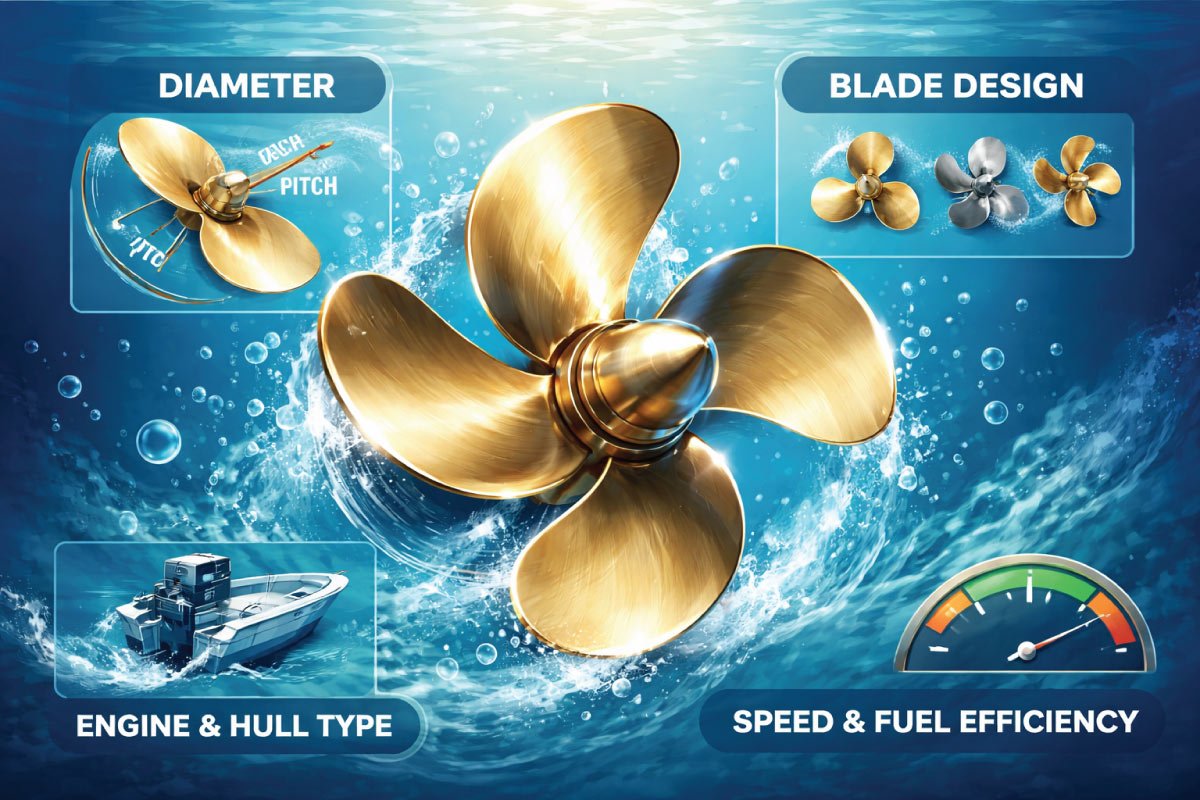
Although propellers may appear similar, even minor differences in diameter, pitch, or blade design can significantly affect speed, fuel efficiency, handling, and overall performance.
Choosing the right propeller is essential to match your boat’s engine, hull type, and intended use, ensuring optimal thrust, smooth operation, and safe maneuverability on the water.
Understanding Propeller Size Basics
Marine propeller size is expressed using two key measurements: diameter and pitch.
These numbers determine how the propeller interacts with the water and directly influence your boat’s speed, efficiency, and handling.
Understanding what these values represent is essential for selecting the right propeller for your engine and hull.
Diameter × Pitch
For example:
14 × 19
This means:
14 inches in diameter
19 inches of pitch
Let’s break those terms down.
Propeller Diameter Explained
Propeller diameter refers to the distance across the circle traced by the spinning blades.
It directly affects the volume of water the propeller can move, influencing thrust, speed, and overall performance.
Selecting the correct diameter is essential for efficient propulsion, optimal engine load, and smooth operation, ensuring that the vessel achieves its intended speed and handling characteristics.
How Diameter Affects Performance
A larger propeller diameter moves more water with each rotation, generating stronger thrust at lower speeds.
This makes it ideal for heavy boats, vessels carrying significant loads, or applications requiring powerful acceleration.
Larger diameters improve handling when towing or climbing waves but may limit top speed due to increased drag. Proper clearance and matching to the engine are essential.
Moves more water
Provides better low-speed thrust
Ideal for heavy boats or boats carrying loads
2- Smaller diameter
Less water displacement
Higher top speed potential
Common on lightweight or high-speed boats
Diameter is usually limited by the boat’s lower unit and hull design, so manufacturers often specify an acceptable range.
Propeller Pitch Explained
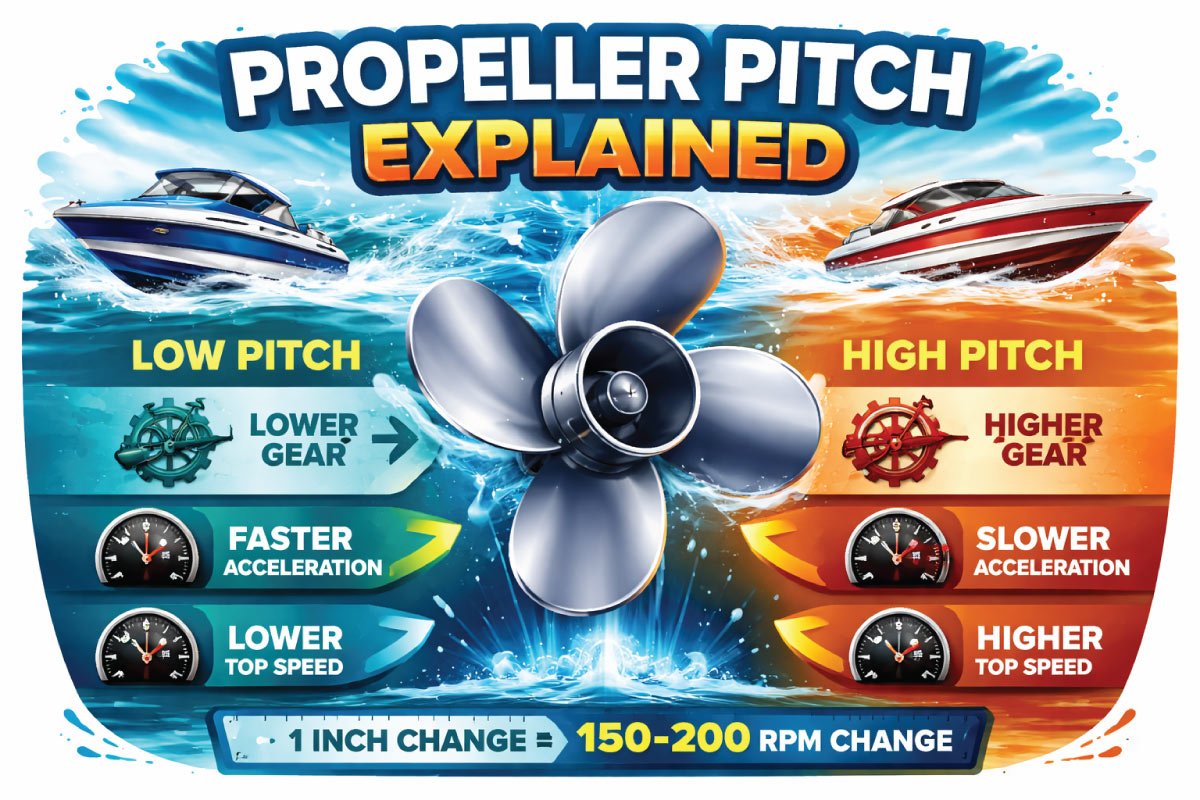
Propeller pitch is the theoretical distance, in inches, that a propeller would move forward with one full rotation if it were moving through a solid medium without any slippage.
Pitch determines how much water the blades “bite” and directly affects acceleration, speed, and engine RPM.
Pitch in Simple Terms
Think of pitch like bicycle gears:
Low pitch = lower gear
Faster acceleration
Lower top speed
High pitch = higher gear
Slower acceleration
Higher top speed
Changing pitch by just 1 inch can alter engine RPM by approximately 150–200 RPM.
Marine Propeller Size Chart (General Reference)
Choosing the right propeller starts with understanding common size ranges for different boats and engines.
While individual performance depends on hull design, load, and driving conditions, this chart provides a general reference to help narrow down diameter and pitch options.
Always confirm final selection with your engine manufacturer to ensure safe and efficient operation.
General Propeller Size Chart
Choosing the right propeller begins with understanding typical size ranges for different boat types and engine horsepower.
While exact specifications depend on hull design, load, and driving conditions, this table provides a general reference to help boaters narrow down appropriate diameter and pitch options.
Always confirm with your engine manufacturer before making a final selection to ensure safe and efficient performance.
| Boat Type | Engine HP Range | Typical Diameter (in) | Typical Pitch (in) |
|---|---|---|---|
| Small fishing boat | 9.9–25 HP | 9 – 10.5 | 8 – 11 |
| Aluminum runabout | 25–75 HP | 10.5 – 13 | 11 – 15 |
| Bowrider / Deck boat | 90–150 HP | 13 – 14.5 | 15 – 19 |
| Pontoon boat | 40–150 HP | 13 – 15 | 11 – 15 |
| Offshore / Cruiser | 200+ HP | 14.5 – 17 | 19 – 25 |
Note: These are starting points, not exact recommendations.
Propeller Pitch Explained
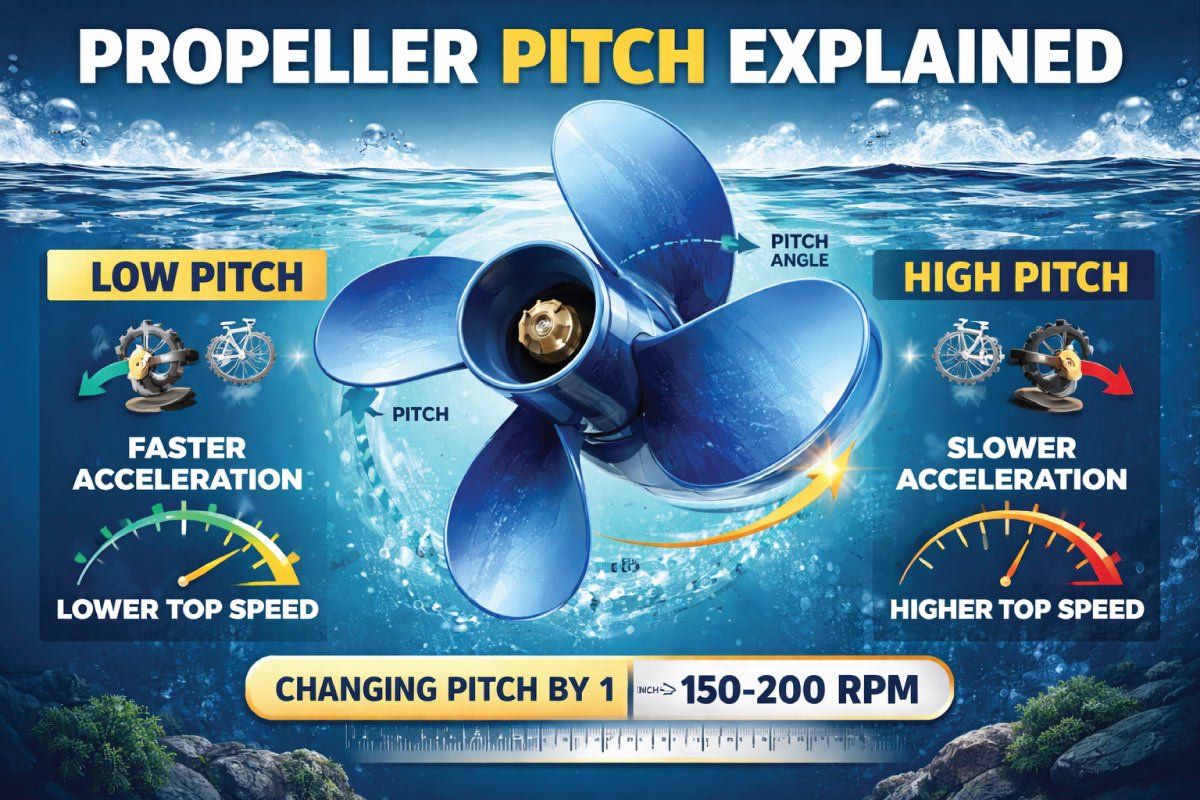
Propeller pitch is the theoretical distance, in inches, that a propeller would move forward with one full rotation if it were moving through a solid medium without any slippage.
Pitch determines how much water the blades “bite” and directly affects acceleration, speed, and engine RPM.
Pitch in Simple Terms
Think of pitch like bicycle gears:
Low pitch = lower gear
Faster acceleration
Lower top speed
High pitch = higher gear
Slower acceleration
Higher top speed
Changing pitch by just 1 inch can alter engine RPM by approximately 150–200 RPM.
Blade Count Comparison
The number of blades on a propeller directly affects boat performance, including speed, thrust, and handling.
Increasing blade count generally improves grip and stability but can slightly reduce top-end speed.
Understanding the trade-offs helps match propeller design to your boating needs, whether for speed, towing, or smooth handling in rough conditions.
| Blade Count | Advantages | Best Use Case |
|---|---|---|
| 3-Blade | Higher top speed, efficient | General boating, speed |
| 4-Blade | Better grip, smoother ride | Towing, rough water |
| 5-Blade | Maximum control, minimal vibration | High-performance boats |
More blades improve grip and control but usually reduce top speed slightly.
Matching Propeller Size to Engine RPM
Selecting the right propeller size ensures your engine runs within its optimal wide open throttle (WOT) RPM range.
Proper matching maximizes efficiency, prevents damage, and delivers balanced performance for acceleration, top speed, and fuel economy.
Running outside the recommended RPM range can lead to engine lugging, over-revving, or excessive wear.
Why Correct RPM Matters
Too much pitch → Engine struggles → Low RPM → Lugging
Too little pitch → Engine over-revs → Excessive wear
Most outboard engines operate efficiently between 5,000–6,000 RPM, but always check your engine manual.
Engine RPM and Pitch Adjustment Chart
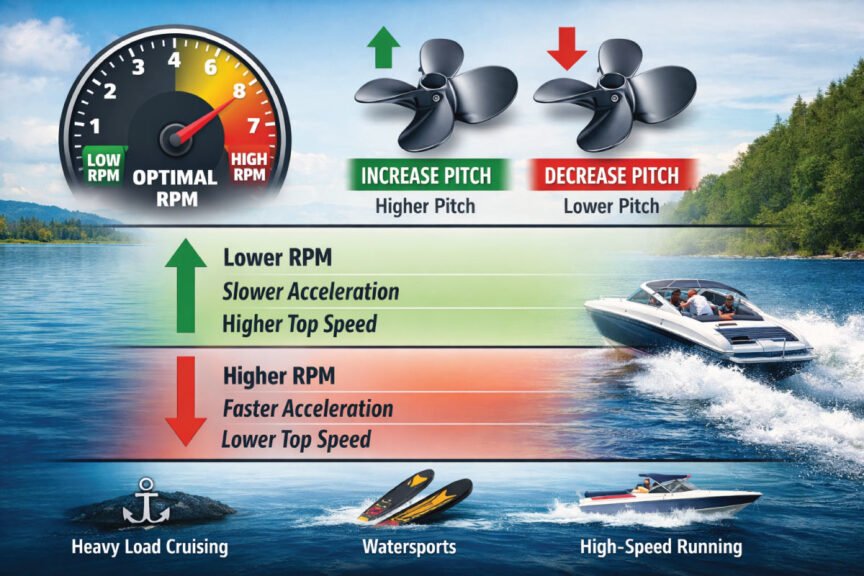
Pitch Change vs RPM Effect
| Pitch Change | Approximate RPM Change | Performance Effect |
|---|---|---|
| +1 inch pitch | −150 to −200 RPM | Higher top speed, slower acceleration |
| −1 inch pitch | +150 to +200 RPM | Faster acceleration, lower top speed |
| +2 inches pitch | −300 to −400 RPM | Significant load increase |
| −2 inches pitch | +300 to +400 RPM | Improved hole shot |
Use this chart when fine-tuning performance.
Boat Weight and Load Considerations
The total weight your boat carries—including passengers, fuel, gear, and environmental factors like waves or currents—significantly impacts propeller performance.
Properly matching propeller size to load ensures optimal thrust, acceleration, and engine efficiency, preventing overloading or underperformance.
Heavier Loads Need:
Lower pitch
Larger diameter
More blades
Lighter Loads Can Handle:
Higher pitch
Smaller diameter
Fewer blades
If your boating style varies (fishing one day, cruising the next), compromise or consider keeping two propellers.
Propeller Material and Size Selection
While propeller material doesn’t directly determine size, it influences performance, durability, and how the propeller behaves under load.
Material choice affects thrust, blade strength, and efficiency, which can in turn impact optimal diameter and pitch selection.
Choosing the right material ensures your propeller delivers consistent performance for your specific boating needs.
Common Propeller Materials
Aluminum
Affordable
Flexes under load
Good for casual boating
Stainless Steel
Stronger and thinner blades
Maintains pitch under load
Improves performance and efficiency
Switching from aluminum to stainless steel may require adjusting pitch downward by 1 inch.
Also Read:
Propeller Size by Boat Type
Propeller Size by Boat Usage
Choosing the right propeller depends not only on engine specifications but also on how you use your boat.
Different activities—such as fishing, cruising, or watersports—require varying thrust, acceleration, and handling characteristics.
The table below provides general guidelines to help match propeller diameter, pitch, and blade count to your boat’s intended use for optimal performance and efficiency.
| Boat Usage | Recommended Diameter | Recommended Pitch | Blade Count |
|---|---|---|---|
| Fishing / Trolling | Medium–Large | Low–Medium | 4 |
| Water Sports (skiing) | Medium | Low | 4 |
| Cruising | Medium | Medium | 3 |
| Speed / Performance | Small–Medium | High | 3 |
| Heavy Load / Pontoon | Large | Low | 4 |
This table helps align your propeller size with how you actually use your boat.
Also Read:
Common Propeller Sizing Mistakes
Selecting the wrong propeller can significantly reduce your boat’s performance, efficiency, and handling.
Many boaters make errors that compromise acceleration, top speed, and engine health.
Understanding common mistakes helps ensure your propeller matches your engine, hull, and typical load, allowing safe and optimal operation.
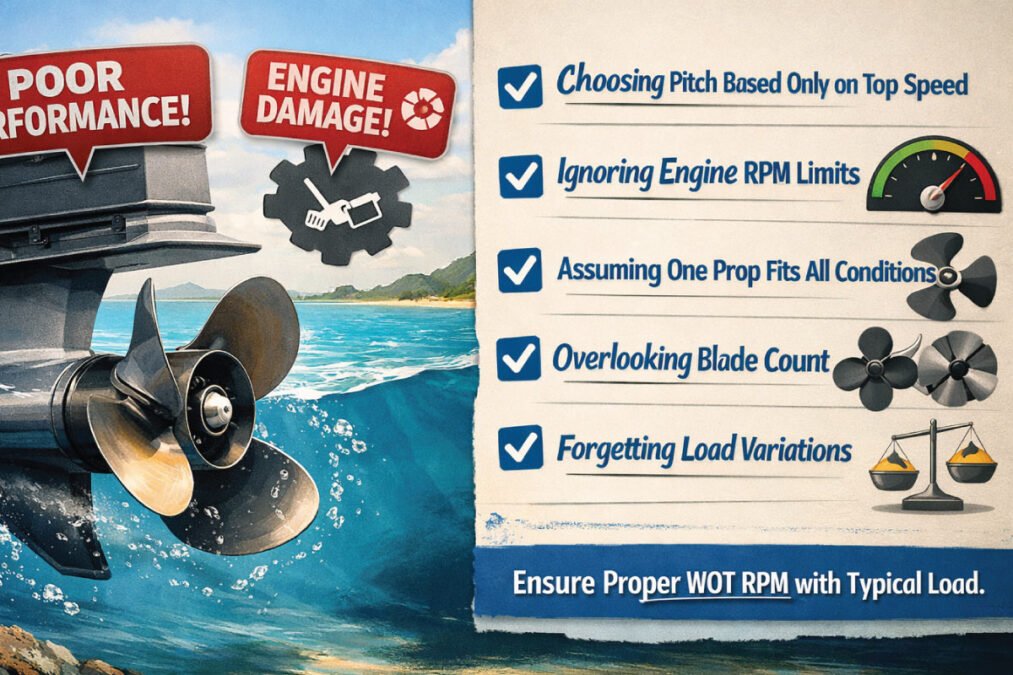
Avoid These Errors:
Choosing pitch based only on top speed
Ignoring engine RPM limits
Assuming one prop fits all conditions
Overlooking blade count
Forgetting load variations
A properly sized propeller should allow your engine to reach its recommended WOT RPM with a typical load.
Also Read:
How to Fine-Tune Your Propeller Choice
Selecting a propeller is just the first step; fine-tuning ensures your boat performs optimally under real-world conditions.
Testing and adjustments help balance speed, acceleration, and fuel efficiency, while also improving handling and safety.
Following a systematic approach allows you to maximize your engine’s potential and enjoy smoother operation on the water.
1- Test at Wide Open Throttle
Start by running your boat at wide open throttle (WOT) to see how the propeller performs under maximum load.
This reveals whether the engine reaches its recommended RPM range and provides insight into thrust, responsiveness, and overall efficiency.
2- Measure Top RPM and Speed
Recording the engine’s top RPM and corresponding speed helps determine if the propeller matches your boat’s engine and hull.
Too high or too low RPM indicates the need for pitch adjustments or a different blade configuration.
3- Observe Acceleration and Handling
Pay attention to how quickly your boat accelerates and how it responds to steering inputs. Good acceleration with smooth handling indicates a well-matched propeller, while sluggish or unstable behavior suggests further adjustment is needed.
4- Adjust Pitch or Blade Count as Needed
If testing reveals underperformance, consider changing the pitch or blade count.
Increasing pitch can boost top speed, while additional blades improve grip and stability.
Many marine dealers offer testing or exchange programs to help find the ideal propeller without unnecessary expense.
Many marine dealers offer propeller testing or exchange programs, which can save time and money.
Also Read:
Final Thoughts
Selecting the right marine propeller involves balancing several key factors, including engine power, desired speed, fuel efficiency, and typical boat usage.
Diameter, pitch, blade count, and material all interact to determine how your boat accelerates, handles, and performs under various load and water conditions.
A well-chosen propeller ensures your vessel operates safely and efficiently, reducing unnecessary strain on the engine.
Understanding propeller fundamentals, such as how pitch affects RPM and how blade count influences thrust, allows you to make informed decisions.
Using reference charts and guidelines helps narrow down the ideal options for your specific boat type and boating style.
Ultimately, the right propeller maximizes performance, enhances fuel efficiency, and improves acceleration and handling.
For uncertain cases, consulting your engine manufacturer or a marine professional ensures proper selection.
Investing in the correct propeller isn’t just an upgrade—it’s essential for a safer, smoother, and more enjoyable boating experience.
Also Read: