
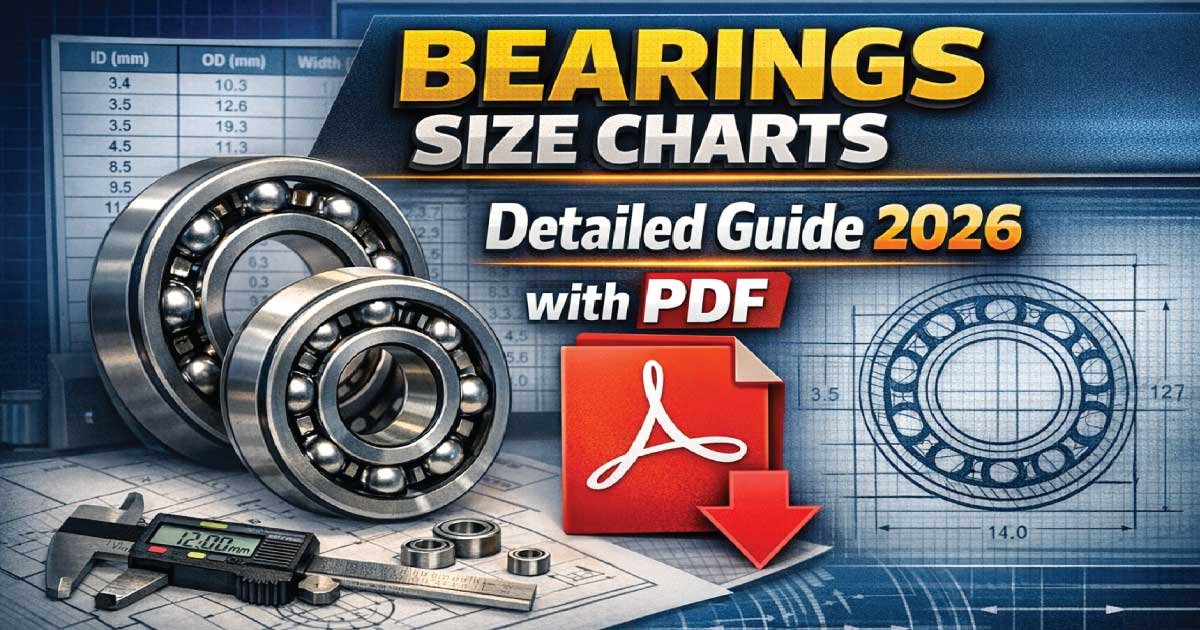
Bearings are essential components in virtually all rotating machinery. They reduce friction, support loads, and ensure smooth motion between moving parts.
Choosing the correct bearing size is critical for reliable performance, long service life, and preventing costly failures.
Whether you are working on industrial equipment, automotive engines, or home projects, understanding bearing dimensions, types, and size charts is crucial.
This guide will cover key dimensions, materials, tolerances, and practical tips for selecting the right bearing, with easy-to-read charts in both metric and inch units.
Why Bearing Size Matters
Selecting the proper bearing size is one of the most important steps in machine assembly. Incorrect sizing can lead to premature wear, misalignment, and even catastrophic failure.
By understanding the relationship between shaft, housing, and bearing dimensions, you ensure smooth and efficient operation.
Incorrectly sized bearings can cause serious issues, such as:
- Excessive wear
- Shaft misalignment
- Overheating
- Noise and vibration
- Premature machine failure
Manufacturers provide bearing size charts to help you match bearings to shafts and housings accurately.
Key Dimensions in a Bearing Size Chart
Before using a size chart, it’s important to understand the key dimensions listed.
These measurements determine how a bearing fits its shaft and housing and directly affect performance, load capacity, and longevity.
1. Inner Diameter (ID)
The inner diameter (ID) is the hole through which the shaft passes.
Choosing the correct ID ensures proper rotation, prevents wobbling, and allows adequate lubrication.
- Measured in millimeters or inches
- Must match the shaft diameter precisely
- Poor fit can lead to vibration, heat, or seizure
Tip: Always measure the shaft carefully before selecting a bearing.
2. Outer Diameter (OD)
The outer diameter (OD) is the total external measurement of the bearing.
Correct OD sizing ensures the bearing fits snugly into the housing, preventing unwanted rotation and maintaining alignment under load.
- Fits securely into the housing bore
- Too small → bearing may spin
- Too large → installation becomes difficult
3. Width / Length
The width or length of a bearing determines load distribution and stability.
A longer bearing can handle higher radial loads but may increase friction, while shorter bearings are compact but may wear faster under heavy loads.
- Affects load capacity and wear distribution
- Longer bearings → higher load capacity
- Shorter bearings → compact design, faster wear under heavy load
4. Wall Thickness
Wall thickness refers to the distance between the inner and outer surfaces of a bearing.
It impacts the bearing’s strength, heat dissipation, and ability to handle radial or axial loads.
- Calculated as (OD − ID) ÷ 2
- Thin walls → precision equipment
- Thick walls → heavy-duty applications
5. Clearance
Clearance is the small gap between the shaft and the inner diameter of the bearing. This space allows lubrication and thermal expansion.
- Too little → overheating and seizure
- Too much → vibration and noise
High-speed or high-temperature machinery requires precise clearance for proper performance.
Typical Bearing Size Chart (Metric Example)
Metric charts are standard in most industrial and automotive applications. They provide a quick reference to select the correct bearing for a given shaft size.
| Shaft Size (ID) | Outer Diameter (OD) | Width (L) |
|---|---|---|
| 10 mm | 15 mm | 10 mm |
| 12 mm | 17 mm | 12 mm |
| 15 mm | 20 mm | 15 mm |
| 20 mm | 25 mm | 20 mm |
| 25 mm | 30 mm | 25 mm |
| 30 mm | 36 mm | 30 mm |
| 40 mm | 46 mm | 40 mm |
| 50 mm | 56 mm | 50 mm |
This format makes it easy to match your shaft with the proper bearing dimensions.
Inch-Based Bearing Size Chart
In the U.S., inch measurements are still common in machinery. Using an inch-based chart helps prevent conversion errors and ensures proper fit.
| Shaft Size (ID) | Outer Diameter (OD) | Width (L) |
|---|---|---|
| 1/4 in | 5/16 in | 1/4 in |
| 3/8 in | 1/2 in | 3/8 in |
| 1/2 in | 5/8 in | 1/2 in |
| 3/4 in | 7/8 in | 3/4 in |
| 1 in | 1-1/4 in | 1 in |
Always check whether your equipment uses metric or inch standards before ordering.
Bearings Size Charts PDF
The Bearings Size Charts PDF provides a quick reference for selecting the correct bearing size. It covers both metric and inch standards, helping engineers and technicians ensure proper fit, reduce wear, and maintain mechanical system efficiency.
Common Types of Bearings and Size Considerations
1. Ball Bearings
Ball bearings reduce friction using rolling elements and are common in motors, wheels, and conveyors. Correct dimensions ensure smooth rotation and durability under high speeds.
- Critical measurements: ID, OD, width
- Tight tolerances for precision machinery
- Common in light to medium load applications
2. Roller Bearings
Roller bearings handle heavier radial loads than ball bearings. Cylindrical, tapered, or spherical rollers require careful attention to ID, OD, and length.
- Longer rollers → higher load capacity
- Suitable for heavy-duty industrial machinery
- Size charts guide correct selection
3. Sleeve / Journal Bearings
Journal or sleeve bearings use sliding contact with a thin lubrication layer. Accurate ID, OD, width, and clearance are crucial for smooth operation and long life.
- Cylindrical, simple design
- Common in motors, pumps, and industrial machines
- Size charts are straightforward
4. Thrust Bearings
Thrust bearings are designed for axial loads. They are used in clutches, automotive gearboxes, and rotating shafts. ID, OD, and thickness are critical for correct load distribution.
- Inner and outer diameters must be precise
- Thickness is critical for axial load support
Materials and Their Impact on Size Selection
Bearing material affects performance, load capacity, and thermal expansion. Choosing the right material ensures reliability in both standard and extreme applications.
Common Materials:
- Steel
- Bronze
- Brass
- Plastic (PTFE, nylon, acetal)
- Composite materials
Material choice affects sizing tolerances, lubrication needs, and heat expansion, making proper selection essential.
How to Measure for the Correct Bearing Size
Accurate measurement of bearings prevents premature failure, ensures smooth and efficient operation, reduces wear and vibration, and helps maintain the longevity and reliability of mechanical systems across all applications.
- Measure the shaft diameter with a caliper
- Measure the housing bore
- Measure the bearing width
- Inspect existing bearings for wear
For new designs, always start with the shaft size and work outward.
Discover More:
Common Mistakes When Using Bearing Size Charts
Even experienced technicians can make errors that lead to premature bearing failure.
Common mistakes include mixing metric and inch units, ignoring clearance specifications, selecting width based on availability rather than load, and assuming all manufacturers follow identical tolerances.
Always check the fine print and verify manufacturer specifications before installation.
- Mixing metric and inch units
- Ignoring clearance specifications
- Selecting width based on availability, not load
- Assuming all manufacturers use identical tolerances
Always read the fine print and confirm manufacturer data.
Bearing Tolerances Explained
Tolerances define the allowable variation in dimensions. They ensure bearings fit correctly, reduce vibration, and prevent overheating.
- Tight tolerance → precision equipment
- Loose tolerance → heavy-duty or slow-speed machinery
Size charts typically list nominal, maximum, and minimum values for each dimension.
Discover More:
Applications Where Bearing Size Accuracy Matters
Accurate bearing sizing is critical in high-performance systems. Industries that rely on precise dimensions include:
automotive engines, CNC machines, hydraulic systems, industrial conveyors, and agricultural equipment.
Even a 0.01 mm error can lead to premature wear, reduced efficiency, increased vibration, or complete system failure.
- Automotive engines
- CNC machines
- Hydraulic systems
- Industrial conveyors
- Agricultural equipment
Even a 0.01 mm error can lead to misalignment, increased wear, and reduced machine life.
How to Choose the Right Bearing Using a Size Chart
Selecting the correct bearing is essential for smooth operation and durability.
Use a systematic checklist to ensure a proper fit: match the inner diameter (ID) with the shaft, confirm the outer diameter (OD), and check the width for your application.
- ✔ Match ID with shaft size
- ✔ Match OD with housing bore
- ✔ Choose correct width/length for load
- ✔ Confirm clearance values
- ✔ Verify material compatibility
Following these steps reduces risk of failure and ensures smooth operation.
Discover More:
Final Thoughts
Bearing size charts are essential tools for engineers, mechanics, and DIY enthusiasts. They help ensure precise fit, reliable operation, and long-lasting performance.
By understanding dimensions, tolerances, materials, and proper measurement, you can select the right bearing every time.
Whether working on automotive engines, industrial machinery, or home projects, correct bearing selection reduces wear, vibration, and downtime, saving both time and money.
Always double-check size charts and manufacturer specifications before purchasing.