
Set screws are essential fasteners in mechanical assemblies, widely used in machinery, automotive, and electronic devices.
Despite their small size, they play a crucial role in holding components like pulleys, gears, and collars on shafts.
Choosing the correct set screw size ensures safety, reliability, and smooth operation.
This guide will cover everything from set screw types, sizes, applications, and torque specifications.
What is a Set Screw?
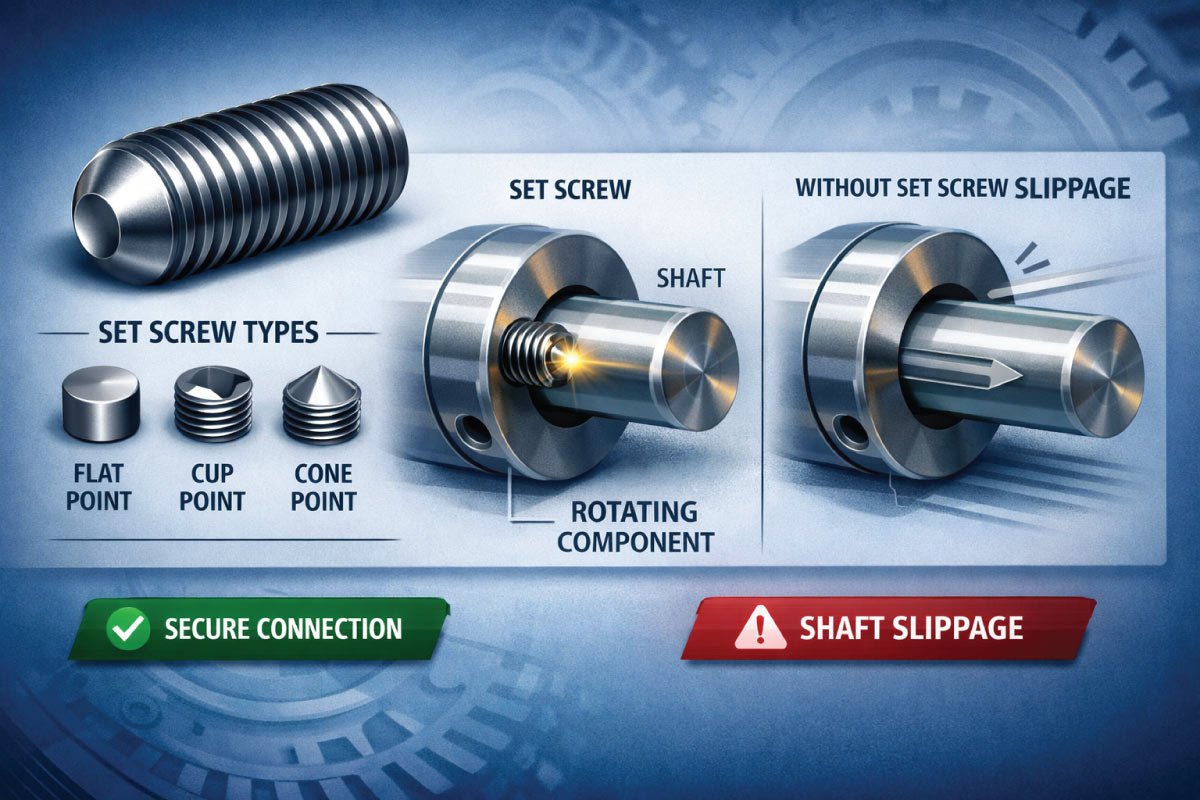
A set screw is a type of fastener designed to secure an object within or against another object without using a nut.
Unlike traditional bolts, set screws are fully threaded and often tightened into a threaded hole in one of the components.
They are commonly used to prevent relative motion between a shaft and a rotating component.
Common Applications of Set Screws
Set screws are widely used in:
Gear assemblies
Pulleys and sprockets
Collar attachments
Electrical equipment
Automotive components
They are particularly useful when space is limited and a nut cannot be applied.
Types of Set Screws
Set screws are essential fasteners used to secure one component to another, typically preventing relative motion between a shaft and a part like a pulley or gear.
What makes them versatile is the variety of tip types, each designed for specific applications, torque requirements, and precision needs.
Choosing the right set screw tip ensures optimal grip, durability, and alignment.
From general-purpose fastening to high-precision machinery, understanding the different types of set screws is key to effective mechanical assembly.
1. Cup Point Set Screws
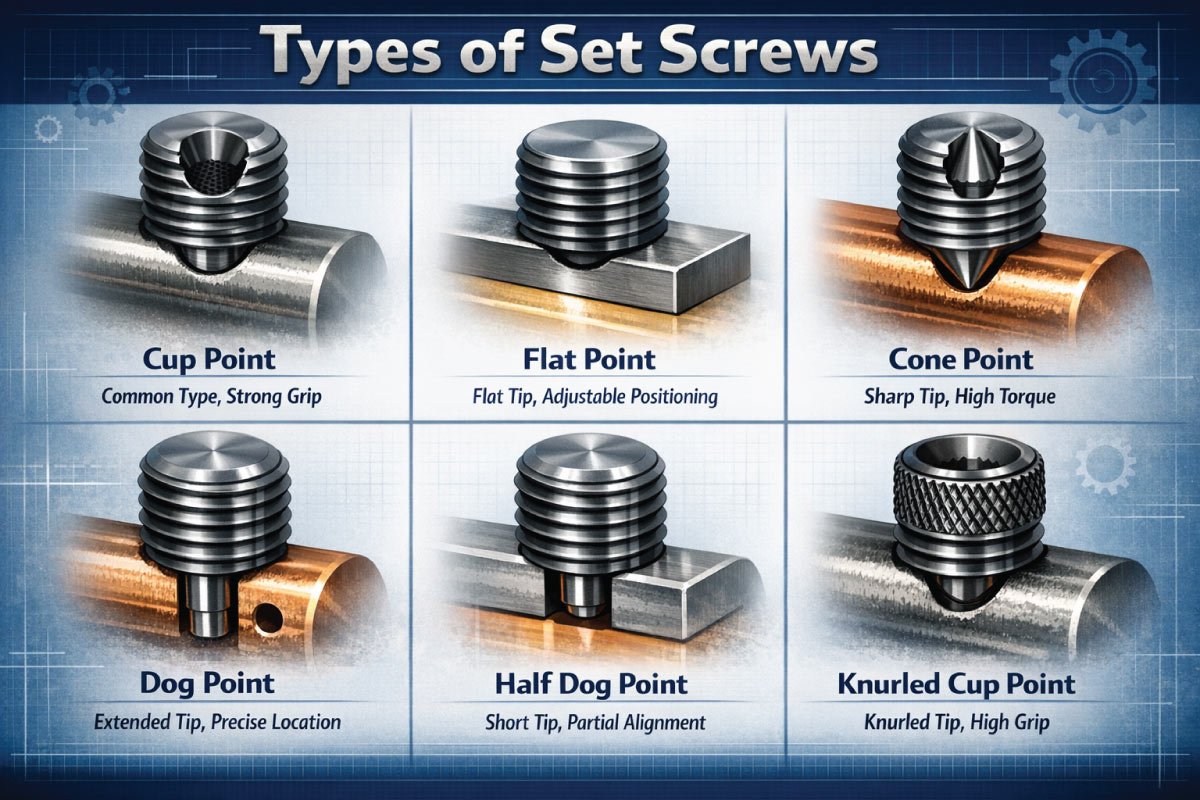
Cup point set screws are the most common type, featuring a recessed cup-shaped tip that provides a strong hold.
The design allows the screw to dig slightly into the surface of the part it secures, preventing slippage.
Cup point screws are widely used in pulleys, gears, and other mechanical components where a firm, reliable connection is essential.
Their versatility makes them the go-to choice for many general-purpose fastening applications.
2. Flat Point Set Screws
Flat point set screws have a completely flat tip, allowing for adjustable positioning without damaging the mating surface.
They are ideal for lightweight applications where repeated adjustments or precise alignment are needed. The flat surface distributes the pressure evenly, reducing the risk of material deformation.
These screws are commonly used in fixtures, assemblies, and components that require gentle but secure holding without penetrating the surface.
3. Cone Point Set Screws
Cone point set screws feature a sharp, tapered tip designed to penetrate the mating material for a very secure grip.
This makes them suitable for high-torque applications where components are subject to significant rotational forces.
The pointed tip digs into the surface, ensuring minimal slippage even under heavy load.
Cone point screws are commonly used in machinery requiring strong mechanical engagement, such as motor shafts and power transmission assemblies.
4. Dog Point Set Screws
Dog point set screws have a cylindrical tip that extends slightly beyond the threaded body.
This design allows for precise location and alignment of components, as the tip fits into a pre-drilled hole or recess on the mating part.
They are especially useful in shaft alignment and situations where repeatable positioning is critical.
Dog point screws are often applied in precision machinery, indexing components, and mechanical assemblies where exact placement is required.
5. Half Dog Point Set Screws
Half dog point set screws are similar to full dog point screws but feature a shorter cylindrical tip.
They provide controlled positioning of components without fully penetrating the mating surface.
This type is ideal for applications where partial alignment or temporary positioning is needed.
Half dog point screws are often used in mechanical assemblies where space is limited, or where a combination of precise location and moderate holding power is required.
6. Knurled Cup Point Set Screws
Knurled cup point set screws have a cup-shaped tip with textured, knurled edges, which increases friction and grip.
They are particularly effective in applications subject to vibration or movement, as the knurling helps prevent loosening over time.
These screws are commonly used in vibrating machinery, automotive assemblies, and industrial equipment where maintaining a secure hold is critical.
The added surface texture ensures superior resistance to rotational forces compared to standard cup point screws.
Set Screw Thread Types
Set screws are available in various thread types to suit both metric and imperial standards.
The thread type affects strength, precision, and compatibility with different components.
Choosing the correct thread ensures proper fastening, reduces the risk of loosening, and provides stability in mechanical assemblies.
From general industrial applications to high-precision machinery, understanding the differences between coarse and fine threads is essential for selecting the right set screw for any project or equipment.
1. Unified National Coarse (UNC)
UNC threads follow the SAE standard and are designed for general use.
They have fewer threads per inch, which provides strong, durable fastening in applications where high precision is not critical.
UNC set screws are widely used in mechanical assemblies, machinery, and general industrial equipment.
2. Unified National Fine (UNF)
UNF threads also follow the SAE standard but have more threads per inch, allowing for precise adjustments and higher clamping force.
They are ideal for high-precision components, such as instruments, automotive assemblies, and applications requiring tight tolerances.
3. Metric Coarse
Metric coarse threads follow ISO standards and are commonly used in general industrial applications.
The wider thread spacing provides easier assembly and good resistance to wear, making them suitable for machinery, structural components, and general fastening needs.
4. Metric Fine
Metric fine threads are also ISO standard but have tighter spacing, which allows for precise adjustments and strong clamping in delicate or high-precision machinery.
They are commonly applied in aerospace, robotics, and precision instruments where accuracy is critical.
Standard Set Screw Sizes
Set screws come in a variety of standard sizes to fit different shaft diameters and mechanical assemblies.
Selecting the correct diameter and length is crucial for ensuring a secure connection, proper torque, and reliable performance.
Standard sizes range from small M3 screws for light-duty applications to larger M10 screws for heavy machinery.
Understanding these common dimensions helps engineers, mechanics, and DIY enthusiasts choose the right set screw for any project.
| Diameter (mm) | Common Lengths (mm) |
|---|---|
| M3 | 4, 6, 8, 10 |
| M4 | 6, 8, 10, 12 |
| M5 | 8, 10, 12, 16 |
| M6 | 10, 12, 16, 20 |
| M8 | 12, 16, 20, 25 |
| M10 | 16, 20, 25, 30 |
How to Measure Set Screw Size
Measuring a set screw correctly is essential to ensure proper fit, holding strength, and compatibility with the mating component.
Incorrect measurements can lead to loose fastening, damaged threads, or alignment issues.
By accurately measuring the diameter, length, and thread pitch, you can confidently select the right replacement or new set screw.
Using simple tools like calipers and thread gauges makes the process quick, precise, and reliable for both metric and imperial fasteners.
Diameter Measurement
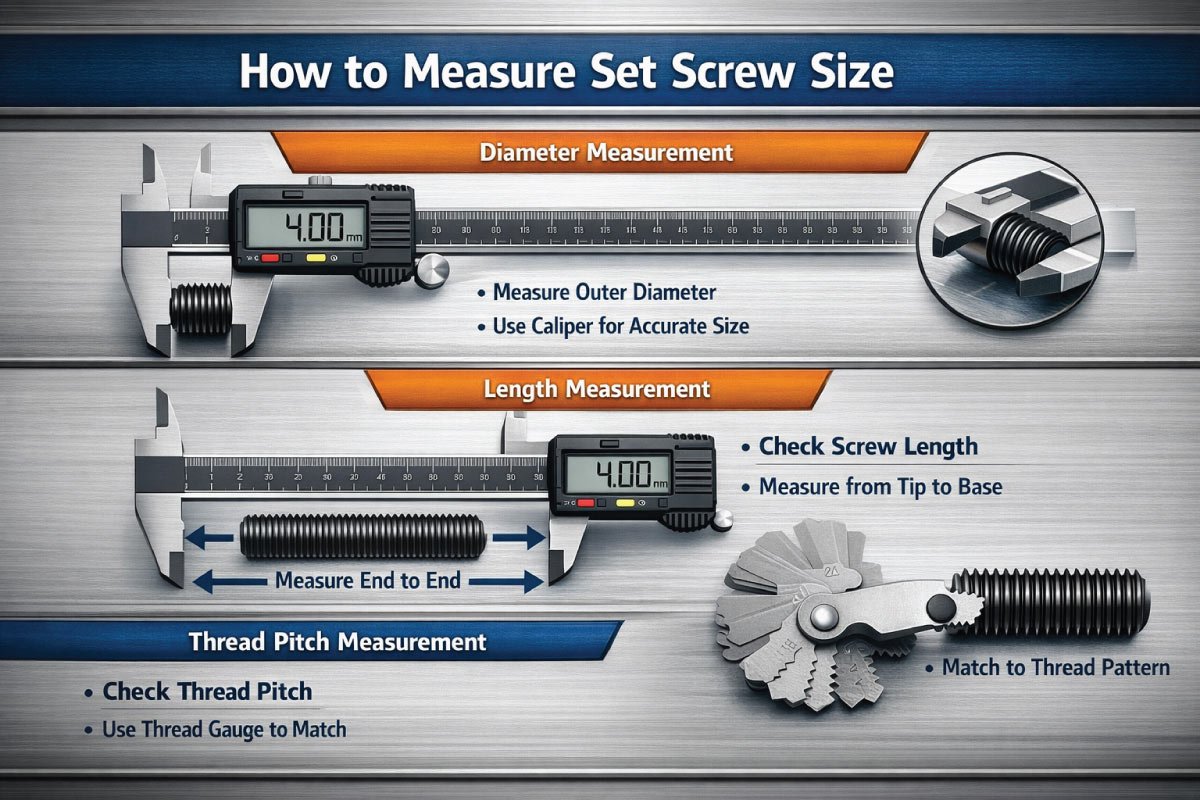
The diameter of a set screw refers to the major, or outer, thread diameter.
To measure it accurately, use a caliper and place it across the widest part of the threads.
Ensure the caliper jaws are perpendicular to the screw to avoid incorrect readings.
This measurement determines the screw size, such as M4 or M6, and is critical for ensuring the set screw fits properly into the threaded hole.
Length Measurement
The length of a set screw is measured from the tip to the base of the screw.
Since set screws are typically headless, the measurement excludes any head and focuses only on the threaded portion.
Place the screw flat and use a caliper or ruler to measure straight from end to end.
Choosing the correct length ensures sufficient engagement without protruding or causing interference in the assembly.
Thread Pitch Measurement
Thread pitch refers to the distance between adjacent threads and determines whether the screw is coarse or fine.
To measure it accurately, use a thread pitch gauge and match the gauge teeth to the screw threads.
Proper thread pitch measurement ensures compatibility with the threaded hole, prevents cross-threading,
and provides optimal holding strength, especially in precision or high-vibration applications.
Set Screw Length Guide
Selecting the correct set screw length is essential for achieving a secure hold without causing damage to shafts or threaded holes.
A screw that is too short may not provide enough engagement, while an overly long screw can interfere with nearby components or weaken the assembly.
Standard length ranges are based on screw diameter and typical application requirements,
helping ensure proper thread engagement, strength, and long-term performance in mechanical systems.
| Diameter | Minimum Length | Maximum Length |
|---|---|---|
| M3 | 4 mm | 12 mm |
| M4 | 6 mm | 16 mm |
| M5 | 8 mm | 20 mm |
| M6 | 10 mm | 25 mm |
| M8 | 12 mm | 30 mm |
| M10 | 16 mm | 40 mm |
Material Options for Set Screws
Set screws are manufactured using various materials to meet specific strength, durability, and environmental requirements.
The choice of material affects performance factors such as corrosion resistance, load capacity, magnetic properties, and surface protection.
From heavy-duty industrial machinery to delicate electronic equipment,
selecting the right set screw material ensures reliable fastening, longer service life, and protection of connected components.
Understanding material options helps in choosing the most suitable set screw for each application.
| Material | Properties | Common Use |
|---|---|---|
| Steel | Strong, economical | General machinery |
| Stainless Steel | Corrosion-resistant | Outdoor/Marine |
| Alloy Steel | High strength | High-load applications |
| Brass | Non-magnetic, corrosion-resistant | Electronics |
| Nylon/Plastic | Lightweight, non-scratch | Sensitive equipment |
Head Types of Set Screws
Set screws are available with different head types—or no head at all—to suit various installation methods, torque requirements, and space constraints.
The head design affects how the screw is driven, how much torque can be applied, and whether the fastener sits flush or protrudes from the surface.
Understanding the different head types helps ensure easy installation, secure fastening, and proper performance in mechanical and structural applications.
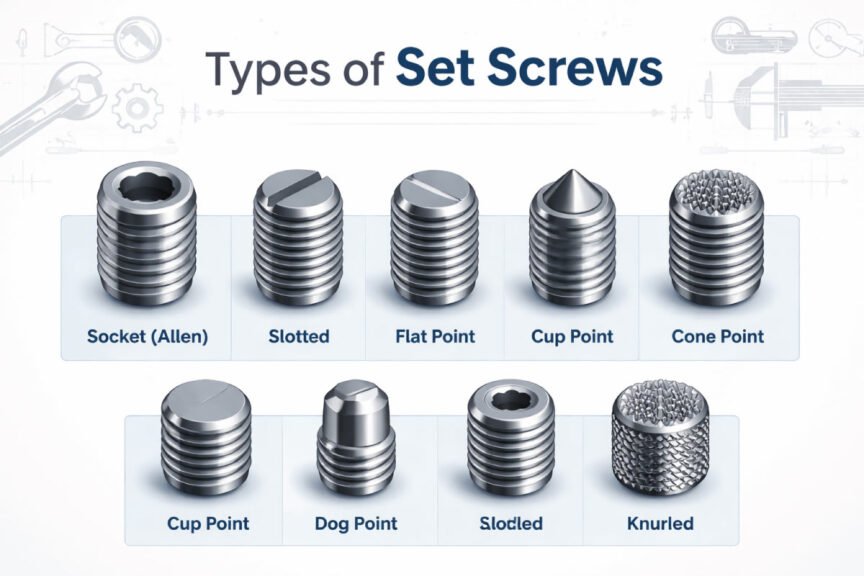
1- Hex Socket (Allen) Head Set Screws
Hex socket, or Allen head, set screws are the most commonly used type.
They allow higher torque application using an Allen key, reducing the risk of slipping during installation.
These screws are widely used in general machinery, automotive parts, and industrial equipment due to their reliability, ease of use, and availability in many sizes and materials.
2- Slotted Head Set Screws
Slotted head set screws feature a single straight slot and are designed for use with flat-head screwdrivers.
They are best suited for light-duty applications where minimal torque is required.
While simple and economical, slotted heads are more prone to cam-out, making them less suitable for high-torque or precision assemblies.
3- Square Socket Head Set Screws
Square socket head set screws are less common but offer excellent resistance to cam-out.
The square recess provides better tool engagement, allowing controlled torque application.
These screws are often used in precision machinery and specialized equipment where secure fastening and accurate torque control are important for maintaining alignment and performance.
4- Flat Head Set Screws
Flat head set screws are designed to sit flush with the surface when installed, creating a smooth and clean finish.
They are commonly used in decorative, embedded, or exposed applications where appearance matters.
This head type also helps prevent interference with moving parts while maintaining a secure hold in the assembly.
5- Headless Set Screws
Headless set screws are fully threaded and sit completely within the threaded hole, leaving no protrusion above the surface.
They are ideal for compact spaces and applications requiring a clean, low-profile finish.
Headless designs are widely used in shafts, collars, and mechanical components where space limitations or safety concerns are critical.
Set Screw Torque Specifications
Applying the correct torque to set screws is essential for achieving secure fastening without damaging the screw or the mating components.
Under-torquing can cause loosening and slippage, while over-torquing may lead to stripped threads or broken screws.
Torque requirements vary based on screw diameter, material, and tip design.
Using recommended torque ranges and proper tools helps ensure reliable performance, especially in precision or high-load mechanical applications.
| Diameter | Material | Torque (Nm) |
|---|---|---|
| M3 | Steel | 0.5–0.8 |
| M4 | Steel | 1.2–1.8 |
| M5 | Steel | 2.5–3.5 |
| M6 | Steel | 4–6 |
| M8 | Steel | 9–12 |
| M10 | Steel | 16–20 |
Choosing the Right Set Screw
Choosing the right set screw is essential for ensuring secure fastening, reliable performance, and long service life in any mechanical assembly.
The correct selection depends on several important factors, including the shaft size, load conditions, and environmental requirements.
A well-chosen set screw prevents slippage, protects mating surfaces, and maintains alignment under stress.
Understanding these key considerations helps engineers, technicians, and DIY users make confident and effective fastening decisions.
Shaft diameter and material
Type of load (axial or rotational)
Tip design for grip and surface protection
Material compatibility
Length for proper engagement
Set Screw vs. Bolt
Set screws and bolts are both widely used fasteners, but they serve different purposes in mechanical assemblies.
While bolts are designed to clamp components together using a nut, set screws are used to secure one part directly against another, often on a shaft.
Their compact design and unique installation method make them ideal for space-limited applications where traditional bolts are impractical.
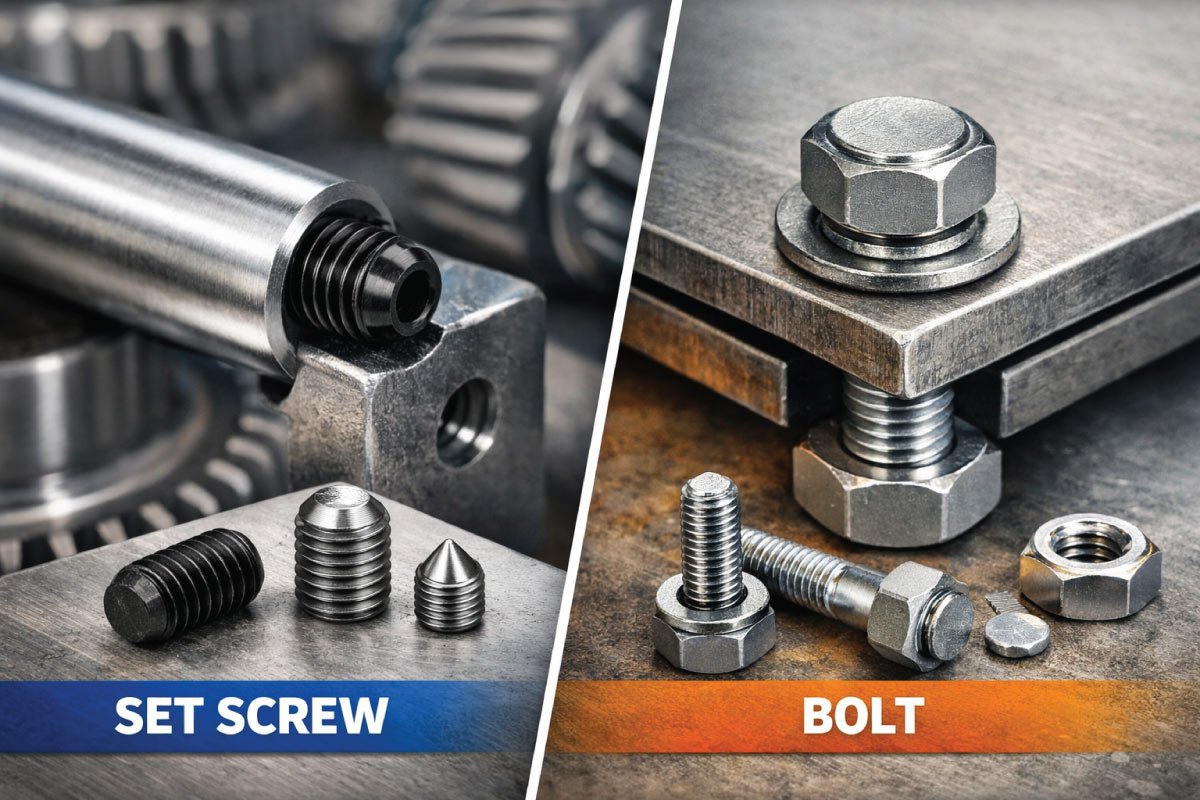
Headless or low-profile
Usually tightened into a threaded hole
Do not require a nut
Ideal for compact assemblies
Common Mistakes in Using Set Screws
Set screws are small components, but improper use can lead to serious mechanical issues such as slippage, damaged shafts, or premature failure.
Many problems arise from incorrect installation choices rather than the fastener itself.
Understanding the most common mistakes when using set screws helps ensure secure fastening, proper load handling, and long-term reliability.
Avoiding these errors can significantly improve performance and reduce maintenance or replacement costs.
Over-tightening causing damage to shaft or component
Using wrong tip for surface material
Using too short set screw causing weak engagement
Ignoring torque specifications
Discover More:
Maintenance Tips
Proper maintenance of set screws is essential to ensure long-term performance, safety, and reliability of mechanical assemblies.
Over time, vibration, environmental exposure, and repeated use can reduce holding strength or cause fastener failure.
Regular inspection and timely replacement help prevent unexpected breakdowns and costly repairs.
Following simple maintenance practices keeps set screws secure, protects connected components, and extends the overall life of machinery and equipment.
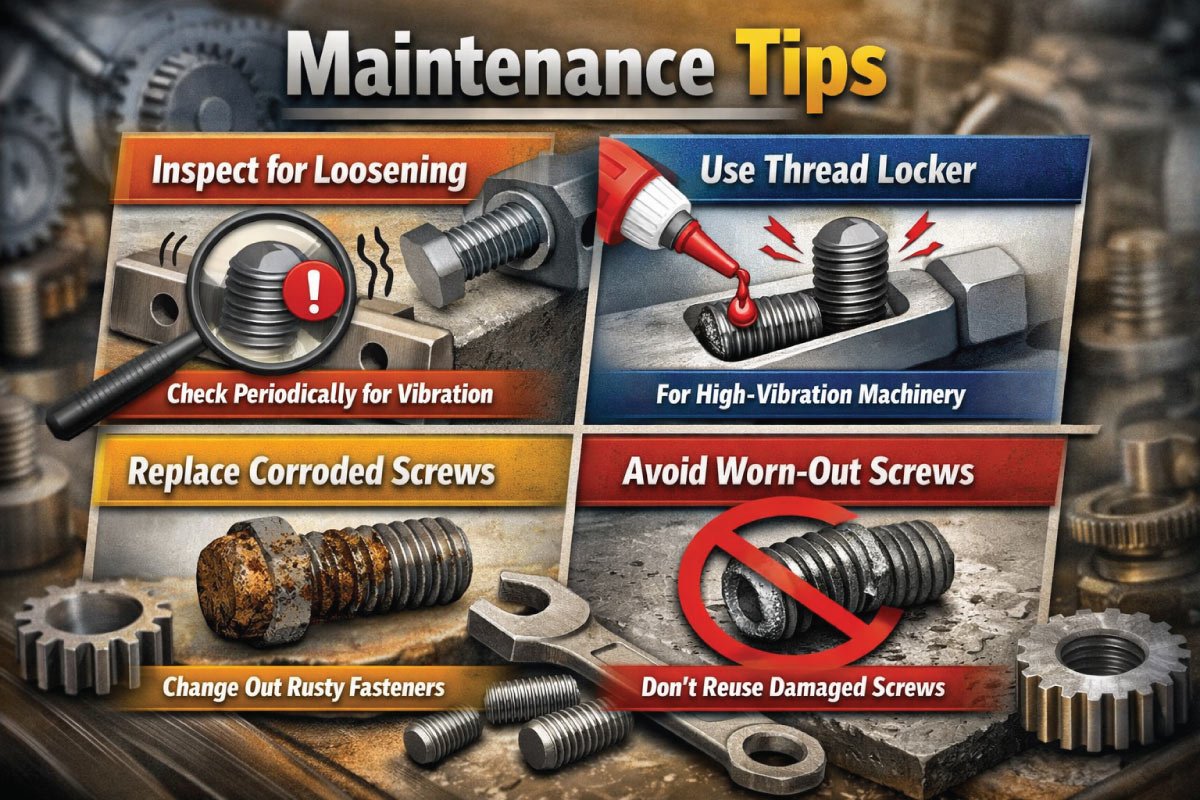
Inspect periodically for loosening due to vibration
Apply thread-locking compound for high-vibration machinery
Replace corroded screws immediately
Avoid reusing worn-out screws
Set Screw Standards
Set screw standards ensure consistency, compatibility, and safety across different industries and regions.
These standards define dimensions, tolerances, materials, and tip or head designs, allowing set screws from different manufacturers to be used interchangeably.
Understanding international and regional standards is especially important when sourcing fasteners globally or working on imported machinery.
Familiarity with common set screw standards helps ensure proper fit, reliable performance, and compliance with engineering specifications.
| Standard | Description | Region |
|---|---|---|
| ISO 4026 | Hexagon socket set screws | International |
| DIN 914 | Set screws with cone point | Europe |
| ANSI B18.3 | Socket head cap screws including set screws | USA |
| JIS B 1176 | Japanese Industrial standard for set screws | Japan |
Discover More:
How to Install a Set Screw
Installing a set screw correctly is essential for ensuring secure fastening, precise alignment, and long-term reliability in mechanical assemblies.
Improper installation can lead to slippage, damage to the shaft, or premature failure of the screw.
By following a few simple steps—including cleaning, alignment, and proper torque application—you can achieve optimal performance.
Additional measures, like using thread-locking compounds, help maintain stability in high-vibration environments.
1. Clean the Threads
Before installation, it is important to thoroughly clean both the set screw and the threaded hole.
Dirt, grease, or debris can prevent proper engagement and cause cross-threading.
Clean threads allow smooth insertion, help achieve the correct torque, and ensure the screw holds securely.
Use a brush, compressed air, or a suitable solvent to remove any residue.
2. Align the Component
Proper alignment of the component on the shaft is critical before tightening the set screw.
Misalignment can lead to uneven pressure, damage, or vibration during operation.
Ensure that pulleys, gears, collars, or other parts are positioned correctly along the shaft and rotated into the desired location for precise engagement.
Double-check the alignment before proceeding.
3. Hand-Tighten the Set Screw
Start by inserting the set screw into the threaded hole and hand-tightening it.
Hand-tightening guides the screw into the threads properly, reducing the risk of cross-threading or stripping.
This step ensures the screw seats evenly and allows for minor adjustments to the component’s position before applying full torque.
4. Apply Proper Torque
Once hand-tightened, use a wrench, Allen key, or torque wrench to apply the recommended torque for the set screw.
Proper torque prevents the screw from loosening during operation while avoiding damage to the threads or shaft.
Follow manufacturer specifications carefully, as torque values vary based on screw size, material, and tip type.
5. Optional: Apply Thread-Locker
In assemblies exposed to vibration or dynamic loads, applying a thread-locking compound can prevent loosening over time.
Apply a small amount to the threads before final tightening.
This ensures the screw remains secure and reduces the risk of slippage, maintaining alignment and stability in rotating or high-vibration machinery.
Discover More:
Tips for High-Precision Applications
High-precision applications demand careful selection and installation of set screws to maintain accurate alignment, secure engagement, and reliable performance.
Using the wrong screw type, tip, or torque can result in misalignment, surface damage, or loosening over time.
Following best practices—such as choosing the appropriate tip, monitoring torque, and considering shaft material,
Ensures that components stay precisely positioned, reducing wear and maximizing the lifespan and efficiency of machinery and precision instruments.
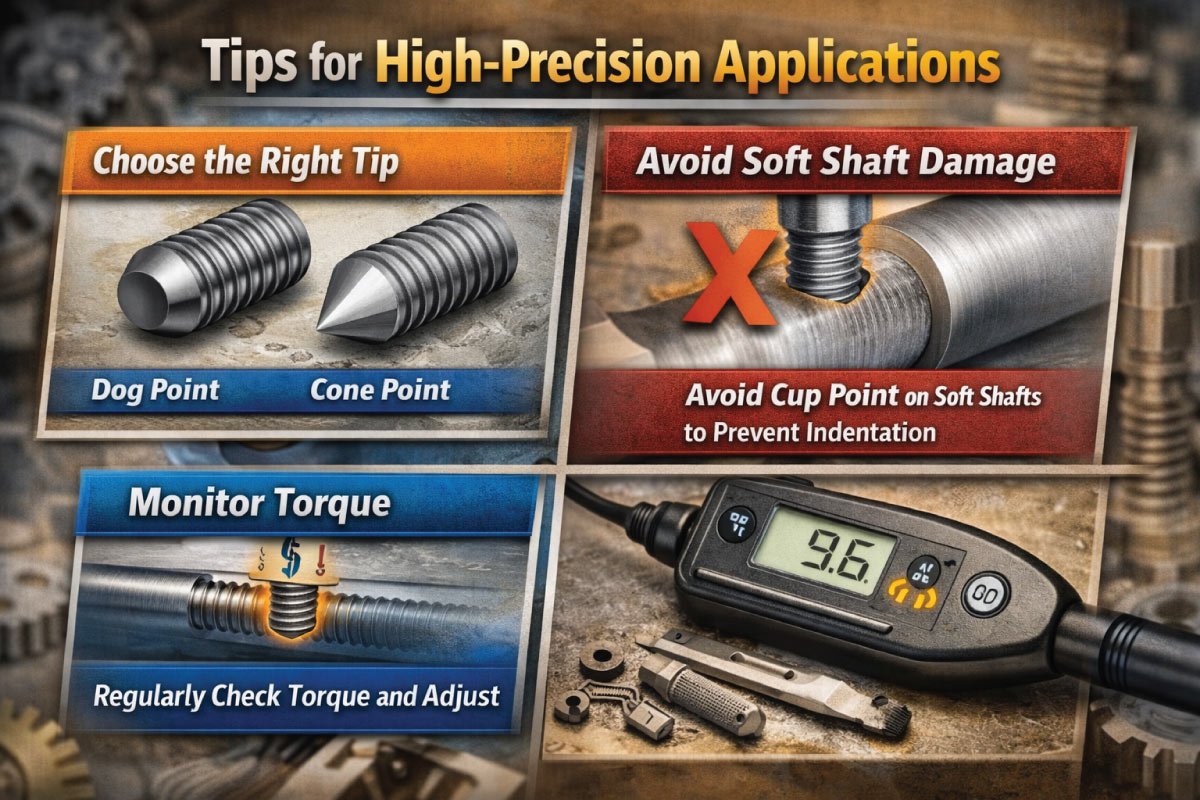
Use dog point or cone point for exact positioning.
Avoid cup point on soft shafts to prevent indentation.
Regularly check torque and adjust.
Discover More:
Additional Set Screw Size Chart (Imperial)
Set screws are available in both metric and imperial sizes to suit a wide range of applications.
Understanding imperial dimensions is important when working with older equipment, imported machinery, or components designed to SAE standards.
The diameter, length, tip type, and material all influence performance, holding strength, and compatibility.
This imperial size chart provides a quick reference for selecting the right set screw for your mechanical assemblies or maintenance projects.
| Diameter (in) | Length (in) | Tip Type | Material |
|---|---|---|---|
| 1/8 | 1/4, 3/8, 1/2 | Cup | Steel |
| 3/16 | 3/8, 1/2, 5/8 | Cone | Alloy Steel |
| 1/4 | 1/2, 3/4, 1 | Dog | Stainless Steel |
| 5/16 | 3/4, 1, 1-1/4 | Flat | Steel |
| 3/8 | 1, 1-1/4, 1-1/2 | Cup | Alloy Steel |
Choosing the right set screw is essential for ensuring secure and reliable mechanical assemblies.
Key factors to consider include screw type, material, tip design, torque specifications, and the specific application.
Proper selection prevents slippage, surface damage, and premature failure, while enhancing equipment longevity, reducing maintenance needs, and ensuring overall safety.
Making informed choices guarantees optimal performance in any machinery or precision system.
Discover More: