
When you are drilling into wood, metal, plastic, or even concrete, one problem shows up again and again:
👉 Understanding drill bit sizes.
Some drill bits are labeled in inches, others in millimeters (mm), and sometimes you will even see centimeters (cm) used for estimation. This mix of measurement systems can easily confuse beginners and even experienced workers at times.
I have personally seen people buy the wrong drill bit just because they did not convert sizes properly. The result? Loose screws, tight holes, or completely ruined workpieces.
That’s why this guide exists.
In this article, you will get:
✔ A complete drill bit size chart (inches, mm, cm)
✔ Simple conversion formulas
✔ Real Examples
✔ Practical tips to avoid mistakes
By the end, you won’t need to guess drill sizes again.
Why Drill Bit Size Units Matter
Before using any drill bit size chart, it’s important to understand why multiple measurement systems exist. Different industries and countries follow different standards, and knowing how they work helps you avoid mistakes, especially when working with imported tools or mixed equipment setups.
🌍 Different Systems Around the World
Different regions use different measurement systems for drill bits and tooling. This is why confusion often happens when switching between tools, manuals, or imported hardware. Understanding each system helps you choose the right drill bit without guesswork or conversion errors.
🇺🇸 Inches (Imperial system)
Common in the United States and many imported tools.
🌍 Millimeters (Metric system)
Used in engineering, manufacturing, and most countries worldwide.
📏 Centimeters (cm)
Rarely used for drill bits, but helpful for quick mental estimation.
🚧 Common Problems People Face
When working across different measurement systems, even experienced users can make mistakes. These issues usually come from misreading fractions, mixing units, or not converting properly before drilling, which leads to poor fitting or wasted materials.
❌ Buying the wrong drill bit size
❌ Confusing inch fractions (like 3/16 vs 5/32)
❌ Poor screw or anchor fitting
❌ Wasting time adjusting or re-drilling holes
Even a small mismatch—like using 6 mm instead of 6.4 mm—can affect the final result.
✅ The Simple Solution
The easiest way to avoid these problems is to always use a combined reference chart. This type of chart shows inches, millimeters, and centimeters together, so you can instantly compare sizes without doing manual conversions or risking calculation errors.
👉 Use a combined conversion chart that shows inches, mm, and cm together.
This removes guesswork completely and helps you work faster and more accurately.
Simple Conversion Logic (Easy Formula)
You don’t need advanced math skills to convert drill bit sizes between systems. A few basic relationships are enough to handle most workshop and DIY situations. Once you remember these values, switching between units becomes quick and natural.
1 inch = 25.4 mm
1 cm = 10 mm
1 inch = 2.54 cm
🔍 Example Conversion
To make conversions easier to understand, let’s look at a simple example using a common drill size. This shows how the same measurement changes across inches, millimeters, and centimeters, helping you visualize the relationship between different systems.
👉 1/2 inch
In mm: 12.7 mm
In cm: 1.27 cm
Once you understand this, converting between units becomes very easy.
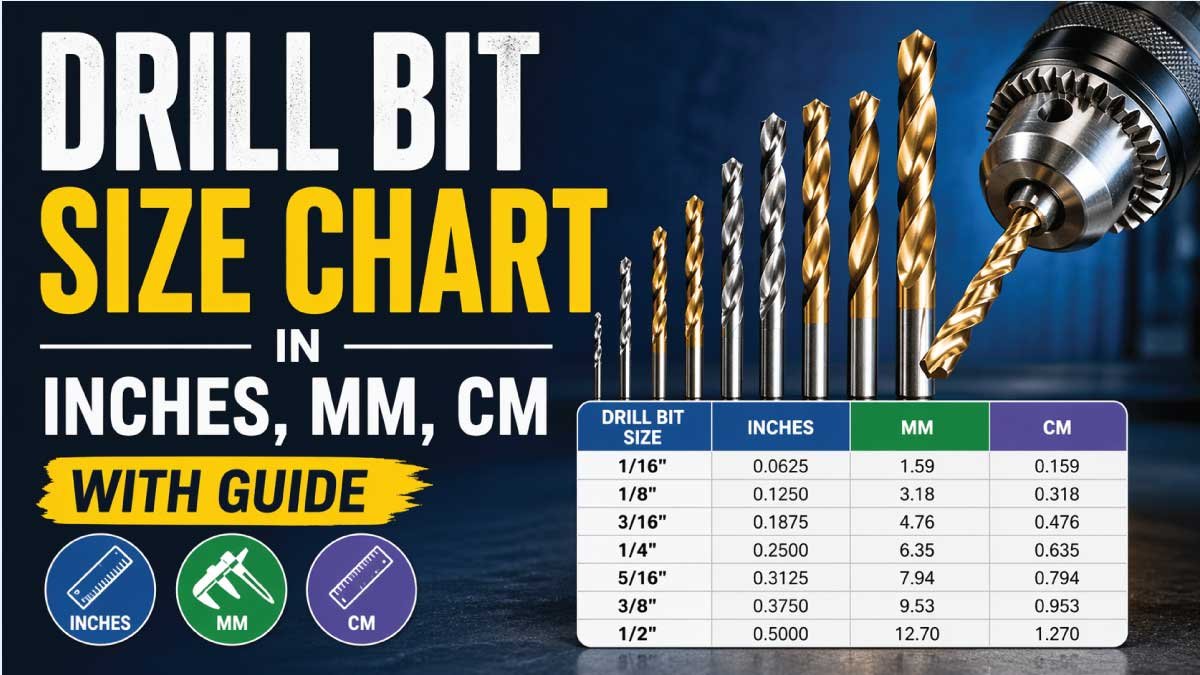
Standard Drill Bit Size Chart (Inches, mm, cm)
A combined chart is one of the most useful references in any workshop or construction site. It allows quick comparison between imperial and metric systems, ensuring accurate drilling, proper fitting, and reduced errors when working with different materials and hardware types.
Here’s a complete reference chart used in workshops, sites, and mechanical work.
🛠️ Drill Bit Size Conversion Chart
| Inches (Fraction) | mm (Millimeters) | cm (Centimeters) |
|---|---|---|
| 1/64 in | 0.4 mm | 0.04 cm |
| 1/32 in | 0.8 mm | 0.08 cm |
| 1/16 in | 1.6 mm | 0.16 cm |
| 3/32 in | 2.4 mm | 0.24 cm |
| 1/8 in | 3.2 mm | 0.32 cm |
| 5/32 in | 4.0 mm | 0.40 cm |
| 3/16 in | 4.8 mm | 0.48 cm |
| 7/32 in | 5.6 mm | 0.56 cm |
| 1/4 in | 6.4 mm | 0.64 cm |
| 5/16 in | 7.9 mm | 0.79 cm |
| 3/8 in | 9.5 mm | 0.95 cm |
| 7/16 in | 11.1 mm | 1.11 cm |
| 1/2 in | 12.7 mm | 1.27 cm |
| 5/8 in | 15.9 mm | 1.59 cm |
| 3/4 in | 19.0 mm | 1.90 cm |
| 1 in | 25.4 mm | 2.54 cm |
This chart is your go-to reference for almost all drilling tasks.
Quick Drill Bit Size Groups (Easy Memory Trick)
Instead of memorizing every single drill bit size, it’s much easier to understand them in grouped ranges. This helps you quickly identify the right bit based on the type of work, saving time and reducing mistakes in both workshop and DIY situations.
🟢 Small Drill Bits (Precision Work)
Range: 1/64″ to 1/8″
These tiny drill bits are used for very delicate and detailed work where accuracy is critical. Because they are thin and fragile, they require steady handling and controlled pressure to avoid breaking during use.
Used for:
Electronics
Jewelry work
Pilot holes
Small screws
These require high precision and careful handling.
🟡 Medium Drill Bits (General Use)
Range: 5/32″ to 1/4″
This category is the most commonly used in everyday drilling tasks. It offers a balance between strength and precision, making it ideal for household repairs and general workshop applications.
Used for:
Furniture assembly
Home repairs
Light construction
This is the most commonly used range for everyday tasks.
🔴 Large Drill Bits (Heavy Work)
Range: 5/16″ to 1″
Large drill bits are designed for heavy-duty applications where strength and durability matter more than precision. They require powerful drills and slower speeds to maintain control and prevent overheating.
Used for:
Bolts
Anchors
Pipes
Structural installations
These require more power and often slower drilling speeds.
Also Read:
How to Choose Drill Bit Size (Simple Method)
Selecting the correct drill bit size depends on more than just measurements. You also need to consider the material you are working with and the type of fastener being installed. Following a step-by-step approach helps ensure accuracy and prevents damage.
Step 1: Identify the Material
Different materials respond differently to drilling, so choosing the right technique is important for clean holes and long-lasting results. Hard materials require more precision, while softer materials allow slight flexibility.
Wood → Use slightly smaller bit for better grip
Metal → Use exact size or tap drill size
Concrete → Match anchor size
Plastic → Standard size, low pressure
Step 2: Identify the Fastener Type
Each fastener type requires a different hole size and drilling approach. Understanding this step ensures proper fitting, prevents loosening, and improves the strength of the final assembly.
Screw → Needs pilot hole
Bolt → Needs clearance hole
Anchor → Needs exact match
Tap → Needs smaller hole
Step 3: Match Using Chart
Once you know the material and fastener type, the final step is to verify your selection using a reliable drill bit chart. This is especially important when switching between metric and imperial systems, as even small differences can affect fit and performance.
Always confirm your size using the chart, especially when switching between inches and mm.
Common Drill Bit Conversion Examples
Understanding real-world conversions makes it much easier to work confidently with different measurement systems. These examples are commonly used in construction, mechanical work, and home improvement projects, helping you quickly identify the correct drill bit without confusion.
🔧 Example 1: 1/4 Inch Drill Bit
6.4 mm
0.64 cm
This is one of the most commonly used drill bit sizes in everyday tasks. It provides a good balance between strength and precision, making it suitable for general-purpose drilling in both home and workshop environments.
Used for:
Wall anchors
Medium screws
General drilling
🔧 Example 2: 1/2 Inch Drill Bit
12.7 mm
1.27 cm
This larger drill bit is designed for heavy-duty applications where strong fastening is required. It is commonly used in structural work and situations where larger bolts or anchors must fit securely and safely.
Used for:
Heavy bolts
Structural work
Concrete drilling
🔧 Example 3: 3/8 Inch Drill Bit
9.5 mm
0.95 cm
This is a versatile mid-range drill bit often used in mechanical and assembly work. It provides enough strength for metal fittings while still maintaining good control and accuracy during drilling operations.
Used for:
Metal bolts
Brackets
Mechanical assembly
Why mm is More Accurate than Inches
In professional engineering, machining, and fabrication, millimeters are preferred over inches because they offer more precision and eliminate rounding errors. This level of accuracy is especially important when working with tight tolerances and machine-fitted components.
✔ Advantages of mm
More precise measurements
Easier calculations
No fractions (like 7/32, 9/64)
Standard in engineering
🔍 Example
Even a small difference in measurement systems can affect fitting accuracy. That’s why engineers prefer metric units when precision is critical.
👉 6.4 mm is exact
👉 1/4 inch is approximate
That small difference matters in precision work like machining.
Also Read:
Final Thoughts
Understanding drill bit sizes in inches, mm, and cm is a fundamental skill for anyone working with tools—whether you’re a beginner or a professional.
Once you learn how to convert and choose the right size:
✔ You avoid costly mistakes
✔ Your work becomes more accurate
✔ You save time and materials
✔ Your results look more professional
🔑 Key Takeaways
👉 Inches = common in hardware stores
👉 mm = most accurate and widely used
👉 cm = quick estimation tool
With this guide and chart, you now have everything you need to confidently select the right drill bit for any job, whether it’s DIY work, mechanical projects, or construction tasks.