
Bearings are essential mechanical components used to reduce friction and support rotating shafts in everything from electric motors and pumps to automobiles, agricultural equipment, conveyors, machinery, and industrial systems. Choosing the correct bearing requires more than knowing its general type. The bearing size, bore diameter, outside diameter, width, load capacity, and bearing series all need to match the application.
A bearing size chart makes it easier to identify a bearing from its number and compare common dimensions. However, bearing numbering systems can vary by manufacturer and bearing type, so the number should always be checked against the relevant manufacturer’s specification.
This complete guide explains bearing dimensions, how to read bearing numbers, common metric and inch bearing sizes, bearing series, clearance, seals, and how to choose the correct replacement bearing.
What Is Bearing Size?
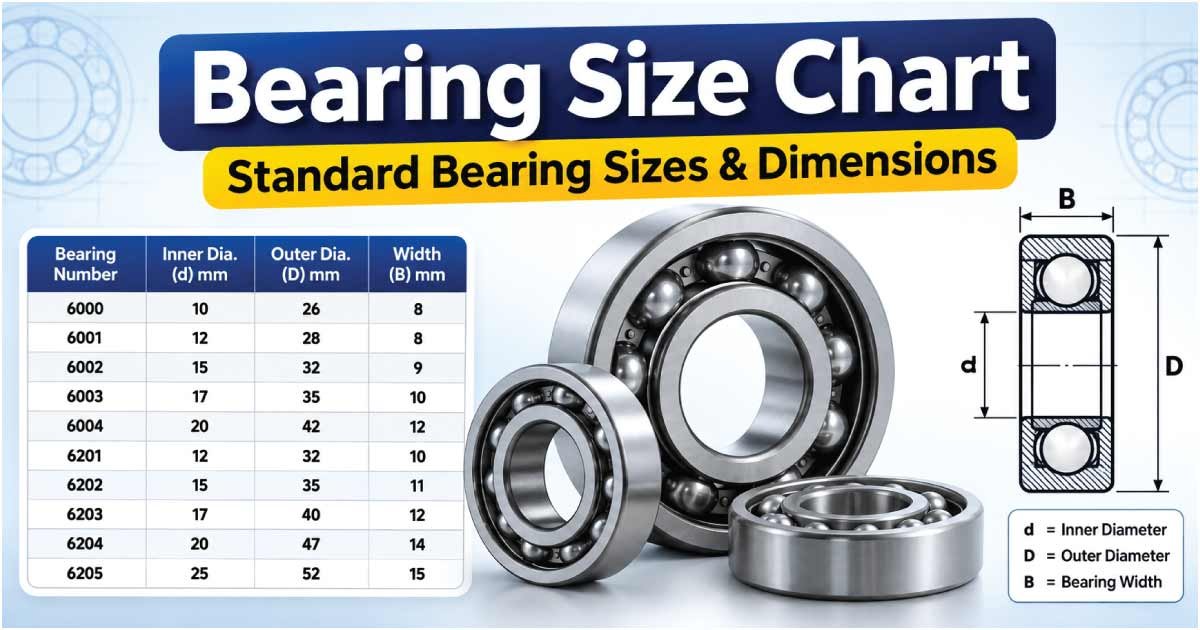
Bearing size refers primarily to the physical dimensions of a bearing. For a standard radial ball bearing, three basic dimensions are especially important:
- Bore diameter (d)
- Outside diameter (D)
- Bearing width (B)
The bore diameter is the size of the shaft that fits inside the bearing. The outside diameter is the measurement across the outer ring. Bearing width is the thickness of the bearing from one side to the other.
For example, a bearing specified as 6205 commonly has dimensions of:
- Bore: 25 mm
- Outside diameter: 52 mm
- Width: 15 mm
However, bearing size is not limited to physical dimensions. Load capacity, speed rating, internal clearance, seal type, and material can also be important when selecting a replacement.
Bearing Dimensions Explained
Understanding the basic bearing dimensions makes bearing identification much easier.
Bore Diameter
The bore diameter is the internal diameter of the bearing.
It determines the shaft size that the bearing is designed to accommodate.
For example, a bearing with a 20 mm bore is designed for an appropriately specified 20 mm shaft diameter.
Outside Diameter
The outside diameter is measured across the outer ring.
This dimension determines how the bearing fits into a housing, bearing block, wheel hub, or other mounting location.
Bearing Width
Width describes the axial thickness of the bearing.
Two bearings can have the same bore and outside diameter but different widths, so width should always be checked when replacing a bearing.
Standard Bearing Size Chart
The following table shows common single-row deep-groove ball bearings and their standard dimensions.
| Bearing Number | Bore Diameter | Outside Diameter | Width |
|---|---|---|---|
| 6000 | 10 mm | 26 mm | 8 mm |
| 6001 | 12 mm | 28 mm | 8 mm |
| 6002 | 15 mm | 32 mm | 9 mm |
| 6003 | 17 mm | 35 mm | 10 mm |
| 6004 | 20 mm | 42 mm | 12 mm |
| 6005 | 25 mm | 47 mm | 12 mm |
| 6006 | 30 mm | 55 mm | 13 mm |
| 6007 | 35 mm | 62 mm | 14 mm |
| 6008 | 40 mm | 68 mm | 15 mm |
| 6009 | 45 mm | 75 mm | 16 mm |
| 6010 | 50 mm | 80 mm | 16 mm |
| 6011 | 55 mm | 90 mm | 18 mm |
| 6012 | 60 mm | 95 mm | 18 mm |
| 6013 | 65 mm | 100 mm | 18 mm |
| 6014 | 70 mm | 110 mm | 20 mm |
| 6015 | 75 mm | 115 mm | 20 mm |
| 6016 | 80 mm | 125 mm | 22 mm |
| 6017 | 85 mm | 130 mm | 22 mm |
| 6018 | 90 mm | 140 mm | 24 mm |
| 6019 | 95 mm | 145 mm | 24 mm |
| 6020 | 100 mm | 150 mm | 24 mm |
These dimensions are common reference dimensions for the 6000-series deep-groove ball bearings. Always verify the exact bearing designation and manufacturer’s catalog before purchasing a replacement.
6200 Series Bearing Size Chart
The 6200 series is one of the most commonly encountered deep-groove ball bearing series.
| Bearing Number | Bore | Outside Diameter | Width |
|---|---|---|---|
| 6200 | 10 mm | 30 mm | 9 mm |
| 6201 | 12 mm | 32 mm | 10 mm |
| 6202 | 15 mm | 35 mm | 11 mm |
| 6203 | 17 mm | 40 mm | 12 mm |
| 6204 | 20 mm | 47 mm | 14 mm |
| 6205 | 25 mm | 52 mm | 15 mm |
| 6206 | 30 mm | 62 mm | 16 mm |
| 6207 | 35 mm | 72 mm | 17 mm |
| 6208 | 40 mm | 80 mm | 18 mm |
| 6209 | 45 mm | 85 mm | 19 mm |
| 6210 | 50 mm | 90 mm | 20 mm |
| 6211 | 55 mm | 100 mm | 21 mm |
| 6212 | 60 mm | 110 mm | 22 mm |
| 6213 | 65 mm | 120 mm | 23 mm |
| 6214 | 70 mm | 125 mm | 24 mm |
| 6215 | 75 mm | 130 mm | 25 mm |
| 6216 | 80 mm | 140 mm | 26 mm |
| 6217 | 85 mm | 150 mm | 28 mm |
| 6218 | 90 mm | 160 mm | 30 mm |
| 6219 | 95 mm | 170 mm | 32 mm |
| 6220 | 100 mm | 180 mm | 34 mm |
6300 Series Bearing Size Chart
The 6300 series generally provides a heavier cross-section than the 6200 series for comparable bore sizes.
| Bearing Number | Bore | Outside Diameter | Width |
|---|---|---|---|
| 6300 | 10 mm | 35 mm | 11 mm |
| 6301 | 12 mm | 37 mm | 12 mm |
| 6302 | 15 mm | 42 mm | 13 mm |
| 6303 | 17 mm | 47 mm | 14 mm |
| 6304 | 20 mm | 52 mm | 15 mm |
| 6305 | 25 mm | 62 mm | 17 mm |
| 6306 | 30 mm | 72 mm | 19 mm |
| 6307 | 35 mm | 80 mm | 21 mm |
| 6308 | 40 mm | 90 mm | 23 mm |
| 6309 | 45 mm | 100 mm | 25 mm |
| 6310 | 50 mm | 110 mm | 27 mm |
| 6311 | 55 mm | 120 mm | 29 mm |
| 6312 | 60 mm | 130 mm | 31 mm |
| 6313 | 65 mm | 140 mm | 33 mm |
| 6314 | 70 mm | 150 mm | 35 mm |
| 6315 | 75 mm | 160 mm | 37 mm |
| 6316 | 80 mm | 170 mm | 39 mm |
| 6317 | 85 mm | 180 mm | 41 mm |
| 6318 | 90 mm | 190 mm | 43 mm |
| 6319 | 95 mm | 200 mm | 45 mm |
| 6320 | 100 mm | 215 mm | 47 mm |
The larger cross-section generally provides greater load-carrying capacity than a smaller bearing series with the same bore, but the correct series depends on the application.
Also Read:
What Do Bearing Numbers Mean?
Bearing numbers can provide useful information about the bearing’s type and dimensions.
Consider the example:
6205
The designation identifies a particular bearing size and series.
In many common bearing numbering systems:
- 6 indicates a single-row deep-groove ball bearing
- 2 identifies the dimensional series
- 05 identifies the bore code
The exact meaning of prefixes and suffixes depends on the bearing standard and manufacturer.
A bearing marked 6205-2RS, for example, is dimensionally based on the 6205 bearing but has additional designation information indicating its sealing arrangement.
Understanding Bearing Bore Codes
Many metric ball bearings use standardized bore codes.
For common bearings with bore diameters of 20 mm and above, the last two digits can often be multiplied by 5 to determine the nominal bore diameter.
For example:
- 6204 → 04 × 5 = 20 mm
- 6205 → 05 × 5 = 25 mm
- 6206 → 06 × 5 = 30 mm
- 6207 → 07 × 5 = 35 mm
- 6208 → 08 × 5 = 40 mm
- 6210 → 10 × 5 = 50 mm
There are special codes for smaller bore sizes, so this rule should not be applied universally to every bearing number.
Bearing Series Explained
The bearing series helps describe the dimensional relationship between the bore, outside diameter, and width.
Common deep-groove ball bearing series include:
- 6000 series
- 6200 series
- 6300 series
- 6400 series
For the same bore diameter, a higher series generally has a larger outside diameter and heavier cross-section.
For example, 6205 and 6305 both have a 25 mm bore, but their outside diameters and widths are different.
6000 Series
The 6000 series generally has a relatively light cross-section.
These bearings can be useful where space and weight are important.
6200 Series
The 6200 series is widely used for general-purpose applications and provides a balance between size and load capacity.
6300 Series
The 6300 series generally has a heavier cross-section and can accommodate greater loads than the corresponding 6200-series bearing.
6400 Series
The 6400 series is larger and heavier than the common 6200 and 6300 series for corresponding bore sizes.
It is selected when the application requires greater capacity and the available housing space permits the larger bearing.
Also Read:
Bearing Size and Load Capacity
Bearing size has a direct relationship with load capacity, but physical dimensions alone do not determine how much load a bearing can safely carry.
Important factors include:
- Bearing type
- Bearing series
- Number and size of rolling elements
- Internal geometry
- Material
- Radial load
- Axial load
- Speed
- Lubrication
- Operating temperature
- Alignment
- Mounting conditions
A larger bearing may generally have a greater load capacity, but the correct selection should be based on the manufacturer’s rated dynamic and static load capacities.
Radial Bearing vs. Thrust Bearing
Not all bearings use the same dimensional system.
Radial Bearings
Radial bearings primarily support loads acting perpendicular to the shaft.
Deep-groove ball bearings are common examples.
They can also accommodate some axial load depending on their design and operating conditions.
Thrust Bearings
Thrust bearings are designed primarily to accommodate axial loads.
Their dimensions and designation systems can differ considerably from radial ball bearings.
For this reason, a radial bearing size chart should not be used to identify a thrust bearing.
Bearing Seals and Shields
Two bearings with identical basic dimensions can have different sealing arrangements.
Common designations include:
- Open
- ZZ
- 2Z
- RS
- 2RS
Open Bearings
Open bearings do not have integral seals or shields.
They are often used where the bearing is protected by an external lubrication or sealing arrangement.
Shielded Bearings
Shielded bearings use metal shields to help protect the rolling elements from larger contaminants while allowing relatively low-friction operation.
Sealed Bearings
Sealed bearings use contact or non-contact seals depending on the design.
A common designation such as 2RS indicates sealing on both sides in many commonly used bearing designation systems.
The exact designation meaning should always be confirmed with the manufacturer.
What Does 6205-2RS Mean?
A bearing marked 6205-2RS is based on the standard 6205 bearing dimensions.
The 6205 dimensions are approximately:
- 25 mm bore
- 52 mm outside diameter
- 15 mm width
The 2RS suffix generally indicates seals on both sides.
This illustrates why the complete bearing number matters. Two bearings can share the same basic dimensions but have different seals, clearance, lubrication, or other features.
Bearing Internal Clearance
Internal clearance is the amount of internal movement between the bearing’s components before installation and operating conditions are taken into account.
Common clearance classes include:
- C2
- CN or Normal
- C3
- C4
- C5
A C3 bearing has greater internal clearance than a normal-clearance bearing.
Higher clearance may be appropriate for applications involving higher operating temperatures, interference fits, or particular operating conditions.
The correct clearance should be selected based on the application rather than assuming that greater clearance is always better.
Bearing Size and Shaft Diameter
The shaft diameter is one of the first measurements to check when replacing a bearing.
If the shaft is 25 mm, a bearing with a 25 mm bore may be a candidate, but you still need to verify:
- Outside diameter
- Width
- Bearing type
- Load rating
- Speed rating
- Clearance
- Seal arrangement
- Mounting requirements
A bearing with the correct bore but incorrect outside diameter will not fit the housing correctly.
Bearing Size and Housing Diameter
The bearing’s outside diameter must match the housing or mounting location.
For example, a 6205 bearing has a 52 mm outside diameter. If the housing is designed for a different outside diameter, the 6205 may not be an appropriate replacement even if its bore fits the shaft.
The housing fit is particularly important for rotating outer-ring applications and precision machinery.
Bearing Width and Available Space
Width can be just as important as bore and outside diameter.
A bearing that is too wide may not fit inside the available axial space.
For example, a 6205 bearing is 15 mm wide, while the corresponding 6305 is 17 mm wide.
Although both have a 25 mm bore, they are not dimensionally identical.
Always measure the available bearing width before selecting a replacement.
Common Bearing Size Comparison
The following comparison shows how different bearing series can have the same bore while using different outside diameters and widths.
| Bearing | Bore | Outside Diameter | Width |
|---|---|---|---|
| 6005 | 25 mm | 47 mm | 12 mm |
| 6205 | 25 mm | 52 mm | 15 mm |
| 6305 | 25 mm | 62 mm | 17 mm |
| 6405 | 25 mm | 80 mm | 21 mm |
This is an important example of why knowing only the shaft diameter is not enough.
All four bearings have a 25 mm bore, but their external dimensions are significantly different.
Also Read:
How to Measure a Bearing
If you do not know the bearing number, you can measure the bearing directly.
Measure the Bore
Measure the internal diameter of the bearing.
A caliper can provide a useful measurement for general identification, although precision equipment may be required for exact engineering measurements.
Measure the Outside Diameter
Measure from one side of the outer ring to the opposite side.
Measure the Width
Measure the bearing from one side face to the other.
Record all three dimensions.
For example:
25 mm × 52 mm × 15 mm
This dimension set corresponds to a common 6205 deep-groove ball bearing.
Bearing Identification by Dimensions
When a bearing number is missing or unreadable, the three primary dimensions can help narrow down the possibilities.
Record:
Bore × Outside Diameter × Width
For example:
20 × 47 × 14 mm
can identify a common bearing dimension associated with the 6204 series.
However, dimensions alone may not identify:
- Seal type
- Clearance
- Internal design
- Material
- Precision class
- Manufacturer-specific features
Therefore, the complete bearing specification should be verified before ordering.
Metric Bearing Size Chart by Bore
Common bearing bore sizes include:
| Bore Diameter | Common Bearing Examples |
|---|---|
| 10 mm | 6000, 6200, 6300 |
| 12 mm | 6001, 6201, 6301 |
| 15 mm | 6002, 6202, 6302 |
| 17 mm | 6003, 6203, 6303 |
| 20 mm | 6004, 6204, 6304 |
| 25 mm | 6005, 6205, 6305 |
| 30 mm | 6006, 6206, 6306 |
| 35 mm | 6007, 6207, 6307 |
| 40 mm | 6008, 6208, 6308 |
| 45 mm | 6009, 6209, 6309 |
| 50 mm | 6010, 6210, 6310 |
| 60 mm | 6012, 6212, 6312 |
| 70 mm | 6014, 6214, 6314 |
| 80 mm | 6016, 6216, 6316 |
| 90 mm | 6018, 6218, 6318 |
| 100 mm | 6020, 6220, 6320 |
The bearing series determines the outside diameter and width.
How to Choose the Correct Replacement Bearing
Choosing a replacement bearing should begin with the original bearing number whenever it is available.
If the number is unreadable, measure the original bearing and determine its type.
Check the following:
1. Bore Diameter
The bearing must fit the shaft correctly.
2. Outside Diameter
The outer ring must fit the housing or mounting location.
3. Width
The replacement must fit the available axial space.
4. Bearing Type
Determine whether you need a deep-groove ball bearing, angular-contact bearing, roller bearing, thrust bearing, or another design.
5. Seal or Shield Type
Match the sealing arrangement where required.
6. Internal Clearance
Check whether the application requires normal, C3, or another clearance class.
7. Load Rating
Verify the bearing’s dynamic and static load ratings against the application.
8. Speed Rating
High-speed applications require bearings appropriate for the operating speed and lubrication conditions.
Common Bearing Size Mistakes
Choosing a Bearing Only by Bore
A bearing with the correct shaft diameter may still have the wrong outside diameter or width.
Ignoring Bearing Series
6000, 6200, and 6300 bearings with the same bore can have significantly different dimensions.
Ignoring Seals
An open bearing and sealed bearing can have the same basic dimensions but perform differently in contaminated or lubricated environments.
Using the Wrong Clearance
The wrong internal clearance can affect temperature, noise, performance, and bearing life.
Assuming All Bearings With the Same Number Are Identical
Manufacturer suffixes can indicate different seals, clearances, cages, lubrication, or precision characteristics.
Bearing Size Chart: Quick Reference
| Bearing | Bore (mm) | OD (mm) | Width (mm) |
|---|---|---|---|
| 6000 | 10 | 26 | 8 |
| 6001 | 12 | 28 | 8 |
| 6002 | 15 | 32 | 9 |
| 6200 | 10 | 30 | 9 |
| 6201 | 12 | 32 | 10 |
| 6202 | 15 | 35 | 11 |
| 6203 | 17 | 40 | 12 |
| 6204 | 20 | 47 | 14 |
| 6205 | 25 | 52 | 15 |
| 6206 | 30 | 62 | 16 |
| 6207 | 35 | 72 | 17 |
| 6208 | 40 | 80 | 18 |
| 6209 | 45 | 85 | 19 |
| 6210 | 50 | 90 | 20 |
| 6304 | 20 | 52 | 15 |
| 6305 | 25 | 62 | 17 |
| 6306 | 30 | 72 | 19 |
| 6307 | 35 | 80 | 21 |
| 6308 | 40 | 90 | 23 |
| 6309 | 45 | 100 | 25 |
| 6310 | 50 | 110 | 27 |
Frequently Asked Questions About Bearing Sizes
How are bearing sizes measured?
Standard bearing dimensions are generally expressed as bore diameter × outside diameter × width.
What are the three main bearing dimensions?
The three primary dimensions are the bore diameter, outside diameter, and width.
What size is a 6205 bearing?
A common 6205 bearing has a 25 mm bore, 52 mm outside diameter, and 15 mm width.
What size is a 6204 bearing?
A standard 6204 bearing commonly measures 20 mm bore, 47 mm outside diameter, and 14 mm width.
What is the difference between 6205 and 6305 bearings?
Both commonly have a 25 mm bore, but the 6305 has a larger outside diameter and greater width than the 6205.
What does 2RS mean on a bearing?
In many common bearing designation systems, 2RS indicates sealing on both sides. Always confirm the exact suffix meaning with the manufacturer.
What does ZZ mean on a bearing?
ZZ commonly indicates metal shields on both sides in many bearing designation systems.
Can I use a bearing with the same bore but different outside diameter?
Usually not if the bearing must fit an existing housing. The outside diameter must be compatible with the housing dimensions.
Can I use a bearing with the same bore and outside diameter but different width?
Only if the application provides enough space and the different width is acceptable. The original specification should be checked before substituting.
How do I find a bearing size without the number?
Measure the bore, outside diameter, and width, then compare those dimensions with a bearing catalog or size chart. Also identify the bearing type and sealing arrangement.
Final Thoughts on Bearing Sizes
A bearing size chart is a useful starting point for identifying and selecting bearings, but the three physical dimensions are only part of the complete bearing specification.
For standard radial ball bearings, always check:
- Bore diameter
- Outside diameter
- Width
- Bearing series
- Bearing type
- Seal or shield
- Internal clearance
- Load capacity
- Speed rating
- Operating conditions
For example, 6000, 6200, and 6300 series bearings can share the same bore diameter while having completely different outside diameters and widths. This means that selecting a bearing solely by shaft size can result in an incorrect fit.
When the original bearing number is available, use it as the starting point and verify all suffixes and specifications. When the number is unavailable, carefully measure the bore × outside diameter × width and identify the bearing type.
The correct bearing is the one that matches both the physical dimensions and the operating requirements of the application. For industrial, automotive, high-speed, or safety-critical equipment, always verify the replacement bearing against the manufacturer’s technical specifications.