
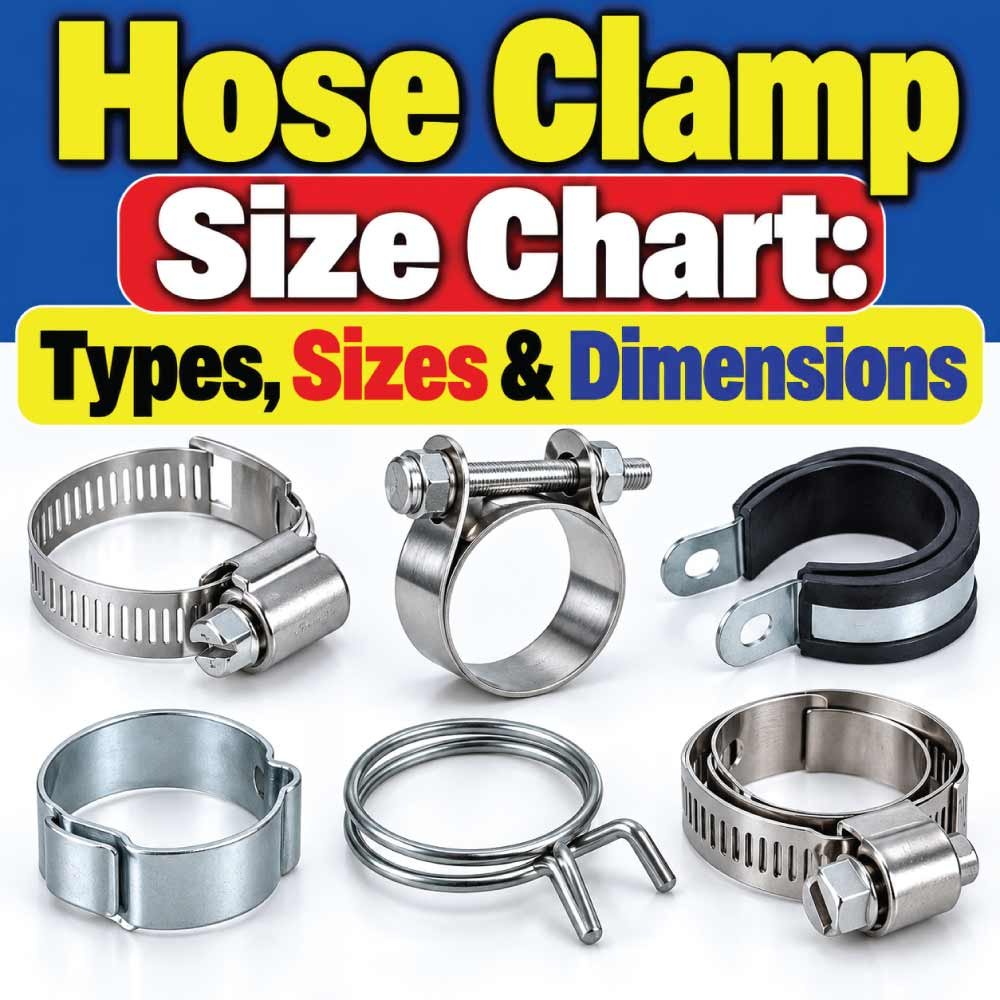
Choosing the correct hose clamp is more than matching a clamp to a hose’s nominal diameter. A clamp must fit the hose’s actual outside diameter (OD) and provide enough adjustment range to create a secure seal without damaging the hose.
This hose clamp size chart explains common clamp sizes, adjustable diameter ranges, clamp types, dimensions, and practical selection methods. You will also learn how to measure a hose, understand clamp sizing, choose between worm-drive, spring, wire, and heavy-duty clamps, and avoid common sizing mistakes.
Because clamp dimensions and adjustment ranges vary by manufacturer, the charts below should be treated as practical sizing guidance rather than a substitute for the manufacturer’s specifications.
What Is a Hose Clamp?
A hose clamp is a mechanical fastening device used to secure a flexible hose around a fitting, pipe, nipple, or other connection. When tightened, the clamp applies radial pressure around the hose, helping maintain a tight connection and reduce the chance of leakage or hose movement.
Hose clamps are commonly found in:
- Automotive cooling and fuel systems
- Plumbing and water connections
- Irrigation systems
- Air and vacuum lines
- Industrial equipment
- Agricultural machinery
- Marine applications
- HVAC and ducting systems
- Pumps and compressors
- General maintenance and repairs
The most important measurement when selecting a clamp is normally the outside diameter of the hose after it is installed over the fitting.
A clamp that is too small may not fit over the connection. A clamp that is excessively large may sit near the bottom of its adjustment range or fail to apply pressure evenly.
Hose Clamp Size Chart
Hose clamps are commonly sold according to their adjustable diameter range. For example, a clamp marked 16–25 mm is designed to accommodate an installed hose diameter within that approximate range.
The following chart provides common size ranges used for general-purpose adjustable hose clamps. Exact availability varies by clamp design and manufacturer.
| Clamp Size Range (mm) | Approx. Range (in.) | Typical Use |
|---|---|---|
| 8–12 mm | 0.31–0.47 in. | Small tubing and narrow hoses |
| 10–16 mm | 0.39–0.63 in. | Small water, air, and fuel lines |
| 12–20 mm | 0.47–0.79 in. | Small general-purpose hoses |
| 16–25 mm | 0.63–0.98 in. | Automotive and plumbing hoses |
| 20–32 mm | 0.79–1.26 in. | Medium hoses |
| 25–40 mm | 0.98–1.57 in. | Plumbing and industrial hoses |
| 32–50 mm | 1.26–1.97 in. | Larger hoses |
| 40–60 mm | 1.57–2.36 in. | Large plumbing and equipment hoses |
| 50–70 mm | 1.97–2.76 in. | Large-diameter hose connections |
| 60–80 mm | 2.36–3.15 in. | Heavy-duty applications |
| 70–90 mm | 2.76–3.54 in. | Large hose assemblies |
| 80–100 mm | 3.15–3.94 in. | Industrial and large plumbing connections |
These are clamp adjustment ranges, not hose nominal sizes. Always compare the measured outside diameter of the installed hose with the manufacturer’s specified clamp range.
How Hose Clamp Sizes Work
The number printed on a hose clamp package generally indicates the minimum and maximum diameter the clamp can accommodate.
For example, a clamp labeled 20–32 mm has an adjustment range intended for connections approximately between 20 and 32 mm in diameter.
This does not mean that every hose measuring 32 mm will be an ideal match. At the extreme end of an adjustment range, the clamp may have limited tightening travel.
For the best fit:
- Install the hose completely onto the fitting.
- Measure the outside diameter of the assembled connection.
- Select a clamp whose working range includes that measurement.
- Prefer a clamp that allows reasonable tightening and adjustment rather than operating exactly at either limit.
- Verify the manufacturer’s specifications for critical applications.
The clamp should sit over the portion of the hose that covers the fitting and should tighten evenly around the connection.
Hose Clamp Dimensions Explained
Hose clamp dimensions include more than diameter. Depending on the design, important specifications can include clamp range, band width, band thickness, screw size, material, and tightening mechanism.
1. Clamp Diameter Range
The clamp range is the most important sizing specification for most adjustable clamps.
It tells you the approximate minimum and maximum diameter over which the clamp can be tightened or expanded.
For example:
25–40 mm = approximately 25 mm minimum to 40 mm maximum adjustment range.
The actual usable range can depend on the clamp’s construction.
2. Band Width
Band width describes how wide the metal band is around the hose.
Common general-purpose worm-drive clamps are available in different band widths. A wider band can distribute clamping force over a larger area, while a narrower band may be more suitable where space is limited.
3. Band Thickness
Band thickness refers to the thickness of the metal strip forming the clamp.
Thicker construction is often associated with heavier-duty clamp designs, but the appropriate specification depends on the application, hose material, fitting, and required clamping load.
4. Screw or Drive Size
Worm-drive clamps use a screw mechanism to reduce or increase the clamp diameter. The drive type and size vary by design.
A clamp may use a slotted, hex, or combination drive, allowing installation with the appropriate hand tool.
5. Clamp Material
Common materials include:
- Stainless steel
- Zinc-plated or coated steel
- Galvanized steel
- Other corrosion-resistant alloys
Stainless steel clamps are often selected where corrosion resistance is important, but the exact grade should be checked when the clamp will encounter aggressive chemicals, saltwater, high temperatures, or other demanding environments.
Common Types of Hose Clamps
Different hose clamp designs solve different problems. The best clamp depends on the hose, operating environment, required clamping force, available space, and whether the connection needs frequent removal.
1. Worm-Drive Hose Clamps
Worm-drive clamps are among the most recognizable hose clamps. They use a perforated or slotted band and a screw mechanism.
As the screw is turned, the band moves through the housing and changes the clamp diameter.
Advantages include:
- Easy installation
- Adjustable diameter
- Widely available
- Suitable for many general-purpose applications
- Easy removal and replacement
They are commonly used for plumbing, automotive maintenance, irrigation, appliances, and general mechanical work.
However, excessive tightening can damage soft hose materials or distort the connection.
2. Spring Hose Clamps
Spring clamps use the elasticity of the metal to maintain clamping pressure.
They are especially useful in applications where temperature changes cause the hose and fitting to expand and contract.
Spring clamps are common in automotive cooling systems and other applications where maintaining consistent pressure is important.
Their main limitation is installation. Depending on the design and location, special pliers may be required to open the clamp.
3. Wire Hose Clamps
Wire clamps use one or more lengths of wire to apply pressure around the hose.
They can work well with certain flexible hose constructions and applications where a compact clamp is desirable.
However, their suitability depends strongly on the hose and connection geometry.
4. T-Bolt Hose Clamps
T-bolt clamps are designed for applications requiring strong and more uniform clamping than many standard worm-drive clamps provide.
They use a T-bolt and nut arrangement and are often found in:
- Industrial equipment
- Turbocharger and charge-air systems
- Large hoses
- High-performance automotive applications
- Heavy-duty machinery
Because T-bolt clamps are available in specific diameter ranges, accurate measurement is particularly important.
5. Constant-Tension Clamps
Constant-tension clamps are designed to maintain clamping pressure as the hose diameter changes because of temperature or other operating conditions.
They are useful when maintaining a reliable connection through repeated thermal cycles is important.
Hose Clamp Types Comparison Chart
The following table provides a general comparison of common clamp designs.
| Clamp Type | Adjustment | Typical Strength | Common Applications |
|---|---|---|---|
| Worm-drive | High | General purpose | Plumbing, automotive, maintenance |
| Spring | Limited | Moderate | Automotive cooling systems |
| Wire | Limited | Application-dependent | Flexible tubing and specialty uses |
| T-bolt | Moderate | High | Industrial and performance systems |
| Constant-tension | Design-dependent | Application-dependent | Thermal cycling applications |
No single clamp type is best for every hose. The hose material and operating conditions should be considered alongside the diameter.
How to Measure a Hose for a Clamp
Accurate measurement is the easiest way to avoid buying the wrong hose clamp size.
1. Install the Hose First
If possible, place the hose fully over the fitting before measuring.
This is important because the hose’s outside diameter at the clamp location is what determines the clamp size.
Measuring the hose while it is disconnected can produce a different result.
2. Measure the Outside Diameter
Use a caliper for the most precise measurement.
Measure the outside diameter around the area where the clamp will sit.
If a caliper is unavailable, a flexible measuring tape can be wrapped around the outside of the hose.
3. Calculate Diameter From Circumference
If you can measure the circumference but not the diameter, use:
Diameter = Circumference ÷ π
For example, if the circumference is approximately 78.5 mm:
78.5 ÷ 3.1416 ≈ 25 mm
This gives an outside diameter of approximately 25 mm.
4. Select a Suitable Clamp Range
Compare the measured diameter with the clamp’s adjustment range.
If the installed hose measures approximately 27 mm, a clamp with a range such as 20–32 mm may be suitable, provided the manufacturer specifies that range and the clamp is appropriate for the application.
Also Read:
How to Choose the Correct Hose Clamp Size
Selecting the correct hose clamp involves more than finding a number that appears close to the hose diameter.
Consider the Installed Diameter
Always prioritize the actual diameter where the clamp will be installed.
A hose marked with a nominal inside diameter does not automatically tell you which clamp to buy because hose wall thickness varies.
Keep the Clamp Within Its Working Range
Avoid choosing a clamp that is barely large enough or barely small enough.
A clamp should have sufficient adjustment capacity to accommodate manufacturing tolerances and allow proper tightening.
Consider Hose Material
Soft rubber, silicone, reinforced rubber, thermoplastic, and other hose materials respond differently to clamping pressure.
A clamp that is appropriate for a reinforced industrial hose may be unsuitable for thin-wall tubing.
Consider Operating Conditions
Think about:
- Temperature
- Pressure
- Vibration
- Chemical exposure
- Moisture
- Corrosion
- Thermal expansion
- Accessibility for maintenance
These factors can determine whether a standard worm-drive clamp is appropriate or whether a specialized design is needed.
Also Read:
Hose Clamp Size Chart by Common Applications
The exact clamp size must always be based on the measured installed diameter, but application categories can help narrow the selection.
| Application | Common Clamp Category | Key Consideration |
|---|---|---|
| Small tubing | Small worm-drive or specialty clamp | Limited space |
| Automotive coolant hose | Worm-drive or spring clamp | Heat and vibration |
| Radiator hose | Worm-drive or spring clamp | Hose material and temperature |
| Irrigation hose | Worm-drive clamp | Outdoor corrosion resistance |
| Plumbing hose | Worm-drive clamp | Diameter and sealing |
| Industrial hose | Heavy-duty or T-bolt | Pressure and mechanical load |
| Air intake hose | Worm-drive or T-bolt | Uniform clamping |
| Large flexible hose | Heavy-duty clamp | Clamp range and band strength |
Application names alone should not determine the clamp size. Measure the actual connection.
Metric vs. SAE Hose Clamp Sizes
Hose clamps are sold using both metric and inch-based measurements.
Metric clamp ranges are usually expressed in millimeters, such as:
- 8–12 mm
- 12–20 mm
- 20–32 mm
- 25–40 mm
- 40–60 mm
In the United States and other markets using inch-based specifications, ranges may be given in inches or fractions.
Because manufacturers use different product series, there is not always a direct one-to-one relationship between every metric and SAE clamp size.
For example, a clamp with an approximate range of 20–32 mm corresponds roughly to 0.79–1.26 inches, but you should select the clamp using the manufacturer’s stated range rather than relying solely on conversion.
Hose Clamp Sizing Mistakes to Avoid
Several common mistakes can lead to leaks, damaged hoses, or an improperly secured connection.
Using Hose ID Instead of Installed OD
This is one of the most common sizing errors.
The hose’s inside diameter identifies the fitting or hose size, but the clamp normally needs to accommodate the outside diameter at the clamping location.
Choosing a Clamp at Its Maximum Diameter
If the hose is almost exactly the maximum diameter of the clamp, there may be little adjustment remaining.
A different clamp range may provide a better fit.
Overtightening the Clamp
More tightening does not always mean a better seal.
Excessive force can:
- Cut into soft hose material
- Deform the hose
- Damage the fitting
- Distort the clamp
- Create an uneven seal
Tighten according to the manufacturer’s recommendations, particularly for critical applications.
Ignoring Corrosion
A clamp exposed to water, road salt, chemicals, or outdoor conditions may require corrosion-resistant construction.
Material selection should match the environment rather than simply choosing the least expensive clamp.
Using the Wrong Clamp Type
A standard worm-drive clamp may be convenient, but it is not automatically suitable for high-pressure, high-temperature, vibrating, or safety-critical systems.
Also Read:
Hose Clamp Installation Tips
Correct installation is just as important as correct sizing.
Position the Clamp Correctly
Place the clamp over the section of hose that fully covers the fitting.
Avoid positioning the clamp over an unsupported portion of hose or directly over a sharp edge.
Keep the Clamp Straight
The clamp band should sit squarely around the hose.
A clamp installed at an angle can apply pressure unevenly and may reduce sealing performance.
Avoid Excessive Tightening
Tighten gradually and inspect the hose as pressure is applied.
For applications with specified torque values, use the manufacturer’s recommended torque rather than relying on feel.
Inspect After Installation
After installation, check for:
- Hose movement
- Visible leakage
- Clamp deformation
- Hose damage
- Uneven band placement
- Signs of corrosion
For systems exposed to pressure or temperature cycling, inspection after initial operation can help identify installation problems.
How Tight Should a Hose Clamp Be?
A hose clamp should be tight enough to secure the hose and create the required seal, but not so tight that it damages the hose.
There is no universal tightening torque that applies to every hose clamp.
The correct value depends on factors such as:
- Clamp design
- Clamp material
- Screw size
- Hose construction
- Fitting material
- Application pressure
- Manufacturer specifications
For general maintenance work, tightening until the hose is securely compressed without visible damage may be appropriate when no torque specification is provided. For engineered or critical connections, follow the manufacturer’s installation instructions.
When Should You Replace a Hose Clamp?
A clamp should be inspected whenever a hose is serviced or replaced.
Replacement may be appropriate when the clamp shows:
- Significant corrosion
- Bent or damaged components
- Stripped screw threads
- Damaged band perforations
- Loss of spring tension
- Deformation
- Difficulty tightening or releasing
- Evidence that it can no longer maintain the required clamping force
It is also important to consider whether a clamp that has been repeatedly tightened and loosened is still in suitable condition.
Hose Clamp Size Chart: Quick Selection Guide
For a quick selection process, use the following steps:
| Step | What to Do |
|---|---|
| 1 | Install the hose onto the fitting |
| 2 | Measure the outside diameter at the clamp location |
| 3 | Record the measurement in mm or inches |
| 4 | Compare it with the manufacturer’s clamp range |
| 5 | Choose a suitable clamp type |
| 6 | Check material and operating conditions |
| 7 | Install the clamp squarely |
| 8 | Tighten according to manufacturer guidance |
| 9 | Inspect the connection for damage or leakage |
This method is more reliable than selecting a clamp solely from the hose’s nominal size.
Frequently Asked Questions About Hose Clamp Sizes
What size hose clamp do I need?
You need a clamp whose adjustable diameter range includes the outside diameter of the hose at the installed clamping location. Measure the assembled connection rather than relying only on the hose’s nominal inside diameter.
How do I know what size hose clamp to buy?
Measure the hose’s outside diameter with a caliper or flexible measuring tape, then choose a clamp range that covers the measurement. Also consider hose material, operating temperature, pressure, corrosion, and clamp type.
Is a hose clamp size based on ID or OD?
For most adjustable hose clamps, the relevant measurement is the outside diameter of the installed hose connection. The hose’s inside diameter is useful for identifying hose and fitting sizes but does not by itself determine the clamp size.
Can I use a larger hose clamp?
A larger clamp may work if its adjustment range still allows the clamp to tighten securely around the connection. However, a clamp that is excessively large may not provide a proper fit. Select a range that comfortably accommodates the measured diameter.
Can a hose clamp be too tight?
Yes. Excessive tightening can damage the hose, deform the connection, or distort the clamp. Follow the manufacturer’s tightening instructions whenever a specified torque is available.
Are stainless steel hose clamps better?
Stainless steel can provide improved corrosion resistance compared with some coated or plated steels. Whether it is the better choice depends on the environment, mechanical requirements, temperature, chemicals, and manufacturer specifications.
What is the most common type of hose clamp?
The worm-drive clamp is one of the most widely used adjustable hose clamp designs because it is readily available, easy to install, and suitable for many general-purpose applications.
What is the difference between a worm-drive clamp and a spring clamp?
A worm-drive clamp uses a screw mechanism to adjust the band diameter, while a spring clamp relies on spring tension. Worm-drive clamps offer convenient adjustment, whereas spring-style designs can be useful where ongoing changes in hose diameter occur.
Final Takeaway
The best way to select a hose clamp is to start with the actual outside diameter of the installed hose, not simply the hose’s nominal size. Once you have that measurement, compare it with the manufacturer’s clamp range and select a clamp type suited to the hose material and operating environment.
A worm-drive hose clamp is a practical choice for many general-purpose connections, while spring, wire, T-bolt, and constant-tension designs may be better for specific operating conditions.
Use the hose clamp size chart as a starting point, but always verify the final diameter range, material, dimensions, and tightening requirements against the manufacturer’s specifications—especially for high-pressure, high-temperature, industrial, automotive, or safety-critical applications.