
If you work with mechanical parts, automotive components, home repairs, or fabrication projects, knowing how to measure bolt size correctly is extremely important. Choosing the wrong bolt can damage threads, weaken joints, or cause mechanical failure.
Whether you are replacing a bolt on an engine, fixing furniture, or buying hardware from a store, this detailed guide will walk you through everything — from understanding bolt terminology to measuring diameter, length, pitch, and grade.
The Bolt That Broke the Engine: Lessons on Measuring Bolt Size, Diameter, Thread Pitch & Grade Correctly
It was a crisp Saturday morning when I decided to replace the worn-out bolts on my car’s brake calipers. I had done small repairs before, but this time, I thought I could “eyeball” the bolt size. Big mistake.
After tightening what I thought was the correct bolt, I started the engine and immediately noticed a vibration. Panicking, I stopped the car and inspected the assembly. To my horror, the bolt didn’t sit correctly. It was slightly too thin, and the threads were not fully engaged. I realized that one wrong bolt could have caused catastrophic failure under load.
That day, I learned an invaluable lesson: measuring bolts correctly is not optional—it’s critical. Every bolt, whether in an engine, a CNC machine, or even a simple furniture project, has specific dimensions designed for strength, alignment, and safety. Diameter, length, thread pitch, and grade all matter. Even the smallest mismatch can lead to stripped threads, loose joints, or mechanical failure.
I invested in a digital caliper and thread pitch gauge immediately. I started checking every bolt I used, comparing them to manufacturer specifications. Over time, my confidence grew. I could identify metric vs. imperial bolts at a glance, measure diameter precisely, and determine the correct thread pitch.
This simple habit transformed my mechanical work. Installations became smoother, joints stronger, and I never again had that gnawing worry about whether a bolt might fail under stress. I even noticed that I could troubleshoot issues faster, simply by verifying if the bolt sizes matched the specifications.
The lesson extends beyond automotive repairs. From home projects to industrial fabrication, bolt measurement is the bridge between success and costly mistakes. A well-measured bolt ensures safety, reliability, and longevity.
That morning taught me that precision matters. A tiny miscalculation, a bolt slightly too short or with the wrong thread, could compromise an entire system. Measuring bolts correctly isn’t just a skill—it’s professionalism in mechanical work.
Since then, I never skip the steps: diameter, length, pitch, and grade. It’s a small effort with massive payoff, and every mechanical project I tackle now starts with the same fundamental rule: measure first, install with confidence.
Why Measuring Bolt Size Correctly Matters
A bolt may look like a simple piece of hardware, but it is manufactured with highly precise engineering tolerances.
Even a minor mismatch in diameter or thread pitch can compromise joint integrity, reduce clamping strength, and create long-term reliability issues in mechanical assemblies.
Even a small mismatch in thread pitch or diameter can:
Strip threads
Cause loose fitting
Create vibration issues
Lead to mechanical failure
Damage expensive components
For example, in automotive work, using the wrong bolt size on a brake assembly or engine mount can be dangerous and may lead to safety risks, costly repairs, or complete component failure under load.
Understand Bolt Anatomy
Before you begin measuring, it is essential to understand the main parts of a bolt. Each section plays a specific mechanical role and directly affects how measurements are taken, especially when determining diameter, length, and proper engagement depth.
Before measuring, you must understand the parts of a bolt:
Head – The top part used for tightening (hex, socket, etc.)
Shank – The smooth portion (if partially threaded)
Threads – Spiral ridges that grip into material
Tip – The end of the bolt
Each of these parts influences how you measure the bolt and determines whether the fastener will fit and function correctly in the intended application.
Step 1: Determine the Bolt Type (Metric or Imperial)
The first and most important step in bolt measurement is identifying the measurement system. Using the wrong system can result in improper fitment, damaged threads, or cross-threading when installing the bolt into a nut or threaded hole.
The first thing to identify is whether the bolt is:
Metric (millimeters)
Imperial/SAE (inches)
How to Identify
Correct identification prevents confusion and ensures accurate replacement. Many mechanical issues occur simply because someone confused metric and imperial fasteners during repair or installation work.
Metric bolts are measured in millimeters (mm)
Imperial bolts are measured in inches
Many bolts have markings on the head indicating grade and system
If you’re working on European or Asian vehicles, bolts are usually metric. American equipment often uses imperial sizes, especially in older machinery and traditional manufacturing systems.
Step 2: Measure the Bolt Diameter
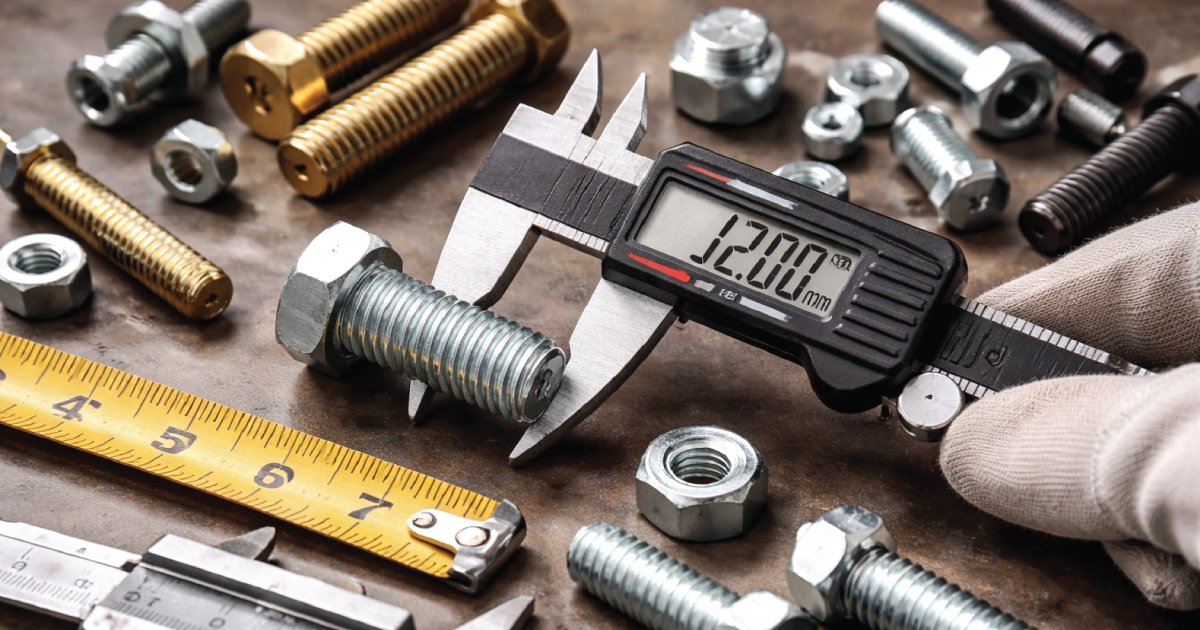
The diameter refers to the thickness of the threaded section and is one of the most critical dimensions. It determines compatibility with nuts, threaded holes, and tapped components in mechanical or structural assemblies.
The diameter is the thickness of the threaded part of the bolt.
What You Need:
Using proper tools improves accuracy and prevents measurement errors that could lead to purchasing the wrong fastener or causing thread damage during installation.
Digital caliper (best option)
Vernier caliper
Or a simple ruler (less accurate)
How to Measure:
Accurate diameter measurement requires focusing only on the threaded section. Measuring incorrectly can result in selecting a bolt that looks similar but does not properly engage with the mating threads.
Measure across the outer edges of the threads.
Do NOT measure the head.
Measure the widest threaded portion.
Example:
Understanding examples makes bolt identification much easier, especially when comparing metric and imperial systems side by side.
If measurement shows 8 mm, it’s an M8 bolt
If measurement shows 1/2 inch, it’s a 1/2-inch bolt
⚠️ Always measure across thread peaks (outermost edges) to ensure the true outside diameter is recorded correctly.
Step 3: Measure the Bolt Length
Bolt length is equally important because insufficient length reduces thread engagement, while excessive length can bottom out inside blind holes and damage internal threads.
Length measurement depends on bolt head type.
For Hex Head, Socket Head, or Cap Bolts
These common bolt types are measured from underneath the head because the head sits above the surface during installation.
Measure from:
Under the head
To the tip of the bolt
Do NOT include the head in measurement.
For Countersunk Bolts (Flat Head)
Countersunk bolts are designed to sit flush with the surface, so their full installed length includes the head.
Measure from:
Top of the head
To the tip
Because countersunk bolts sit flush, their full length includes the head to ensure accurate seating depth.
Step 4: Measure Thread Pitch
Thread pitch determines how tightly threads interlock and directly affects clamping force, vibration resistance, and compatibility with mating parts. Using incorrect pitch can instantly damage threads.
Thread pitch is one of the most important measurements.
It tells you:
How far apart the threads are
Whether the bolt is coarse or fine thread
For Metric Bolts
Metric thread pitch is expressed as the distance between adjacent threads in millimeters. This measurement ensures proper matching with nuts or tapped holes in metric systems.
Thread pitch is measured in millimeters between threads.
Example:
M10 × 1.5
10 = diameter in mm
1.5 = distance between threads (pitch)
How to Measure Metric Pitch
Using a thread pitch gauge provides the most reliable result, especially in precision mechanical or fabrication work.
Use:
Thread pitch gauge (best method)
Or measure distance between 10 threads and divide
Example:
If 10 threads measure 15 mm:
15 ÷ 10 = 1.5 mm pitch
For Imperial Bolts
Imperial thread pitch is measured differently. Instead of millimeters, it uses Threads Per Inch (TPI), indicating how many threads are present within one inch of bolt length.
Thread pitch is measured in Threads Per Inch (TPI).
Example:
1/4-20
1/4 inch diameter
20 threads per inch
How to Measure TPI
Careful counting ensures accuracy when identifying TPI without a gauge.
Place ruler against threads.
Count how many threads fit within 1 inch.
If 20 threads fit → 20 TPI.
Discover More:
Step 5: Identify Bolt Grade (Strength)
Bolt grade determines tensile strength and load capacity. In structural or automotive applications, using the wrong grade can result in bolt stretching, snapping, or catastrophic joint failure.
Bolt strength matters especially in mechanical and structural applications.
Metric Bolt Grades (Numbers on Head)
Metric bolts display strength ratings directly on the head, making identification straightforward when markings are visible.
Common metric grades:
8.8
10.9
12.9
Higher number = stronger bolt.
Imperial Bolt Grades (Lines on Head)
Imperial bolts use radial lines to indicate grade strength.
3 lines = Grade 5
6 lines = Grade 8
Using the wrong grade can lead to failure under load, especially in high-stress or vibration-heavy environments.
Tools Used to Measure Bolt Size
Professional-grade tools provide precision and eliminate guesswork. In fabrication shops, automotive workshops, and mechanical engineering settings, accurate measuring tools are considered essential equipment.
For accurate results, professionals use:
Digital calipers
Thread pitch gauge
Micrometer
Bolt size gauge plate
If you work frequently in fabrication or mechanical repair, investing in a caliper and pitch gauge is highly recommended for long-term accuracy and reliability.
Discover More:
Example: Measuring a Bolt Step-by-Step
Practical examples simplify the learning process and demonstrate how all measurements combine to form a complete bolt specification used in mechanical documentation and purchasing.
Let’s say you removed a bolt from a machine.
Step 1: Measure Diameter
Caliper shows 10 mm → M10
Step 2: Measure Length
From under head to tip = 40 mm
Step 3: Measure Thread Pitch
Pitch gauge shows 1.5 mm
Final Bolt Size:
M10 × 1.5 × 40 mm
That’s the full bolt specification.
Common Bolt Size Chart (Quick Reference)
Familiarity with commonly used sizes saves time in workshops and hardware stores. These sizes appear frequently in machinery, automotive assemblies, and structural fabrication projects.
Metric Common Sizes:
M6
M8
M10
M12
M16
Imperial Common Sizes:
1/4″
5/16″
3/8″
1/2″
5/8″
Discover More:
How to Measure a Bolt Without Tools
Although precision tools are preferred, basic measurement methods can work temporarily in non-critical applications such as household repairs or light-duty installations.
If you don’t have calipers:
Use a ruler
Measure across threads.
Compare with known bolt
Match visually.
Take bolt to hardware store
Most stores have bolt sizing boards.
⚠️ However, for mechanical engineering or automotive repair, guessing is not recommended.
Measuring Car or Engine Bolts
Automotive bolts often operate under high torque, heat, and vibration. Accurate measurement is critical to ensure proper clamping force and prevent thread damage or component loosening.
In automotive work:
Most modern vehicles use metric bolts.
Thread pitch is critical.
Grade matters a lot due to vibration and load.
For example, in brake caliper mounting bolts, using wrong thread pitch can destroy threads inside the knuckle.
Always double-check measurements in high-stress applications.
Coarse vs Fine Thread Bolts
Thread type affects installation speed, clamping performance, and vibration resistance. Selecting the correct thread style ensures optimal mechanical performance in different materials and operating conditions.
Coarse Thread:
Fewer threads per inch
Stronger in soft materials
Faster installation
Fine Thread:
More threads per inch
Better clamping force
Used in high-vibration environments
Make sure you match both diameter AND pitch.
Understand Bolt Size Notation
Bolt size notation follows a structured format that communicates diameter, thread pitch, and length. Understanding this format allows you to quickly interpret specifications in manuals, catalogs, and engineering drawings.
Here’s how bolt sizes are written:
Metric Format:
M10 × 1.5 × 50
M = Metric
10 = Diameter (mm)
1.5 = Pitch (mm)
50 = Length (mm)
Imperial Format:
1/2-13 × 2″
1/2 = Diameter (inch)
13 = Threads per inch
2″ = Length (inch)
Discover More:
Common Mistakes When Measuring Bolt Size
Measurement errors are common, especially among beginners. Even small mistakes can cause incorrect ordering, cross-threading, or installation failure in mechanical assemblies.
Measuring head instead of threads
Including head in hex bolt length
Ignoring thread pitch
Confusing metric with imperial
Not checking grade
Even experienced mechanics sometimes mix up M10 and 3/8″, which look similar but are dimensionally different.
How Bolt Size Affects Mechanical Performance
Bolt size directly influences strength, alignment, and durability in mechanical systems. Proper sizing ensures the joint performs as intended under load, vibration, and environmental stress conditions.
In mechanical systems:
Correct diameter ensures proper fit
Correct pitch ensures thread engagement
Correct grade ensures load capacity
Correct length ensures full engagement without bottoming out
For example, in metal fabrication and machine assembly, improper bolt sizing can cause joint misalignment or structural weakness.
Quick Bolt Measuring Checklist
✔ Measure diameter across threads
✔ Measure length correctly
✔ Identify metric or imperial
✔ Measure pitch (mm or TPI)
✔ Check bolt grade
If all five match, you have the correct bolt.
Professional Tip for Mechanical Projects
Since you work in mechanical or fabrication-related content, here’s an important note: When dealing with precision assemblies such as CNC machines, automotive engines, or structural frames:
- Always use digital calipers.
- Never reuse stretched bolts.
- Follow manufacturer torque specifications.
- Replace with same grade or higher (if approved).
Bolt measurement is not just about size — it’s about safety and performance.
Final Thoughts
Measuring bolt size correctly is a basic but critical mechanical skill. Whether you’re a DIY enthusiast, mechanic, or engineer, understanding how to measure:
- Diameter
- Length
- Thread pitch
- Grade
ensures safe, secure, and professional-quality work.
A simple caliper and thread gauge can save you from stripped threads, failed joints, or costly mistakes. If you make bolt measurement a habit instead of guessing, your mechanical projects will become more accurate, durable, and professional.