
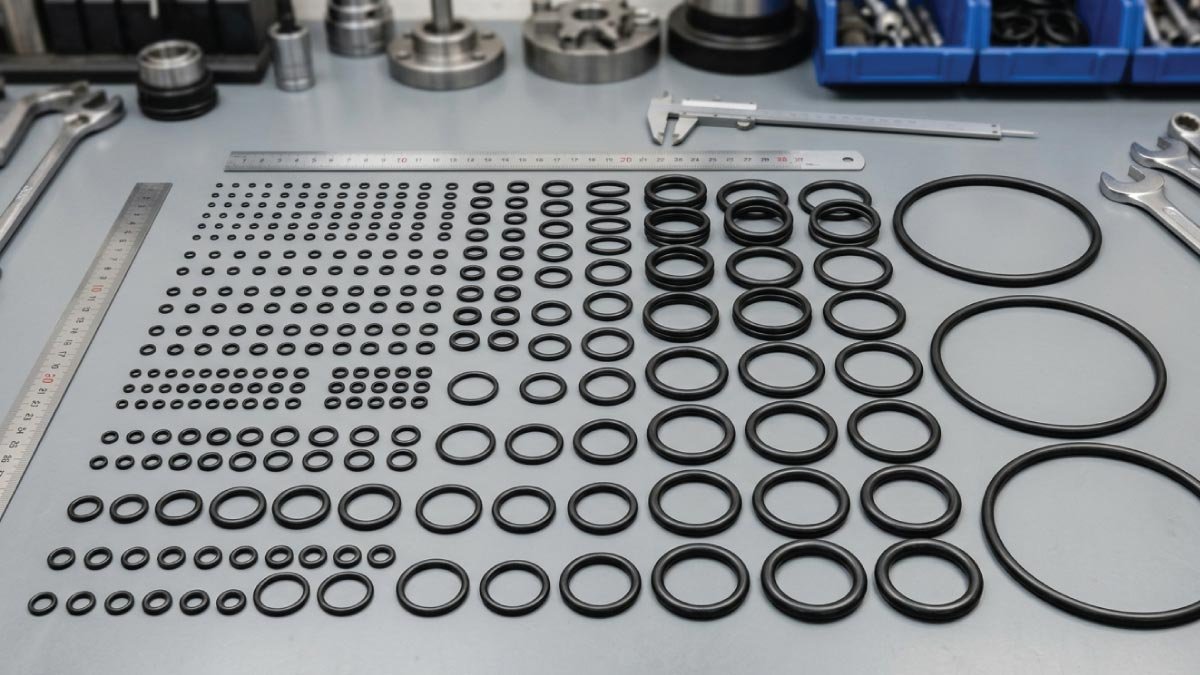
If you’ve ever worked with hydraulic systems, automotive parts, or even simple plumbing connections, chances are you’ve come across an O-ring. At first glance, it looks like nothing more than a small rubber loop but in reality, it plays a critical role in preventing leaks and maintaining pressure.
Understanding O-ring sizes is essential whether you’re a mechanical engineer, a DIY enthusiast, or someone managing industrial equipment. Choosing the wrong size can lead to leaks, system failure, and unnecessary costs.
In this complete guide, I will walk you through everything you need to know about O-ring size charts in a clear, practical way.
What is an O-Ring?
An O-ring is a circular sealing component, typically made from elastomers like rubber, silicone, or fluorocarbon. Its primary purpose is to sit in a groove and create a seal between two surfaces, preventing the escape of liquids or gases.
You will find O-rings used in:
- Automotive engines
- Hydraulic systems
- Pneumatic tools
- Plumbing fixtures
- Industrial machinery
Despite their simplicity, they are engineered with precision—and that’s where size becomes critical.
Why O-Ring Size Matters
Let me explain this in a practical way.
Imagine you install an O-ring that’s slightly too small. When stretched, it becomes thinner and weaker, which can cause leaks. On the other hand, if it’s too large, it won’t fit properly into the groove, leading to poor sealing.
Correct sizing ensures:
- Proper compression
- Leak prevention
- Longer lifespan
- Optimal system performance
That’s why engineers rely on standardized O-ring size charts instead of guessing.
Key Dimensions of an O-Ring
Before diving into the size chart, you need to understand the three most important measurements. These dimensions are essential because they directly affect sealing performance, compatibility, and durability. Choosing the wrong size can lead to leaks, pressure loss, or failure in mechanical systems.
1. Inside Diameter (ID)
This is the distance across the inner circle of the O-ring. It determines how well the O-ring fits onto a shaft or inside a groove. A correct inside diameter ensures a snug fit without overstretching, which is critical for maintaining sealing efficiency and preventing deformation during operation.
2. Outside Diameter (OD)
This measures the total diameter from one outer edge to the other. It helps determine whether the O-ring will properly fit within a housing or cavity. The outside diameter is especially important when space constraints are tight, ensuring the seal does not get compressed excessively or fail under pressure.
3. Cross-Section (CS)
Also called thickness, this is the width of the ring material itself. The cross-section plays a major role in sealing performance, as it determines how much compression the O-ring can handle. A proper thickness ensures durability, flexibility, and the ability to maintain a tight seal under varying pressures and temperatures.
Simple Relationship:
OD = ID + (2 × CS)
This formula shows the mathematical relationship between the three key dimensions. It allows engineers and designers to quickly calculate one value if the other two are known. Understanding this relationship helps ensure accurate sizing and proper sealing performance in different applications.
These three dimensions define every O-ring size.
Standard O-Ring Size Systems
There are different sizing standards used worldwide. The most common ones include systems developed for consistency, compatibility, and ease of manufacturing. Understanding these standards is important when selecting O-rings for global applications, as sizes and labeling methods may vary across regions and industries.
1. AS568 (USA Standard)
This is the most widely used standard, especially in automotive and industrial applications. It provides a comprehensive range of sizes using a standardized numbering system, making it easy to identify and replace O-rings. Its consistency ensures compatibility across various equipment and manufacturers in the United States and beyond.
- Sizes are labeled with dash numbers (e.g., -001, -010, -214)
- Each number corresponds to a specific ID and cross-section
2. Metric O-Ring Sizes
Used globally, especially in Europe and Asia, metric O-ring sizes follow a straightforward measurement system. These sizes are defined using millimeters, making them easier to understand and apply in international projects. Metric sizing is commonly used in modern machinery and equipment due to its simplicity and global acceptance.
- Measured in millimeters
- Defined by ID × CS (e.g., 10 × 2 mm)
3. BS (British Standard)
Common in the UK, this standard provides a range of O-ring sizes tailored to British engineering practices. It uses a specific coding system that aligns with traditional industrial requirements. Although less common globally than AS568, it remains important for maintaining compatibility with UK-based systems and legacy equipment.
- Uses codes like BS001, BS010, etc.
O-Ring Size Chart (AS568 Standard)
Here’s a simplified version of a standard O-ring size chart. This chart provides a quick reference for selecting the correct O-ring based on inside diameter and cross-section. It is especially useful for engineers, technicians, and maintenance professionals who need accurate sizing for sealing applications.
| Dash Number | Inside Diameter (inches) | Cross Section (inches) |
|---|---|---|
| -001 | 0.029 | 0.040 |
| -002 | 0.042 | 0.040 |
| -003 | 0.056 | 0.040 |
| -004 | 0.070 | 0.040 |
| -005 | 0.085 | 0.040 |
| -010 | 0.239 | 0.070 |
| -014 | 0.364 | 0.070 |
| -020 | 0.614 | 0.070 |
| -112 | 0.737 | 0.103 |
| -214 | 0.984 | 0.139 |
This chart helps you quickly identify the correct size based on your application.
Metric O-Ring Size Chart
Metric sizes are more straightforward because they are written directly using millimeters. This makes them easier to read and apply, especially in international engineering environments. Unlike other standards, metric O-rings clearly define both inner diameter and thickness, reducing confusion and simplifying selection for various applications.
| Inside Diameter (mm) | Cross Section (mm) |
|---|---|
| 5 | 1 |
| 10 | 2 |
| 20 | 2.5 |
| 25 | 3 |
| 50 | 5 |
For example, a 10 × 2 mm O-ring means:
- 10 mm inner diameter
- 2 mm thickness
Also Read:
How to Measure an O-Ring
If you already have an O-ring but don’t know its size, you can measure it easily using simple tools. Accurate measurement is important to ensure proper sealing and avoid leaks. Even small errors in measurement can lead to poor performance or failure in mechanical systems.
Step 1: Measure Inside Diameter
Use a vernier caliper or ruler to measure the inner circle. Make sure the O-ring is placed flat on a surface and not stretched during measurement. Accurate inside diameter measurement ensures the O-ring will fit properly onto shafts or inside grooves without unnecessary stress or deformation.
Step 2: Measure Thickness
Measure the cross-section from one side of the ring to the other. This thickness determines how much compression the O-ring can handle during installation. A precise measurement helps maintain the correct sealing pressure and ensures the O-ring performs effectively under different operating conditions.
Step 3: Calculate OD
Use the formula:
OD = ID + (2 × CS)
This formula allows you to calculate the outer diameter once you know the inside diameter and thickness. It is especially useful when verifying whether an O-ring will fit properly into a specific housing or groove design.
Pro Tip:
Always measure without stretching the O-ring, as stretching can distort its true dimensions. Even slight deformation can lead to incorrect sizing, which may cause sealing issues, leaks, or reduced lifespan of the O-ring in practical applications.
Choosing the Right O-Ring Size
Selecting the correct O-ring size depends on more than just basic measurements. Factors like application type, pressure conditions, and installation environment also play a critical role. A properly chosen O-ring ensures reliable sealing, longer service life, and better overall performance in mechanical systems.
1. Groove Design
The groove where the O-ring sits must match its size precisely. Incorrect groove dimensions can cause over-compression or insufficient sealing. Proper groove design ensures the O-ring stays in place, maintains uniform pressure, and performs efficiently without damage during operation.
2. Compression Ratio
An O-ring typically needs 20–30% compression to seal effectively. This compression creates the necessary contact force between surfaces. Too little compression may result in leaks, while too much can damage the O-ring, reducing its lifespan and overall sealing performance.
3. Stretch Limits
- Inner diameter stretch: up to 5%
- Cross-section compression: up to 30%
These limits ensure the O-ring maintains its shape and sealing ability. Exceeding these values can cause permanent deformation, weakening the seal. Staying within recommended limits helps achieve consistent performance and prevents premature failure.
4. Application Type
Different systems require different fits depending on movement and pressure conditions. Understanding the application helps in selecting the right O-ring size and material, ensuring optimal performance and minimizing wear over time.
- Static sealing (no movement)
- Dynamic sealing (moving parts)
Also Read:
Common O-Ring Materials and Their Impact
Size isn’t the only factor when selecting an O-ring—material also plays a crucial role in performance. Different materials offer varying resistance to temperature, chemicals, and pressure. Choosing the right material ensures durability, reliability, and compatibility with the operating environment.
1- Nitrile (Buna-N)
Nitrile is one of the most commonly used O-ring materials, especially in oil and fuel systems. It offers good resistance to petroleum-based fluids and is cost-effective. Its balance of durability and affordability makes it a popular choice for general industrial and automotive applications.
- Best for oil and fuel systems
- Cost-effective
2- Silicone
Silicone O-rings are known for their excellent flexibility and high-temperature resistance. They perform well in extreme temperature conditions but are generally less durable under mechanical stress. They are often used in applications where flexibility and temperature stability are more important than strength.
- Great for high temperatures
- Flexible but less durable
3- Viton (FKM)
Viton is a high-performance material known for its excellent chemical and heat resistance. It is commonly used in harsh environments where exposure to aggressive fluids or high temperatures is expected. Although more expensive, it provides superior durability and long-term reliability.
- Excellent chemical resistance
- Used in harsh environments
4- EPDM
EPDM is ideal for applications involving water, steam, and weather exposure. It offers excellent resistance to heat, ozone, and aging. However, it is not suitable for oil-based systems. Its durability in outdoor and water-related environments makes it a reliable material choice.
- Ideal for water and steam applications
Applications of O-Ring Size Charts
Understanding O-ring size charts becomes especially useful in real-world scenarios. These charts help ensure accurate selection, proper fit, and reliable sealing performance across different industries. Whether you’re working on small repairs or large industrial systems, correct sizing prevents leaks, improves efficiency, and extends equipment lifespan.
1- Automotive Repairs
When replacing engine seals, knowing the exact size ensures leak-free performance. O-rings are commonly used in engines, fuel systems, and air conditioning units. Using the correct size helps maintain pressure, prevents fluid leakage, and ensures the smooth operation of critical automotive components under varying temperatures and conditions.
2- Hydraulic Systems
Proper sizing prevents pressure loss and system failure. Hydraulic systems rely heavily on tightly sealed connections to maintain fluid pressure. Even a slight mismatch in O-ring size can cause leaks, reduce efficiency, and lead to costly damage or downtime in machinery and heavy equipment.
3- Plumbing
Incorrect O-ring sizes can cause water leakage in taps and pipes. In plumbing systems, O-rings are essential for creating watertight seals. Choosing the right size ensures proper fitting, prevents drips, and helps maintain long-term durability in household and commercial water systems.
4- Industrial Equipment
Precision sizing is critical for maintaining efficiency and safety. Industrial machines often operate under high pressure and extreme conditions. Correct O-ring sizing ensures reliable sealing, reduces wear and tear, and prevents unexpected failures that could disrupt operations or pose safety risks.
Also Read:
Common Mistakes to Avoid
Over the years, I’ve seen people make the same mistakes repeatedly when working with O-rings. Avoiding these common errors can save time, reduce costs, and improve overall system performance. Paying attention to detail ensures better sealing results and longer-lasting components.
1- Guessing the Size
Never assume the size—always measure or check the chart. Guessing can lead to improper fit, causing leaks or system failure. Taking a few extra minutes to measure accurately ensures you select the correct O-ring and avoid unnecessary replacements or maintenance issues.
2- Ignoring Tolerances
Even small deviations can cause sealing failure. O-rings are designed with precise tolerances, and slight variations in size can affect performance. Ignoring these tolerances may result in poor sealing, increased wear, and reduced reliability in both simple and complex systems.
3- Using the Wrong Standard
Mixing metric and AS568 sizes can lead to incorrect fits. These standards are not interchangeable, and confusion between them often causes sizing errors. Always confirm the standard being used to ensure compatibility with your equipment and avoid installation problems.
4- Overstretching
Stretching an O-ring too much weakens it and reduces lifespan. Excessive stretching can cause permanent deformation, reducing its ability to seal effectively. Always stay within recommended stretch limits to maintain strength, flexibility, and long-term performance in your application.
Tips for Working with O-Rings
Here are some practical tips that can save you time and trouble:
- Always keep a size chart handy in your workshop
- Store O-rings in a cool, dry place
- Lubricate before installation to prevent damage
- Replace worn-out O-rings immediately
- Use proper tools to avoid cuts or deformation
How to Read an O-Ring Size Code
Let’s break it down with an example:
AS568-214
- “AS568” = Standard
- “214” = Size code
From the chart, you can find:
- ID: 0.984 inches
- CS: 0.139 inches
Once you understand this system, identifying O-rings becomes much easier.
O-Ring Groove Design Basics
Even with the correct size, poor groove design can cause failure.
Key considerations:
- Groove width should be slightly larger than the O-ring
- Depth should allow proper compression
- Surface finish should be smooth to avoid wear
A well-designed groove ensures the O-ring performs efficiently over time.
Also Read:
When to Replace an O-Ring
O-rings don’t last forever. Watch for these signs:
- Cracks or cuts
- Loss of elasticity
- Flattened shape
- Leakage in the system
Replacing them early can prevent costly repairs later.
Final Thoughts
O-rings may seem like small components, but they play a huge role in mechanical systems. Understanding how to read and use an O-ring size chart can make a big difference in performance, reliability, and safety.
Whether you’re working on a car engine, fixing a leaking pipe, or managing industrial machinery, getting the size right is essential. Take the time to measure accurately, refer to standard charts, and choose the right material for your application.
Once you get comfortable with O-ring sizing, it becomes second nature and you will avoid many common problems that others face.
FAQs:
How do you size an O-ring?
To size an O-ring, measure its inner diameter (ID), outer diameter (OD), and cross-section (thickness). The most important dimensions are ID and cross-section. You can use a caliper or refer to a standard O-ring size chart to match the exact dimensions accurately.
What is the standard O-ring size in mm?
There is no single standard O-ring size in millimeters because sizes vary depending on application and standards like metric or AS568. However, common metric O-rings range from 1 mm to over 500 mm in diameter, with cross-sections typically between 1 mm and 10 mm.
How big is an O-ring?
O-rings come in a wide range of sizes, from very small (a few millimeters in diameter) to very large industrial sizes exceeding several meters. The size depends on the application, such as sealing small plumbing fittings or large hydraulic cylinders in heavy machinery systems.
What size is a 17 O-ring?
A “17 O-ring” typically refers to a size designation from a standard chart, often indicating a specific inner diameter and cross-section. For example, in some standards, a size 17 O-ring may have an inner diameter around 17 mm, but exact dimensions vary by system used.
What size is an O-size ring?
The term “O-size ring” is not a precise measurement but rather a general reference to O-rings as a category. Actual size must be defined using inner diameter and cross-section. Without specific dimensions or a standard reference, the term alone does not indicate an exact size.
Is the O-ring size small?
O-ring sizes can be small or large depending on their intended use. Some are tiny and used in electronics or medical devices, while others are large for industrial equipment. So, O-ring size is not always small—it varies widely based on application requirements.