
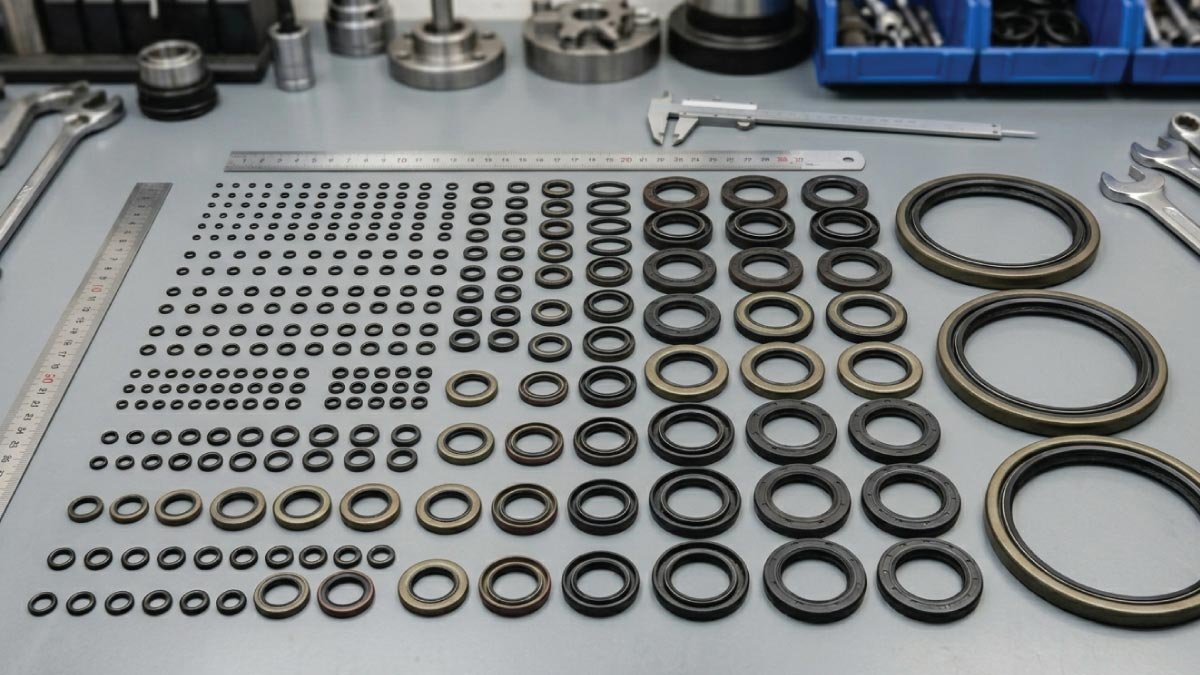
An oil seal — also called a rotary shaft seal, lip seal, or radial shaft seal — is a precision component that keeps lubricants inside a mechanical system while blocking contaminants from entering.
Whether you are working on an automotive gearbox, a hydraulic pump, an industrial machine, or an agricultural implement, using the wrong oil seal size causes leaks, accelerates wear, and leads to costly equipment failure.
This comprehensive oil seal size guide covers everything you need to know: what dimensions define an oil seal, how to measure oil seal size accurately, how to read an oil seal size chart, and how to choose the right seal for your application. By the end, you will have the confidence to identify, measure, and replace any oil seal correctly.
What Is an Oil Seal? (Core Concepts)
Before diving into measurements, it is important to understand what you are measuring. An oil seal is a mechanical seal that fills the gap between a rotating shaft and a stationary housing bore.
It uses a flexible lip, typically made from nitrile rubber (NBR), fluoroelastomer (FKM/Viton), silicone, or polyacrylate, pressed against the shaft by a garter spring to maintain a dynamic seal.
Key Components of an Oil Seal
- Outer metal case — provides structural rigidity and presses into the housing bore
- Sealing lip — the flexible element that contacts the rotating shaft
- Garter spring — applies radial force to keep the lip in contact with the shaft
- Dust lip (secondary lip) — present on double-lip seals; excludes dirt and moisture
Understanding these components helps you understand why three specific dimensions fully define an oil seal size.
The Three Critical Oil Seal Dimensions
Every oil seal is defined by three measurements, universally written in the order: Shaft Diameter (d) × Housing Bore (D) × Width (b), all expressed in millimeters (or inches in imperial applications).
1. Inner Diameter (ID) — Shaft Diameter
The inner diameter is the dimension of the seal’s bore opening — the hole through which the rotating shaft passes. This measurement must match the shaft diameter precisely. A seal with too large an ID leaks immediately; one with too small an ID cannot be installed and damages the sealing lip.
Typical range: 6 mm to 2,000+ mm depending on application
2. Outer Diameter (OD) — Housing Bore Diameter
The outer diameter is the overall outside diameter of the seal’s metal case. This must match the housing bore with a slight interference fit — typically 0.1 mm to 0.5 mm of press fit — to hold the seal firmly in place and prevent it from rotating or leaking past the outer case.
Typical range: 16 mm to 2,200+ mm
3. Width (W) — Seal Height
The width, also called the height or thickness, is the axial length of the seal from face to face. This must match the depth of the housing recess. If the seal is too wide, it protrudes and gets damaged; too narrow, and it may tilt or fail to seal properly.
Typical range: 5 mm to 50+ mm for standard applications
How to Measure Oil Seal Size: Step-by-Step
Measuring an old or unknown oil seal correctly is the most reliable way to find a replacement. You will need a vernier caliper (digital or analog) for accurate results. A ruler is not precise enough.
Tools Required
- Digital vernier caliper (resolution: 0.01 mm / 0.001 inch)
- Clean cloth or shop rag
- Good lighting
Step 1 — Clean the Seal
Wipe the seal thoroughly with a clean cloth. Dirt, grease, and rubber distortion from the old installation can throw off your measurements by 0.5 mm or more, enough to cause fitment problems.
Step 2 — Measure the Inner Diameter (ID)
Open the caliper jaws and place the inside measurement tips inside the bore of the seal. Expand gently until both tips touch the inner lip surface. Do not compress the rubber lip — you want the natural bore diameter. Record the measurement in millimeters.
Pro Tip: Measure the ID at two perpendicular points (90° apart). If the readings differ by more than 0.3 mm, the old seal is deformed and may not give you accurate figures — measure the shaft instead.
Step 3 — Measure the Outer Diameter (OD)
Use the outside jaws of the caliper to measure across the widest point of the outer metal case. Ensure the jaws are square and not tilted. Record the measurement.
Pro Tip: If the metal case is corroded or deformed, measure the housing bore in the machine directly — this is more reliable than measuring a damaged seal.
Step 4 — Measure the Width
Close the caliper and use the depth probe or the flat outside jaws placed across the face of the seal to measure its axial thickness. Ensure you are measuring the full width from the flat back face to the front lip face.
Step 5 — Record in Standard Format
Write your three measurements in the standard format:
ID × OD × Width (e.g., 35 × 52 × 8 mm)
This is the universal language of oil seal sizing used by all manufacturers and suppliers worldwide.
Oil Seal Size Chart: Common Standard Sizes
The following table lists commonly used standard oil seal sizes across automotive, industrial, and agricultural applications. Sizes are given in millimeters.
| ID (mm) | OD (mm) | Width (mm) | Common Application |
|---|---|---|---|
| 12 | 22 | 7 | Small engines, pumps |
| 15 | 26 | 7 | Motorcycle cranks |
| 20 | 32 | 7 | Gearbox input shafts |
| 25 | 40 | 8 | Automotive differentials |
| 30 | 42 | 8 | Axle shafts |
| 35 | 52 | 8 | Common gearbox shaft |
| 38 | 55 | 10 | Agricultural PTO shafts |
| 40 | 55 | 8 | Wheel hubs |
| 45 | 65 | 10 | Industrial gearboxes |
| 50 | 68 | 10 | Hydraulic cylinder rods |
| 55 | 72 | 10 | Truck axle shafts |
| 60 | 80 | 10 | Large pump shafts |
| 70 | 90 | 10 | Heavy machinery |
| 80 | 100 | 10 | Industrial drive shafts |
| 90 | 110 | 13 | Large axle hubs |
| 100 | 125 | 13 | Industrial compressors |
Note: This chart lists general standard sizes. Always verify with the specific OEM part number or direct measurement for critical applications.
Also Read:
Oil Seal Size Designation Systems
Oil seals are coded differently by various manufacturers and standards bodies. Understanding these codes helps you cross-reference part numbers across brands.
ISO / DIN Standard Designation
The ISO 6194 standard and DIN 3760 standard define oil seal dimensions and tolerances for metric seals. A standard designation appears as:
DIN 3760 – A 35 × 52 × 8 – NBR
Where:
- A = single lip, with spring
- 35 = shaft diameter (ID)
- 52 = housing bore (OD)
- 8 = width
- NBR = nitrile rubber material
Type Codes (Common Variants)
| Code | Description |
|---|---|
| R / TC | Double lip with spring (most common automotive type) |
| SC / A | Single lip with spring |
| TB | Double lip with spring, metal outer case |
| VC | Single lip, no spring (light duty) |
Reading a Manufacturer Part Number
For example, a seal marked TC 40-60-10 means:
- TC type (double lip)
- 40 mm shaft (ID)
- 60 mm bore (OD)
- 10 mm wide
Oil Seal Size Tolerances: What You Need to Know
Tolerance is the acceptable range of variation from the nominal dimension. Oil seal tolerances are critical to both sealing performance and installation ease.
1- Inner Diameter Tolerance
The seal ID is typically manufactured slightly smaller than the shaft diameter to create lip preload. For example, a seal with a nominal ID of 35 mm may have an actual free-state ID of 33.5 mm to 34.5 mm. The garter spring provides the clamping force.
2- Outer Diameter Tolerance
The outer metal case is manufactured with a slight oversize compared to the housing bore, typically +0.1 mm to +0.4 mm, to achieve a press fit that holds the seal stationary.
3- Width Tolerance
Width tolerances are generally ±0.3 mm to ±0.5 mm for standard seals and must be matched to the housing depth.
Also Read:
How to Choose the Right Oil Seal Size for Your Application
Knowing the dimensions is just the first step. Selecting the correct seal also involves material choice, pressure rating, speed rating, and temperature range.
Shaft Speed and Surface Finish
Oil seals are rated for specific shaft surface speeds (meters per second). A common standard seal handles up to 4–6 m/s. High-speed applications require PTFE-lip seals. Additionally, the shaft surface finish should be Ra 0.2–0.8 µm for optimal lip contact — too rough accelerates wear; too smooth causes the lip to hydroplane and lose contact.
Temperature Range by Material
| Material | Temperature Range | Best For |
|---|---|---|
| NBR (Nitrile) | -40°C to +120°C | General purpose, oils |
| FKM (Viton) | -20°C to +200°C | Hot oils, fuels, chemicals |
| Silicone | -65°C to +180°C | Extreme cold, food machinery |
| PTFE | -70°C to +260°C | High speed, aggressive media |
| ACM (Polyacrylate) | -30°C to +175°C | Automotive hot gear oil |
Pressure Rating
Standard lip seals are designed for low-pressure applications (typically under 0.5 bar). For hydraulic cylinders operating at higher pressures, use dedicated hydraulic rod seals or pressure-rated PTFE lip seals.
Common Oil Seal Sizing Mistakes to Avoid
Even experienced mechanics make these errors. Knowing them saves time and money.
Measuring a deformed old seal. A seal that has been running for years may be compressed, swollen, or warped. Always cross-check by measuring the shaft and housing bore directly on the machine.
Confusing metric and imperial dimensions. A 1.5-inch shaft is 38.1 mm — not 38 mm. This small difference can cause a metric seal to leak. Always confirm which measurement system your application uses.
Ignoring the housing bore. Some mechanics focus only on the shaft size and assume the OD. Always measure both shaft and bore, especially on older or aftermarket equipment.
Overlooking seal type. A double-lip seal (TC type) adds external contamination exclusion that a single-lip seal cannot provide. For dusty or wet environments, always select the double-lip type.
Also Read:
Conclusion: Getting Oil Seal Sizing Right the First Time
Oil seal sizing is a precise science that rewards careful measurement and correct part selection. The three key dimensions — inner diameter, outer diameter, and width — combined with the right material and seal type give you a complete specification for finding or ordering the correct replacement seal.
Always measure with a calibrated digital caliper, record dimensions in the standard ID × OD × Width format, cross-reference against a reliable oil seal size chart, and match the material grade to your operating temperature and media. Following this process eliminates guesswork, prevents repeat failures, and keeps your machinery running leak-free.
FAQs:
How to check oil seal size?
To check oil seal size, measure the inner diameter (ID), outer diameter (OD), and width using a vernier caliper. Ensure the seal is clean and not stretched. Cross-check your measurements with a standard size chart to confirm accuracy and choose the correct replacement for proper sealing performance.
What are the different sizes of oil seals?
Oil seals come in various metric and inch sizes, typically defined by inner diameter, outer diameter, and width. Common sizes include 10×26×7 mm, 25×40×7 mm, and 50×72×8 mm. These variations allow oil seals to fit different shafts and housings across automotive, industrial, and mechanical applications.
What is the seal size?
Seal size refers to the three main dimensions of an oil seal: inner diameter (ID), outer diameter (OD), and width. These measurements determine how well the seal fits a shaft and housing. Correct seal size ensures proper sealing, prevents leaks, and maintains the efficiency of mechanical systems.
How to find seal size?
To find seal size, measure the shaft diameter for ID, the housing bore for OD, and the groove depth for width. Use a vernier caliper for accuracy. If the old seal is available, measure it carefully and compare the results with a standard oil seal size chart.
How to select an oil seal?
Selecting an oil seal involves choosing the correct size, material, and type based on your application. Consider shaft size, operating temperature, pressure, and fluid type. Ensure proper fit and compatibility with the environment to achieve reliable sealing performance and extend the lifespan of your machinery.