
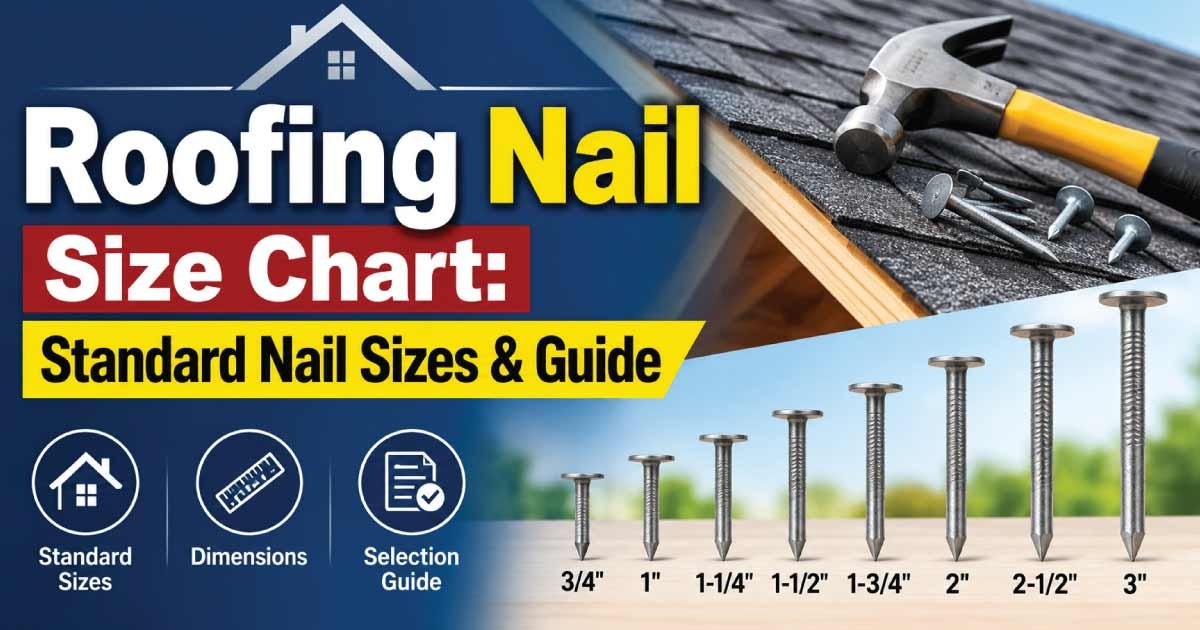
A roofing nail may look like a simple fastener, but its length, shank style, diameter, head size, and material all affect how well a roofing system performs. Choosing the wrong nail can lead to poor fastening, exposed nail heads, leaks, shingle damage, or inadequate penetration into the roof deck.
This roofing nail size chart explains common roofing nail sizes, dimensions, shank types, materials, and applications. It also covers how to choose the correct nail length, how roofing nails differ from standard nails, and the most common mistakes to avoid.
Whether you are installing asphalt shingles, replacing damaged roofing, or buying nails for a repair project, use the chart as a starting point and always confirm the requirements of the roofing manufacturer and applicable local building code.
Roofing Nail Size Chart
Roofing nails are commonly identified by length, shank diameter or gauge, head diameter, shank type, and material. The exact dimensions vary by manufacturer, so the following chart represents common sizes rather than one universal standard.
| Roofing Nail Length (in.) | Approx. Length (mm) | Common Use | Typical Shank Style |
|---|---|---|---|
| 3/4 | 19.1 | Thin roofing components and specialty applications | Smooth |
| 1 | 25.4 | Certain roofing repairs and thin materials | Smooth/Ring |
| 1-1/4 | 31.8 | Common asphalt shingle installation | Smooth/Ring |
| 1-1/2 | 38.1 | Thicker roof assemblies and selected applications | Smooth/Ring |
| 1-3/4 | 44.5 | Thick assemblies or special roofing applications | Ring/Screw |
| 2 | 50.8 | Thick materials and specific roofing systems | Ring/Screw |
1-1/4-inch nails are widely used for asphalt shingles, but that does not mean they are correct for every roof. The required nail length depends on the number and thickness of roofing layers, decking, underlayment, and the manufacturer’s installation instructions.
Common Roofing Nail Gauge
Roofing nails are generally made with a relatively thick shank because they need to withstand wind loads and hold roofing materials securely.
| Common Gauge Range | General Characteristics | Typical Roofing Use |
|---|---|---|
| 11 gauge | Heavier shank | Heavy-duty roofing applications |
| 12 gauge | Common roofing nail size | Asphalt shingles and general roofing |
| 13 gauge | Smaller shank | Specialty/light-duty applications where permitted |
Gauge terminology can be confusing because a lower gauge number generally indicates a thicker wire or shank. Always compare the manufacturer’s stated shank diameter when exact fastening dimensions matter.
What Are Roofing Nails?
Roofing nails are fasteners specifically designed to attach roofing materials to a roof deck or other approved substrate. They are typically characterized by a relatively large head and corrosion-resistant construction.
The large head helps distribute the fastening force over the roofing material. This is particularly important with asphalt shingles, where a small-headed nail could provide inadequate holding area or damage the shingle.
A roofing nail usually consists of four important parts:
Head: The broad top surface that contacts the roofing material.
Shank: The straight section that enters the roof deck.
Point: The end that penetrates the roofing material and substrate.
Coating or finish: A corrosion-resistant treatment or material used to improve durability.
The nail’s design must match the roofing product. Asphalt shingles, underlayment, metal roofing, and other systems may have different fastening requirements.
Roofing Nail Dimensions Explained
Understanding the dimensions of a roofing nail makes it easier to compare different products and select an appropriate fastener.
1. Nail Length
Nail length is measured from the underside of the head to the tip.
For example, a 1-1/4-inch roofing nail has a nominal length of 1.25 inches, or approximately 31.8 mm.
Length is one of the most important specifications because the nail needs to pass through the roofing material and achieve the required penetration into the approved substrate.
A nail that is too short may not provide adequate holding power. A nail that is unnecessarily long may penetrate farther than intended or create problems with the roof assembly.
2. Shank Diameter
The shank is the main body of the nail. Its diameter influences strength and holding capacity.
Roofing nails are commonly manufactured with relatively substantial shanks compared with many general-purpose finishing nails. Exact diameter should be taken from the manufacturer’s specification rather than inferred only from the gauge.
3. Head Diameter
Roofing nails normally have a larger head than ordinary construction nails.
The wider head helps prevent the nail from pulling through relatively soft roofing materials. Head diameter is particularly important for shingle fastening because the head must remain securely on the shingle without cutting through it.
4. Shank Type
The shank may be smooth, ring-shanked, or screw-shaped. This feature affects how strongly the nail resists withdrawal.
The right shank design depends on the roofing system and its installation requirements.
Types of Roofing Nails
Not all roofing nails have the same shank design or corrosion resistance. Selecting the correct type is just as important as selecting the correct length.
Smooth-Shank Roofing Nails
Smooth-shank nails have a straight, relatively uniform body.
They are widely used because they are simple to manufacture and drive. They can be appropriate for many standard roofing applications when the roofing manufacturer specifies them.
Advantages include:
- Simple installation
- Easy availability
- Consistent driving characteristics
- Suitable for many conventional applications
Their main limitation is that they generally provide less withdrawal resistance than a properly designed ring-shank nail.
Ring-Shank Roofing Nails
Ring-shank nails have circular ridges around the shank. These ridges increase resistance to withdrawal because the surrounding material grips the irregular surface.
They are often selected where higher holding power is desired or where the roofing product specifically calls for ring-shank fasteners.
However, ring-shank nails are not automatically better for every roofing project. The correct nail must still meet the roofing system’s requirements for diameter, length, head size, corrosion resistance, and installation method.
Screw-Shank Roofing Nails
Screw-shank nails have a spiral or helical profile.
The shape can provide strong withdrawal resistance and may be used for particular roofing or construction applications. Their use should follow the roofing manufacturer’s specifications rather than being chosen simply because they offer high holding power.
Roofing Nail Material and Corrosion Resistance
Roofing nails are exposed to moisture, temperature changes, condensation, and sometimes harsh environmental conditions. For this reason, corrosion resistance is a critical specification.
Common roofing nail materials and finishes include:
| Material/Finish | General Characteristic | Typical Consideration |
|---|---|---|
| Galvanized steel | Steel with zinc protection | Common general roofing applications |
| Hot-dip galvanized | Thicker zinc coating process | Greater corrosion protection than many basic coatings |
| Stainless steel | Highly corrosion-resistant metal | Useful in demanding environments and where specified |
| Copper | Excellent corrosion resistance and compatibility in some systems | Specialty roofing applications |
The correct material depends on the roof covering, local climate, exposure, and manufacturer requirements.
Do not select nails based only on price. A nail that corrodes prematurely can compromise the fastening system even if its original length and diameter were correct.
How to Choose the Correct Roofing Nail Size
Choosing roofing nails is not simply a matter of picking the longest nail available. The nail must be compatible with the complete roof assembly.
Consider these factors before purchasing fasteners.
1. Identify the Roofing Material
Start by determining what you are fastening.
Different materials may require different fastener dimensions. Asphalt shingles, for example, have specific fastening requirements that can differ from metal roofing or specialty roof coverings.
2. Check the Manufacturer’s Instructions
The roofing product manufacturer should be your primary reference for fastening requirements.
Look for information about:
- Nail length
- Minimum shank diameter
- Head diameter
- Nail placement
- Number of nails per shingle
- Approved materials or coatings
- Acceptable shank designs
- Special fastening zones
Manufacturer instructions can vary between products, even when the products appear similar.
3. Consider Roof Deck Thickness
The nail needs enough length to pass through the roofing material and reach the required penetration into the roof deck or approved substrate.
If the deck is thicker, a longer nail may be necessary. If the roofing assembly contains additional layers, the required nail length may also change.
4. Consider the Number of Roofing Layers
Replacing shingles over an existing roof can change the total thickness the nail must pass through.
For this reason, a nail that works for a single-layer installation may not be appropriate for a thicker assembly.
5. Check Local Building Requirements
Building codes can establish requirements for fastening, wind resistance, roofing installation, and related construction details.
The applicable code depends on your location and project. Where code requirements and manufacturer instructions differ, professional guidance should be obtained rather than guessing.
Common Asphalt Shingle Nail Size
For conventional asphalt shingles, 1-1/4-inch roofing nails are a common starting point for many standard installations.
However, the correct size can change depending on the roof assembly.
For example, longer nails may be required when:
- The roofing material is thicker.
- Multiple roofing layers are present.
- The deck configuration requires greater penetration.
- The manufacturer specifies a longer fastener.
- The roof uses a specialty shingle or system.
The goal is not simply to use a nail that reaches through the roof covering. It must achieve the required penetration while remaining compatible with the roof design.
Roofing Nail Length Guide by Application
The following guide provides a practical way to think about common roofing nail lengths.
| Nail Length | Approx. Metric Length | Potential Application |
|---|---|---|
| 3/4 in. | 19.1 mm | Thin materials or specialty applications |
| 1 in. | 25.4 mm | Selected repairs and roofing components |
| 1-1/4 in. | 31.8 mm | Common asphalt shingle applications |
| 1-1/2 in. | 38.1 mm | Thicker roofing assemblies |
| 1-3/4 in. | 44.5 mm | Selected thick or specialty systems |
| 2 in. | 50.8 mm | Thick assemblies and specific applications |
This table should be treated as a selection reference, not a substitute for the roofing product’s installation instructions.
Discover More:
How Many Roofing Nails Per Shingle?
The required number of nails is determined by the roofing product, roof design, installation pattern, and applicable requirements.
A common mistake is assuming every asphalt shingle needs the same number of nails. Standard installation and high-wind installation can have different fastening requirements.
Manufacturers may specify additional nails or different placement in areas such as:
- High-wind zones
- Roof edges
- Rakes
- Hips
- Ridges
- Special starter courses
Always follow the manufacturer’s nail placement diagram when one is provided.
Nail quantity and nail size are separate issues. Using more nails does not automatically compensate for using the wrong nail dimensions or an unapproved fastener.
Roofing Nails vs. Regular Nails
Roofing nails are not simply ordinary nails with a different name.
The most important differences are their head design, corrosion resistance, shank characteristics, and intended application.
| Feature | Roofing Nail | General Construction Nail |
|---|---|---|
| Head | Usually broad | Varies by nail type |
| Corrosion resistance | Important requirement | Depends on application |
| Shank | Often substantial | Varies widely |
| Intended use | Roofing materials | General construction |
| Fastening requirements | Often product-specific | Application-dependent |
Using a general-purpose nail for roofing can be inappropriate if it does not meet the roofing manufacturer’s requirements.
A roofing fastener must withstand the environmental conditions and mechanical demands of the roof system.
What Is the Best Shank Type for Roofing?
There is no single shank type that is best for every roofing application.
Smooth-shank nails are common and suitable for many applications when specified.
Ring-shank nails can provide greater withdrawal resistance and may be preferred for certain roofing systems or high-wind applications.
Screw-shank nails can also provide strong withdrawal resistance but should only be used where the roofing system permits them.
The best choice is therefore the shank type specified or accepted by the roofing manufacturer and applicable requirements, not necessarily the nail with the highest theoretical holding power.
How to Measure a Roofing Nail
Measuring a roofing nail is straightforward if you know which dimensions matter.
Measure Nail Length
Place the nail on a flat surface and measure from the underside of the head to the tip.
Do not include the head itself in the nominal nail length.
Measure Shank Diameter
Use a caliper for the most accurate measurement.
Measure the main cylindrical portion of the shank rather than the head or pointed tip.
Measure Head Diameter
Measure straight across the widest portion of the nail head.
This measurement is important because roofing nails generally rely on their broad head to hold roofing material securely.
Record the Material and Finish
Physical measurements alone are not enough. Also record whether the nail is galvanized, stainless steel, copper, or another approved material.
Discover More:
Common Roofing Nail Problems
Incorrect nails or incorrect installation can contribute to roofing problems.
Underdriven Nails
An underdriven nail does not sit correctly against the roofing material.
The raised head can interfere with shingle placement and may leave the roofing material improperly secured.
Overdriven Nails
An overdriven nail can cut into or damage the roofing material.
With asphalt shingles, excessive driving can reduce the effective holding area of the head and damage the shingle surface.
Crooked Nails
A nail driven at an incorrect angle may not provide the intended fastening performance.
Proper nail placement and a suitable driving technique are essential.
Incorrect Nail Length
A nail that is too short may fail to achieve the required penetration.
A nail that is excessively long may penetrate farther into the assembly than intended.
Corroded Nails
Rust or corrosion can weaken the fastener over time, particularly in environments with substantial moisture exposure.
Using the specified corrosion-resistant material or coating is therefore an important part of roof installation.
Common Roofing Nail Selection Mistakes
Avoid these mistakes when buying or installing roofing nails:
Choosing by length alone: Length is only one part of the specification.
Ignoring the roofing manufacturer: Product instructions should guide fastener selection.
Using ordinary nails: General construction nails may not meet roofing requirements.
Ignoring corrosion resistance: Exterior roofing requires suitable environmental protection.
Using the wrong head size: The head must properly secure the roofing material.
Assuming longer is always better: Excessive length is not a substitute for correct specifications.
Mixing fastener types: Do not substitute smooth, ring, or screw shanks without confirming approval.
Ignoring roof thickness: Additional layers can change the required nail length.
Driving nails incorrectly: Both underdriving and overdriving can create problems.
Roofing Nail Size Chart: Quick Reference
For quick selection, the following summary brings the most important dimensions and characteristics together.
| Specification | Common Roofing Range/Option | What to Check |
|---|---|---|
| Length | 3/4–2 in. common sizes | Roofing thickness and required penetration |
| Gauge | 11–13 gauge commonly encountered | Manufacturer’s required shank diameter |
| Shank | Smooth, ring, screw | Approved shank design |
| Head | Broad roofing-style head | Required head diameter |
| Material | Galvanized, stainless steel, copper | Corrosion and compatibility requirements |
| Measurement | Inches or millimeters | Use consistent units |
| Application | Shingles and roofing systems | Product-specific instructions |
The ranges shown are useful for understanding the roofing nail market, but exact specifications should always be confirmed before installation.
Discover More:
Tips for Buying Roofing Nails
When purchasing roofing nails, check the package or manufacturer’s product information for more than just the length.
Look for:
- Exact nail length
- Shank diameter or gauge
- Head diameter
- Shank design
- Material
- Coating or corrosion resistance
- Approved roofing applications
- Compatibility with the roofing material
- Manufacturer’s installation requirements
If purchasing nails for a large roofing project, keep the product packaging or technical documentation. This makes it easier to verify the fastener specifications later.
Frequently Asked Questions
What size roofing nails are most commonly used?
A 1-1/4-inch roofing nail is commonly used for many asphalt shingle installations. However, the correct size depends on the complete roof assembly, shingle design, deck, and manufacturer instructions.
Are roofing nails different from regular nails?
Yes. Roofing nails are designed specifically for roofing applications and commonly feature a broad head and corrosion-resistant construction. Their dimensions and shank characteristics are selected for roofing requirements.
Are ring-shank roofing nails better than smooth-shank nails?
Ring-shank nails can provide greater withdrawal resistance, but that does not automatically make them appropriate for every roof. The roofing system must permit or specify the shank type.
What length roofing nails should I use for shingles?
For many conventional asphalt shingle installations, 1-1/4-inch nails are common. Thicker assemblies or specific products may require longer fasteners. Always check the shingle manufacturer’s instructions.
Can I use 1-inch nails for roofing shingles?
A 1-inch nail may be suitable for certain thin roofing applications, but it should not be substituted for the manufacturer’s specified shingle fastener without verifying the required penetration.
What gauge are roofing nails?
Roofing nails are commonly encountered in 11- to 13-gauge sizes, with 11 and 12 gauge being common in many products. Exact shank diameter should be checked against the manufacturer’s specification.
Why do roofing nails have large heads?
The broad head distributes fastening force over a larger area of the roofing material. This helps the nail secure the material without the head easily pulling through it.
How long should a roofing nail penetrate the deck?
The required penetration depends on the roofing system, deck construction, applicable requirements, and manufacturer instructions. Do not assume one penetration value applies to every roof.
Should roofing nails be galvanized?
Many roofing applications use galvanized or otherwise corrosion-resistant fasteners. The appropriate finish depends on the roofing material, environment, and manufacturer’s requirements.
Can roofing nails be used for metal roofing?
Metal roofing systems often use specifically approved fasteners, which may differ substantially from nails used for asphalt shingles. Always use the fastener type specified for the particular metal roofing system.
Final Takeaway
The correct roofing nail size depends on more than nail length. The roofing material, deck thickness, number of layers, shank design, head diameter, corrosion resistance, and manufacturer’s installation requirements all matter.
For many asphalt shingle applications, 1-1/4-inch roofing nails are a common size, while longer nails may be needed for thicker assemblies. Ring-shank and other specialized designs can provide different fastening characteristics, but they should only be used when appropriate for the roofing system.
Use the roofing nail size chart as a practical reference, then verify the exact fastener specifications in the roofing manufacturer’s instructions and applicable local requirements. Correct nail selection and installation help create a secure, durable roofing assembly and reduce avoidable fastening problems.