
A 4×8 diamond plate is one of the most commonly used metal sheets in fabrication, construction, automotive flooring, and industrial applications. Known for its raised pattern (diamond or tread design), it provides excellent anti-slip performance, durability, and strength.
This guide explains the full 4×8 diamond plate size chart, thickness options, weight details, material types, and how to choose the right sheet for your project.
Table of Contents
ToggleWhat Is a 4×8 Diamond Plate?
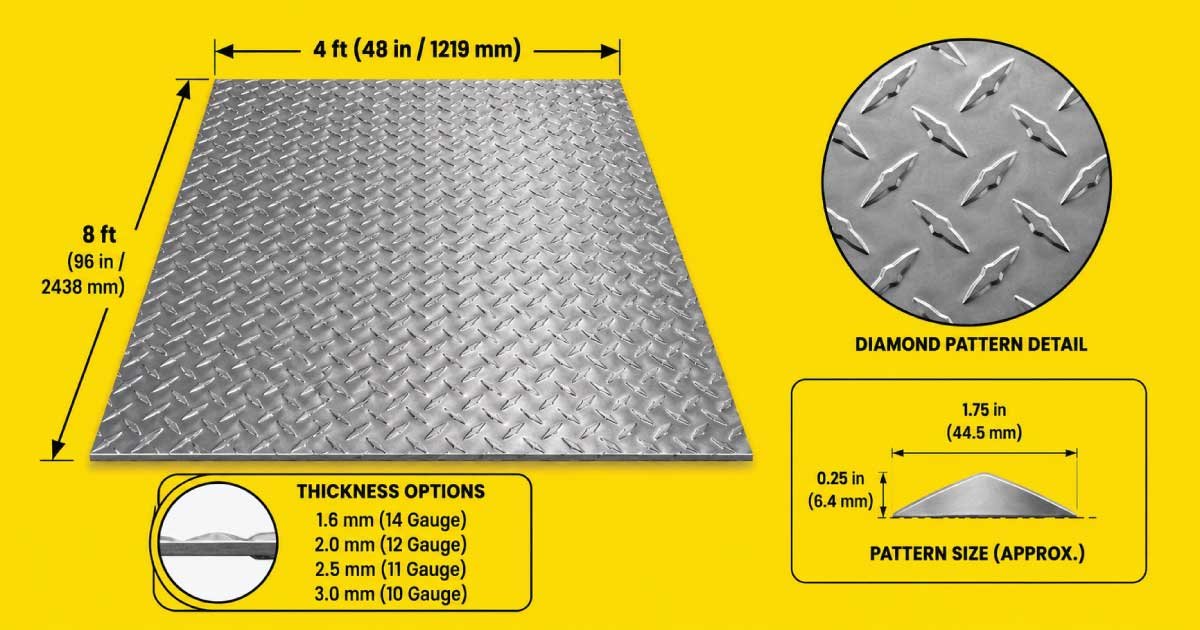
A 4×8 diamond plate is a flat metal sheet that comes in a standard industrial size of 4 feet by 8 feet. It is widely used in construction, automotive, and industrial applications because of its strong structure and anti-slip surface. The sheet features a raised diamond or tread pattern that improves traction and safety in working environments.
The standard dimensions are:
- Width: 4 feet (48 inches / 1219 mm)
- Length: 8 feet (96 inches / 2438 mm)
- Surface: Raised diamond or tread pattern
The raised pattern improves grip, making it ideal for:
- Truck beds
- Stair treads
- Flooring in workshops
- Industrial walkways
- Toolboxes and trailers
It is also called:
- Checker plate
- Tread plate
- Floor plate
Standard 4×8 Diamond Plate Size Chart
Although the footprint size remains constant (4×8 ft), the thickness varies depending on application.
Common thickness chart:
| Thickness (inches) | Thickness (mm) | Weight (approx.) | Common Use |
|---|---|---|---|
| 0.045″ (1.2 mm) | 1.2 mm | ~40–45 kg | Light covers, panels |
| 0.063″ (1.6 mm) | 1.6 mm | ~55–60 kg | Wall protection |
| 1/8″ (0.125″) | 3 mm | ~75–80 kg | Toolboxes, flooring |
| 3/16″ (0.188″) | 4.5–5 mm | ~110–120 kg | Truck beds, ramps |
| 1/4″ (0.25″) | 6 mm | ~150–160 kg | Heavy-duty flooring |
| 3/8″ (0.375″) | 9 mm | ~220–240 kg | Industrial platforms |
👉 The thicker the plate, the higher the load capacity and durability.
Material Types Used in 4×8 Diamond Plates
Diamond plates are manufactured from different types of metals to meet specific strength, durability, and environmental requirements. The choice of material depends on factors such as load capacity, corrosion resistance, appearance, and cost. Each material offers unique advantages for particular industrial, commercial, and residential applications.
1. Aluminum Diamond Plate
Aluminum diamond plate is one of the most popular choices due to its lightweight construction and excellent resistance to corrosion. It is easy to handle, cut, and install, making it suitable for a wide range of applications. Its attractive appearance also makes it a common option for decorative projects and vehicle accessories.
- Lightweight
- Corrosion resistant
- Easy to cut and install
- Most common for truck beds and decorative use
Widely supplied by manufacturers such as Ryerson.
2. Steel Diamond Plate
Steel diamond plate is known for its exceptional strength and durability. It can withstand heavy loads and harsh working conditions, making it a preferred choice for industrial flooring, equipment platforms, and heavy-duty applications. Although heavier than aluminum, it offers superior structural support.
- Extremely strong
- Higher load capacity
- Used in industrial flooring and heavy machinery
Common in construction and fabrication industries.
3. Stainless Steel Diamond Plate
Stainless steel diamond plate combines strength with outstanding corrosion resistance. It performs well in environments exposed to moisture, chemicals, and frequent cleaning. While it is generally more expensive than aluminum or carbon steel, its long service life often makes it a cost-effective investment.
- Corrosion-resistant
- Used in food processing and marine environments
- More expensive but long-lasting
Weight Calculation for 4×8 Diamond Plates
Weight depends on material and thickness.
Approximate weights (steel):
| Thickness | Weight |
|---|---|
| 1/8″ | ~80 kg |
| 3/16″ | ~115 kg |
| 1/4″ | ~160 kg |
| 3/8″ | ~230 kg |
Formula for weight:
Weight = Length × Width × Thickness × Density of material
- Steel density ≈ 7.85 g/cm³
- Aluminum density ≈ 2.7 g/cm³
👉 This is why aluminum plates are much lighter than steel.
Standard 4×8 Diamond Plate Applications
The 4×8 diamond plate is one of the most widely used metal sheet formats in industrial, commercial, and construction environments. Its standardized size makes it easy to transport, cut, and install, while its raised tread pattern provides strong anti-slip properties. This combination of durability and safety makes it suitable for heavy-duty applications where strength, protection, and traction are essential.
1. Truck Bed Flooring
4×8 diamond plates are commonly used as truck bed liners due to their high strength and resistance to wear. They protect the bed surface from scratches, dents, and heavy impact caused by loaded cargo. The textured surface also helps prevent items from sliding during transport, improving load stability and safety while driving on rough or uneven roads.
2. Trailer Decks
These plates are frequently installed on trailer floors to improve durability and load-bearing capacity. They can withstand continuous heavy use, harsh weather conditions, and exposure to moisture or dirt. This makes them ideal for commercial trailers, utility trailers, and hauling applications where long-term strength and reliability are required.
3. Stair Steps and Walkways
Diamond plates are widely used on stairs and walkways in industrial facilities, construction sites, and public areas. The raised pattern provides excellent grip, reducing the risk of slipping, especially in wet, oily, or dusty conditions. This makes them a preferred safety solution in environments where foot traffic safety is a priority.
4. Industrial Platforms
In factories, workshops, and production facilities, 4×8 diamond plates are used to build strong working platforms. These surfaces support heavy machinery and equipment while providing a stable and secure walking area for workers. Their durability ensures long service life even under constant industrial use and heavy mechanical stress.
5. Garage Flooring
Diamond plates are also used in garages to protect concrete floors from oil spills, vehicle weight, and chemical exposure. They enhance floor strength and durability while also improving traction for vehicles and pedestrians. This makes garage environments safer, cleaner, and more resistant to long-term wear and damage.
6. Wall Protection Panels
In warehouses, loading docks, and industrial spaces, diamond plates are installed on walls to protect them from damage caused by forklifts, tools, or heavy equipment. They act as a protective barrier, preventing dents, scratches, and structural damage, which helps maintain facility safety and reduces maintenance costs.
7. Elevator Interiors
4×8 diamond plates are sometimes used in elevator interiors, especially in industrial or commercial buildings. They provide a strong, impact-resistant surface that can handle frequent use and heavy traffic. In addition to durability, they offer a clean, modern appearance while protecting interior surfaces from wear and damage.
Overall, the anti-slip surface and high durability of 4×8 diamond plates make them ideal for safety-critical environments where strength, grip, and long-term performance are essential.
Types of Diamond Plate Patterns
The surface pattern of a diamond plate is not only decorative but also plays a major role in improving safety and functionality. These raised patterns increase traction, reduce slipping risks, and enhance performance in industrial, commercial, and transport applications. Different patterns are selected based on the required grip level, load conditions, and working environment.
1. Single Diamond Pattern
The single diamond pattern features a simple raised diamond-shaped design across the surface. It is the most common pattern used in general-purpose applications where moderate grip and a clean appearance are required. This pattern is widely found in vehicle flooring and light industrial use.
- Basic raised diamond shape
- Common in light-duty applications
2. Five-Bar Pattern
The five-bar pattern consists of parallel raised bars arranged in sets of five. This design provides stronger traction compared to the single diamond pattern, making it suitable for heavy-duty environments. It is commonly used in industrial flooring where safety and grip are critical.
- Parallel bar design
- Better grip for industrial flooring
3. Custom Tread Patterns
Custom tread patterns are specially designed for specific machinery or industrial requirements. These patterns are engineered to provide maximum grip, drainage, and performance depending on the application. They are often used in specialized equipment or high-performance environments.
- Used in specialized machinery
- Designed for maximum grip and drainage
Thickness Selection Guide
Selecting the correct thickness for a 4×8 diamond plate is essential for ensuring safety, strength, and long-term durability. The thickness determines how much load the plate can handle, how resistant it is to bending, and how well it performs in different environments. Choosing the right category helps match the material to its intended application.
1. Light Duty (1.2 mm – 2 mm)
Light-duty diamond plates are thin and easy to cut, shape, and install. They are mainly used for decorative and non-load-bearing applications where strength requirements are minimal. These plates are ideal for interior or light protective uses.
- Wall coverings
- Decorative panels
- Light enclosures
2. Medium Duty (3 mm – 5 mm)
Medium-duty plates offer a balanced combination of strength and workability. They are strong enough for moderate loads and everyday industrial use while still being manageable for fabrication and installation. This makes them the most commonly used thickness range.
- Truck beds
- Garage flooring
- Toolboxes
3. Heavy Duty (6 mm – 9 mm+)
Heavy-duty diamond plates are designed for extreme strength and high-load environments. They are thick, highly durable, and capable of withstanding heavy machinery, constant traffic, and harsh working conditions without deformation.
- Industrial walkways
- Heavy machinery platforms
- Construction sites
Advantages of 4×8 Diamond Plates
4×8 diamond plates are widely used in industrial, commercial, and automotive applications due to their strength, durability, and safety features. Their standardized size makes them easy to work with, while the raised tread pattern improves grip and performance in demanding environments. These advantages make them a reliable choice for flooring, protection, and structural applications.
1. Anti-Slip Surface
The raised diamond pattern provides excellent traction, reducing the risk of slipping in wet, oily, or dusty conditions. This makes 4×8 diamond plates ideal for high-traffic areas such as stairs, walkways, and industrial platforms. The improved grip enhances safety for workers and equipment in environments where stability is critical.
2. High Strength
Steel diamond plates are designed to handle heavy loads without bending or deforming. Their strong structure allows them to support vehicles, machinery, and heavy equipment with ease. This makes them suitable for demanding applications like truck beds, trailer floors, and industrial flooring where strength and load-bearing capacity are essential.
3. Durability
4×8 diamond plates are highly resistant to impact, wear, and environmental damage. They can withstand harsh working conditions, including exposure to moisture, chemicals, and temperature changes. This long-lasting durability reduces the need for frequent replacements, making them a cost-effective solution for both industrial and commercial use.
4. Easy Installation
The standardized 4×8 size makes diamond plates easy to transport, cut, and install in different settings. This simplifies fabrication and reduces installation time and labor costs. Their uniform dimensions also allow for better planning and efficient coverage of large surface areas with minimal waste.
5. Versatility
4×8 diamond plates are used in a wide range of applications, including automotive flooring, industrial platforms, garage floors, wall protection, and architectural designs. Their combination of strength, safety, and aesthetic appeal makes them suitable for both functional and decorative purposes across various industries.
Read Our Complete Guide:
How to Cut a 4×8 Diamond Plate
Cutting a 4×8 diamond plate requires the right tools and technique because the material is strong and has a raised surface pattern. The cutting method depends mainly on whether the plate is aluminum or steel. Using proper equipment ensures clean edges, accurate sizing, and safe handling during fabrication work.
1. Cutting Aluminum Diamond Plate
Aluminum diamond plate is easier to cut compared to steel because it is softer and lighter. It can be shaped using common power tools, making it suitable for DIY and light fabrication projects. However, proper blade selection is important to avoid jagged edges and material distortion.
- Circular saw with carbide blade
- Jigsaw for small cuts
2. Cutting Steel Diamond Plate
Steel diamond plate is much stronger and requires heavy-duty cutting tools. It is commonly processed in workshops or industrial settings where precision and power tools are available. Cutting steel generates heat and sparks, so controlled equipment and steady handling are essential for safe and accurate results.
- Plasma cutter
- Angle grinder
- Industrial shear machine
Safety Precautions
Always wear proper protective gear such as gloves, safety goggles, and face protection when cutting diamond plates. The edges can become extremely sharp after cutting, and metal fragments or sparks may cause injury. Secure the sheet properly before cutting to avoid movement and ensure clean, controlled cuts.
Read Our Complete Guide:
How to Choose the Right 4×8 Diamond Plate
Selecting the right 4×8 diamond plate depends on the intended application, load conditions, environment, and budget. Choosing the correct material and thickness ensures safety, durability, and long-term performance. A well-matched diamond plate not only improves functionality but also reduces maintenance costs and extends service life in industrial, automotive, or architectural use.
1. Load Requirement
The first factor to consider is the load the plate will carry. Heavy-duty applications such as truck beds, industrial flooring, or machinery platforms require thicker steel diamond plates to prevent bending or deformation. For lighter use, thinner plates may be sufficient. Matching thickness with load ensures structural strength and long-term reliability.
2. Environment
Environmental conditions play a key role in material selection. In wet, humid, or corrosive environments, stainless steel or aluminum diamond plates are preferred due to their resistance to rust and corrosion. For dry indoor environments, mild steel or aluminum can be used effectively. Choosing the right material helps maintain durability and prevents premature surface damage.
3. Weight Limit
If portability is important, aluminum diamond plates are the best choice due to their lightweight nature. They are easier to handle, transport, and install compared to steel plates. This makes them suitable for applications where frequent movement or installation adjustments are required, such as temporary flooring or mobile equipment setups.
4. Budget
Budget is another important factor when selecting a diamond plate. Steel plates are generally more affordable and widely used in industrial applications. Stainless steel, while more durable and corrosion-resistant, is the most expensive option. Aluminum falls in between, offering a balance of cost, weight, and corrosion resistance depending on the application needs.
5. Application Type
The intended use of the diamond plate determines the ideal thickness and material. Decorative applications typically use thin aluminum plates for aesthetics and light-duty protection. In contrast, industrial applications require thick steel plates for maximum strength, durability, and load-bearing capacity. Selecting based on application ensures both performance and cost-efficiency.
Read Our Complete Guide:
Common Problems with Incorrect Plate Selection
Incorrect selection of diamond plate size, thickness, or material can lead to serious performance and safety issues in real-world applications. When the plate is not suited for the load or environment, it may fail prematurely, reduce efficiency, and create maintenance and safety risks in industrial, automotive, or construction settings.
- Slipping hazards
- Structural bending
- Corrosion damage
- Early wear and tear
- Installation failure
Proper selection ensures safety and performance.
Standard Industry Sizes vs Custom Sizes
Diamond plates are commonly available in standard sizes, with 4×8 ft being the most widely used due to easy transport and installation. However, manufacturers also produce larger or custom-cut sheets for specialized projects. These custom options help reduce waste, improve fit, and meet specific engineering or architectural requirements.
- 5×10 ft plates
- 4×10 ft plates
- Custom cut-to-size sheets
Custom plates are used in large industrial or architectural projects.
Read Our Complete Guide:
Safety Tips When Handling Diamond Plates
Handling diamond plates requires careful attention because of their weight and sharp edges. Steel plates in particular can be heavy and difficult to control during movement or installation. Following proper safety practices reduces the risk of injury and ensures safe transportation, cutting, and installation in workshops or construction environments.
- Always wear gloves (sharp edges)
- Use proper lifting equipment for steel plates
- Secure plates during transport
- Avoid dragging on finished surfaces
Future Trends in Diamond Plates
The diamond plate industry is evolving with new manufacturing technologies and material improvements. Modern advancements focus on reducing weight, increasing corrosion resistance, and improving sustainability. These innovations are making diamond plates more efficient for transportation, aerospace, and industrial applications while maintaining strength and durability.
- Lighter aluminum alloys
- Anti-corrosion coatings
- Laser-cut precision patterns
- Eco-friendly steel production
Companies like Alcoa are developing advanced lightweight aluminum solutions for transportation and aerospace industries.
Conclusion
A 4×8 diamond plate size chart is an important reference for selecting the right sheet in industrial, automotive, and construction applications. Although the standard size remains 4×8 feet, the real variation comes from thickness, material type, and surface pattern, which directly affect performance, strength, and suitability for different environments.
Choosing the correct diamond plate ensures:
- Better safety
- Higher durability
- Cost efficiency
- Long-term performance
Whether you are building a truck bed, industrial walkway, garage flooring, or workshop surface, understanding the size chart helps you make a more accurate, reliable, and safe selection for your project.
Read Our Complete Guide:
FAQs:
1. What is a 4×8 diamond plate used for?
A 4×8 diamond plate is mainly used for flooring, truck beds, trailers, stair treads, and industrial walkways. Its raised pattern provides strong anti-slip protection, making it ideal for safety-critical environments. It is also used in garages, toolboxes, and wall protection panels due to its strength, durability, and resistance to wear and impact.
2. What materials are used in diamond plates?
Diamond plates are commonly made from aluminum, steel, and stainless steel. Aluminum is lightweight and corrosion-resistant, steel offers high strength for heavy-duty use, and stainless steel provides excellent rust protection for harsh environments. Each material is selected based on load requirements, environment, and cost, making diamond plates suitable for many industrial and commercial applications.
3. How thick should a diamond plate be?
Thickness depends on application. Light-duty uses require 1.2–2 mm sheets, medium-duty applications use 3–5 mm, and heavy-duty industrial work requires 6–9 mm or more. Thicker plates handle higher loads and provide better durability. Choosing the correct thickness ensures safety, prevents bending, and extends the lifespan of flooring, platforms, or structural installations.
4. Is aluminum diamond plate strong enough for trucks?
Yes, aluminum diamond plate is strong enough for light to medium truck bed applications. It is widely used because it is lightweight, corrosion-resistant, and easy to install. However, for extremely heavy loads or industrial transport, steel diamond plate is preferred due to its higher strength and better resistance to deformation under pressure.
5. How do you cut a diamond plate safely?
Diamond plates can be cut using a circular saw, jigsaw, angle grinder, or plasma cutter depending on the material. Aluminum is easier to cut, while steel requires heavy-duty tools. Always wear gloves, goggles, and protective gear. Secure the sheet properly before cutting to avoid movement, and ensure clean, accurate, and safe cutting results.
6. What is the difference between steel and aluminum diamond plates?
Steel diamond plates are stronger and better for heavy-duty industrial use, while aluminum plates are lighter and resistant to corrosion. Steel is ideal for high-load flooring and machinery, whereas aluminum is preferred for trucks, trailers, and decorative use. The choice depends on weight requirements, environment, durability needs, and budget considerations for the project.
7. Why is diamond plate called checker plate?
Diamond plate is also called checker plate because of its raised geometric pattern that resembles a checkerboard or diamond shape. This pattern is designed to improve grip and reduce slipping. The terms “tread plate” and “floor plate” are also used in different regions, but all refer to the same anti-slip metal sheet design.