
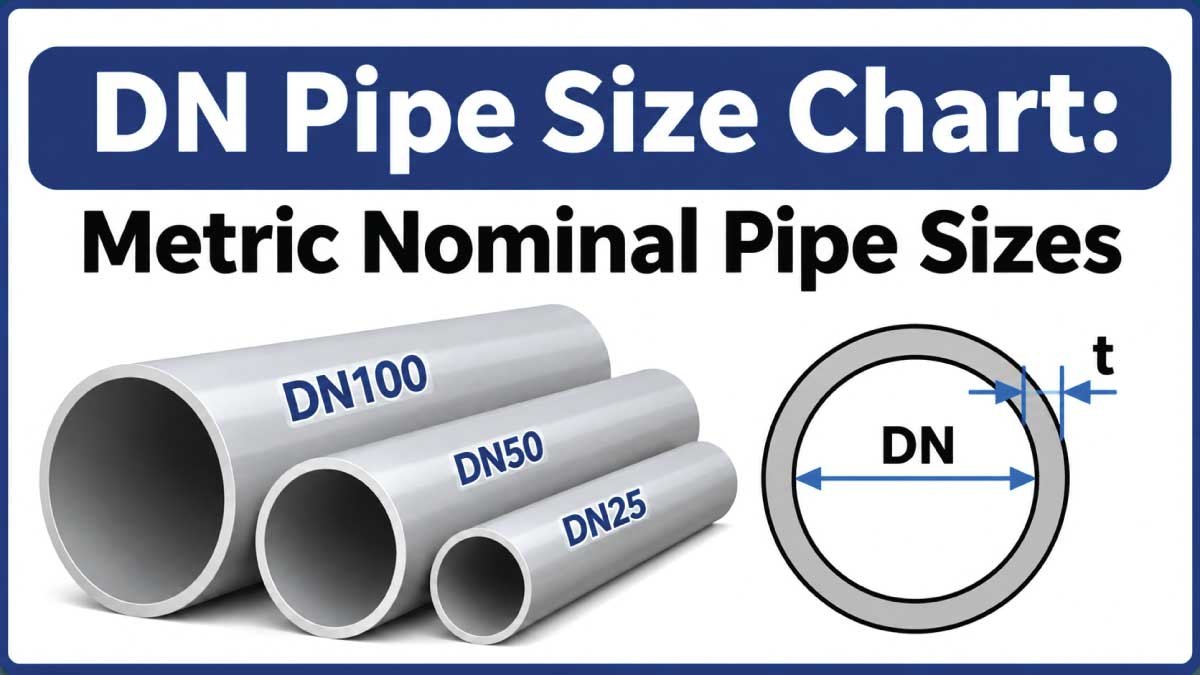
If you need to identify a pipe by DN size, convert between metric and NPS designations, or understand what a designation such as DN50 or DN100 actually means, a DN pipe size chart provides a useful starting point. DN stands for nominal diameter and is widely used with international piping systems, valves, fittings, and flanges.
One important point is that DN is not necessarily the actual inside or outside diameter in millimeters. ISO 6708 defines DN as a dimensionless designation that is indirectly related to the physical size of the pipe or component.
This guide explains common metric nominal pipe sizes, their approximate NPS equivalents, outside diameters, how DN relates to actual pipe dimensions, and how to select the correct size for a piping application.
What Is DN Pipe Size?
DN, or nominal diameter, is a standardized size designation used to identify components in a piping system. It normally appears as the letters DN followed by a number, such as DN25, DN50, DN100, or DN300.
Although the number is commonly associated with millimeters, the DN value itself is dimensionless. For example, DN50 does not simply mean that the pipe has an exact 50 mm inside diameter or outside diameter.
ISO 6708 specifies DN as a reference designation for pipework components and provides preferred DN values. The number is indirectly related to the physical dimensions of the component.
This distinction matters because two pipes with the same DN can have different wall thicknesses and therefore different inside diameters.
For example:
- DN50 identifies the nominal pipe size.
- The actual outside diameter depends on the applicable pipe dimensional standard.
- The inside diameter depends on the outside diameter and wall thickness.
- Wall thickness can vary according to the pipe schedule, pressure class, material, and applicable standard.
Therefore, a DN pipe size chart should be used for identification and compatibility, while detailed engineering calculations should use the exact dimensional standard and manufacturer data.
DN Pipe Size Chart
The following chart provides commonly used DN sizes alongside their approximate NPS equivalents and standard outside diameters for common steel pipe dimensions.
| DN Size | Approx. NPS | Outside Diameter (mm) | Outside Diameter (in) |
|---|---|---|---|
| DN10 | 3/8 | 17.1 | 0.675 |
| DN15 | 1/2 | 21.3 | 0.840 |
| DN20 | 3/4 | 26.7 | 1.050 |
| DN25 | 1 | 33.4 | 1.315 |
| DN32 | 1 1/4 | 42.2 | 1.660 |
| DN40 | 1 1/2 | 48.3 | 1.900 |
| DN50 | 2 | 60.3 | 2.375 |
| DN65 | 2 1/2 | 73.0 | 2.875 |
| DN80 | 3 | 88.9 | 3.500 |
| DN100 | 4 | 114.3 | 4.500 |
| DN125 | 5 | 141.3 | 5.563 |
| DN150 | 6 | 168.3 | 6.625 |
| DN200 | 8 | 219.1 | 8.625 |
| DN250 | 10 | 273.0 | 10.750 |
| DN300 | 12 | 323.9 | 12.750 |
| DN350 | 14 | 355.6 | 14.000 |
| DN400 | 16 | 406.4 | 16.000 |
| DN450 | 18 | 457.2 | 18.000 |
| DN500 | 20 | 508.0 | 20.000 |
| DN550 | 22 | 558.8 | 22.000 |
| DN600 | 24 | 609.6 | 24.000 |
| DN650 | 26 | 660.4 | 26.000 |
| DN700 | 28 | 711.2 | 28.000 |
| DN750 | 30 | 762.0 | 30.000 |
| DN800 | 32 | 812.8 | 32.000 |
| DN900 | 36 | 914.4 | 36.000 |
| DN1000 | 40 | 1016.0 | 40.000 |
These outside diameters are representative of commonly used steel-pipe dimensions and are particularly useful when comparing DN designations with NPS. They should not be treated as universal dimensions for every pipe material or piping standard.
ASME’s pipe standards, for example, distinguish pipe dimensions from tube dimensions and specify standardized dimensions for welded and seamless wrought steel pipe.
How to Read a DN Pipe Size Chart
Reading a DN chart is straightforward once the difference between nominal size and actual dimensions is understood.
Suppose a piping drawing specifies DN100.
The DN designation tells you that the component belongs to the nominal 100-size category. For commonly used steel pipe dimensions, DN100 corresponds approximately to NPS 4 and has an outside diameter of about 114.3 mm.
It does not mean:
- The outside diameter is exactly 100 mm.
- The inside diameter is exactly 100 mm.
- Every DN100 pipe has the same wall thickness.
- Every DN100 pipe has the same flow area.
Instead, DN acts as a common size identifier.
To determine the actual internal diameter, you need the pipe’s outside diameter and wall thickness.
A simplified relationship is:
Inside Diameter = Outside Diameter − 2 × Wall Thickness
For example, if a pipe has an outside diameter of 114.3 mm and a wall thickness of 6.0 mm:
Inside Diameter = 114.3 − (2 × 6.0) = 102.3 mm
The example demonstrates why DN and actual bore should not be treated as interchangeable measurements.
DN vs NPS: What Is the Difference?
One of the most common questions about metric pipe sizing is how DN compares with NPS.
DN is the nominal sizing designation commonly associated with international metric-based piping systems. NPS, or Nominal Pipe Size, is the designation commonly used in North American piping standards.
Both systems identify nominal pipe sizes, but their numbering systems are different.
For example:
| Metric Nominal Size | NPS Size | Common Outside Diameter |
|---|---|---|
| DN15 | 1/2 | 21.3 mm |
| DN20 | 3/4 | 26.7 mm |
| DN25 | 1 | 33.4 mm |
| DN32 | 1 1/4 | 42.2 mm |
| DN40 | 1 1/2 | 48.3 mm |
| DN50 | 2 | 60.3 mm |
| DN80 | 3 | 88.9 mm |
| DN100 | 4 | 114.3 mm |
| DN150 | 6 | 168.3 mm |
| DN200 | 8 | 219.1 mm |
| DN250 | 10 | 273.0 mm |
| DN300 | 12 | 323.9 mm |
| DN400 | 16 | 406.4 mm |
| DN500 | 20 | 508.0 mm |
| DN600 | 24 | 609.6 mm |
The important takeaway is that DN and NPS are not simply two ways of writing the same measured diameter.
ISO terminology similarly describes NPS as an alphanumeric designation whose number is indirectly related to the physical size of the component.
Common DN Pipe Sizes and Their Applications
Different nominal pipe sizes are used for different piping requirements. The appropriate size depends on flow rate, pressure, fluid characteristics, velocity, allowable pressure loss, connection requirements, and the applicable design standard.
DN15 to DN50
Small nominal sizes such as DN15, DN20, DN25, DN32, DN40, and DN50 are frequently encountered in smaller piping systems.
Typical applications can include:
- Instrument connections
- Small water lines
- Utility piping
- Building services
- Equipment connections
- Small process lines
- Drain and auxiliary systems
DN50 is especially common as a nominal 2-inch pipe size in industrial and building-service applications.
DN65 to DN150
Medium-sized piping includes DN65, DN80, DN100, DN125, and DN150.
These sizes can be found in:
- Water distribution
- Heating and cooling systems
- Fire protection systems
- Industrial process piping
- Pump connections
- Mechanical services
- Compressed-air systems
DN100 corresponds approximately to NPS 4, while DN150 corresponds approximately to NPS 6.
DN200 to DN600
Larger pipe sizes such as DN200, DN250, DN300, DN400, DN500, and DN600 are common in larger industrial, municipal, utility, and infrastructure systems.
Applications may include:
- Large water mains
- Industrial process piping
- Cooling-water systems
- Municipal distribution
- Large pump and equipment connections
- Utility pipelines
- Treatment facilities
At these sizes, selecting the correct wall thickness and material becomes particularly important because pipe weight, pressure capacity, support requirements, and installation methods can have a significant effect on system design.
Why DN Does Not Equal Actual Pipe Diameter
The biggest mistake people make when using a DN chart is assuming the DN number represents an exact physical diameter.
For example, DN50 is not a 50 mm outside-diameter pipe. A commonly used steel pipe corresponding to DN50 has an outside diameter of approximately 60.3 mm.
Likewise, DN100 commonly corresponds to an outside diameter of approximately 114.3 mm.
This occurs because nominal sizing systems developed as standardized reference systems rather than simple measured-diameter systems.
The DN number is therefore useful for identifying compatible components, but it should not automatically be used as the dimension for fabrication or machining.
When an exact dimension is required, check:
- Outside diameter
- Inside diameter
- Wall thickness
- Pipe schedule
- Material
- Applicable dimensional standard
- End connection type
- Flange dimensions
- Pressure rating
This is particularly important when replacing an existing pipe or fitting.
DN Pipe Size and Wall Thickness
DN identifies the nominal size, but wall thickness determines how much material exists between the inside and outside surfaces of the pipe.
For steel pipe, wall thickness can be specified through systems such as pipe schedules or other dimensional designations, depending on the governing standard.
For a given DN, different wall thicknesses can result in different internal diameters.
For example, a DN100 pipe may retain the same nominal size and outside diameter while having different wall thicknesses.
That means the following characteristics can change:
- Internal diameter
- Flow area
- Internal volume
- Weight per unit length
- Pressure capability
- Hydraulic resistance
- Material quantity
ASME B36.10M is one example of a standard covering dimensions of welded and seamless wrought steel pipe.
Therefore, a DN pipe size chart should not be confused with a complete pipe wall thickness chart.
How to Choose the Correct DN Pipe Size
Choosing a pipe size involves more than matching a nominal diameter to a connection.
1. Determine the Required Flow
Start with the required flow rate. A pipe that is too small can produce excessive velocity and pressure loss, while an unnecessarily large pipe can increase material and installation costs.
The required diameter should be determined using the appropriate hydraulic or process-design method.
2. Check the Fluid
The fluid being transported affects pipe selection.
Consider whether the system carries:
- Water
- Steam
- Air
- Gas
- Oil
- Chemicals
- Slurries
- Other process fluids
Temperature, viscosity, density, corrosiveness, and solids content can all affect the selection.
3. Check Pressure and Temperature
Pipe material and wall thickness must be suitable for the operating conditions.
A nominal size alone does not establish pressure capability. Working pressure depends on material, design, temperature, wall thickness, and the applicable design standard.
4. Confirm Connection Compatibility
Check whether the pipe needs to connect to:
- Flanges
- Valves
- Pumps
- Fittings
- Threaded components
- Welded components
- Equipment nozzles
The DN designation helps identify compatible nominal sizes, but the exact connection dimensions still need to be verified.
5. Check the Applicable Standard
Always identify the dimensional standard before ordering or fabricating pipe.
Different standards can cover different materials, dimensions, tolerances, and applications. A pipe described only as “DN100” may not provide enough information for procurement.
Also Read:
DN Pipe Size vs Outside Diameter
Outside diameter is especially important when physical clearance matters.
For commonly used steel pipe sizes, the relationship can look surprising:
| DN | NPS | Approx. OD (mm) |
|---|---|---|
| DN25 | 1 | 33.4 |
| DN50 | 2 | 60.3 |
| DN80 | 3 | 88.9 |
| DN100 | 4 | 114.3 |
| DN150 | 6 | 168.3 |
| DN200 | 8 | 219.1 |
| DN250 | 10 | 273.0 |
| DN300 | 12 | 323.9 |
| DN400 | 16 | 406.4 |
| DN500 | 20 | 508.0 |
| DN600 | 24 | 609.6 |
This is why installers should not use the DN number as the physical dimension when checking whether a pipe will fit through an opening or into a support.
For clearance calculations, use the actual outside diameter specified by the relevant standard.
DN Pipe Size for Valves and Fittings
DN designations are also widely used for piping components such as valves and fittings.
A valve might be identified as DN100, for example, indicating its nominal connection size. However, the valve’s actual dimensions, bore, face-to-face length, flange details, pressure class, and end connection must still be checked against the applicable standard.
ISO documentation describes DN as a size designation used for pipework components and notes that the designation is indirectly related to the physical size of the bore or outside diameter of end connections.
This makes DN particularly useful when matching components within a piping system.
However, DN alone is not enough information to specify an entire valve or fitting.
A complete specification may also require:
- DN size
- Pressure rating
- Material
- Connection type
- Facing
- Valve type
- Temperature rating
- Applicable standard
- Manufacturer requirements
Also Read:
DN and PN Are Not the Same Thing
Another common misunderstanding is confusing DN with PN.
DN identifies the nominal size of a pipework component.
PN is associated with nominal pressure designation.
They answer different questions:
- DN: What nominal size is the component?
- PN: What nominal pressure designation applies?
For example, a component might be designated using both a DN size and a PN pressure designation.
The presence of a DN number does not mean the component can safely operate at a particular pressure.
ISO terminology treats nominal pressure as a separate designation related to pressure reference and mating compatibility. Actual permissible working pressure depends on factors such as material, design, and operating temperature.
Also Read:
Common Mistakes When Using a DN Pipe Chart
A DN chart is useful, but several mistakes can lead to incorrect pipe selection.
Mistake 1: Treating DN as the Actual Diameter
DN50 does not automatically mean a 50 mm inside or outside diameter.
Always check the actual dimensional standard.
Mistake 2: Ignoring Wall Thickness
Two pipes with the same nominal size can have different wall thicknesses and therefore different internal diameters.
Mistake 3: Assuming DN Automatically Determines Pressure Rating
Pipe size and pressure capability are separate considerations.
Mistake 4: Mixing Standards
Do not combine dimensions from different standards without checking compatibility.
Mistake 5: Using Nominal Size for Clearance
When determining whether a pipe will physically fit, use its actual outside diameter rather than the DN number.
Mistake 6: Assuming All Materials Use Identical Dimensions
Steel, stainless steel, plastic, copper, and other piping systems can use different dimensional systems.
For example, thermoplastic piping standards may define nominal outside diameter differently from steel-pipe systems. ISO documentation distinguishes nominal outside diameter as a specified dimension assigned to a nominal size for thermoplastic piping.
How to Measure an Existing Pipe and Identify Its DN Size
If the pipe marking is unavailable, you can use measurements as an identification aid, but measurement alone may not always establish the exact DN.
Step 1: Measure the Outside Diameter
Use a caliper for smaller pipes or a suitable tape and calculation method for larger pipes.
Record the outside diameter in millimeters.
Step 2: Compare the Measurement
Compare the measured outside diameter with the relevant pipe dimension table.
For example, an outside diameter near 60.3 mm is commonly associated with NPS 2 and approximately DN50 in standard steel pipe dimensions.
Step 3: Determine Wall Thickness
If possible, measure the wall thickness.
This allows the approximate internal diameter to be determined:
ID = OD − 2t
where:
- ID = inside diameter
- OD = outside diameter
- t = wall thickness
Step 4: Check Pipe Markings
Look for markings showing:
- DN
- NPS
- Schedule
- Material grade
- Standard
- Manufacturer
- Pressure designation
Step 5: Verify Before Ordering
For replacement work, confirm the size against the existing fitting, valve, flange, or equipment connection.
Do not rely solely on an outside-diameter measurement when an exact replacement is required.
Metric Nominal Pipe Size Conversion Guide
For quick reference, these are some of the most frequently encountered DN-to-NPS relationships:
| DN | NPS | Common Name |
|---|---|---|
| DN15 | 1/2 | 1/2-inch pipe |
| DN20 | 3/4 | 3/4-inch pipe |
| DN25 | 1 | 1-inch pipe |
| DN32 | 1 1/4 | 1 1/4-inch pipe |
| DN40 | 1 1/2 | 1 1/2-inch pipe |
| DN50 | 2 | 2-inch pipe |
| DN65 | 2 1/2 | 2 1/2-inch pipe |
| DN80 | 3 | 3-inch pipe |
| DN100 | 4 | 4-inch pipe |
| DN125 | 5 | 5-inch pipe |
| DN150 | 6 | 6-inch pipe |
| DN200 | 8 | 8-inch pipe |
| DN250 | 10 | 10-inch pipe |
| DN300 | 12 | 12-inch pipe |
| DN350 | 14 | 14-inch pipe |
| DN400 | 16 | 16-inch pipe |
| DN450 | 18 | 18-inch pipe |
| DN500 | 20 | 20-inch pipe |
| DN600 | 24 | 24-inch pipe |
The conversion should be treated as a nominal correspondence, not a mathematical conversion from millimeters to inches.
For example, DN100 is associated with NPS 4, but 100 mm is only 3.94 inches. The actual standard outside diameter of common NPS 4 steel pipe is approximately 114.3 mm.
Frequently Asked Questions About DN Pipe Sizes
What does DN mean in pipe size?
DN means nominal diameter. It is a standardized reference designation used to identify the nominal size of components in a piping system. The DN number is dimensionless and is not necessarily the actual pipe diameter.
Is DN the same as pipe diameter?
No. DN is a nominal designation. The actual outside and inside diameters depend on the applicable pipe standard, material, wall thickness, and other specifications.
What is DN50 in inches?
DN50 corresponds approximately to NPS 2, commonly called a 2-inch nominal pipe.
What is DN100 in inches?
DN100 corresponds approximately to NPS 4, commonly called a 4-inch nominal pipe.
What is DN200 in inches?
DN200 corresponds approximately to NPS 8.
Does DN determine wall thickness?
No. DN identifies nominal pipe size. Wall thickness must be determined separately using the applicable dimensional standard, schedule, material specification, or manufacturer information.
Does DN determine pressure rating?
No. DN and pressure designation are separate. Pressure capability depends on the complete component specification, including material, wall thickness, design, temperature, and applicable standard.
Is DN used only for pipes?
No. DN is also used for many piping components, including valves, fittings, and other components where nominal size identification is required.
Can I use DN to calculate flow?
Not by itself. Hydraulic calculations generally require the actual internal diameter, not simply the nominal DN designation.
Final Takeaway
A DN pipe size chart is an efficient way to identify metric nominal pipe sizes and compare them with NPS designations. Common sizes such as DN25, DN50, DN100, DN150, DN200, and DN300 provide standardized reference points across many piping systems.
The most important concept is that DN is a nominal designation, not an exact measured diameter. ISO 6708 specifically defines DN as a dimensionless reference designation that is indirectly related to the physical dimensions of pipework components.
When selecting or replacing pipe, use DN as the starting point, then verify the actual outside diameter, wall thickness, inside diameter, material, pressure rating, connection dimensions, and applicable standard.
For basic identification, the DN-to-NPS chart is usually sufficient. For fabrication, engineering calculations, procurement, or pressure applications, always consult the relevant pipe and component standard or manufacturer documentation. This approach helps prevent costly sizing errors and ensures that pipes, valves, fittings, and other components are properly matched.