
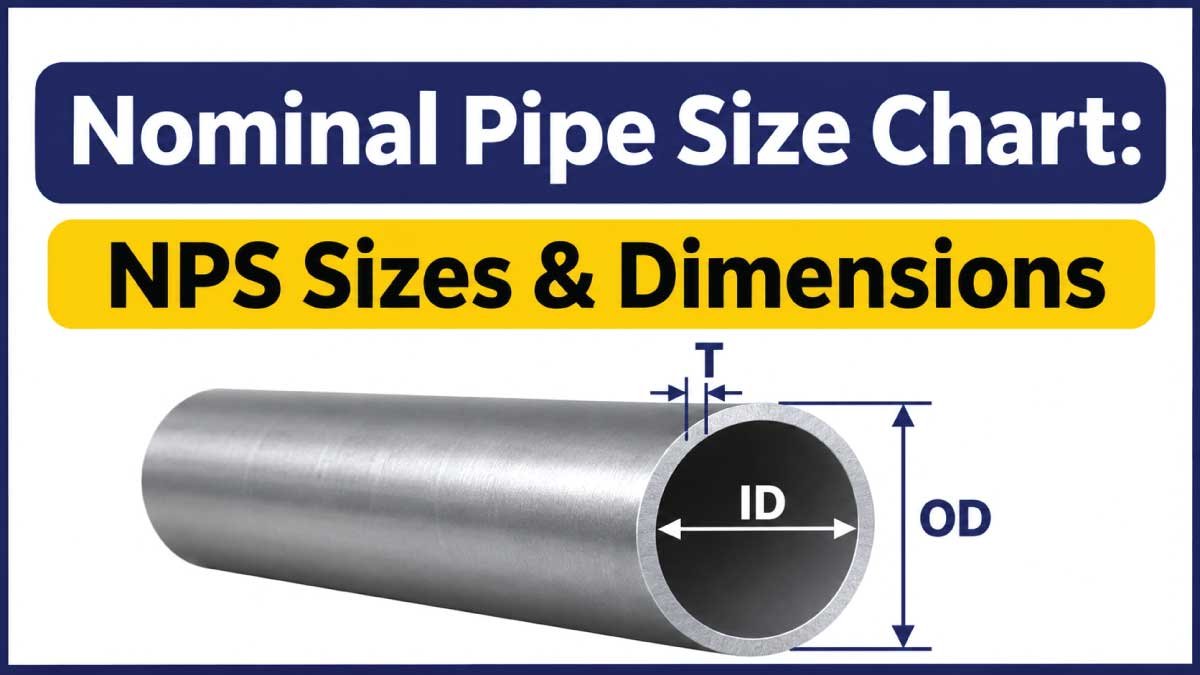
The Nominal Pipe Size Chart is an essential reference for engineers, fabricators, contractors, maintenance professionals, and anyone working with industrial piping. NPS identifies pipe size using a standardized designation, but the nominal number does not always equal the pipe’s actual outside diameter or inside diameter.
Understanding NPS is especially important when selecting pipe, fittings, flanges, valves, or replacement components. A pipe marked NPS 2, for example, does not have an actual 2-inch outside diameter. Its standardized outside diameter is 2.375 inches, while its inside diameter changes depending on wall thickness or pipe schedule.
This guide explains NPS sizes, outside diameters, DN equivalents, pipe schedules, wall thickness, measurement methods, and common sizing mistakes. The charts provide a practical reference for identifying and comparing standard pipe dimensions.
What Is Nominal Pipe Size (NPS)?
Nominal Pipe Size (NPS) is a North American standard designation used to identify pipe size. It is expressed in inches and is widely used with standards such as ASME and ASTM piping specifications.
The word nominal means the designation is primarily a standardized size name rather than a direct measurement of the pipe’s actual diameter.
For many smaller pipe sizes, the NPS number differs noticeably from the actual outside diameter. For larger pipe sizes, particularly NPS 14 and above, the nominal size corresponds more closely to the actual outside diameter expressed in inches.
For example:
- NPS 1/2 has an outside diameter of 0.840 inches.
- NPS 1 has an outside diameter of 1.315 inches.
- NPS 2 has an outside diameter of 2.375 inches.
- NPS 4 has an outside diameter of 4.500 inches.
- NPS 6 has an outside diameter of 6.625 inches.
- NPS 12 has an outside diameter of 12.750 inches.
- NPS 14 has an outside diameter of 14.000 inches.
This distinction is one of the most important things to understand when using a nominal pipe size chart.
NPS Size Chart: Standard Pipe Outside Diameters
The following chart provides commonly used NPS designations and their standardized outside diameters. Outside diameter is particularly important because fittings, flanges, clamps, and other components are generally designed around the standardized pipe OD.
| NPS Size | Outside Diameter (in) | Outside Diameter (mm) | Approx. DN |
|---|---|---|---|
| 1/8 | 0.405 | 10.3 | DN 6 |
| 1/4 | 0.540 | 13.7 | DN 8 |
| 3/8 | 0.675 | 17.1 | DN 10 |
| 1/2 | 0.840 | 21.3 | DN 15 |
| 3/4 | 1.050 | 26.7 | DN 20 |
| 1 | 1.315 | 33.4 | DN 25 |
| 1 1/4 | 1.660 | 42.2 | DN 32 |
| 1 1/2 | 1.900 | 48.3 | DN 40 |
| 2 | 2.375 | 60.3 | DN 50 |
| 2 1/2 | 2.875 | 73.0 | DN 65 |
| 3 | 3.500 | 88.9 | DN 80 |
| 3 1/2 | 4.000 | 101.6 | DN 90 |
| 4 | 4.500 | 114.3 | DN 100 |
| 5 | 5.563 | 141.3 | DN 125 |
| 6 | 6.625 | 168.3 | DN 150 |
| 8 | 8.625 | 219.1 | DN 200 |
| 10 | 10.750 | 273.1 | DN 250 |
| 12 | 12.750 | 323.9 | DN 300 |
| 14 | 14.000 | 355.6 | DN 350 |
| 16 | 16.000 | 406.4 | DN 400 |
| 18 | 18.000 | 457.2 | DN 450 |
| 20 | 20.000 | 508.0 | DN 500 |
| 24 | 24.000 | 609.6 | DN 600 |
Note: DN values are approximate metric designations used for cross-reference. They should not be treated as exact mathematical conversions of NPS.
NPS vs Actual Pipe Diameter
One of the most common mistakes when working with pipe is assuming that the NPS number equals the measured outside diameter.
It does not.
For example, a pipe labeled NPS 2 has a standardized outside diameter of 2.375 inches, not 2.000 inches. Likewise, an NPS 1 pipe has an outside diameter of 1.315 inches.
This system exists because pipe dimensions evolved around standardized manufacturing and fitting requirements. The nominal designation provides a convenient way to identify compatible components without requiring the nominal number to represent a direct physical measurement.
For larger sizes, the relationship becomes simpler. An NPS 16 pipe has a standardized outside diameter of 16 inches, while an NPS 20 pipe has an outside diameter of 20 inches.
Therefore, when identifying an unknown pipe, do not determine NPS from the nominal label alone or assume OD equals NPS.
NPS Pipe Dimensions: OD, ID, and Wall Thickness
A complete understanding of pipe dimensions requires looking at three primary measurements:
- Outside diameter (OD)
- Inside diameter (ID)
- Wall thickness
The outside diameter is determined by the nominal pipe size and dimensional standard. The wall thickness depends on the selected pipe schedule, material specification, and applicable standard.
The basic relationship is:
Inside Diameter = Outside Diameter − 2 × Wall Thickness
For example, if a pipe has an outside diameter of 2.375 inches and a wall thickness of 0.154 inches, its approximate inside diameter is:
2.375 − (2 × 0.154) = 2.067 inches
This illustrates why two pipes with the same NPS can have different inside diameters.
Why Inside Diameter Changes
The NPS designation alone does not provide enough information to calculate the actual bore.
A piping specification may identify a pipe as:
NPS 2, Schedule 40
or
NPS 2, Schedule 80
Both are NPS 2 pipes with the same standardized outside diameter, but the heavier-wall pipe has a smaller inside diameter.
This distinction matters for:
- Flow capacity
- Pressure resistance
- Weight
- Welding
- Threading
- Hydraulic calculations
- Equipment connections
Understanding Pipe Schedule
Pipe schedule, often abbreviated as SCH, identifies a standardized wall-thickness series.
Common schedule designations include:
- Schedule 5
- Schedule 10
- Schedule 20
- Schedule 30
- Schedule 40
- Schedule 60
- Schedule 80
- Schedule 100
- Schedule 120
- Schedule 140
- Schedule 160
Not every schedule is available for every NPS size or material.
A higher schedule generally indicates a thicker wall for a given nominal pipe size, although the exact relationship must be checked against the applicable dimensional standard.
NPS 2 Example
Consider NPS 2 pipe.
The standardized outside diameter remains 2.375 inches across different schedules. What changes is the wall thickness and therefore the inside diameter.
| NPS | OD (in) | Schedule | Wall Thickness (in) | Approx. ID (in) |
|---|---|---|---|---|
| 2 | 2.375 | 10 | 0.065 | 2.245 |
| 2 | 2.375 | 40 | 0.154 | 2.067 |
| 2 | 2.375 | 80 | 0.218 | 1.939 |
| 2 | 2.375 | 160 | 0.343 | 1.689 |
These values illustrate the dimensional principle, but the exact pipe specification should always be verified against the applicable dimensional standard and material specification before fabrication or pressure-service use.
NPS and DN: What’s the Difference?
NPS and DN are two different pipe size designation systems.
NPS is commonly used in the United States and other applications following North American piping practices. DN, meaning diamètre nominal or nominal diameter, is widely used internationally and is expressed as a metric designation.
They are related but not interchangeable as exact measurements.
For example:
| NPS | Approx. DN | OD (mm) |
|---|---|---|
| 1/2 | DN 15 | 21.3 |
| 1 | DN 25 | 33.4 |
| 2 | DN 50 | 60.3 |
| 3 | DN 80 | 88.9 |
| 4 | DN 100 | 114.3 |
| 6 | DN 150 | 168.3 |
| 8 | DN 200 | 219.1 |
| 10 | DN 250 | 273.1 |
| 12 | DN 300 | 323.9 |
| 16 | DN 400 | 406.4 |
| 20 | DN 500 | 508.0 |
| 24 | DN 600 | 609.6 |
For purchasing or engineering work, use the actual dimensional standard rather than converting NPS to DN by simple multiplication.
How to Measure Pipe Size
When an existing pipe is unmarked, measuring it can help identify the likely nominal size. However, measurement alone may not establish the complete specification.
Step 1: Measure the Outside Diameter
Use a caliper for smaller pipes or a suitable diameter measurement method for larger pipes.
Measure across the widest point of the pipe’s exterior.
Compare the measured result with a standard NPS OD chart.
For example, an outside diameter close to:
- 1.315 in suggests NPS 1
- 2.375 in suggests NPS 2
- 3.500 in suggests NPS 3
- 4.500 in suggests NPS 4
- 6.625 in suggests NPS 6
Step 2: Measure Wall Thickness
If possible, determine the wall thickness using a suitable thickness gauge or by measuring both OD and ID where the inside surface is accessible.
Step 3: Determine the Schedule
Once the NPS and wall thickness are known, compare the measurements with the applicable dimensional tables.
Do not assume a pipe is Schedule 40 simply because it is a common configuration.
Step 4: Check the Markings
Pipe markings can provide information such as:
- Nominal size
- Wall thickness or schedule
- Material grade
- Manufacturing specification
- Manufacturer identification
- Heat or traceability information
For critical applications, markings and documentation should take priority over visual identification.
Also Read:
Common NPS Pipe Sizes and Applications
Different NPS sizes are used across residential, commercial, industrial, process, and utility piping systems.
Typical applications vary according to material, pressure, temperature, fluid, code requirements, and system design.
Small NPS Sizes
NPS 1/8 through NPS 2 are frequently encountered in:
- Instrumentation
- Small process lines
- Utility piping
- Pneumatic systems
- Plumbing applications
- Equipment connections
Medium NPS Sizes
NPS 2 1/2 through NPS 8 are widely used for:
- Water distribution
- Industrial utilities
- HVAC systems
- Process piping
- Fire protection
- Compressed air
Large NPS Sizes
NPS 10 and larger can be found in applications such as:
- Large water systems
- Process plants
- Power facilities
- Chemical processing
- Oil and gas infrastructure
- Cooling-water systems
The appropriate pipe size should always be selected based on engineering requirements rather than application category alone.
Also Read:
NPS Pipe Size vs Schedule
NPS and schedule describe different aspects of a pipe.
NPS identifies the nominal pipe size, while schedule relates to wall thickness.
This can be summarized as follows:
| Parameter | What It Describes |
|---|---|
| NPS | Nominal pipe size |
| OD | Standardized outside diameter |
| ID | Actual internal opening |
| Wall thickness | Thickness of the pipe wall |
| Schedule | Standard wall-thickness designation |
| DN | Metric nominal size designation |
This distinction is important when ordering replacement pipe.
Specifying only NPS 4 pipe, for example, may not provide enough information. The material, schedule, dimensional standard, and other service requirements may also need to be specified.
Which Pipe Standards Define NPS Dimensions?
Several standards are relevant to pipe dimensions, depending on the pipe material and application.
For carbon steel and alloy steel pipe dimensions, ASME B36.10M is a major dimensional reference. Stainless steel pipe dimensions are covered by ASME B36.19M.
Other specifications may define material, manufacturing method, mechanical properties, testing, or service requirements rather than simply defining dimensional size.
This distinction matters because a dimensional chart does not replace the complete product specification.
Before purchasing or fabricating pipe, verify:
- Applicable ASME or ASTM standard
- Material grade
- NPS
- Schedule or wall thickness
- Manufacturing requirements
- Pressure and temperature service
- End connection requirements
- Applicable piping code
For safety-critical systems, the project specification and governing code should take precedence over a general online chart.
Also Read:
How to Choose the Correct NPS Size
Selecting pipe size is more than matching a diameter to an existing connection.
Consider the complete operating requirement.
1. Required Flow
The required flow rate affects the internal diameter needed by the system. A smaller bore can increase velocity and pressure loss.
2. Pressure
Operating pressure is a major consideration when selecting wall thickness and material.
The selected pipe must satisfy the applicable design requirements rather than simply choosing a larger schedule.
3. Temperature
Temperature can affect material properties, allowable stresses, and design requirements.
4. Fluid or Gas
The conveyed medium influences material compatibility, corrosion resistance, cleanliness, and design considerations.
5. Connection Compatibility
The pipe must match connected:
- Flanges
- Valves
- Fittings
- Pumps
- Heat exchangers
- Equipment nozzles
6. Applicable Codes and Standards
Always verify the requirements governing the specific installation.
A pipe that physically fits a connection may still be unsuitable for the intended service.
Common NPS Sizing Mistakes
Several mistakes repeatedly cause confusion when identifying pipe.
Mistake 1: Assuming NPS Equals OD
An NPS 2 pipe does not have a 2-inch OD. Always consult the NPS dimension chart.
Mistake 2: Ignoring Schedule
Two pipes can have the same NPS and OD while having different wall thicknesses and IDs.
Mistake 3: Treating DN as an Exact Conversion
DN 50 and NPS 2 are commonly associated, but DN is a nominal designation rather than an exact metric conversion of NPS.
Mistake 4: Selecting Pipe by Outside Diameter Alone
A measured OD can help identify NPS, but it does not establish wall thickness, material, pressure rating, or service suitability.
Mistake 5: Mixing Dimensional Standards
Pipe, fittings, flanges, and valves should be checked against compatible standards. Mixing components without confirming dimensions can create fit-up or performance problems.
NPS Pipe Dimensions: Quick Reference
For fast identification, the following values are among the most commonly encountered:
| NPS | OD (in) | OD (mm) | Approx. DN |
|---|---|---|---|
| 1/2 | 0.840 | 21.3 | DN 15 |
| 3/4 | 1.050 | 26.7 | DN 20 |
| 1 | 1.315 | 33.4 | DN 25 |
| 1 1/2 | 1.900 | 48.3 | DN 40 |
| 2 | 2.375 | 60.3 | DN 50 |
| 3 | 3.500 | 88.9 | DN 80 |
| 4 | 4.500 | 114.3 | DN 100 |
| 6 | 6.625 | 168.3 | DN 150 |
| 8 | 8.625 | 219.1 | DN 200 |
| 10 | 10.750 | 273.1 | DN 250 |
| 12 | 12.750 | 323.9 | DN 300 |
| 14 | 14.000 | 355.6 | DN 350 |
| 16 | 16.000 | 406.4 | DN 400 |
| 20 | 20.000 | 508.0 | DN 500 |
| 24 | 24.000 | 609.6 | DN 600 |
These outside diameters are useful for general identification and dimensional comparison. For detailed engineering work, consult the applicable pipe standard and product documentation.
Frequently Asked Questions About NPS
What does NPS mean in piping?
NPS means Nominal Pipe Size. It is a standardized pipe-size designation used primarily in North American piping systems. The NPS number does not necessarily equal the actual outside diameter.
Is NPS the same as pipe diameter?
No. NPS is a nominal designation. The actual outside diameter is determined by the applicable dimensional standard, and the inside diameter depends on wall thickness.
What is the OD of NPS 2 pipe?
The standard outside diameter of NPS 2 pipe is 2.375 inches, or approximately 60.3 mm.
What is the OD of NPS 4 pipe?
NPS 4 pipe has a standard outside diameter of 4.500 inches, or approximately 114.3 mm.
Does a higher pipe schedule mean a larger outside diameter?
Generally, for a given NPS, changing schedule changes the wall thickness rather than the standardized outside diameter. A heavier schedule therefore normally has a smaller inside diameter.
What is the difference between NPS and DN?
NPS is an inch-based nominal designation, while DN is a metric nominal designation. They provide corresponding size references but should not be treated as exact conversions.
How do I identify an unmarked pipe?
Measure the outside diameter and, where possible, wall thickness. Compare the measurements with a recognized dimensional standard. Pipe markings, material documentation, and manufacturer information provide stronger identification than OD measurement alone.
What standard should I use for NPS dimensions?
The correct standard depends on pipe material and application. ASME B36.10M is commonly used for welded and seamless wrought steel pipe dimensions, while ASME B36.19M covers stainless steel pipe dimensions. Always confirm the applicable project and material standard.
Final Takeaway
A Nominal Pipe Size Chart provides a quick way to understand standardized NPS designations and outside diameters, but NPS alone does not tell you the complete physical dimensions of a pipe.
The most important relationships to remember are:
- NPS identifies the nominal pipe size.
- Outside diameter is standardized and does not always equal the NPS number.
- Schedule determines standardized wall-thickness series.
- Inside diameter changes with wall thickness.
- DN provides a metric nominal size reference rather than an exact conversion.
- Material, pressure, temperature, and applicable standards must be considered for actual pipe selection.
For simple identification, an NPS chart can quickly narrow down the pipe size. For engineering, purchasing, fabrication, or pressure-service applications, however, always verify the complete specification against the applicable standard and manufacturer documentation.