
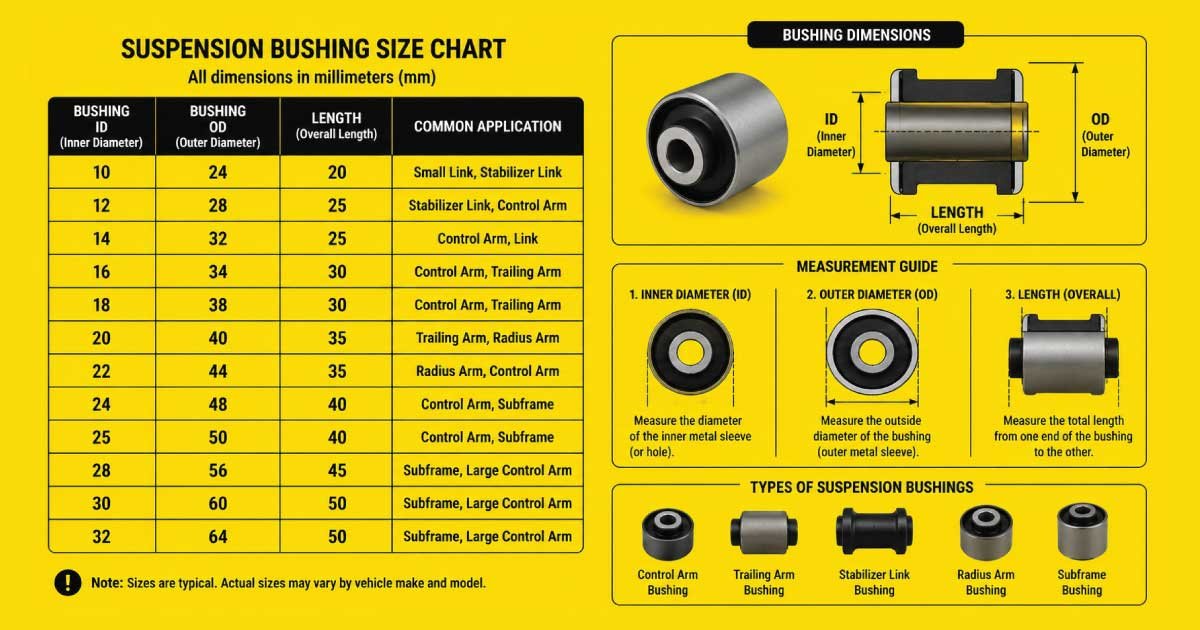
Suspension bushings are one of the most important yet often overlooked components in a vehicle’s suspension system. They play a crucial role in absorbing shocks, reducing vibration, maintaining alignment, and ensuring smooth handling. Whether you are working on passenger cars, trucks, SUVs, or heavy-duty vehicles, choosing the correct suspension bushing size is essential for safety, ride comfort, and performance.
A wrong-sized bushing can cause noise, uneven tire wear, poor handling, and even suspension failure. This is why mechanics and technicians rely on a suspension bushing size chart to match bushings accurately with control arms, sway bars, leaf springs, and suspension links.
This complete guide covers suspension bushing sizes, types, materials, applications, measurement methods, and selection tips in detail.
What Is a Suspension Bushing?
A suspension bushing is a small yet very important part of a vehicle’s suspension system. It is usually made from rubber or polyurethane and is placed between metal components to absorb shocks and vibrations. Its main purpose is to improve ride comfort, reduce noise, and allow smooth controlled movement in the suspension system.
By acting as an insulating layer, it helps maintain stability and prevents excessive wear in suspension joints. Without bushings, driving would feel harsh, noisy, and unstable, especially on uneven roads or rough terrain.
It is commonly used between:
- Control arms and chassis
- Shock absorbers and mounting points
- Sway bars and links
- Leaf spring mounts
- Steering components
Bushings act as a cushion between metal parts, preventing direct metal-to-metal contact.
Main Functions of Suspension Bushings
- Absorb road shocks and vibrations
- Reduce noise in suspension systems
- Maintain wheel alignment stability
- Improve ride comfort
- Increase suspension lifespan
Without bushings, suspension systems would be harsh, noisy, and prone to rapid wear.
Why Suspension Bushing Size Matters
Suspension bushing size plays a crucial role in vehicle stability, comfort, and safety. These small components absorb shocks, reduce vibration, and maintain proper alignment between suspension parts. If the bushing size is incorrect, it can negatively affect handling, increase wear on components, and reduce overall driving performance. Choosing the right size ensures smooth operation and long-term reliability of the suspension system.
1. Prevents Misalignment
Incorrect suspension bushing sizes can disrupt the alignment of suspension geometry. When bushings are too loose or too tight, they may shift under load, causing uneven wheel positioning and poor handling. Proper sizing keeps all components correctly aligned, ensuring stable steering response, improved control, and safer vehicle operation under different road conditions.
2. Reduces Wear and Tear
Correctly sized bushings help distribute loads evenly across suspension components such as control arms and joints. This balanced load reduces excessive stress on individual parts, preventing premature wear. When bushings fit properly, they absorb impact more effectively, protecting surrounding components and extending the overall lifespan of the suspension system.
3. Improves Ride Quality
Suspension bushings are designed to absorb vibrations and road shocks, and correct sizing ensures they function effectively. Properly fitted bushings provide smoother cushioning, reducing noise and harshness during driving. This improves overall ride comfort by isolating vibrations from the chassis, resulting in a more stable and comfortable driving experience, especially on rough or uneven roads.
4. Ensures Proper Fitment
Accurate bushing size is essential for proper installation and long-term performance. Loose bushings can move excessively, while oversized ones may be difficult to install or cause stress on components. Correct fitment ensures secure positioning, stable operation, and reduced risk of early failure. It also simplifies installation and maintenance, saving time and effort during repairs or replacements.
Suspension Bushing Size Chart (Common Inch Sizes)
The following chart shows standard suspension bushing sizes used in many vehicles, especially in North American systems.
| Inner Diameter (ID) | Outer Diameter (OD) | Common Application |
|---|---|---|
| 10 mm (0.39″) | 20 mm (0.79″) | Small linkage bushings |
| 12 mm (0.47″) | 24 mm (0.94″) | Compact car suspension |
| 14 mm (0.55″) | 28 mm (1.10″) | Control arm bushings |
| 16 mm (0.63″) | 30 mm (1.18″) | Sway bar links |
| 18 mm (0.71″) | 32 mm (1.26″) | Passenger vehicles |
| 20 mm (0.79″) | 35 mm (1.38″) | Light SUVs |
| 22 mm (0.87″) | 38 mm (1.50″) | Truck suspension |
| 24 mm (0.94″) | 40 mm (1.57″) | Heavy-duty control arms |
| 25 mm (0.98″) | 42 mm (1.65″) | Off-road vehicles |
| 28 mm (1.10″) | 45 mm (1.77″) | Commercial trucks |
| 30 mm (1.18″) | 48 mm (1.89″) | Heavy industrial vehicles |
These sizes vary depending on manufacturer design and vehicle type.
Metric Suspension Bushing Size Chart
Metric bushings are widely used in modern vehicles, especially European and Asian models.
| Inner Diameter | Outer Diameter | Application |
|---|---|---|
| 8 mm | 18 mm | Small joints |
| 10 mm | 20 mm | Compact vehicles |
| 12 mm | 24 mm | Control arms |
| 14 mm | 28 mm | Suspension links |
| 16 mm | 30 mm | Sway bars |
| 18 mm | 32 mm | Passenger cars |
| 20 mm | 35 mm | SUVs |
| 22 mm | 38 mm | Light trucks |
| 24 mm | 40 mm | Heavy vehicles |
| 26 mm | 42 mm | Off-road suspension |
| 28 mm | 45 mm | Commercial vehicles |
Types of Suspension Bushings
Different types of suspension bushings are designed to meet various driving conditions, vehicle requirements, and performance expectations. Each type uses different materials and construction methods that affect comfort, durability, and handling. Choosing the right bushing type ensures proper balance between ride quality and suspension control.
1. Rubber Bushings
Rubber bushings are the most commonly used type in standard passenger vehicles. They are factory-installed in most cars because they provide a smooth and quiet driving experience. Their flexible nature helps absorb shocks and vibrations effectively, making them ideal for everyday driving and comfort-focused applications.
Advantages:
- Smooth and quiet ride
- Good vibration absorption
- Low cost
- OEM standard
Disadvantages:
- Wear out faster
- Less performance handling
Used in most passenger vehicles.
2. Polyurethane Bushings
Polyurethane bushings are stronger and stiffer compared to rubber bushings. They are widely used in performance, sports, and off-road vehicles where better handling and durability are required. These bushings improve suspension response but slightly reduce ride comfort due to their firmness.
Advantages:
- Higher durability
- Better handling response
- Resistant to oil and chemicals
Disadvantages:
- Slightly stiffer ride
- More road vibration
3. Hydraulic Bushings
Hydraulic bushings are advanced components filled with fluid that enhances damping performance. This fluid-filled design allows better vibration absorption and smoother ride quality. They are commonly used in premium vehicles where comfort and refinement are top priorities.
Advantages:
- Excellent comfort
- Superior vibration control
Used in:
- Luxury vehicles
- High-end SUVs
4. Solid Bushings
Solid bushings are made from metal or reinforced materials and offer maximum rigidity. They do not flex like rubber or polyurethane, which results in very precise suspension movement. These are used in high-performance and heavy-duty applications where strength and accuracy are more important than comfort.
Advantages:
- Maximum strength
- No flex
- Precise handling
Used in:
- Racing vehicles
- Heavy-duty applications
Common Suspension Bushing Locations
Suspension bushings are installed at multiple points throughout a vehicle’s suspension system. Each location serves a specific purpose in improving ride quality, stability, and durability. These bushings help isolate vibrations, support movement, and reduce wear between metal components under different driving conditions.
1. Control Arm Bushings
Control arm bushings are located where the control arms connect to the vehicle’s chassis. They play a crucial role in maintaining proper wheel alignment and allowing controlled movement of the suspension system. These bushings absorb shocks from the road and help keep the tires in consistent contact with the surface for better handling and safety.
Functions:
- Maintain wheel alignment
- Absorb road impact
2. Sway Bar Bushings
Sway bar bushings are used to secure the stabilizer (sway) bar to the vehicle’s frame or chassis. They allow the sway bar to twist and move while still keeping it firmly in place. These bushings are important for reducing body roll during turns and improving overall cornering stability.
Functions:
- Reduce body roll
- Improve cornering stability
3. Shock Absorber Bushings
Shock absorber bushings are located at the mounting points of the shock absorbers. They act as a cushioning layer between the shock and the vehicle body, helping to reduce vibration and noise. These bushings also improve the overall efficiency of the suspension system by allowing smoother shock movement.
Functions:
- Reduce vibration
- Improve shock performance
4. Leaf Spring Bushings
Leaf spring bushings are commonly found in trucks and heavy-duty vehicles. They are installed at the mounting points of leaf springs and help support heavy loads while allowing controlled movement. These bushings also reduce friction between metal parts, increasing durability and extending suspension life.
Functions:
- Support heavy loads
- Reduce metal friction
Read Our Complete Guide:
How to Measure Suspension Bushings
Accurate measurement of suspension bushings is essential for proper fitment, smooth suspension movement, and long-lasting performance. Even small sizing errors can lead to vibration, poor handling, or premature wear of suspension components. Using proper tools like a vernier caliper and following a step-by-step method ensures correct selection and reliable installation.
1. Step 1: Measure Inner Diameter (ID)
Start by measuring the inner diameter of the bushing, which is the space where the bolt or shaft passes through. Use a vernier caliper for precise measurement of the shaft or mounting bolt size. This ensures the bushing will fit securely without being too tight or too loose, maintaining proper suspension movement and alignment.
2. Step 2: Measure Outer Diameter (OD)
Next, measure the outer diameter of the bushing by checking the opening of the mounting housing or bracket. This dimension determines how tightly the bushing fits into the suspension arm. A correct outer diameter ensures a firm press-fit, preventing movement, vibration, or displacement during vehicle operation and load changes.
3. Step 3: Measure Length
Measure the overall length of the bushing to ensure it matches the width of the mounting area. This step is important for maintaining proper alignment and load distribution. If the bushing is too short or too long, it can cause uneven pressure, poor performance, and increased wear on surrounding suspension components over time.
4. Step 4: Check Tolerance
Finally, check the allowable tolerance between the bushing and its mounting components. A slight clearance is acceptable to allow movement and vibration absorption, but excessive play is not suitable. Proper tolerance ensures smooth operation, reduces stress on suspension parts, and helps maintain stability, comfort, and safety during driving under different road conditions.
Suspension Bushing Wear Chart (Symptoms)
| Problem | Possible Cause |
|---|---|
| Clunking noise | Worn rubber bushings |
| Steering vibration | Loose control arm bushings |
| Uneven tire wear | Misaligned suspension |
| Poor handling | Degraded sway bar bushings |
| Creaking sound | Dry or cracked bushings |
Read Our Complete Guide:
How to Choose the Right Suspension Bushing Size
Choosing the correct suspension bushing size is essential for maintaining vehicle stability, comfort, and safety. The right bushings ensure proper alignment, reduce vibration, and improve overall suspension performance. Incorrect sizing or material selection can lead to premature wear, poor handling, and increased stress on suspension components. A careful selection process helps ensure long-lasting and reliable performance.
1. Match OEM Specifications
Always begin by checking the Original Equipment Manufacturer (OEM) specifications for your vehicle. These guidelines provide exact measurements and material recommendations for suspension bushings. Following OEM standards ensures proper fitment, maintains factory-level performance, and reduces the risk of compatibility issues. It is the most reliable reference point for selecting the correct bushing size.
2. Measure Correctly
Accurate measurement is crucial when selecting suspension bushings. Use precision tools such as vernier calipers to measure inner diameter, outer diameter, and length. Even small measurement errors can lead to improper fitment, causing vibration or premature wear. Correct measurements ensure the bushing fits securely and performs effectively under different driving conditions.
3. Consider Vehicle Type
Different vehicle types require different bushing materials and sizes. Passenger cars typically use rubber bushings for comfort and noise reduction. SUVs often require stronger rubber or polyurethane bushings for durability. Performance vehicles may use polyurethane or solid bushings for better handling and control. Selecting based on vehicle type ensures balanced performance and ride quality.
4. Check Load Requirements
The load a vehicle carries significantly affects bushing selection. Heavier vehicles or those carrying frequent loads require stronger and more durable bushings to handle increased stress. Proper load-rated bushings help prevent deformation, maintain alignment, and extend suspension life. Ignoring load requirements can lead to faster wear and reduced safety.
5. Consider Driving Conditions
Driving conditions play a key role in choosing suspension bushings. Off-road driving, rough terrain, and uneven surfaces require more durable materials like polyurethane or heavy-duty rubber. These materials withstand higher stress and impact levels. Choosing bushings based on real driving conditions ensures better performance, improved durability, and long-term reliability of the suspension system.
Read Our Complete Guide:
Installation Tips for Suspension Bushings
Proper installation of suspension bushings is essential for ensuring smooth vehicle performance, correct alignment, and long service life. Even high-quality bushings can fail early if they are installed incorrectly. Using the right tools, following correct procedures, and maintaining alignment helps avoid damage and ensures the suspension system works as intended.
1. Use Proper Tools
Always use the correct tools for installing suspension bushings, especially hydraulic or mechanical presses. Attempting to install bushings without proper equipment can cause deformation, cracking, or improper seating. A press ensures even pressure distribution, allowing the bushing to fit securely into the control arm or mounting housing without damage or misalignment.
2. Lubricate Poly Bushings
Polyurethane bushings should always be lubricated before installation to reduce friction during assembly. Proper lubrication helps the bushing slide smoothly into place and prevents tearing or binding. It also reduces noise during operation and extends service life. Using manufacturer-recommended grease ensures compatibility and prevents premature wear or stiffness after installation.
3. Check Alignment
Correct alignment during installation is critical for suspension performance. Misaligned bushings can lead to uneven load distribution, increased stress, and rapid wear. Always ensure the bushing is seated straight and properly centered in the housing. Careful alignment improves durability, maintains proper suspension geometry, and ensures smooth, stable vehicle handling under all driving conditions.
4. Replace in Pairs
Suspension bushings should always be replaced in pairs, even if only one appears worn. Replacing both sides ensures balanced performance and consistent handling across the suspension system. If only one bushing is replaced, it can lead to uneven wear, handling imbalance, and reduced stability. Pair replacement helps maintain proper vehicle control and long-term suspension reliability.
Advantages of Proper Bushing Selection
Choosing the correct suspension bushing is essential for achieving balanced performance, safety, and comfort in any vehicle. The right size and material help the suspension system absorb shocks effectively, maintain proper alignment, and operate smoothly under different driving conditions. Proper bushing selection not only improves driving experience but also extends the life of suspension components and tires.
1. Ride Comfort
Correctly selected bushings significantly improve ride comfort by absorbing road shocks and vibrations. They reduce the impact of bumps, potholes, and uneven surfaces, resulting in a smoother and more stable driving experience. This helps minimize driver and passenger fatigue, especially during long-distance travel or when driving on rough or poorly maintained roads.
2. Steering Stability
Proper bushings maintain accurate suspension alignment and reduce unwanted movement in steering and suspension joints. This leads to improved steering response and better vehicle control. With stable bushings, the vehicle feels more predictable during cornering, lane changes, and high-speed driving, enhancing overall driving confidence and safety.
3. Tire Life
Well-chosen suspension bushings help maintain correct wheel alignment with the road surface. This prevents uneven tire wear caused by misalignment or excessive suspension movement. As a result, tires last longer and perform more efficiently, reducing the frequency of replacements and lowering overall maintenance costs for the vehicle.
4. Vehicle Safety
Suspension bushings play an important role in maintaining vehicle safety by keeping suspension components stable and properly positioned. Good-quality bushings reduce excessive movement that can negatively affect braking performance, steering accuracy, and road grip. This ensures the vehicle remains stable and safe under different driving conditions and sudden maneuvers.
5. Suspension Durability
Using the correct bushings reduces stress and strain on suspension components such as control arms and joints. This minimizes premature wear and prevents mechanical damage over time. Improved durability means fewer repairs, longer component life, and better overall reliability of the suspension system, making the vehicle more cost-effective to maintain.
6. Noise Reduction
High-quality bushings act as a cushion between metal components, reducing direct metal-to-metal contact. This helps eliminate squeaks, rattles, and vibrations that often develop in worn suspension systems. The result is a quieter cabin environment and a more comfortable driving experience, especially on rough or uneven road surfaces.
Conclusion
A suspension bushing size chart is essential for mechanics, automotive engineers, and DIY repair enthusiasts. Suspension bushings may look small, but they play a major role in how a vehicle handles, feels, and performs.
By understanding sizes, materials, types, and applications, you can ensure proper fitment and long-lasting performance. Whether you’re repairing a passenger car or maintaining heavy-duty suspension systems, selecting the correct bushing size ensures safety, comfort, and reliability on the road.
Read Our Complete Guide:
FAQs:
1. What is a suspension bushing used for?
A suspension bushing is used to connect suspension components while reducing vibration, noise, and shock. It acts as a cushion between metal parts like control arms, sway bars, and shock mounts. This improves ride comfort, maintains alignment, and increases suspension life. Without bushings, vehicles would experience harsh driving conditions and rapid wear of suspension components.
2. How do I know what size suspension bushing I need?
You can determine the correct size by measuring the inner diameter, outer diameter, and length using a vernier caliper. The inner diameter must match the bolt or shaft size, while the outer diameter fits the housing. Always compare measurements with OEM specifications or a suspension bushing size chart to ensure proper fitment and performance.
3. What happens if I use the wrong bushing size?
Using the wrong suspension bushing size can cause serious issues such as poor alignment, vibration, clunking noises, and uneven tire wear. It may also lead to premature suspension failure and unsafe handling. Incorrect sizing can allow excessive movement or create tight stress points, reducing the overall efficiency and lifespan of the suspension system.
4. What materials are suspension bushings made from?
Suspension bushings are commonly made from rubber, polyurethane, hydraulic fluid-filled rubber, and solid materials like metal or reinforced composites. Rubber provides comfort and noise reduction, while polyurethane offers durability and better handling. Hydraulic bushings improve ride smoothness, and solid bushings are used in performance or heavy-duty applications where maximum strength is required.
5. How often should suspension bushings be replaced?
Suspension bushings typically last between 50,000 to 100,000 miles depending on driving conditions, vehicle type, and material quality. They should be replaced when signs like noise, vibration, or poor handling appear. Regular inspection during maintenance helps detect wear early, ensuring safe driving performance and preventing damage to other suspension components.
6. Can worn suspension bushings affect tire wear?
Yes, worn suspension bushings can directly affect tire wear. When bushings degrade, they cause misalignment in the suspension system, leading to uneven tire contact with the road. This results in irregular or accelerated tire wear. Replacing faulty bushings helps maintain proper alignment, improving tire life and ensuring smoother, safer vehicle performance.
7. Are polyurethane bushings better than rubber bushings?
Polyurethane bushings are stronger and last longer than rubber bushings, offering better handling and durability. However, they provide a stiffer ride and more road vibration. Rubber bushings are better for comfort and noise reduction. The choice depends on vehicle use—comfort-focused drivers prefer rubber, while performance and off-road users often choose polyurethane.