
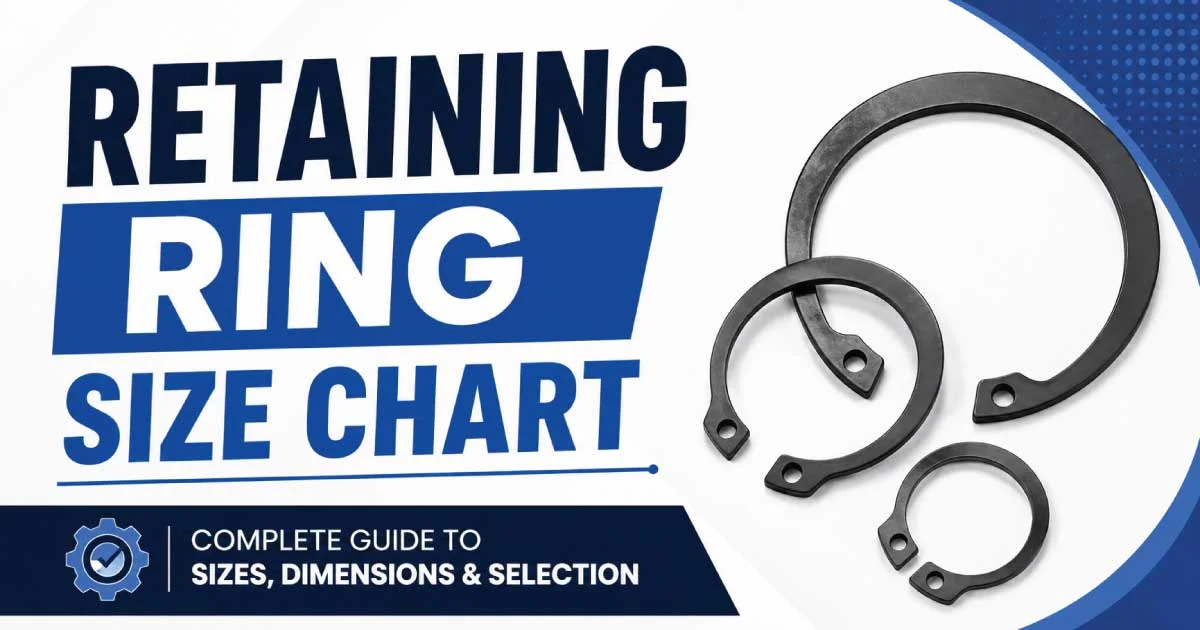
Retaining rings are small but essential mechanical components used to secure parts on shafts, axles, and inside housings. They prevent unwanted movement and help maintain the correct position of bearings, gears, pins, and other rotating or stationary components. Choosing the correct retaining ring size is important because an incorrectly sized ring can fail under pressure, become loose, or damage the assembly.
A retaining ring size chart helps engineers, technicians, and manufacturers quickly identify the correct ring dimensions based on shaft diameter, groove size, ring thickness, and application requirements. This guide explains retaining ring sizes, types, measurements, and how to select the right retaining ring for your project.
Retaining Ring Size Chart
Retaining rings are available in different sizes depending on the diameter of the shaft or housing where they will be installed. The most important measurement is the nominal diameter, which refers to the shaft diameter for external rings or housing bore diameter for internal rings.
| Retaining Ring Size | Shaft/Housing Diameter | Typical Ring Thickness | Common Applications |
|---|---|---|---|
| Small | 1/8″ – 1/4″ | 0.010″ – 0.025″ | Small machinery, electronics |
| Medium | 1/4″ – 1″ | 0.025″ – 0.050″ | Automotive parts, bearings |
| Large | 1″ – 3″ | 0.050″ – 0.100″ | Industrial equipment |
| Heavy Duty | 3″ and above | 0.100″+ | Heavy machinery applications |
The exact dimensions vary by manufacturer and retaining ring standard. Always check the manufacturer’s specifications before installation.
What Is a Retaining Ring?
A retaining ring is a circular fastener designed to fit into a groove on a shaft or inside a bore. Once installed, the ring creates a shoulder that holds components in place. Unlike traditional fasteners such as bolts or nuts, retaining rings require very little space and provide a simple method for securing mechanical assemblies.
Retaining rings are commonly manufactured from spring steel, stainless steel, or other high-strength materials. Their flexible design allows them to expand during installation and return to their original shape when seated inside the groove.
Common applications include:
- Automotive transmissions
- Electric motors
- Hydraulic systems
- Pumps and compressors
- Gear assemblies
- Bearings and shafts
- Industrial machinery
Types of Retaining Rings and Their Sizes
Different applications require different retaining ring designs. The two main categories are external retaining rings and internal retaining rings.
External Retaining Ring Size Chart
External retaining rings are installed on shafts. They fit into grooves cut around the outside diameter of a shaft and prevent components from sliding off.
| Shaft Diameter | External Ring Size | Common Thickness |
|---|---|---|
| 1/4 inch | E-250 | 0.025 inch |
| 3/8 inch | E-375 | 0.032 inch |
| 1/2 inch | E-500 | 0.040 inch |
| 3/4 inch | E-750 | 0.050 inch |
| 1 inch | E-1000 | 0.062 inch |
| 1-1/2 inch | E-1500 | 0.080 inch |
External retaining rings are widely used in rotating applications because they provide strong axial holding force while taking minimal space.
Internal Retaining Ring Size Chart
Internal retaining rings are installed inside a bore or housing. They expand outward and press against the groove walls to hold components securely.
| Housing Diameter | Internal Ring Size | Typical Use |
|---|---|---|
| 1/4 inch | I-250 | Small assemblies |
| 1/2 inch | I-500 | Bearings and motors |
| 1 inch | I-1000 | Mechanical equipment |
| 2 inch | I-2000 | Industrial machinery |
| 3 inch | I-3000 | Heavy applications |
Internal rings are commonly found in gearboxes, pumps, and bearing housings where components must remain positioned inside a bore.
Also Read: Complete Shoulder Bolt Size Guide and Measurement Chart
How to Measure a Retaining Ring Size
Selecting the correct retaining ring requires accurate measurements. Several dimensions must be considered before choosing a replacement ring.
1. Measure Shaft Diameter
For external retaining rings, measure the outside diameter of the shaft where the ring will be installed. Use a precision caliper for accurate measurement.
A shaft that measures 1 inch requires a retaining ring designed specifically for a 1-inch shaft. Using a smaller or larger ring can cause improper fit.
2. Measure Groove Diameter
The groove diameter determines how securely the retaining ring sits on the shaft or inside the housing. The groove must match the retaining ring specifications.
Important groove measurements include:
- Groove diameter
- Groove width
- Groove depth
- Distance from the shaft edge
3. Check Ring Thickness
Retaining ring thickness affects the amount of axial load the ring can handle. Heavy-duty applications require thicker rings, while lightweight applications may use thinner designs.
Retaining Ring Material Options
The material of a retaining ring affects its strength, corrosion resistance, and operating temperature capability.
Carbon Steel Retaining Rings
Carbon steel rings are the most common option because they provide excellent strength at an affordable cost. They are widely used in general industrial applications.
Advantages include:
- High strength
- Good wear resistance
- Low cost
- Suitable for standard environments
Stainless Steel Retaining Rings
Stainless steel retaining rings are used where corrosion resistance is important. They are common in marine equipment, food processing machinery, and outdoor applications.
Benefits include:
- Rust resistance
- Long service life
- Better performance in harsh environments
Special Alloy Retaining Rings
Some applications require special materials that can withstand extreme temperatures, chemicals, or heavy loads. Alloy retaining rings are used in aerospace, automotive, and specialized industrial equipment.
Also Read: Reducer Size Guide with Size Charts, Dimensions & Standards
Retaining Ring Standards and Specifications
Retaining rings are manufactured according to industry standards to ensure compatibility and reliability. Common standards include:
- ANSI retaining ring standards
- DIN retaining ring standards
- ISO retaining ring specifications
Standardization helps manufacturers produce rings with consistent dimensions and allows replacement parts to be easily identified.
When selecting a retaining ring, consider:
- Shaft or bore diameter
- Groove dimensions
- Load requirements
- Operating environment
- Material requirements
How to Install a Retaining Ring Correctly
Proper installation is important to prevent retaining ring failure. The ring should always be installed using the correct tools.
External Ring Installation
External retaining rings are usually installed using retaining ring pliers. The pliers expand the ring so it can slide over the shaft and fit into the groove.
Installation steps:
- Clean the shaft and groove area.
- Check that the ring matches the shaft size.
- Expand the ring carefully with pliers.
- Place the ring into the groove.
- Confirm that the ring is fully seated.
Internal Ring Installation
Internal retaining rings are compressed before installation. Once placed inside the bore, they expand outward into the groove.
Always verify that the ring is properly seated before operating the equipment.
Common Retaining Ring Problems
Using the wrong size retaining ring can lead to several mechanical problems.
Loose Retaining Ring: A ring that is too large may not hold securely and can move during operation.
Broken Retaining Ring: Excessive load, incorrect installation, or damaged grooves can cause the ring to break.
Incorrect Groove Fit: A groove that is too wide or too deep can prevent the ring from providing enough holding force.
Corrosion Damage: In harsh environments, standard steel rings may rust and lose strength. Stainless steel options may be required.
Choosing the Right Retaining Ring Size
The correct retaining ring depends on the application requirements. Before purchasing a retaining ring, consider the following factors:
- Diameter of shaft or housing
- Required load capacity
- Operating temperature
- Environmental conditions
- Installation space
- Material compatibility
For general mechanical repairs, standard carbon steel retaining rings are often suitable. For demanding environments, stainless steel or specialty alloy rings provide better durability.
Final Thoughts on Retaining Ring Size
A retaining ring size chart makes it easier to select the correct ring for different mechanical applications. Understanding shaft diameter, groove dimensions, ring type, and material options helps ensure a secure and reliable installation.
Whether you are repairing automotive equipment, industrial machinery, or small mechanical assemblies, choosing the correct retaining ring size improves safety, performance, and component life. Always compare measurements with manufacturer specifications to achieve the best possible fit.
Also Read: Aerospace Fastener Sizes Explained: Complete Guide