
Copper pipes have been a trusted choice for plumbing, heating, refrigeration, and industrial applications for decades. Their durability, corrosion resistance, and ability to handle both hot and cold temperatures make them one of the most reliable piping materials available. Whether you’re installing a residential water supply system, designing an HVAC setup, or working on a commercial plumbing project, understanding copper pipe sizes is essential.
Copper pipes come in various diameters, wall thicknesses, and grades. Choosing the correct size ensures proper water flow, pressure maintenance, and long-term system performance. This guide explains copper pipe dimensions, sizing standards, wall thickness types, and includes a detailed copper pipe size chart for easy reference.
What Is a Copper Pipe?
A copper pipe is a hollow tube manufactured from copper metal and designed to transport water, gas, refrigerants, and other fluids. Copper is widely used because it is naturally resistant to corrosion, easy to work with, and capable of lasting for decades when properly installed.
Copper piping is commonly found in:
- Residential plumbing systems
- Commercial buildings
- Water distribution networks
- HVAC systems
- Refrigeration equipment
- Fire sprinkler systems
- Medical gas systems
Because of its proven reliability, copper remains one of the most widely used piping materials worldwide.
Why Copper Pipe Size Matters
Selecting the correct copper pipe size is essential for maintaining proper system performance, efficiency, and reliability. Pipe size directly affects water flow rate, pressure stability, and overall system behavior in plumbing, HVAC, and industrial applications.
When a pipe is too small for the required demand, it restricts flow and creates operational problems. This can reduce system efficiency and cause performance issues in connected fixtures and equipment.
Using a pipe that is too small can result in:
- Reduced water flow
- Pressure loss
- Increased noise
- Poor appliance performance
On the other hand, oversizing a pipe may seem safer, but it can increase costs and reduce system efficiency if not properly designed. It may also lead to unnecessary material usage without providing additional benefits.
Using a pipe that is too large can lead to:
- Higher installation costs
- Unnecessary material expenses
- Reduced system efficiency
Proper pipe sizing ensures smooth fluid movement, balanced pressure, and long service life for the entire system.
Understand The Copper Pipe Measurements
Before using a copper pipe size chart, it is important to understand how copper pipes are measured. Unlike some materials, copper pipe sizing can be confusing because it uses a mix of nominal and actual measurements depending on the reference point.
Proper understanding of these measurements helps ensure correct pipe selection, accurate fittings, and safe installation in plumbing and mechanical systems.
1. Nominal Pipe Size
Copper pipes are identified by nominal size rather than the exact physical dimensions. This means the labeled size is a standard reference and not the true measurement of the pipe.
For example:
- A 1/2-inch copper pipe does not have an outside diameter of exactly 1/2 inch.
- The nominal size generally refers to the approximate inside diameter.
2. Outside Diameter (OD)
Outside diameter refers to the total width of the pipe measured from one outer edge to the other. In copper piping, OD is standardized and remains consistent for each pipe size, making it important for fitting compatibility.
- Measurement across the external width of the pipe
- Standardized across sizes for proper fitting
3. Inside Diameter (ID)
Inside diameter is the measurement of the hollow opening inside the pipe where fluid flows. This value can change depending on wall thickness.
- Measures internal flow space
- Varies with wall thickness
4. Wall Thickness
Wall thickness determines the strength and durability of the pipe. It also affects pressure-handling capacity and overall performance in different applications.
- Thicker walls provide higher strength
- Improves pressure resistance and durability
- Helps protect against physical damage
Types of Copper Pipes
Copper pipes are classified into different types based on wall thickness and pressure-handling capacity. Each type is designed for specific applications in plumbing, construction, and industrial systems. Choosing the right type ensures safety, efficiency, and long-lasting performance.
1. Type K Copper Pipe
Type K copper pipe has the thickest walls among standard copper pipe types, making it the strongest and most durable option. It is mainly used in heavy-duty and high-pressure systems where long service life and underground installation are required.
Applications include:
- Underground water service lines
- Municipal water systems
- High-pressure applications
Advantages:
- Maximum durability
- Excellent pressure resistance
- Long lifespan
2. Type L Copper Pipe
Type L is the most commonly used copper pipe in residential and commercial plumbing systems. It offers a strong balance between durability and cost, making it suitable for general water distribution and building installations.
Applications include:
- Residential plumbing
- Commercial plumbing
- Fire protection systems
Advantages:
- Good balance between strength and cost
- Suitable for most water distribution systems
3. Type M Copper Pipe
Type M copper pipe has thinner walls compared to Type L, making it a more affordable option for low to moderate pressure applications. It is commonly used in residential plumbing where cost efficiency is important.
Applications include:
- Residential water systems
- Low-pressure plumbing systems
Advantages:
- Lower cost
- Easier handling
4. DWV Copper Pipe
DWV stands for Drain, Waste, and Vent. These copper pipes are specifically designed for non-pressurized systems and are used to safely remove wastewater and gases from plumbing systems.
- Designed for non-pressurized drainage systems
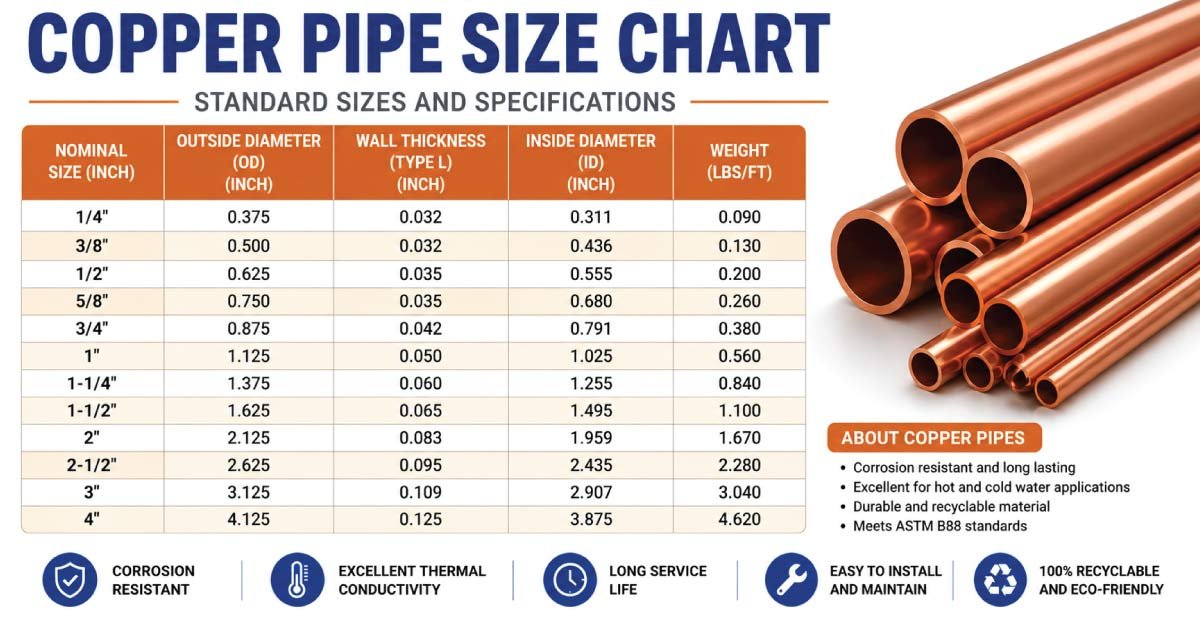
Copper Pipe Size Chart (Standard Dimensions)
The following chart shows common copper pipe sizes and their outside diameters.
| Nominal Size | Outside Diameter (OD) |
|---|---|
| 1/4 inch | 0.375 inch |
| 3/8 inch | 0.500 inch |
| 1/2 inch | 0.625 inch |
| 5/8 inch | 0.750 inch |
| 3/4 inch | 0.875 inch |
| 1 inch | 1.125 inch |
| 1-1/4 inch | 1.375 inch |
| 1-1/2 inch | 1.625 inch |
| 2 inch | 2.125 inch |
| 2-1/2 inch | 2.625 inch |
| 3 inch | 3.125 inch |
| 4 inch | 4.125 inch |
These dimensions are widely recognized across plumbing and construction industries.
Copper Pipe Wall Thickness Chart
Wall thickness varies depending on pipe type.
Type K Copper Pipe
| Nominal Size | Wall Thickness |
|---|---|
| 1/2 inch | 0.049 inch |
| 3/4 inch | 0.065 inch |
| 1 inch | 0.065 inch |
| 1-1/2 inch | 0.072 inch |
| 2 inch | 0.083 inch |
Type L Copper Pipe
| Nominal Size | Wall Thickness |
|---|---|
| 1/2 inch | 0.040 inch |
| 3/4 inch | 0.045 inch |
| 1 inch | 0.050 inch |
| 1-1/2 inch | 0.058 inch |
| 2 inch | 0.070 inch |
Type M Copper Pipe
| Nominal Size | Wall Thickness |
|---|---|
| 1/2 inch | 0.028 inch |
| 3/4 inch | 0.032 inch |
| 1 inch | 0.035 inch |
| 1-1/2 inch | 0.042 inch |
| 2 inch | 0.058 inch |
These values demonstrate why Type K is stronger than Type L and Type M.
Common Copper Pipe Sizes and Their Uses
Copper pipes are available in different sizes, and each size is designed to handle specific flow requirements and system demands. Choosing the correct diameter is important for maintaining proper water pressure, efficient flow, and reliable system performance in residential, commercial, and industrial applications.
1/2-Inch Copper Pipe
This is one of the most commonly used small copper pipe sizes in residential plumbing systems. It is ideal for supplying water to individual fixtures where flow demand is relatively low.
- Bathroom fixtures
- Kitchen faucets
- Small branch water lines
3/4-Inch Copper Pipe
3/4-inch copper pipe is widely used for higher-demand residential systems. It supports multiple fixtures and provides more stable water pressure compared to smaller sizes.
- Main residential water supply lines
- Water heater connections
- Multiple fixture supply lines
1-Inch Copper Pipe
This size is typically used in larger residential buildings and small commercial systems where higher water flow is required for multiple usage points.
- Larger homes
- Commercial buildings
- Main distribution lines
1-1/2-Inch Copper Pipe
1-1/2-inch copper pipes are designed for heavy-duty plumbing systems that require higher flow capacity and consistent pressure distribution.
- Commercial plumbing systems
- Fire protection systems
- High-demand water systems
2-Inch and Larger Copper Pipes
These large-diameter copper pipes are used in major infrastructure projects where maximum water flow and distribution efficiency are required.
- Industrial facilities
- Municipal water systems
- Large commercial buildings
Advantages of Copper Pipes
Copper pipes are widely used in plumbing and HVAC systems because of their durability, safety, and long-term performance. They have been trusted for decades in residential, commercial, and industrial applications due to their ability to handle different environmental and operating conditions effectively.
1. Corrosion Resistance
Copper naturally resists rust and corrosion, making it highly reliable in water supply systems. It maintains its structural integrity even when exposed to moisture for long periods. This resistance helps reduce leaks, maintenance needs, and system failures over time, ensuring stable performance in plumbing networks.
2. Long Service Life
One of the biggest advantages of copper pipes is their long lifespan. Many copper piping systems can last 50 years or more when properly installed and maintained. This durability makes them a cost-effective choice in the long run, especially for critical water supply and heating systems.
3. Heat Resistance
Copper performs exceptionally well under both high and low temperature conditions. It does not weaken or deform easily when exposed to hot water, making it ideal for heating systems and hot water lines. Its stability across temperature ranges ensures consistent performance in demanding applications.
4. Bacterial Resistance
Copper has natural antimicrobial properties that help inhibit the growth of bacteria and other harmful microorganisms. This makes it especially suitable for drinking water systems, where maintaining water quality and hygiene is essential for health and safety in residential and commercial buildings.
5. Recyclability
Copper is 100% recyclable without losing its quality or performance. This makes it an environmentally friendly piping material that supports sustainable construction practices. Recycling copper also reduces environmental impact and conserves natural resources, making it a preferred choice for green building projects.
6. Proven Reliability
Copper has been used in plumbing systems for many decades and has a strong track record of reliable performance. Its consistent results in various applications make it a trusted material among engineers and plumbers. This long history of use confirms its dependability in modern piping systems.
3. HVAC and Refrigeration
Copper is widely used in HVAC and refrigeration systems because of its excellent thermal conductivity. It allows efficient heat transfer, which improves cooling and heating performance. Copper tubing also handles refrigerants safely under pressure, making it a reliable choice for air conditioning systems, refrigerators, and large-scale climate control applications.
4. Medical Facilities
In medical environments, copper tubing is commonly used for delivering medical gases such as oxygen and nitrous oxide. Its reliability, cleanliness, and resistance to contamination make it suitable for critical healthcare systems. Copper’s antibacterial properties also help maintain safer and more hygienic gas delivery in hospitals and clinical settings.
5. Industrial Operations
Copper tubing is also used in industrial systems for process piping and specialized fluid transport. It performs well under varying temperature and pressure conditions, making it suitable for manufacturing plants and processing units. Its durability and corrosion resistance ensure consistent performance in demanding industrial environments where reliability is essential.
Copper Pipe vs PEX Pipe
Many homeowners and professionals compare copper and PEX piping because both are widely used in modern plumbing systems. Each material has unique strengths, and the best choice depends on budget, installation conditions, and long-term performance requirements.
Copper pipes are known for durability and long service life, while PEX pipes are valued for flexibility and easier installation. Understanding their differences helps in selecting the right option for a specific project.
Copper Advantages
- Longer lifespan
- Higher heat resistance
- Better UV resistance
- Proven track record
PEX Advantages
- Lower installation cost
- Greater flexibility
- Faster installation
Both materials have advantages depending on project requirements and system design needs.
Tips for Choosing the Right Copper Pipe Size
Selecting the correct copper pipe size is essential for maintaining proper water flow, pressure balance, and system efficiency. Proper planning helps prevent performance issues and reduces long-term maintenance problems.
Key Considerations
- Calculate expected flow rates
- Consider water pressure requirements
- Account for future expansion
- Verify local plumbing codes
- Choose the appropriate pipe type
- Compare installation costs
- Evaluate long-term durability
Proper planning ensures efficient, safe, and reliable system performance over time.
Conclusion
Understanding copper pipe sizes and specifications is essential for successful plumbing, HVAC, and industrial projects. Copper pipes are available in various nominal sizes and wall thicknesses, with Type K, Type L, and Type M being the most common classifications.
The copper pipe size charts provided in this guide offer a useful reference for selecting the correct dimensions for your application. By considering factors such as pipe size, wall thickness, pressure requirements, and intended use, you can choose the right copper pipe and build a durable system that delivers reliable performance for decades.
Also Read: 👉 PVC pipes are widely used in plumbing, drainage, irrigation, and construction projects due to their durability and affordability. This guide explains PVC pipe types, PVC pipe sizes, and the materials used in their manufacturing. Learn the differences between common PVC categories, sizing standards, and applications. Read the full post to gain practical insights and choose the right PVC pipe for your needs.