
High-Density Polyethylene (HDPE) pipes have become one of the most popular piping solutions for water supply, irrigation, drainage, gas distribution, and industrial applications. Known for their flexibility, durability, and corrosion resistance, HDPE pipes offer a long-lasting alternative to traditional metal and concrete piping systems.
One of the most important factors when selecting an HDPE pipe is understanding its dimensions. HDPE pipes are available in various diameters, pressure ratings, and wall thicknesses. Choosing the correct size ensures efficient flow, proper pressure handling, and reliable long-term performance.
This guide explains HDPE pipe sizing, dimensions, standards, pressure classes, and includes a detailed HDPE pipe size chart for easy reference.
What Is an HDPE Pipe?
HDPE stands for High-Density Polyethylene, a thermoplastic polymer widely used in piping systems. HDPE pipes are manufactured from high-density polyethylene resin, which provides excellent strength, flexibility, and resistance to chemicals and environmental conditions.
HDPE pipes are commonly used for:
- Potable water supply
- Agricultural irrigation
- Gas distribution
- Industrial fluid transport
- Sewer systems
- Drainage systems
- Mining operations
- Telecommunications conduit
Because of their flexibility and durability, HDPE pipes have become a preferred choice for modern infrastructure projects.
Why HDPE Pipe Size Matters
Selecting the correct HDPE pipe size is essential for ensuring efficient fluid transport and overall system performance. HDPE pipes are widely used in water supply, irrigation, and industrial systems, where proper sizing directly affects flow behavior, pressure stability, and long-term operating costs.
When the pipe size is too small for the required demand, the system becomes restricted and works harder to maintain flow. This increases energy use and reduces efficiency over time.
A pipe that is too small may cause:
- Reduced flow capacity
- Excessive pressure loss
- Higher pumping costs
On the other hand, using an oversized pipe can also create unnecessary expenses without improving system performance. It may also lead to inefficient material usage and higher project costs.
A pipe that is too large may result in:
- Increased material costs
- Higher installation expenses
- Reduced efficiency
Proper HDPE pipe sizing ensures balanced flow rates, stable pressure performance, and overall cost-effectiveness for long-term system reliability.
Understanding HDPE Pipe Dimensions
Before using an HDPE pipe size chart, it is important to understand how HDPE pipe dimensions are measured. These measurements determine flow capacity, pressure rating, and compatibility with fittings. HDPE systems follow standardized sizing methods to ensure consistency in industrial, agricultural, and water supply applications.
1. Outside Diameter (OD)
Outside Diameter refers to the total width of the pipe measured from one outer edge to the other. HDPE pipes are commonly classified based on their OD, making it a key measurement for selecting compatible fittings and system components.
- Measurement across the external width of the pipe
- Primary sizing standard for HDPE systems
2. Inside Diameter (ID)
Inside Diameter is the internal space through which fluid flows. It directly affects flow rate and system efficiency. The ID varies depending on the wall thickness of the pipe.
- Determines flow capacity
- Changes with wall thickness
3. Wall Thickness
Wall thickness defines the strength and pressure-handling capability of HDPE pipes. It plays a critical role in durability and system safety.
- Affects pressure rating and strength
- Thicker walls increase durability
- Reduces internal diameter
4. Nominal Diameter (DN)
Nominal Diameter (DN) is an international standard used to represent pipe sizes in a simplified way. It is commonly used in engineering and global piping systems.
- DN50 ≈ 50 mm
- DN100 ≈ 100 mm
- Standardized global sizing system
These measurement standards ensure proper selection, compatibility, and performance in HDPE piping systems across different applications.
Understand The SDR in HDPE Pipes
HDPE pipes are commonly classified using SDR, which is one of the most important factors in determining pipe strength and pressure capacity. SDR helps engineers and installers choose the right pipe for specific water, gas, and industrial applications based on wall thickness and operating pressure.
What is SDR?
SDR stands for Standard Dimension Ratio. It defines the relationship between the pipe’s outside diameter and its wall thickness.
Formula:
- SDR = Outside Diameter ÷ Wall Thickness
What SDR Means for Pipe Performance
SDR value directly affects the strength and pressure-handling ability of HDPE pipes. It helps determine whether a pipe is suitable for low-pressure or high-pressure systems.
- A lower SDR value means thicker walls and higher pressure capacity
- A higher SDR value means thinner walls and lower pressure capacity
Common SDR Ratings
HDPE pipes are manufactured in several standard SDR classes used across different applications:
- SDR 9
- SDR 11
- SDR 13.6
- SDR 17
- SDR 21
- SDR 26
Understanding SDR is essential when selecting HDPE pipes for pressure-based systems, as it ensures safe operation, proper flow performance, and long-term durability.
HDPE Pipe Size Chart (Metric Dimensions)
The following chart shows common HDPE pipe sizes.
| Nominal Diameter (DN) | Outside Diameter (mm) |
|---|---|
| DN20 | 20 mm |
| DN25 | 25 mm |
| DN32 | 32 mm |
| DN40 | 40 mm |
| DN50 | 50 mm |
| DN63 | 63 mm |
| DN75 | 75 mm |
| DN90 | 90 mm |
| DN110 | 110 mm |
| DN125 | 125 mm |
| DN160 | 160 mm |
| DN200 | 200 mm |
| DN250 | 250 mm |
| DN315 | 315 mm |
| DN400 | 400 mm |
| DN500 | 500 mm |
| DN630 | 630 mm |
These dimensions are commonly used in water and industrial piping systems.
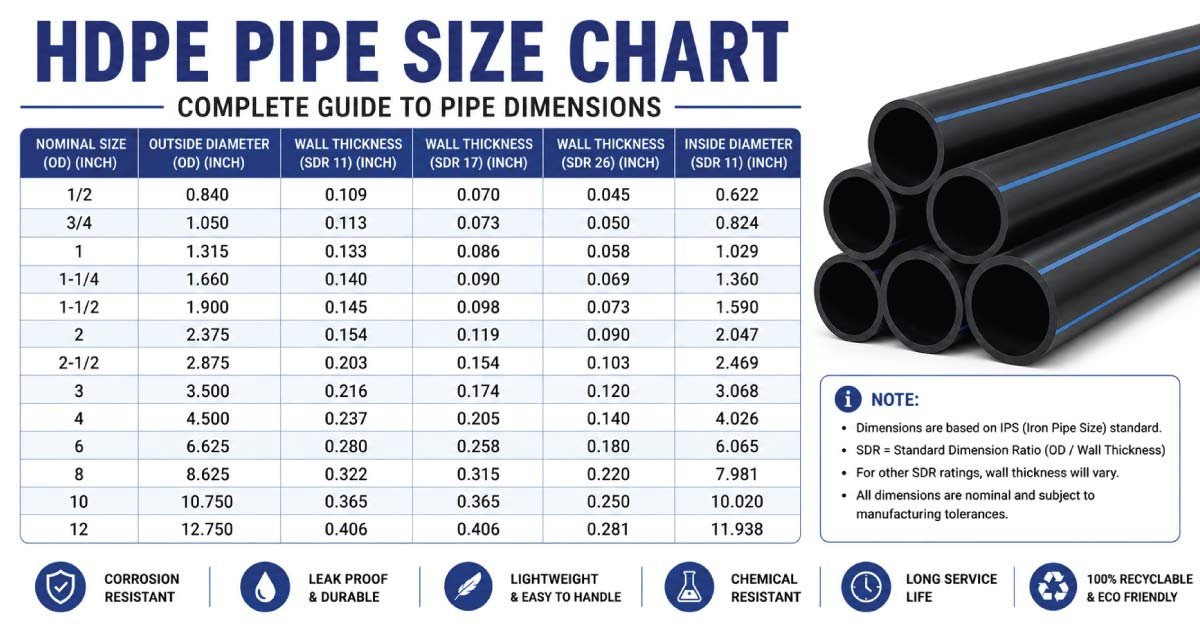
HDPE Pipe Size Chart (Inch Dimensions)
For projects using imperial measurements, the following sizes are common.
| Nominal Size | Outside Diameter |
|---|---|
| 1/2 inch | 0.840 inch |
| 3/4 inch | 1.050 inch |
| 1 inch | 1.315 inch |
| 1-1/4 inch | 1.660 inch |
| 1-1/2 inch | 1.900 inch |
| 2 inch | 2.375 inch |
| 3 inch | 3.500 inch |
| 4 inch | 4.500 inch |
| 6 inch | 6.625 inch |
| 8 inch | 8.625 inch |
| 10 inch | 10.750 inch |
| 12 inch | 12.750 inch |
These sizes are widely used in North American piping systems.
HDPE Pipe SDR Chart Example
The wall thickness varies according to SDR rating.
110 mm HDPE Pipe Example
| SDR Rating | Wall Thickness |
|---|---|
| SDR 26 | 4.2 mm |
| SDR 21 | 5.3 mm |
| SDR 17 | 6.6 mm |
| SDR 13.6 | 8.1 mm |
| SDR 11 | 10.0 mm |
| SDR 9 | 12.3 mm |
This chart illustrates how wall thickness increases as SDR decreases.
HDPE Pipe Pressure Ratings
Pressure ratings depend on SDR and pipe material grade.
Common pressure classes include:
| Pressure Rating | Approximate Pressure |
|---|---|
| PN6 | 6 Bar |
| PN8 | 8 Bar |
| PN10 | 10 Bar |
| PN12.5 | 12.5 Bar |
| PN16 | 16 Bar |
| PN20 | 20 Bar |
| PN25 | 25 Bar |
Higher pressure ratings generally require thicker pipe walls.
Always verify manufacturer specifications before installation.
Common HDPE Pipe Sizes and Their Uses
HDPE pipes are manufactured in a wide range of diameters, and each size is designed for specific flow requirements and system demands. Selecting the correct size is important for ensuring efficient water movement, proper pressure control, and long-term system reliability in residential, agricultural, and industrial applications.
20 mm to 32 mm HDPE Pipes
These small-diameter pipes are mainly used for light-duty applications where low to moderate water flow is required. They are common in household and garden systems due to their flexibility and ease of installation.
- Residential water supply
- Garden irrigation
- Small distribution lines
40 mm to 63 mm HDPE Pipes
This medium size range is widely used in agricultural and rural water systems where consistent water distribution is needed over moderate distances.
- Agricultural irrigation
- Small commercial systems
- Rural water supply networks
75 mm to 160 mm HDPE Pipes
These pipes are suitable for larger systems that require higher flow capacity and more stable pressure conditions. They are commonly used in infrastructure and industrial applications.
- Municipal water distribution
- Industrial piping systems
- Medium-sized irrigation projects
200 mm to 400 mm HDPE Pipes
Large-diameter HDPE pipes are used in high-capacity systems where significant water or waste transport is required over long distances.
- Sewer systems
- Large water transmission projects
- Stormwater drainage systems
500 mm and Larger HDPE Pipes
These are very large pipes used in major infrastructure and heavy industrial projects where maximum flow capacity is required.
- Municipal infrastructure
- Mining operations
- Industrial fluid transport
- Large-scale water supply systems
Advantages of HDPE Pipes
HDPE (High-Density Polyethylene) pipes are widely used in water supply, gas distribution, industrial systems, and irrigation networks due to their durability and performance. Compared to traditional piping materials, HDPE offers several advantages that improve reliability, reduce maintenance, and extend system lifespan.
1. Corrosion Resistance
Unlike metal pipes, HDPE does not rust, corrode, or degrade when exposed to moisture and many chemicals. This makes it ideal for underground installations, water distribution systems, and harsh environments where corrosion can significantly reduce the lifespan of traditional piping materials.
2. Flexibility
HDPE pipes are highly flexible, allowing them to bend without breaking under stress. This flexibility helps them withstand ground movement, soil settlement, and seismic activity. As a result, HDPE systems are often preferred in areas prone to earthquakes or shifting ground conditions.
3. Lightweight Construction
HDPE pipes are much lighter than steel, concrete, and other traditional pipe materials. Their lightweight design simplifies transportation, handling, and installation. This reduces labor requirements and equipment costs, making HDPE a cost-effective solution for both small and large-scale projects.
4. Leak-Free Joints
One of the key benefits of HDPE piping systems is the use of fusion welding technology. This process creates strong, seamless joints that are as strong as the pipe itself. These leak-resistant connections help reduce water loss, improve system efficiency, and minimize maintenance requirements.
5. Long Service Life
HDPE pipes are designed for long-term performance and can often last more than 50 years under normal operating conditions. Their resistance to corrosion, chemical attack, and environmental stress contributes to their exceptional durability, making them a reliable investment for infrastructure and utility projects.
6. Chemical Resistance
HDPE performs exceptionally well in chemically aggressive environments. It is resistant to a wide range of acids, alkalis, and industrial chemicals, making it suitable for chemical processing plants, wastewater systems, and industrial fluid transport applications where other materials may deteriorate over time.
HDPE Pipe Standards
HDPE pipes are manufactured according to internationally recognized standards that ensure consistency, safety, and performance. These standards define dimensions, material properties, testing procedures, and pressure ratings. Following these specifications helps ensure that HDPE pipes are compatible with fittings and suitable for their intended applications.
1. ISO Standards
ISO (International Organization for Standardization) standards are widely used around the world for HDPE piping systems. They establish requirements for dimensions, material quality, pressure ratings, and testing methods. ISO-compliant HDPE pipes are commonly used in water supply, industrial processing, and infrastructure projects across international markets.
2. ASTM Standards
ASTM (American Society for Testing and Materials) standards are commonly used in North America. These standards provide specifications for HDPE pipe materials, manufacturing processes, and performance requirements. ASTM compliance helps ensure that HDPE pipes meet strict quality and durability standards for water, gas, and industrial applications.
3. AWWA Standards
AWWA (American Water Works Association) standards are specifically designed for municipal water distribution systems. They focus on the performance, safety, and reliability of HDPE pipes used in public water infrastructure. Compliance with AWWA standards helps ensure long-term service and dependable operation in water utility networks.
4. EN Standards
EN (European Standards) are widely adopted throughout Europe and many international markets. These standards define technical requirements for HDPE pipes, including dimensions, pressure classifications, and material quality. EN-compliant pipes provide consistency and compatibility across a broad range of industrial and municipal applications.
Compliance with recognized HDPE pipe standards helps ensure product quality, system reliability, and compatibility with fittings, valves, and other piping components used worldwide.
HDPE Pipe Applications
HDPE pipes are used in numerous industries because of their strength, flexibility, corrosion resistance, and long service life. Their ability to handle water, gases, chemicals, and wastewater makes them one of the most versatile piping materials available today. These advantages have led to widespread adoption across residential, commercial, and industrial sectors.
1. Water Supply Systems
HDPE pipes are widely used in municipal and residential water distribution networks. Their leak-resistant joints and corrosion resistance help maintain water quality while reducing maintenance costs. They are suitable for both underground and above-ground installations, making them a reliable choice for long-term water supply infrastructure.
2. Agricultural Irrigation
Farmers commonly use HDPE pipes for irrigation systems because they efficiently transport water across large agricultural areas. Their flexibility allows easy installation over uneven terrain, while their durability ensures reliable performance in outdoor environments. This helps improve water management and supports productive farming operations.
3. Gas Distribution
Many gas utility companies use HDPE pipes for natural gas distribution due to their strength and leak-resistant fusion-welded joints. HDPE can withstand ground movement and environmental stress without cracking, making it a safe and dependable option for underground gas transportation networks.
4. Industrial Facilities
Industrial plants often rely on HDPE piping to transport water, chemicals, and process fluids. Its excellent chemical resistance allows it to perform well in harsh industrial environments where traditional metal pipes may corrode or deteriorate. This makes HDPE a preferred material in many manufacturing operations.
5. Mining Operations
In the mining industry, HDPE pipes are frequently used for slurry transport, tailings management, and process water systems. Their abrasion resistance and flexibility help them handle demanding operating conditions. This durability reduces downtime and maintenance costs in challenging mining environments.
6. Drainage and Sewer Systems
HDPE is an excellent choice for underground drainage and sewer applications because it resists corrosion, chemical attack, and root intrusion. Its smooth interior surface improves flow efficiency and helps prevent blockages. These characteristics contribute to reliable long-term performance in wastewater and stormwater management systems.
Conclusion
Understanding HDPE pipe dimensions is essential for designing efficient water, gas, drainage, and industrial piping systems. HDPE pipes are available in a wide range of diameters, SDR ratings, and pressure classes, allowing engineers and contractors to select the most suitable option for virtually any application.
The HDPE pipe size charts provided in this guide offer a practical reference for standard dimensions and specifications. By considering factors such as outside diameter, wall thickness, SDR, and pressure rating, you can confidently choose the right HDPE pipe for your project and ensure reliable performance for decades.
Also Read: 👉 Understanding pipe sizes is essential for selecting the right piping system for plumbing, construction, and industrial applications. This guide covers pipe types, common uses, and accurate pipe measurements, including diameter, wall thickness, and sizing standards. Learn how different pipe sizes affect performance and installation. Read the full post for expert insights, practical examples, and detailed sizing information.