
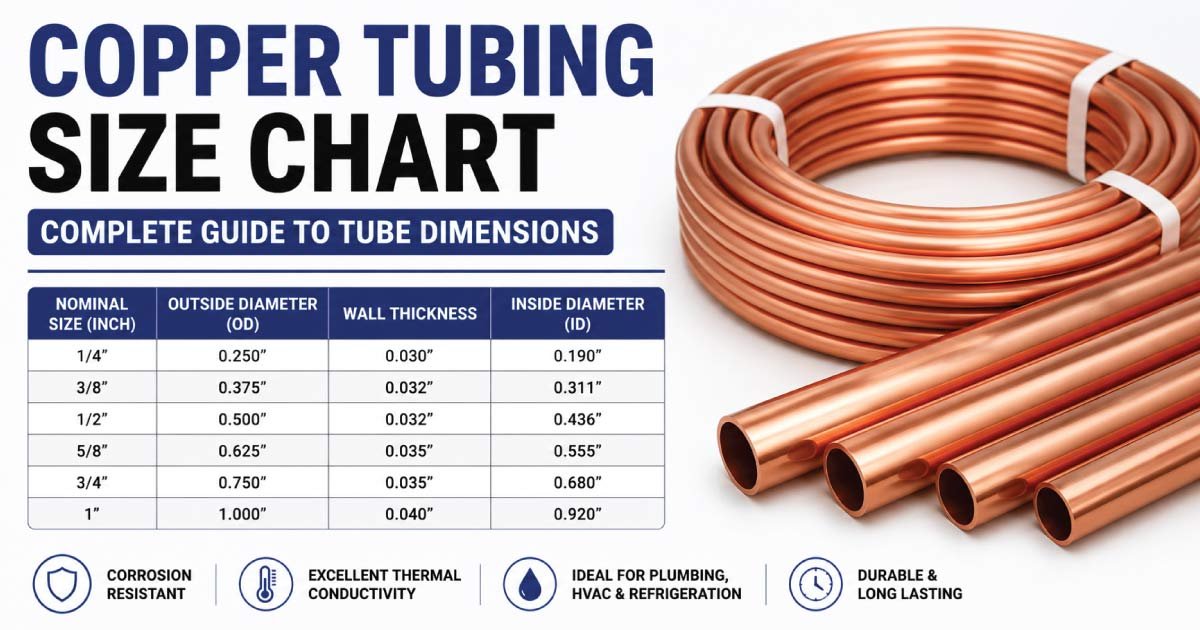
Copper tubing is one of the most widely used materials in plumbing, HVAC systems, refrigeration, and industrial applications. Its durability, corrosion resistance, excellent thermal conductivity, and long service life make it a preferred choice for professionals and homeowners alike.
However, selecting the correct copper tube size can be confusing because copper tubing dimensions are measured differently from many other piping materials. Understanding copper tubing sizes, outside diameters, wall thicknesses, and applications is essential for ensuring proper system performance.
In this complete guide, you will learn everything about copper tubing dimensions, standard sizing systems, types of copper tubes, and how to use a copper tubing size chart effectively.
What Is Copper Tubing?
Copper tubing is a hollow cylindrical metal tube manufactured from copper. It is commonly used for transporting water, refrigerants, gases, and other fluids.
Copper tubing is popular because it offers:
- Excellent corrosion resistance
- Long lifespan
- High temperature tolerance
- Easy installation
- Strong yet lightweight construction
- Natural antimicrobial properties
Copper tubes are available in various sizes and wall thicknesses to suit different applications.
Understand The Copper Tubing Dimensions
Before using a copper tubing size chart, it is important to understand how copper tubing is measured. Unlike some materials, copper tubing sizing is based on standardized dimensions that help ensure compatibility across plumbing and HVAC systems. These measurements directly affect flow capacity, pressure rating, and overall performance of the tubing system.
1. Nominal Size
The nominal size is the standard industry designation used to identify copper tubing. It does not always represent the exact physical measurement of the tube but serves as a reference for selecting compatible fittings and systems. This standardized labeling makes it easier to match pipes in plumbing, refrigeration, and heating applications.
2. Outside Diameter (OD)
The outside diameter is the actual measurement taken across the outer surface of the copper tube. It is a critical dimension because it determines fitting compatibility. In copper tubing systems, fittings are typically designed to match specific OD values, ensuring a tight and secure connection without leakage or misalignment.
3. Inside Diameter (ID)
The inside diameter represents the internal opening of the tube through which fluids or gases flow. It is one of the most important measurements because it directly affects flow capacity. A larger inside diameter allows higher flow rates, while a smaller one may restrict movement depending on system requirements.
4. Wall Thickness
Wall thickness refers to the distance between the outer and inner surfaces of the tube. It plays a key role in determining strength, durability, and pressure-handling ability. Thicker walls provide greater resistance to pressure and mechanical stress, making them suitable for demanding applications such as refrigeration and high-pressure plumbing systems.
The relationship between these dimensions is essential for accurate sizing and system design:
Inside Diameter = Outside Diameter − (2 × Wall Thickness)
Copper Tubing Size Chart
The following chart shows common copper tubing sizes used in residential and commercial applications.
| Nominal Size (in.) | Outside Diameter (in.) | Outside Diameter (mm) |
|---|---|---|
| 1/8 | 0.125 | 3.18 |
| 3/16 | 0.188 | 4.76 |
| 1/4 | 0.250 | 6.35 |
| 5/16 | 0.313 | 7.94 |
| 3/8 | 0.375 | 9.53 |
| 1/2 | 0.500 | 12.70 |
| 5/8 | 0.625 | 15.88 |
| 3/4 | 0.750 | 19.05 |
| 7/8 | 0.875 | 22.23 |
| 1 | 1.000 | 25.40 |
| 1-1/8 | 1.125 | 28.58 |
| 1-1/4 | 1.250 | 31.75 |
| 1-3/8 | 1.375 | 34.93 |
| 1-1/2 | 1.500 | 38.10 |
| 2 | 2.000 | 50.80 |
| 2-1/2 | 2.500 | 63.50 |
| 3 | 3.000 | 76.20 |
| 4 | 4.000 | 101.60 |
These dimensions are commonly used in refrigeration, HVAC, plumbing, and industrial systems.
Types of Copper Tubing
Copper tubing is widely used in plumbing and mechanical systems and is classified based on wall thickness, strength, and application. Each type is designed for specific pressure levels and installation environments, making it important to choose the right type for safety and performance.
1. Type K Copper Tubing
Type K copper tubing has the thickest walls among standard copper types, making it the strongest and most durable option. It is designed for high-pressure and demanding applications where long service life and underground reliability are required.
Characteristics:
- Highest pressure rating
- Superior durability
- Suitable for underground installations
- Long service life
Common applications:
- Water service lines
- Underground plumbing
- Industrial piping
2. Type L Copper Tubing
Type L is the most commonly used copper tubing in residential and commercial plumbing systems. It offers a balanced combination of strength and affordability, making it suitable for a wide range of general-purpose installations.
Characteristics:
- Medium wall thickness
- Excellent balance of strength and cost
- Suitable for most residential and commercial systems
Common applications:
- Interior plumbing
- Fire sprinkler systems
- HVAC installations
3. Type M Copper Tubing
Type M copper tubing has thinner walls compared to Type K and Type L, making it a lightweight and cost-effective option. It is commonly used in low to medium-pressure plumbing systems where high strength is not required.
Characteristics:
- Lightweight
- More affordable
- Easy to install
Common applications:
- Residential water distribution
- Low-pressure plumbing systems
4. DWV Copper Tubing
DWV stands for Drain, Waste, and Vent, and this type of copper tubing is specifically designed for non-pressurized systems. It is not used for water supply but plays an important role in waste and drainage management.
Characteristics:
- Thin wall construction
- Designed for non-pressurized systems
Applications:
- Drainage systems
- Vent piping
- Wastewater transport
Copper Tube Wall Thickness Chart
Wall thickness varies depending on the copper tube type.
| Nominal Size | Type K (in.) | Type L (in.) | Type M (in.) |
|---|---|---|---|
| 1/2 | 0.049 | 0.040 | 0.028 |
| 3/4 | 0.065 | 0.045 | 0.032 |
| 1 | 0.065 | 0.050 | 0.035 |
| 1-1/4 | 0.072 | 0.055 | 0.042 |
| 1-1/2 | 0.080 | 0.058 | 0.045 |
| 2 | 0.095 | 0.070 | 0.058 |
Thicker walls provide higher pressure ratings and improved durability.
Soft Copper Tubing vs Hard Copper Tubing
Copper tubing is produced in two main forms—soft and hard—each designed for different installation needs. The key difference lies in flexibility and strength, which affects how they are used in plumbing, HVAC, and industrial systems.
1. Soft Copper Tubing
Soft copper tubing is annealed during manufacturing, which makes it highly flexible and easy to work with. It is commonly used in systems where bending and routing around obstacles is required without using many fittings.
Benefits:
- Flexible
- Easy to bend
- Fewer fittings required
- Faster installation
Applications:
- Refrigeration lines
- Air conditioning systems
- Gas distribution
2. Hard Copper Tubing
Hard copper tubing is rigid and stronger, making it suitable for straight runs and exposed installations. It provides better structural support and is commonly used in permanent plumbing systems.
Benefits:
- Greater structural integrity
- Better for exposed installations
- Resistant to deformation
Applications:
- Residential plumbing
- Commercial water systems
- Industrial piping
How Copper Tubing Sizes Are Measured
Copper tubing sizes can be confusing for beginners because they are not always measured in the same way across all industries. Unlike pipes that often use nominal sizing, copper tubing is usually specified using actual dimensions, especially in HVAC and refrigeration work.
In most HVAC and refrigeration systems, copper tubing is identified by its outside diameter (OD) rather than the inside diameter. This ensures accurate fitting and system compatibility where precision is important for pressure and flow control.
For plumbing applications, sizing can sometimes follow nominal standards, which may not match the exact physical measurement of the tube. This difference makes it important to carefully check specifications before installation.
Therefore, always verify:
- Outside diameter
- Wall thickness
- Tube type
- Pressure rating
Before purchasing copper tubing, confirming these details ensures proper fit, safe operation, and system compatibility.
Common Copper Tubing Applications
Copper tubing is widely used across multiple industries due to its strength, corrosion resistance, and excellent thermal conductivity. It performs well in both residential and industrial environments, making it a reliable choice for fluid and gas transport systems.
1. Plumbing Systems
Copper is one of the most trusted materials for water supply systems in homes and buildings. It provides long-lasting performance and maintains water quality over time.
- Hot water supply
- Cold water supply
- Water service lines
2. HVAC Systems
Copper tubing is essential in heating, ventilation, and air conditioning systems because it efficiently transfers heat and withstands pressure changes.
- Air conditioning systems
- Heat pumps
- Refrigeration units
3. Medical Gas Systems
In healthcare facilities, copper tubing is used for safe and reliable gas distribution systems. It is preferred for its cleanliness and durability.
- Oxygen delivery
- Medical vacuum systems
- Specialized gas distribution
4. Industrial Applications
Copper tubing is also used in various industrial processes where strength and thermal performance are important.
- Chemical transport
- Hydraulic systems
- Heat exchangers
Advantages of Copper Tubing
Copper tubing remains one of the most widely used materials in plumbing, HVAC, and refrigeration systems due to its durability and reliable performance. Its natural properties make it suitable for both residential and industrial applications, offering long-term value and consistent efficiency.
1. Excellent Corrosion Resistance
Copper has a natural ability to resist corrosion and rust, even when exposed to moisture and water over long periods. This makes it highly reliable for plumbing systems where water quality and pipe longevity are important. Its resistance helps maintain system integrity and reduces the need for frequent repairs or replacements.
2. Long Service Life
One of the biggest advantages of copper tubing is its exceptional lifespan. When properly installed and maintained, it can last more than 50 years. This long service life makes it a cost-effective choice in the long run, especially for critical systems where durability is essential.
3. High Temperature Resistance
Copper tubing performs well under both high and low temperature conditions. It does not easily warp, crack, or lose strength when exposed to heat or cold. This makes it ideal for hot water lines, refrigeration systems, and HVAC applications where temperature changes are frequent.
4. Antimicrobial Properties
Copper naturally has antimicrobial characteristics that help inhibit the growth of bacteria and other harmful microorganisms. This makes it a safe and reliable option for potable water systems, ensuring cleaner water quality and improved hygiene in residential and commercial plumbing networks.
5. Recyclable Material
Copper is fully recyclable without any loss in quality or performance. This makes it an environmentally friendly choice for sustainable construction and manufacturing. Recycling copper also reduces environmental impact and supports resource conservation, making it a preferred material in green building practices.
How to Choose the Right Copper Tube Size
Selecting the correct copper tube size is important for ensuring proper flow, pressure stability, and long-term system reliability. Using the wrong size can lead to pressure loss, inefficient performance, or even system failure. The right choice depends on usage requirements, installation conditions, and code compliance.
1. Flow Requirements
Flow rate is one of the most important factors when choosing copper tubing size. Systems that carry higher volumes of water or fluid require larger diameter tubes to maintain smooth flow and reduce resistance. Proper sizing ensures efficient distribution and prevents pressure drops in multi-fixture or high-demand systems.
2. Pressure Requirements
The pressure level inside the system determines the type of copper tubing needed. High-pressure applications require thicker-walled tubing such as Type K, which offers greater strength and durability. Medium and low-pressure systems may use Type L or Type M depending on performance needs and system design.
3. Installation Location
Where the tubing is installed also affects the choice of size and type. Underground installations typically use Type K tubing because it provides the highest durability and resistance to external damage. Above-ground systems may use lighter types since they are less exposed to physical stress and environmental hazards.
4. Budget Considerations
Cost is another key factor in selecting copper tubing. Type M tubing is generally the most economical option and is commonly used in residential plumbing systems. While it has thinner walls compared to other types, it is still suitable for many low to moderate pressure applications when properly installed.
5. Industry Standards
Always follow local plumbing and building codes when selecting copper tube sizes. These standards ensure safety, performance, and compliance with regulatory requirements. Adhering to industry guidelines also helps prevent installation issues and ensures compatibility with fittings and other system components.
Copper Tubing Standards
Copper tubing is manufactured according to strict international standards to ensure safety, performance, and consistency. These standards define dimensions, material quality, pressure ratings, and testing requirements. Following them ensures that copper tubing performs reliably in plumbing, HVAC, and industrial systems.
1. ASTM Standards
ASTM (American Society for Testing and Materials) develops detailed specifications for copper tubing, including size dimensions, wall thickness, chemical composition, and quality control requirements. These standards ensure that tubing meets performance expectations and can safely handle different pressure and environmental conditions in various applications.
2. ASME Standards
ASME (American Society of Mechanical Engineers) provides guidelines for the design and use of copper tubing in pressure systems and mechanical installations. These standards focus on safety and structural integrity, ensuring that tubing performs effectively in systems where pressure and mechanical stress are significant factors.
3. NSF Standards
NSF (National Sanitation Foundation) certifications confirm that copper tubing is safe for use in potable (drinking) water systems. This certification ensures that the tubing does not release harmful substances into the water supply, maintaining high standards of hygiene and public health safety.
Compliance with these standards ensures that copper tubing delivers consistent quality, long-term durability, and safe performance across residential, commercial, and industrial applications.
Tips for Working With Copper Tubing
Professionals follow several best practices when installing copper tubing.
- Measure carefully before cutting.
- Use proper tube cutters.
- Deburr cut ends.
- Select the correct fittings.
- Avoid excessive bending.
- Support tubing adequately.
- Pressure test installations before use.
These practices improve system longevity and performance.
Common Mistakes to Avoid
Many installation problems result from sizing errors.
Avoid these common mistakes:
- Choosing tubing based solely on outside diameter
- Ignoring wall thickness
- Using the wrong tube type
- Failing to account for pressure requirements
- Selecting undersized tubing for high-flow applications
Careful planning helps prevent costly repairs later.
Copper Tubing vs Copper Pipe
Many people use the terms copper tubing and copper pipe interchangeably, but they are not exactly the same. The main difference lies in how they are sized and where they are typically used in plumbing and mechanical systems.
Copper tubing is usually measured by its actual outside diameter (OD). It is commonly used in HVAC, refrigeration, and precision systems where exact sizing is important for fittings and performance.
Copper pipe, on the other hand, often uses nominal sizing, which does not match the exact physical measurement. It is more commonly found in general plumbing systems for water distribution.
Understanding this distinction helps ensure proper material selection and prevents fitting or compatibility issues during installation.
Conclusion
Understanding copper tubing dimensions is essential for designing efficient plumbing, HVAC, refrigeration, and industrial systems. A copper tubing size chart provides a quick reference for selecting the correct outside diameter, wall thickness, and tube type for a specific application.
Whether you’re installing a residential water line, an air conditioning system, or an industrial process line, choosing the right copper tubing size improves performance, safety, and longevity. By understanding nominal sizes, outside diameters, wall thickness classifications, and common applications, you can confidently select the most suitable copper tubing for your project.
Also Read: 👉 Measuring pipe diameter accurately is essential for selecting the correct fittings, replacements, and plumbing components. This guide explains how to measure pipe diameter easily with a size chart, helping you identify standard pipe sizes, outside diameters, and nominal dimensions. Learn simple measurement techniques and avoid costly mistakes. Read the full post for detailed size charts, practical examples, and expert plumbing tips.