
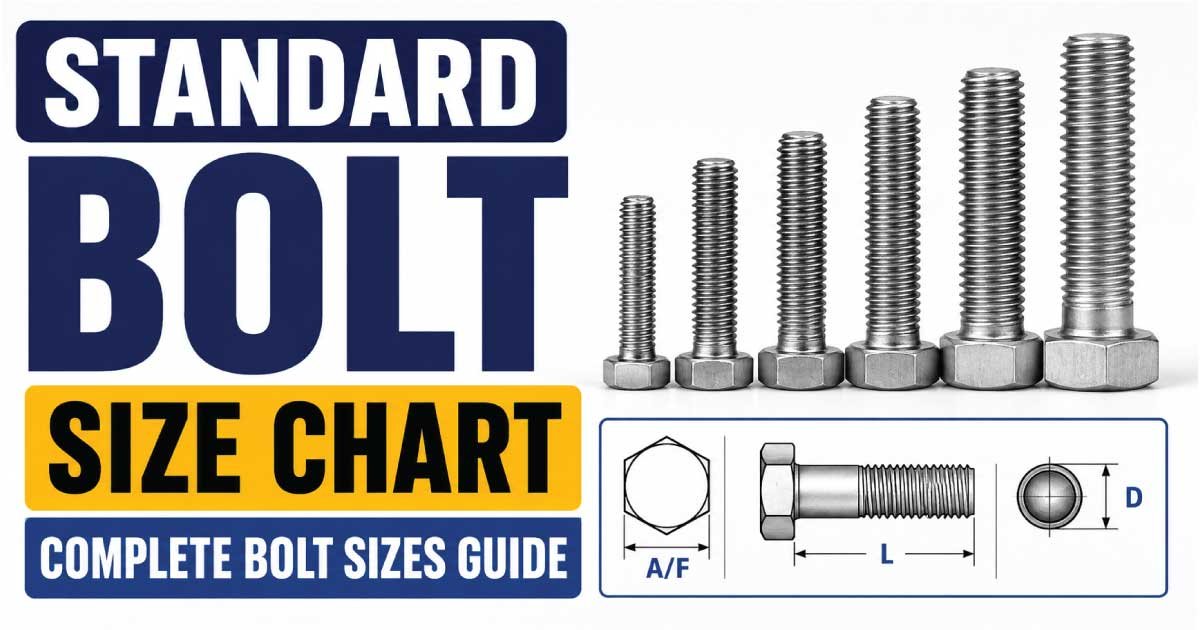
A standard bolt size chart is a useful reference for identifying common inch-based bolt sizes, diameters, thread counts, and related dimensions. Standard bolts are widely used in automotive repair, machinery, construction, manufacturing, maintenance, woodworking, and general hardware applications.
Unlike metric bolts, which are identified using millimeters and the M designation, standard or inch bolts are commonly identified by fractions such as 1/4 inch, 3/8 inch, 1/2 inch, 5/8 inch, and 3/4 inch. Their thread specification is normally given in threads per inch (TPI).
Standard Bolt Size Chart
The following chart provides common standard bolt diameters and typical UNC and UNF thread specifications.
| Standard Bolt Size | Nominal Diameter | UNC Threads Per Inch | UNF Threads Per Inch |
|---|---|---|---|
| #6 | 0.138 in | 32 | 40 |
| #8 | 0.164 in | 32 | 36 |
| #10 | 0.190 in | 24 | 32 |
| 1/4 in | 0.250 in | 20 | 28 |
| 5/16 in | 0.3125 in | 18 | 24 |
| 3/8 in | 0.375 in | 16 | 24 |
| 7/16 in | 0.4375 in | 14 | 20 |
| 1/2 in | 0.500 in | 13 | 20 |
| 9/16 in | 0.5625 in | 12 | 18 |
| 5/8 in | 0.625 in | 11 | 18 |
| 3/4 in | 0.750 in | 10 | 16 |
| 7/8 in | 0.875 in | 9 | 14 |
| 1 in | 1.000 in | 8 | 12 |
| 1-1/8 in | 1.125 in | 7 | 12 |
| 1-1/4 in | 1.250 in | 7 | 12 |
| 1-3/8 in | 1.375 in | 6 | 12 |
| 1-1/2 in | 1.500 in | 6 | 12 |
The exact thread designation should always be checked against the applicable fastener standard because thread combinations and specifications can vary.
What Is a Standard Bolt?
A standard bolt generally refers to a fastener manufactured using an inch-based measurement system rather than the metric system. These bolts are commonly found in the United States and in equipment designed around imperial measurements.
Standard bolts can use several different thread systems. Two of the most common are:
- UNC — Unified National Coarse
- UNF — Unified National Fine
Other thread standards may also be encountered depending on the application and equipment.
Standard bolt dimensions can include diameter, length, thread pitch expressed as TPI, head size, thread length, material, and strength grade.
How to Read Standard Bolt Sizes
A standard bolt designation may look like:
1/2-13 × 2
This specification can be understood as:
- 1/2 = nominal bolt diameter
- 13 = 13 threads per inch
- 2 = 2-inch bolt length
Another example is:
3/8-16 × 1-1/2
This means:
- 3/8 inch nominal diameter
- 16 TPI
- 1-1/2 inch length
The thread series may also be included, such as 1/2-13 UNC or 1/2-20 UNF.
Standard Bolt Diameter Chart
Bolt diameter is one of the most important measurements for identifying an inch-based fastener.
| Bolt Size | Diameter in Inches | Diameter in Millimeters |
|---|---|---|
| #6 | 0.138 in | 3.51 mm |
| #8 | 0.164 in | 4.17 mm |
| #10 | 0.190 in | 4.83 mm |
| 1/4 in | 0.250 in | 6.35 mm |
| 5/16 in | 0.3125 in | 7.94 mm |
| 3/8 in | 0.375 in | 9.53 mm |
| 7/16 in | 0.4375 in | 11.11 mm |
| 1/2 in | 0.500 in | 12.70 mm |
| 9/16 in | 0.5625 in | 14.29 mm |
| 5/8 in | 0.625 in | 15.88 mm |
| 3/4 in | 0.750 in | 19.05 mm |
| 7/8 in | 0.875 in | 22.23 mm |
| 1 in | 1.000 in | 25.40 mm |
| 1-1/8 in | 1.125 in | 28.58 mm |
| 1-1/4 in | 1.250 in | 31.75 mm |
| 1-1/2 in | 1.500 in | 38.10 mm |
UNC Bolt Size Chart
UNC, or Unified National Coarse, is one of the most common inch-based thread systems. Coarse threads have fewer threads per inch compared with fine threads of the same nominal diameter.
| Bolt Size | UNC TPI |
|---|---|
| #6 | 32 |
| #8 | 32 |
| #10 | 24 |
| 1/4 in | 20 |
| 5/16 in | 18 |
| 3/8 in | 16 |
| 7/16 in | 14 |
| 1/2 in | 13 |
| 9/16 in | 12 |
| 5/8 in | 11 |
| 3/4 in | 10 |
| 7/8 in | 9 |
| 1 in | 8 |
| 1-1/8 in | 7 |
| 1-1/4 in | 7 |
| 1-3/8 in | 6 |
| 1-1/2 in | 6 |
UNC bolts are commonly used for general-purpose fastening and many mechanical applications.
UNF Bolt Size Chart
UNF, or Unified National Fine, uses more threads per inch than UNC for the same nominal diameter.
| Bolt Size | UNF TPI |
|---|---|
| #6 | 40 |
| #8 | 36 |
| #10 | 32 |
| 1/4 in | 28 |
| 5/16 in | 24 |
| 3/8 in | 24 |
| 7/16 in | 20 |
| 1/2 in | 20 |
| 9/16 in | 18 |
| 5/8 in | 18 |
| 3/4 in | 16 |
| 7/8 in | 14 |
| 1 in | 12 |
| 1-1/8 in | 12 |
| 1-1/4 in | 12 |
| 1-3/8 in | 12 |
| 1-1/2 in | 12 |
A UNF bolt should be matched with a nut having the same diameter and thread specification.
Also Read: Circuit Breaker Sizes Explained 2026: With Charts
UNC vs UNF Bolts
The main difference between UNC and UNF is the number of threads per inch.
For example, a 1/2-inch bolt can be available as:
- 1/2-13 UNC
- 1/2-20 UNF
Both have a nominal diameter of 1/2 inch, but the thread spacing is different.
UNC has 13 threads per inch, while UNF has 20 threads per inch.
Because their threads are different, a UNC nut should not be forced onto a UNF bolt or vice versa.
Standard Bolt Head Size Chart
The bolt head determines the wrench or socket required for installation and removal. Head dimensions depend on the specific bolt standard and configuration.
Common reference values for hex-head bolts include:
| Bolt Diameter | Common Head Width |
|---|---|
| 1/4 in | 7/16 in |
| 5/16 in | 1/2 in |
| 3/8 in | 9/16 in |
| 7/16 in | 5/8 in |
| 1/2 in | 3/4 in |
| 9/16 in | 7/8 in |
| 5/8 in | 15/16 in |
| 3/4 in | 1-1/8 in |
| 7/8 in | 1-5/16 in |
| 1 in | 1-1/2 in |
These values are useful for general identification, but exact head dimensions should be confirmed against the applicable bolt standard.
Standard Bolt Length Chart
Bolt length is normally measured from the underside of the head to the end of the bolt for standard hex-head bolts.
| Bolt Length | Decimal Inches | Millimeters |
|---|---|---|
| 1/2 in | 0.500 | 12.7 mm |
| 3/4 in | 0.750 | 19.1 mm |
| 1 in | 1.000 | 25.4 mm |
| 1-1/4 in | 1.250 | 31.8 mm |
| 1-1/2 in | 1.500 | 38.1 mm |
| 2 in | 2.000 | 50.8 mm |
| 2-1/2 in | 2.500 | 63.5 mm |
| 3 in | 3.000 | 76.2 mm |
| 3-1/2 in | 3.500 | 88.9 mm |
| 4 in | 4.000 | 101.6 mm |
| 5 in | 5.000 | 127.0 mm |
| 6 in | 6.000 | 152.4 mm |
The correct length depends on the thickness of the materials being joined and the required thread engagement.
Standard Bolt Size Conversion Chart
Metric and standard bolts can have similar nominal diameters, but similar sizes do not automatically mean that they can be substituted.
| Standard Size | Diameter | Closest Metric Diameter |
|---|---|---|
| 1/4 in | 6.35 mm | M6 |
| 5/16 in | 7.94 mm | M8 |
| 3/8 in | 9.53 mm | M10 |
| 7/16 in | 11.11 mm | M12 |
| 1/2 in | 12.70 mm | M12 |
| 9/16 in | 14.29 mm | M14 |
| 5/8 in | 15.88 mm | M16 |
| 3/4 in | 19.05 mm | M20 |
| 7/8 in | 22.23 mm | M22 |
| 1 in | 25.40 mm | M24/M27 range |
These are diameter comparisons only. Thread pitch and thread form must also match before any fastener substitution is considered.
Also Read: Drill Chuck Sizes and Types: 2026 Complete Chart Guide
Standard Bolt Sizes for Common Applications
Several inch-based bolt sizes are frequently encountered in general hardware and mechanical work.
1/4-inch bolts are commonly used for smaller assemblies, brackets, equipment, and general fastening.
5/16-inch and 3/8-inch bolts are common in machinery, automotive components, brackets, frames, and maintenance applications.
1/2-inch bolts are frequently used for larger mechanical assemblies and heavier fastening requirements.
5/8-inch, 3/4-inch, and larger bolts are often used where larger fasteners are required, depending on the design and engineering specifications.
The appropriate bolt should always be selected according to the requirements of the specific application rather than size alone.
How to Measure a Standard Bolt
If you have an unknown bolt, several measurements can help identify it.
First, measure the outside diameter of the threaded section. Because standard bolt diameters are expressed in inches, you can use a ruler or digital caliper with inch measurements.
Next, determine the thread count. A thread pitch gauge can help identify the TPI, or you can count the threads over a measured one-inch section.
Finally, measure the bolt length and head width.
The identification process is:
- Measure the bolt diameter.
- Determine the diameter in inches.
- Measure or identify the threads per inch.
- Determine whether the thread is UNC or UNF.
- Measure bolt length.
- Measure the head width.
- Check any grade or manufacturer markings.
- Compare the measurements with a standard bolt size chart.
Standard Bolt Grade Chart
Bolt dimensions alone do not determine how much load a fastener can safely handle. Bolt grade and material are also important.
Common inch-based fasteners can be manufactured to different SAE or ASTM specifications and grades. Head markings can provide information about the fastener’s strength classification.
When replacing a bolt, do not select a replacement based only on diameter and length. The replacement should meet the required specification and strength for the application.
For automotive, structural, machinery, lifting, or other safety-critical applications, use the specified fastener rather than relying on appearance alone.
Standard Bolt Size and Wrench Size
Bolt diameter and wrench size are two different measurements.
For example, a 1/2-inch bolt does not necessarily mean that a 1/2-inch wrench will fit its head. The bolt diameter identifies the threaded shank, while the wrench size identifies the width of the bolt head.
This distinction is important when purchasing tools.
Before selecting a socket, measure the head across the flats and compare it with the appropriate head-size specification.
Standard Bolt vs Metric Bolt
The primary difference between standard and metric bolts is the measurement system.
| Feature | Standard Bolt | Metric Bolt |
|---|---|---|
| Measurement | Inches | Millimeters |
| Diameter Example | 1/2 in | M12 |
| Thread Measurement | TPI | Thread pitch in mm |
| Common Thread Types | UNC, UNF | Coarse, fine |
| Length | Inches | Millimeters |
| Common Use | Inch-based equipment | Metric equipment |
Although some standard and metric bolts have similar diameters, their threads may be completely different.
Also Read: Collet Sizes: Complete Guide with Charts (2026)
How to Choose the Correct Standard Bolt
Selecting the correct standard bolt requires checking several dimensions and specifications.
Before buying a replacement bolt, confirm:
- Nominal diameter
- Bolt length
- Threads per inch
- UNC or UNF thread type
- Head dimensions
- Bolt grade
- Material
- Surface finish
- Thread length
- Application requirements
A bolt should fit correctly without forcing the threads. If a bolt requires excessive force to start, stop and verify the thread specification rather than attempting to tighten it.
Standard Bolt Size Chart Quick Reference
For quick identification, the following sizes are among the most commonly encountered inch-based bolts:
| Bolt Size | Diameter | UNC | UNF |
|---|---|---|---|
| 1/4 in | 0.250 in | 20 TPI | 28 TPI |
| 5/16 in | 0.3125 in | 18 TPI | 24 TPI |
| 3/8 in | 0.375 in | 16 TPI | 24 TPI |
| 7/16 in | 0.4375 in | 14 TPI | 20 TPI |
| 1/2 in | 0.500 in | 13 TPI | 20 TPI |
| 9/16 in | 0.5625 in | 12 TPI | 18 TPI |
| 5/8 in | 0.625 in | 11 TPI | 18 TPI |
| 3/4 in | 0.750 in | 10 TPI | 16 TPI |
| 7/8 in | 0.875 in | 9 TPI | 14 TPI |
| 1 in | 1.000 in | 8 TPI | 12 TPI |
Final Thoughts on Standard Bolt Sizes
A standard bolt size chart makes it easier to identify common inch-based fasteners by diameter, thread count, length, and thread series. The most important measurements are the nominal diameter, threads per inch, bolt length, head dimensions, and thread type.
When identifying an unknown bolt, never rely on diameter alone. A 1/2-inch UNC bolt and a 1/2-inch UNF bolt have the same nominal diameter but different threads and require different matching nuts.
For accurate replacement, always verify the complete bolt specification and, for critical applications, follow the applicable manufacturer’s or engineering standard.