
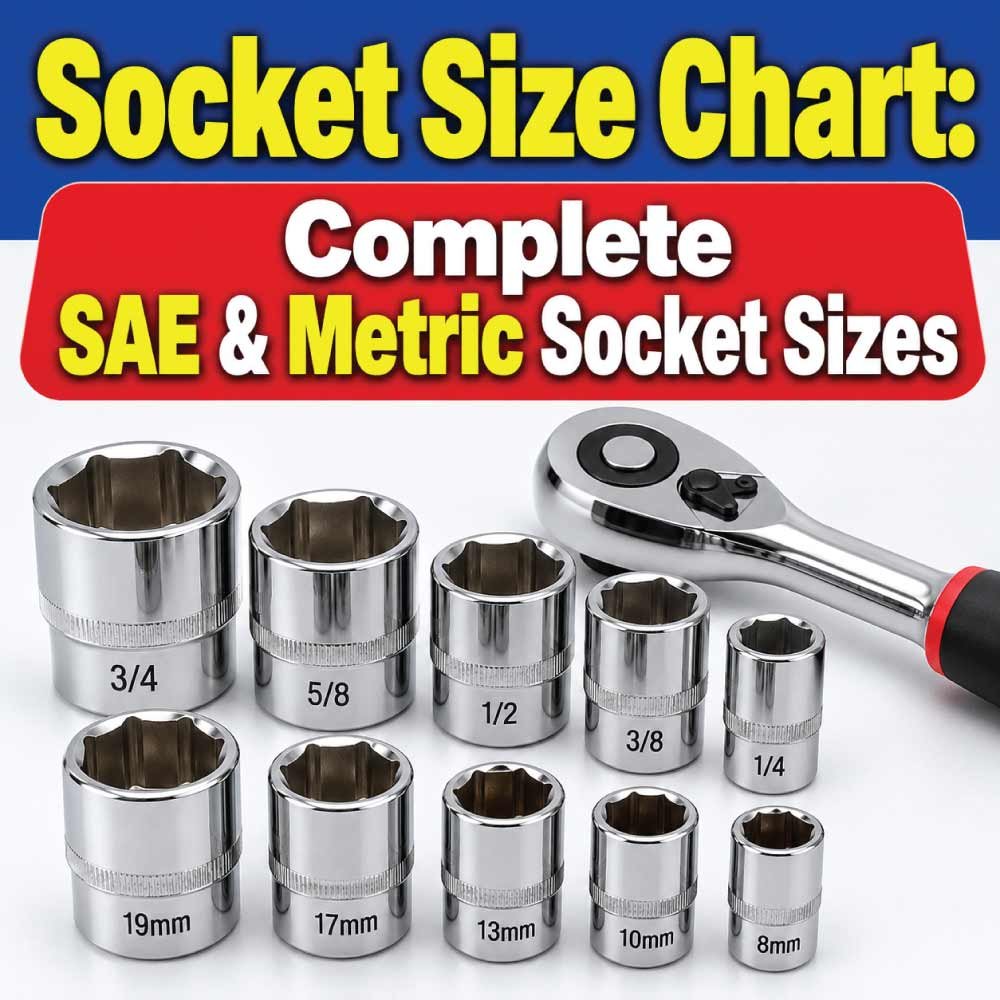
Choosing the correct socket can be frustrating when a toolbox contains both SAE and metric sockets. A socket that looks almost identical to another may still be too loose, too tight, or simply the wrong size for the fastener.
This socket size chart provides a practical reference for common SAE and metric socket sizes, along with decimal-inch conversions. It also explains socket drive sizes, how SAE and metric measurements differ, how to choose the right socket, and what to do when you are between sizes.
Whether you work on cars, motorcycles, machinery, home repairs, or general maintenance, understanding socket sizes makes fastening work faster and helps reduce the risk of damaging nuts and bolt heads.
What Is a Socket Size?
A socket size refers to the size of the fastener head that the socket is designed to fit. For example, a 10 mm socket is designed to fit a fastener with a nominal 10 mm hexagonal head, while a 3/8-inch SAE socket is designed around a 3/8-inch fastener size.
The socket’s working opening is different from its drive size. A socket can have a 1/4-inch drive and still be a 10 mm socket.
Socket sizes are commonly identified using two measurement systems:
- Metric: measured in millimeters, such as 8 mm, 10 mm, and 13 mm.
- SAE: measured in inches, such as 1/4″, 3/8″, and 1/2″.
- Drive size: the square connection between the socket and ratchet, commonly 1/4″, 3/8″, 1/2″, and 3/4″.
Understanding these three measurements prevents one of the most common socket mistakes: confusing the socket opening size with the ratchet drive size.
Metric Socket Size Chart
Metric sockets are measured in millimeters (mm) and are widely used on modern vehicles, machinery, appliances, bicycles, and general mechanical equipment.
The following chart covers common metric socket sizes.
| Metric Socket Size | Approx. SAE Equivalent | Decimal Inch Equivalent |
|---|---|---|
| 4 mm | 5/32″ | 0.1575″ |
| 5 mm | 3/16″ | 0.1969″ |
| 6 mm | 1/4″ | 0.2362″ |
| 7 mm | 9/32″ | 0.2756″ |
| 8 mm | 5/16″ | 0.3150″ |
| 9 mm | 11/32″ | 0.3543″ |
| 10 mm | 3/8″ | 0.3937″ |
| 11 mm | 7/16″ | 0.4331″ |
| 12 mm | 15/32″ | 0.4724″ |
| 13 mm | 1/2″ | 0.5118″ |
| 14 mm | 9/16″ | 0.5512″ |
| 15 mm | 19/32″ | 0.5906″ |
| 16 mm | 5/8″ | 0.6299″ |
| 17 mm | 11/16″ | 0.6693″ |
| 18 mm | 11/16″ | 0.7087″ |
| 19 mm | 3/4″ | 0.7480″ |
| 21 mm | 13/16″ | 0.8268″ |
| 22 mm | 7/8″ | 0.8661″ |
| 24 mm | 15/16″ | 0.9449″ |
| 27 mm | 1-1/16″ | 1.0630″ |
| 30 mm | 1-3/16″ | 1.1811″ |
| 32 mm | 1-1/4″ | 1.2598″ |
The SAE equivalents in this table are approximate dimensional comparisons, not guaranteed interchangeable sizes. A metric and SAE socket may be close in diameter but still have enough difference to cause poor engagement.
SAE Socket Size Chart
SAE sockets use inch-based measurements. SAE is commonly associated with U.S. customary measurements and remains widely encountered on older American vehicles, machinery, equipment, and many general-purpose tools.
Here are common SAE socket sizes.
| SAE Socket Size | Decimal Inch | Approx. Metric Equivalent |
|---|---|---|
| 1/4″ | 0.250″ | 6.35 mm |
| 9/32″ | 0.281″ | 7.14 mm |
| 5/16″ | 0.313″ | 7.94 mm |
| 11/32″ | 0.344″ | 8.73 mm |
| 3/8″ | 0.375″ | 9.53 mm |
| 7/16″ | 0.438″ | 11.11 mm |
| 1/2″ | 0.500″ | 12.70 mm |
| 9/16″ | 0.563″ | 14.29 mm |
| 5/8″ | 0.625″ | 15.88 mm |
| 11/16″ | 0.688″ | 17.46 mm |
| 3/4″ | 0.750″ | 19.05 mm |
| 13/16″ | 0.813″ | 20.64 mm |
| 7/8″ | 0.875″ | 22.23 mm |
| 15/16″ | 0.938″ | 23.81 mm |
| 1″ | 1.000″ | 25.40 mm |
| 1-1/16″ | 1.063″ | 26.99 mm |
| 1-1/8″ | 1.125″ | 28.58 mm |
| 1-1/4″ | 1.250″ | 31.75 mm |
| 1-3/8″ | 1.375″ | 34.93 mm |
| 1-1/2″ | 1.500″ | 38.10 mm |
The metric values shown are mathematical conversions. They should not be treated as evidence that a particular metric socket is a suitable replacement for an SAE socket.
SAE vs Metric Socket Sizes
The biggest difference is how the socket size is expressed. Metric sockets are identified in millimeters, while SAE sockets are identified in fractions or decimal inches.
For example:
- 10 mm = 0.3937 inch
- 12 mm = 0.4724 inch
- 13 mm = 0.5118 inch
- 1/2 inch = 12.7 mm
- 5/8 inch = 15.875 mm
- 3/4 inch = 19.05 mm
Some sizes are relatively close to one another. For example, 19 mm and 3/4 inch differ by only about 0.05 mm in the nominal conversion. However, being close does not automatically make them interchangeable.
Why You Should Not Force a Close Size
Using an almost-correct socket can create several problems:
- The socket may not fully engage the fastener.
- Torque can become concentrated on the corners.
- A worn fastener may become rounded.
- The socket can slip under load.
- Removing a damaged fastener can become much more difficult.
For a normal hex fastener, the safest approach is to use the correct socket size that fully seats on the fastener.
Common Socket Drive Sizes
The socket opening size and the drive size are separate specifications.
The drive is the square opening that connects to a ratchet, breaker bar, torque wrench, extension, or other compatible tool.
| Drive Size | Typical Use | General Characteristics |
|---|---|---|
| 1/4″ | Small fasteners, electronics, light mechanical work | Compact |
| 3/8″ | Automotive and general repair | Versatile |
| 1/2″ | Larger automotive and mechanical work | Higher torque capability |
| 3/4″ | Heavy equipment and large fasteners | Heavy-duty |
| 1″ | Large industrial applications | Very high-load applications |
Drive selection depends on the required torque, available clearance, and the size of the fastener.
A 1/2-inch drive socket does not mean the socket opening is 1/2 inch. You can have a 1/2-inch-drive socket in sizes such as 10 mm, 13 mm, 19 mm, 24 mm, and many others.
How to Choose the Correct Socket Size
Selecting a socket is usually straightforward when the fastener is in good condition and its size is known.
1. Identify the Measurement System
First determine whether the fastener is likely to be metric or SAE.
Vehicle and equipment specifications, service manuals, markings, and the original hardware can provide useful clues.
2. Try the Correct Socket
Place the socket directly over the fastener.
The socket should:
- Sit squarely on the fastener.
- Fully engage the flats.
- Have minimal noticeable movement.
- Remain seated when light pressure is applied.
Do not hammer a standard socket onto a fastener simply because it is close in size.
3. Check the Drive Size
Once the socket opening is selected, make sure its drive matches the ratchet or other tool.
For example, a 13 mm socket with a 3/8-inch drive requires a 3/8-inch-drive ratchet.
4. Consider Access and Torque
The largest socket is not always the best choice.
In a tight space, a compact ratchet and shallow socket may be more practical. For high-torque work, a larger drive system may be appropriate if the socket, tool, fastener, and manufacturer’s instructions support it.
Deep, Shallow, and Specialty Sockets
Socket size is only one part of choosing the right tool. Socket depth and design can also matter.
Shallow Sockets
Shallow sockets are useful when the fastener does not extend deeply into the socket.
Their compact profile can be advantageous in areas with limited clearance.
Deep Sockets
Deep sockets provide additional internal depth for fasteners mounted on longer studs or threaded shafts.
They are especially useful when a standard shallow socket bottoms out before reaching the fastener.
Impact Sockets
Impact sockets are designed for use with compatible impact tools and are generally made for the repeated shock loads associated with those tools.
They are commonly identified by their heavier construction and typically darker finish, although appearance alone should not be used to determine whether a socket is impact-rated.
Spark Plug Sockets
Spark plug sockets are specialized sockets designed around spark plug dimensions and often include features intended to help retain the plug during installation or removal.
The required size varies by spark plug and engine application.
6-Point vs 12-Point Sockets
A 6-point socket contacts the six flats of a conventional hex fastener and is often preferred when maximum engagement is important.
A 12-point socket can provide more starting positions, which can be useful where access is restricted.
For stubborn or damaged hex fasteners, a properly sized 6-point socket is often a better choice than a 12-point design.
Also Read:
How to Convert SAE Socket Sizes to Metric
To convert an SAE size to millimeters, multiply the inch measurement by 25.4.
For example:
1/2 inch × 25.4 = 12.7 mm
Likewise:
3/4 inch × 25.4 = 19.05 mm
To convert millimeters to inches, divide the measurement by 25.4.
19 mm ÷ 25.4 ≈ 0.748 inch
These calculations are useful for understanding the dimensional relationship between SAE and metric measurements.
However, a conversion does not mean the resulting socket size is interchangeable. Socket fit depends on the actual fastener geometry and tolerance.
Most Common Socket Sizes
If you are building a general-purpose socket set, certain sizes are encountered frequently, although the ideal selection depends heavily on the equipment you service.
Common Metric Sizes
Common metric sizes often found in general mechanical work include:
- 8 mm
- 10 mm
- 12 mm
- 13 mm
- 14 mm
- 15 mm
- 17 mm
- 18 mm
- 19 mm
- 21 mm
- 22 mm
Common SAE Sizes
Frequently encountered SAE sizes include:
- 1/4″
- 5/16″
- 3/8″
- 7/16″
- 1/2″
- 9/16″
- 5/8″
- 11/16″
- 3/4″
- 13/16″
- 7/8″
- 15/16″
- 1″
A complete set will normally contain additional intermediate sizes.
Also Read:
Socket Size Chart for Automotive Work
Automotive applications can contain both metric and SAE fasteners depending on the vehicle, component, manufacturer, model year, and replacement parts.
A practical automotive socket collection may include several drive sizes.
| Drive | Useful Socket Range | Typical Applications |
|---|---|---|
| 1/4″ | Small metric and SAE sizes | Interior and light-duty fasteners |
| 3/8″ | Small to medium sizes | General automotive work |
| 1/2″ | Medium to large sizes | Suspension and larger fasteners |
| 3/4″ | Large sizes | Heavy-duty equipment and large hardware |
This is a general selection guide, not a specification for every vehicle. Always follow the vehicle manufacturer’s service information where exact socket requirements matter.
Common Socket Size Mistakes to Avoid
Even experienced DIY users can encounter problems when selecting sockets.
Using SAE on a Metric Fastener
A close SAE size may appear to fit a metric fastener, but even a small mismatch can affect engagement.
Using Metric on an SAE Fastener
The same problem occurs in reverse. A socket that feels almost correct should not automatically be used.
Confusing Drive Size With Socket Size
A 3/8-inch-drive socket can have many different opening sizes. The 3/8-inch measurement identifies the drive connection, not the fastener.
Using the Wrong Socket Type
Standard sockets should not automatically be substituted for impact-rated sockets when using an impact tool.
Ignoring a Damaged Fastener
If the fastener head is rounded, rusted, or damaged, selecting a slightly smaller or larger standard socket may make the situation worse. A purpose-designed extraction solution may be more appropriate.
Also Read:
How to Tell What Socket Size You Need
If the fastener size is unknown, start by examining the head and choosing a socket that appears to fit.
Use the smallest appropriate socket that fully seats without excessive force.
A good fit should feel solid rather than loose. If you can visibly see gaps between the socket and fastener flats, try another size.
For critical mechanical work, do not rely solely on visual estimation. Consult the equipment documentation, fastener specifications, or manufacturer service information when available.
For heavily corroded or damaged fasteners, measurement may also become less reliable because corrosion can alter the original dimensions.
Frequently Asked Questions About Socket Sizes
Are SAE and metric sockets interchangeable?
Not generally. Some SAE and metric sizes have very similar nominal dimensions, but similar dimensions do not guarantee a safe or proper fit. Use the specified socket size whenever possible.
What are the most common metric socket sizes?
Common metric sizes include 8 mm, 10 mm, 12 mm, 13 mm, 14 mm, 15 mm, 17 mm, 18 mm, and 19 mm, although requirements vary by application.
What are the most common SAE socket sizes?
Common SAE sizes include 1/4″, 5/16″, 3/8″, 7/16″, 1/2″, 9/16″, 5/8″, 11/16″, 3/4″, and 7/8″.
Is a 19 mm socket the same as 3/4 inch?
No. 3/4 inch equals 19.05 mm, while 19 mm is slightly smaller. Although the difference is small, they are technically different sizes and should not be treated as identical.
What does 1/2-inch drive mean on a socket?
It means the socket has a 1/2-inch square drive connection for a compatible ratchet, breaker bar, torque wrench, or extension. It does not mean that the socket opening is 1/2 inch.
Should I use a 6-point or 12-point socket?
A 6-point socket generally provides stronger engagement with a conventional hex fastener. A 12-point socket can be useful when access is limited because it offers more engagement positions.
What socket size is best for automotive repairs?
There is no single automotive socket size. A combination of metric and SAE sockets, commonly across 1/4-inch, 3/8-inch, and 1/2-inch drive systems, provides broader coverage.
Socket Size Chart: Key Takeaways
A good understanding of socket sizes helps you work more efficiently and avoid damaged fasteners.
Remember these important points:
- Metric sockets use millimeters.
- SAE sockets use inches.
- Drive size is separate from socket opening size.
- SAE-to-metric conversions show dimensional relationships but do not guarantee interchangeability.
- A socket should fully and squarely engage the fastener.
- Use the appropriate socket type for the tool and application.
- 6-point sockets can be a strong choice for conventional hex fasteners.
- Deep sockets are useful when studs or threaded sections extend beyond shallow socket depth.
- Always follow manufacturer specifications when an exact tool size or torque procedure is required.
The right socket should fit the fastener securely rather than merely appearing close. Keeping both SAE and metric socket sizes organized and understanding their drive systems makes automotive, mechanical, and household repair work much easier.
Conclusion
This socket size chart gives you a practical reference for common SAE and metric socket sizes, conversions, drive dimensions, and socket types. The key is to distinguish between the fastener size and drive size, then select a socket that fully engages the fastener.
Although some SAE and metric sizes are extremely close, they should not automatically be considered interchangeable. For reliable fastening and removal, use the exact size whenever possible, select the appropriate drive and socket type, and check manufacturer specifications for critical applications.