
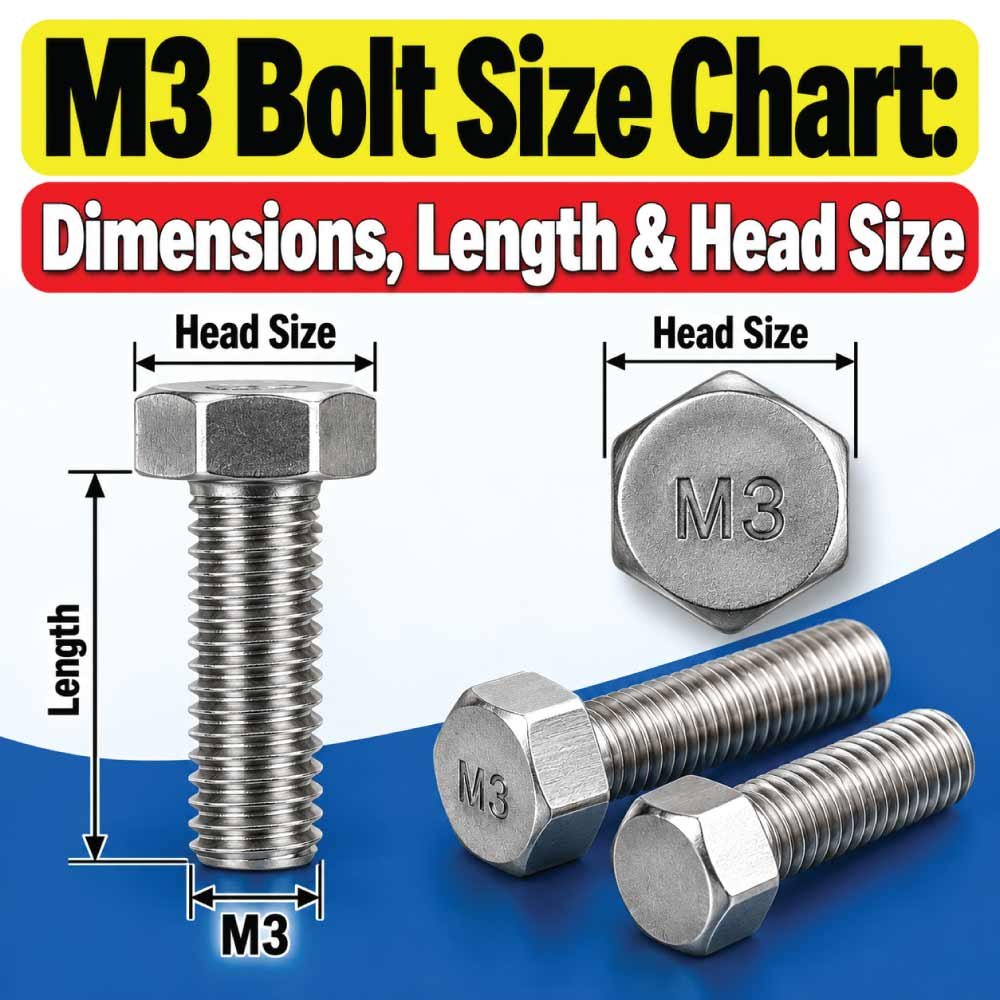
An M3 bolt size chart makes it easier to identify the correct metric fastener for a project without guessing from appearance alone. M3 bolts have a nominal thread diameter of 3 mm, but their overall dimensions vary according to bolt length, head style, thread standard, and applicable specification.
For most general-purpose M3 fasteners, the commonly encountered coarse thread has a 0.5 mm pitch. However, an M3 bolt can be manufactured in different lengths and head configurations, so knowing only the 3 mm diameter is not enough to select the right fastener.
This guide covers M3 bolt dimensions, standard lengths, thread pitch, head sizes, measurement methods, socket requirements, and practical selection tips. It also explains why an M3 hex bolt and an M3 socket head cap screw can have different head dimensions even though both use the same M3 thread.
M3 Bolt Size Chart
The table below provides a practical reference for commonly used M3 metric bolt sizes. Bolt length refers to the threaded shank length measured from underneath the head to the end of the bolt for standard head styles.
| M3 Bolt Length | Nominal Diameter | Typical Thread Pitch | Length in Inches | Typical Use |
|---|---|---|---|---|
| 5 mm | 3 mm | 0.5 mm | 0.197 in | Thin assemblies |
| 6 mm | 3 mm | 0.5 mm | 0.236 in | Small brackets |
| 8 mm | 3 mm | 0.5 mm | 0.315 in | General fastening |
| 10 mm | 3 mm | 0.5 mm | 0.394 in | Electronics and machinery |
| 12 mm | 3 mm | 0.5 mm | 0.472 in | General assemblies |
| 16 mm | 3 mm | 0.5 mm | 0.630 in | Thicker components |
| 20 mm | 3 mm | 0.5 mm | 0.787 in | Mechanical assemblies |
| 25 mm | 3 mm | 0.5 mm | 0.984 in | Longer joint assemblies |
| 30 mm | 3 mm | 0.5 mm | 1.181 in | Brackets and frames |
| 35 mm | 3 mm | 0.5 mm | 1.378 in | Deep assemblies |
| 40 mm | 3 mm | 0.5 mm | 1.575 in | Longer fastening applications |
| 50 mm | 3 mm | 0.5 mm | 1.969 in | Thick or multi-layer assemblies |
These lengths are commonly available, but availability varies by manufacturer, head style, material, and fastener standard. Always check the manufacturer’s dimensional drawing when a precise specification is important.
What Does M3 Mean on a Bolt?
The designation M3 describes the nominal diameter of the bolt’s metric thread. The letter M indicates a metric thread, while 3 represents a nominal diameter of approximately 3 millimeters.
M3 does not describe the bolt’s total length or head size.
For example, an M3 × 12 bolt generally means:
- M3 = approximately 3 mm nominal thread diameter
- 12 = 12 mm nominal bolt length
- Thread pitch = normally 0.5 mm for a common coarse M3 thread, unless another pitch is specified
An M3 × 20 bolt therefore has the same nominal thread diameter as an M3 × 12 bolt, but it has a longer shank.
M3 Bolt Designation Example
A specification such as M3 × 16 identifies the thread diameter and length, but the head style may still need to be specified.
For example, an application could use:
- M3 × 16 hex bolt
- M3 × 16 socket head cap screw
- M3 × 16 pan head screw
- M3 × 16 flat head screw
All can have an M3 thread while having substantially different head dimensions.
M3 Bolt Dimensions
The important dimensions of an M3 bolt include the nominal diameter, thread pitch, length, head diameter or width, head height, and sometimes the drive size.
The exact head dimensions depend on the applicable fastener standard.
| Dimension | Typical M3 Specification |
|---|---|
| Nominal thread diameter | 3 mm |
| Common coarse pitch | 0.5 mm |
| Coarse threads per inch equivalent | 50.8 TPI equivalent |
| Bolt length | Varies by application |
| Head size | Depends on head style |
| Drive size | Depends on head style |
| Thread system | Metric |
The most important point is that M3 identifies the thread size, not the complete physical dimensions of the bolt.
M3 Thread Size and Pitch
Thread pitch is the distance from one thread crest to the next, measured parallel to the bolt’s axis.
For a common coarse M3 metric thread, the pitch is 0.5 mm. This means the distance between adjacent thread crests is 0.5 mm.
An M3 coarse thread can therefore be written as:
M3 × 0.5
In many general-purpose fastener listings, the pitch is omitted because the coarse pitch is understood. Fine-pitch M3 fasteners also exist, so the pitch should be confirmed whenever thread compatibility matters.
Why Thread Pitch Matters
The mating nut or threaded hole must have a compatible thread.
An M3 bolt with the wrong pitch may:
- Fail to start correctly
- Bind during installation
- Damage the internal thread
- Produce an unreliable connection
- Appear to fit initially but become damaged during tightening
Never force an M3 bolt into a threaded hole simply because the diameter appears correct.
M3 Bolt Head Size Chart
The head size of an M3 bolt depends heavily on its head design and standard. This is one of the most common sources of confusion when people search for M3 bolt dimensions.
A standard hex-head M3 bolt and an M3 socket head cap screw do not have the same head dimensions.
For example, commonly encountered ISO-style M3 hexagon-head fasteners use an approximately 5.5 mm across-flats head size, while an M3 socket head cap screw is typically associated with a smaller cylindrical head and a 2.5 mm internal hex drive.
| M3 Head Style | Typical Head Characteristic | Common Drive |
|---|---|---|
| Hex head | Hexagonal external head | Wrench/socket |
| Socket head cap screw | Cylindrical head | Internal hex |
| Pan head | Rounded/slightly domed head | Phillips or internal drive, depending on design |
| Flat/countersunk head | Head sits flush when installed | Phillips, hex, Torx, or other drive |
| Button head | Low-profile rounded head | Usually internal hex or another specified drive |
These are head-style categories rather than universal dimensions. A manufacturer’s drawing should be used when the head diameter, head height, or drive dimensions must fit a confined space.
M3 Hex Bolt Head Dimensions
A conventional M3 hex-head bolt has an external six-sided head designed to be tightened with a wrench or socket.
For commonly used ISO metric hex-head designs, the across-flats dimension for M3 is generally 5.5 mm.
The head height and other dimensional details depend on the particular standard and product type.
This distinction is important because the term M3 hex bolt tells you the thread size and general head style, but the applicable standard determines the exact geometry.
Across Flats vs Across Corners
When measuring a hexagonal bolt head, two dimensions can be obtained:
- Across flats (AF): distance between two opposite flat sides
- Across corners: distance between two opposite corners
Tool sizes are normally specified according to the across-flats dimension.
Therefore, an M3 hex-head bolt with a 5.5 mm across-flats head requires a wrench or socket designed for approximately 5.5 mm across flats.
M3 Socket Head Cap Screw Dimensions
An M3 socket head cap screw is different from an M3 hex-head bolt. It has a cylindrical head with a recessed hexagonal drive.
A commonly used ISO-style M3 socket head cap screw has approximately:
| Dimension | Typical Value |
|---|---|
| Thread diameter | 3 mm |
| Common coarse pitch | 0.5 mm |
| Head diameter | 5.5 mm |
| Head height | 3 mm |
| Internal hex key size | 2.5 mm |
These values are useful for identification, but the applicable standard and manufacturer drawing should control where exact dimensions are required.
Socket head cap screws are particularly useful where a relatively compact external footprint and recessed drive are desirable.
M3 Bolt Length Chart
M3 bolts are manufactured in numerous lengths. The correct length depends on the thickness of the parts being joined, washer thickness, nut engagement, and the design of the joint.
| Length | Approx. Inches | Common Application |
|---|---|---|
| 5 mm | 0.197 in | Very thin components |
| 6 mm | 0.236 in | Thin panels |
| 8 mm | 0.315 in | Small assemblies |
| 10 mm | 0.394 in | Electronics and brackets |
| 12 mm | 0.472 in | General assemblies |
| 16 mm | 0.630 in | Moderate material thickness |
| 20 mm | 0.787 in | Mechanical assemblies |
| 25 mm | 0.984 in | Thicker joints |
| 30 mm | 1.181 in | Brackets and frames |
| 40 mm | 1.575 in | Multi-layer assemblies |
| 50 mm | 1.969 in | Deep assemblies |
Not every manufacturer stocks every length. Some suppliers also offer intermediate or longer sizes.
How Is an M3 Bolt Measured?
Measuring an M3 bolt correctly is straightforward if you identify each dimension separately.
1. Measure the Thread Diameter
Use a caliper to measure across the threaded portion of the bolt.
A correctly identified M3 bolt should have a nominal thread diameter of approximately 3 mm.
Because the actual major diameter can differ slightly from the nominal designation due to thread tolerances, do not expect every measurement to read exactly 3.000 mm.
2. Measure the Bolt Length
For most conventional bolts and screws, measure from the bearing surface underneath the head to the end of the bolt.
Do not normally include the head height when specifying the length of a standard hex-head or socket-head fastener.
For a countersunk fastener, however, the measurement convention can differ because the head is designed to sit inside a countersunk hole.
3. Measure the Thread Pitch
If the pitch is unknown, use a metric thread pitch gauge.
For a common M3 coarse thread, the gauge should identify 0.5 mm pitch.
You can also compare the bolt against a known M3 nut, but a thread gauge is preferable when identification must be reliable.
4. Measure the Head
The appropriate measurement depends on the head type.
For a hex head, measure:
- Across flats
- Across corners if required
- Head height
For a socket head, measure:
- Head diameter
- Head height
- Internal hex size
For a countersunk head, measure:
- Head diameter
- Head angle
- Head height or countersink geometry as applicable
How to Choose the Correct M3 Bolt Length
Choosing the right M3 bolt length is more than selecting the longest bolt that fits.
The bolt should provide sufficient thread engagement without extending unnecessarily far beyond the nut or threaded component.
Consider these factors:
Combined thickness of the materials
Washer thickness
Nut thickness
Required thread engagement
Presence of spacers
Countersunk or non-countersunk installation
Available clearance behind the assembly
A practical selection process is:
- Measure the total thickness being clamped.
- Add the thickness of any washers.
- Account for the nut or threaded hole.
- Select the nearest suitable standard length.
- Confirm that the bolt does not interfere with nearby components.
The required engagement depends on the material, joint design, load, thread quality, and applicable engineering requirements. There is no single M3 bolt length that is correct for every application.
Also Read:
M3 Bolt vs M3 Screw
The terms bolt and screw are often used interchangeably in everyday hardware descriptions, but engineering terminology can distinguish them based on how the fastener is installed and used.
An M3 bolt may be used with an M3 nut, while an M3 screw may be designed to engage directly with a tapped hole or another threaded component.
For online purchasing, it is more useful to look at the actual specifications:
- Thread diameter
- Thread pitch
- Length
- Head style
- Drive type
- Material
- Strength class
- Finish
This prevents confusion caused by inconsistent naming between suppliers.
Common M3 Bolt Head Types
Different applications call for different head designs.
Hex Head
The hexagonal external head is suitable where a wrench or socket can access the fastener.
Typical advantages:
- Easy wrench access
- Familiar installation method
- Useful for mechanical assemblies
- Available in many materials and grades
Socket Head
Socket head cap screws have a cylindrical head with an internal hexagonal recess.
They are useful where:
- Space around the head is limited
- A recessed drive is preferred
- A compact fastening arrangement is needed
Button Head
Button-head fasteners have a rounded, lower-profile head. They are often selected when appearance or reduced head height is important.
Countersunk Head
Countersunk M3 fasteners are designed to sit flush with the surrounding surface when used with a correctly prepared countersunk hole.
They are useful for:
- Panels
- Covers
- Enclosures
- Assemblies where protruding heads are undesirable
Also Read:
M3 Bolt Materials and Grades
M3 bolts are available in several materials and strength classifications.
Common choices include:
Carbon or alloy steel for general mechanical applications
Stainless steel where corrosion resistance is important
Aluminum for specialized lightweight applications
Brass for electrical, decorative, or specialized assemblies
Material selection should consider the environment and mechanical requirements.
For steel fasteners, the property class is important. A higher property class generally indicates higher specified mechanical strength, but the correct fastener must be selected according to the joint design rather than simply choosing the strongest available option.
Stainless steel fasteners also have different grades and mechanical properties, so “stainless M3” is not a complete engineering specification.
M3 Bolt Applications
Because M3 fasteners are relatively small, they are common in assemblies where compact hardware is needed.
Typical applications include:
- Electronics
- Electrical enclosures
- Small machinery
- Instrumentation
- 3D printer assemblies
- Robotics
- Computer hardware
- Model construction
- Small brackets
- Sheet-metal assemblies
- Prototyping equipment
- Consumer products
The correct M3 fastener depends on the mechanical load, environment, installation space, and material being joined.
Also Read:
M3 Bolt and Nut Compatibility
An M3 bolt should be paired with an M3 nut having the same thread pitch.
For the common coarse thread, this means an M3 × 0.5 bolt should mate with an M3 × 0.5 nut.
Do not assume that every M3 nut will automatically match every M3 bolt. Always verify the pitch where the fastener is non-standard or where fine threads may be involved.
Common M3 nut styles include:
- Hex nuts
- Nylon-insert lock nuts
- Flange nuts
- Wing nuts
- Square nuts
- Specialized machine nuts
The external nut dimensions vary according to the nut standard and style, even though the internal thread may be M3.
Common M3 Bolt Selection Mistakes
Small fasteners can cause large assembly problems when the specification is incomplete.
Choosing by Diameter Alone
Knowing that a bolt is M3 does not tell you whether its length or head will work.
Always check:
- Diameter
- Pitch
- Length
- Head type
- Drive size
- Material
- Strength class where applicable
Ignoring Thread Pitch
Two M3 fasteners can have different pitches. Forcing an incompatible thread can damage the mating component.
Measuring Length Incorrectly
For most conventional M3 bolts, length is measured from under the head to the bolt tip, not from the top of the head.
Using the Wrong Tool
An M3 hex-head bolt and an M3 socket head may require completely different tools.
Do not select a wrench or Allen key solely because the fastener is labeled M3.
Assuming All M3 Heads Are the Same
This is perhaps the most important mistake. M3 identifies the thread size, not the head dimensions.
M3 Bolt Size in Inches
Metric M3 bolts are specified in millimeters, but approximate inch conversions can help when comparing imperial hardware.
| Metric Length | Approx. Inch Length |
|---|---|
| 5 mm | 0.197 in |
| 6 mm | 0.236 in |
| 8 mm | 0.315 in |
| 10 mm | 0.394 in |
| 12 mm | 0.472 in |
| 16 mm | 0.630 in |
| 20 mm | 0.787 in |
| 25 mm | 0.984 in |
| 30 mm | 1.181 in |
| 40 mm | 1.575 in |
| 50 mm | 1.969 in |
These are conversions only. An inch-size fastener with a similar diameter is not automatically interchangeable with an M3 fastener, because thread form, pitch, and tolerances can differ.
M3 Bolt vs M2 and M4 Bolts
M3 is part of a series of common small metric fastener sizes.
| Size | Nominal Diameter | Typical Coarse Pitch | General Relative Size |
|---|---|---|---|
| M2 | 2 mm | 0.4 mm | Smaller |
| M3 | 3 mm | 0.5 mm | Medium-small |
| M4 | 4 mm | 0.7 mm | Larger |
This comparison is useful when deciding whether an M3 fastener is appropriate for an assembly.
However, changing from M3 to M2 or M4 should not be based on diameter alone. The threaded hole, nut, clearance hole, head dimensions, load requirements, and available installation space must also be compatible.
Frequently Asked Questions About M3 Bolts
What is the diameter of an M3 bolt?
An M3 bolt has a nominal thread diameter of 3 mm. The actual measured major diameter can differ slightly because of manufacturing tolerances and thread geometry.
What is the standard M3 bolt pitch?
The commonly used coarse M3 metric thread has a 0.5 mm pitch. Other M3 pitches can exist, so verify the specification when thread compatibility is critical.
What size head does an M3 bolt have?
There is no single head size for every M3 bolt. Head dimensions depend on the head style and applicable standard. A commonly encountered ISO-style M3 hex-head fastener has an approximately 5.5 mm across-flats head.
What Allen key fits an M3 socket head cap screw?
A commonly specified M3 socket head cap screw uses a 2.5 mm internal hex key. Always confirm the manufacturer’s specification for the particular fastener.
How is M3 bolt length measured?
For most conventional non-countersunk bolts and screws, measure from the underside of the head to the end of the fastener. Countersunk fasteners follow different measurement conventions.
Is M3 the same as a 3 mm bolt?
M3 has a nominal thread diameter of 3 mm, so the terms can sound equivalent. However, M3 also identifies a metric thread system, including its pitch specification. A generic “3 mm bolt” is not a complete thread specification.
Can an M3 bolt fit an M3 nut?
Yes, provided the bolt and nut have matching thread pitch and compatible specifications. A standard M3 × 0.5 bolt should be matched with a compatible M3 × 0.5 nut.
What lengths do M3 bolts come in?
M3 bolts and screws are commonly available in lengths such as 5, 6, 8, 10, 12, 16, 20, 25, 30, 40, and 50 mm, although availability depends on the manufacturer and head style.
Final Thoughts on M3 Bolt Sizes
An M3 bolt size chart is useful for quickly comparing diameter, pitch, length, and head dimensions, but the M3 designation alone does not define the entire fastener.
The key specifications to check are the 3 mm nominal thread diameter, thread pitch, bolt length, head style, head dimensions, drive size, material, and strength classification where applicable. For common coarse M3 threads, the pitch is 0.5 mm, while exact head dimensions depend on the fastener design and standard.
When replacing an existing M3 fastener, measure the old bolt carefully and verify its thread pitch and head style. For engineered assemblies, use the manufacturer’s dimensional drawing or applicable fastener standard rather than relying only on a general size chart.