
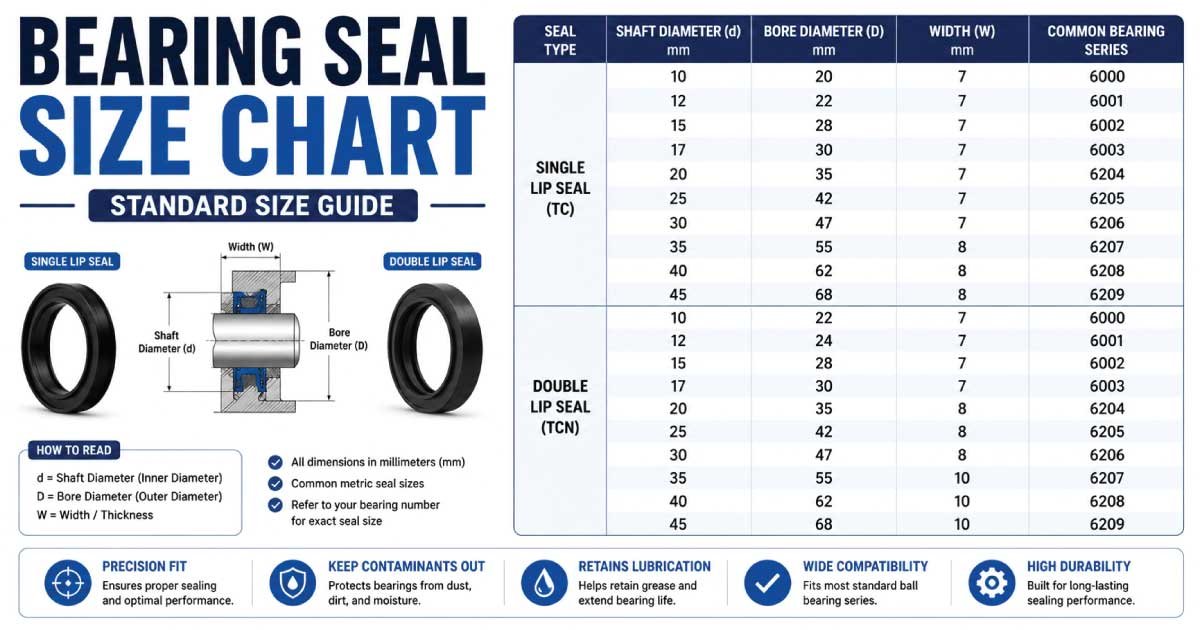
Bearing seals play a critical role in protecting bearings from dust, dirt, moisture, and other contaminants while keeping lubricants inside the bearing. Whether you’re replacing a wheel bearing seal, electric motor bearing seal, agricultural equipment seal, or industrial machinery seal, selecting the correct size is essential for maximizing bearing life and performance.
A seal that is too small may not fit properly, while one that is too large can allow contaminants to enter or lubricant to leak. Understanding bearing seal dimensions and how to measure them will help you choose the correct replacement every time.
This complete guide explains bearing seal sizes, common seal types, measurement methods, and includes easy-to-read bearing seal size charts for metric and imperial applications.
What Is a Bearing Seal?
A bearing seal is a small but essential protective component used in mechanical systems to protect bearings from contamination and maintain proper lubrication. It plays a critical role in ensuring smooth operation, reducing wear, and extending the overall lifespan of rotating assemblies in machines, vehicles, and industrial equipment.
A bearing seal is installed around a bearing to:
- Keep grease or oil inside the bearing
- Prevent dirt and dust from entering
- Block water and moisture
- Reduce wear and corrosion
- Extend bearing service life
Each of these functions helps maintain optimal bearing performance. Without a proper seal, contaminants can enter the bearing and cause friction, overheating, and premature failure, leading to costly repairs and downtime.
Bearing seals are commonly made from durable and flexible materials such as rubber, nitrile (NBR), silicone, polyurethane, or fluorocarbon (Viton). These materials are selected based on temperature resistance, chemical exposure, and operating conditions to ensure long-lasting protection.
Bearing Seal Dimensions Explained
Bearing seals are identified using a standardized sizing system that ensures compatibility with shafts and housings. Understanding these dimensions is important for selecting the correct replacement seal and avoiding installation issues.
A bearing seal is defined by three primary dimensions:
- Inside Diameter (ID) – Fits over the shaft
- Outside Diameter (OD) – Fits into the housing or bore
- Width (Thickness) – Overall width of the seal
Seal sizes are typically written as:
ID × OD × Width
For example:
25 × 47 × 7 mm
means:
- Inside Diameter = 25 mm
- Outside Diameter = 47 mm
- Width = 7 mm
This standardized format makes it easier to identify and replace seals accurately. Even small measurement errors can result in leaks, poor sealing performance, or improper fitting inside the bearing housing.
Metric Bearing Seal Size Chart
The following table lists common metric bearing seal sizes used in various mechanical and industrial applications. These sizes are widely available and cover a broad range of standard machinery requirements.
| Inside Diameter (mm) | Outside Diameter (mm) | Width (mm) |
|---|---|---|
| 10 | 22 | 5 |
| 12 | 24 | 5 |
| 15 | 28 | 7 |
| 17 | 30 | 7 |
| 20 | 32 | 7 |
| 20 | 35 | 7 |
| 22 | 35 | 7 |
| 25 | 37 | 7 |
| 25 | 47 | 7 |
| 30 | 42 | 7 |
| 30 | 47 | 7 |
| 35 | 52 | 7 |
| 40 | 55 | 8 |
| 45 | 62 | 8 |
| 50 | 68 | 8 |
| 55 | 72 | 8 |
| 60 | 80 | 10 |
| 65 | 85 | 10 |
| 70 | 90 | 10 |
| 80 | 100 | 10 |
Each size is designed for specific shaft and housing combinations, ensuring proper sealing and smooth bearing operation. Selecting the correct dimensions is essential to avoid leakage, misalignment, or premature wear of the bearing system.
Common Wheel Bearing Seal Sizes
Wheel bearing seals vary depending on vehicle type, load capacity, and axle design. These seals are commonly used in automotive, trailer, and agricultural equipment applications where durability and resistance to contamination are critical.
| Seal Size (mm) | Typical Applications |
|---|---|
| 25 × 47 × 7 | Small passenger cars |
| 30 × 52 × 7 | Compact SUVs |
| 35 × 52 × 7 | Light trucks |
| 40 × 62 × 8 | Trailers |
| 45 × 65 × 8 | Agricultural equipment |
| 50 × 72 × 8 | Heavy-duty axles |
Always verify the manufacturer’s specifications before purchasing a replacement seal. Even when sizes appear similar, small differences in design or tolerance can affect performance, sealing efficiency, and bearing life.
Bearing Seal Types
Bearing seals come in different designs to suit various operating environments, speeds, and contamination levels. Choosing the correct seal type is essential for maintaining lubrication, preventing contamination, and ensuring long-term bearing performance. Each design offers specific advantages depending on the application and working conditions.
1. Single-Lip Seal
The single-lip seal is the most commonly used type in general mechanical systems. It features one sealing edge that makes contact with the shaft to retain lubricant inside the bearing while blocking light external contaminants.
- Most common type
- Retains lubricant
- Keeps out light contaminants
- Suitable for general-purpose machinery
This type is widely used in standard industrial and automotive applications where operating conditions are not extremely harsh. It offers a balance between cost, performance, and ease of replacement, making it ideal for everyday machinery.
2. Double-Lip Seal
The double-lip seal includes an additional sealing edge that provides extra protection against dirt, dust, and moisture. This design is especially useful in environments where contamination risk is higher.
Benefits include:
- Better dust resistance
- Improved moisture protection
- Longer bearing life
The second lip acts as a backup barrier, reducing the chances of lubricant leakage and external contamination entering the bearing. This significantly increases reliability in demanding environments such as construction equipment and outdoor machinery.
3. Metal-Cased Seal
Metal-cased seals feature a rigid outer shell that provides strong structural support and excellent dimensional stability. They are designed to withstand heavy-duty operating conditions and maintain shape under pressure.
- Strong outer shell
- Excellent dimensional stability
- Ideal for industrial equipment
These seals are commonly used in high-load applications where precision and durability are critical. The metal casing helps maintain a secure fit within the housing, reducing the risk of deformation during operation.
4. Rubber-Covered Seal
Rubber-covered seals combine a metal core with an outer rubber layer, improving flexibility and sealing performance. This design helps compensate for minor housing imperfections and ensures a tighter fit.
- Better sealing against housing imperfections
- Easier installation
- Reduced risk of leakage
They are especially useful in applications where slight variations in housing dimensions may occur. The rubber surface provides better adaptability, helping maintain consistent sealing performance even under vibration or thermal expansion.
Bearing Seal Material Guide
The material used in a bearing seal directly affects its durability, temperature resistance, and compatibility with different chemicals and operating environments. Selecting the right material is crucial for achieving long service life and reliable performance.
| Material | Temperature Range | Common Uses |
|---|---|---|
| Nitrile (NBR) | -40°C to 120°C | General machinery |
| Silicone | -60°C to 200°C | High-temperature equipment |
| Viton (FKM) | -20°C to 250°C | Automotive and chemical industries |
| Polyurethane | -40°C to 100°C | Hydraulic systems |
| PTFE (Teflon) | Up to 260°C | High-speed industrial applications |
Each material offers a different balance of flexibility, heat resistance, and chemical stability. For example, NBR is widely used due to its cost-effectiveness and general-purpose performance, while PTFE is preferred in high-speed or chemically aggressive environments.
Choosing the correct material ensures that the seal performs reliably under operating stress, prevents premature wear, and extends the overall lifespan of the bearing system.
How to Measure a Bearing Seal
Accurate measurement of a bearing seal is essential for selecting the correct replacement and ensuring proper sealing performance. Even a small mismatch in dimensions can lead to oil leakage, contamination, or premature bearing failure. Using proper tools and following a systematic approach helps achieve precise results and reliable fitment.
Step 1: Measure the Inside Diameter (ID)
The inside diameter is the measurement of the inner opening of the seal that fits over the rotating shaft. This is one of the most critical dimensions because it directly affects how tightly the seal grips the shaft.
- Use a digital caliper to measure the shaft where the seal fits.
- Ensure the caliper is properly aligned for accuracy.
- Take multiple readings to confirm consistency.
A correct ID ensures proper sealing contact with the shaft, preventing lubricant leakage and keeping contaminants out of the bearing system.
Step 2: Measure the Outside Diameter (OD)
The outside diameter refers to the total width of the seal that fits into the housing or bore. This measurement ensures that the seal sits firmly in place without movement or looseness.
- Measure the bore or housing where the seal is installed.
- Check that the caliper is centered for an accurate reading.
- Avoid measuring worn or damaged housing edges.
A proper OD fit is essential for maintaining a tight seal within the housing. If the OD is incorrect, the seal may slip, rotate, or fail to maintain pressure during operation.
Step 3: Measure the Width
The width (or thickness) of the bearing seal determines how deeply it sits inside the housing and how much surface contact it provides for sealing performance.
- Measure the seal’s thickness from one face to the other.
- Keep the caliper straight to avoid angled errors.
- Record the measurement carefully for reference.
Correct width ensures proper alignment within the housing and helps maintain consistent sealing pressure across the entire contact surface.
Final Measurement Tip
Record all measurements in millimeters or inches before ordering a replacement seal. Always double-check values, as bearing seals require precise sizing for effective performance. Even minor errors in measurement can lead to leakage, contamination, or reduced bearing life.
Read our newest article here: Brake Rotor Size Chart: Complete Guide 2026 With Pdf
Understanding Bearing Seal Numbers
Bearing seals are often marked with size numbers printed directly on their outer surface. These markings provide a quick and standardized way to identify the correct dimensions without needing to measure the seal manually.
For example:
25 × 47 × 7
This indicates:
- 25 mm shaft diameter
- 47 mm housing diameter
- 7 mm seal width
Each number represents a critical dimension that ensures proper fit and sealing performance. The first value refers to the inside diameter, the second to the outside diameter, and the third to the width of the seal.
If the markings are worn, faded, or completely missing due to usage or corrosion, the seal must be measured manually using a caliper. Accurate measurement is essential in such cases to avoid incorrect replacement and potential system failure.
Signs a Bearing Seal Needs Replacement
A bearing seal plays a vital role in protecting lubrication and preventing contamination. When it becomes worn or damaged, it can no longer perform effectively, leading to serious mechanical issues. Early detection of failure signs helps prevent costly repairs and bearing damage.
Replace a bearing seal if you notice:
- Grease leaking from the bearing
- Oil stains around the shaft
- Dirt entering the bearing
- Excessive bearing noise
- Bearing overheating
- Visible cracks or tears in the seal
- Hardened or brittle rubber
Each of these symptoms indicates that the seal is no longer maintaining a proper barrier between internal lubrication and external contaminants. Ignoring these warning signs can lead to increased friction, overheating, and premature bearing failure.
Common Applications
Bearing seals are widely used across multiple industries to ensure smooth operation, reduce wear, and extend equipment life. They are essential in any system involving rotating shafts and lubricated bearings.
1. Automotive
- Wheel hubs
- Transmissions
- Differentials
- Engines
In vehicles, bearing seals help maintain lubrication and prevent dirt or water from entering critical rotating components, ensuring smooth and safe operation.
2. Industrial Equipment
- Electric motors
- Pumps
- Gearboxes
- Conveyor systems
Industrial machinery relies heavily on bearing seals to reduce downtime and maintain continuous operation under heavy loads and high speeds.
3. Agriculture
- Tractors
- Harvesters
- Seed drills
Agricultural equipment often operates in dusty and muddy environments, making bearing seals essential for preventing contamination and extending service life.
4. Manufacturing
- CNC machines
- Compressors
- Industrial rollers
In manufacturing systems, precision and reliability are critical. Bearing seals help maintain consistent performance and reduce maintenance requirements.
5. Home Equipment
- Washing machines
- Lawn mowers
- Power tools
- Garage equipment
Even in household tools and appliances, bearing seals play an important role in ensuring smooth operation, reducing noise, and improving durability over time.
Read our newest article here: Piston Ring Size Chart: A Complete Guide 2026 with Pdf
Tips for Choosing the Right Bearing Seal
Selecting the correct bearing seal is essential for ensuring proper lubrication retention, contamination protection, and long-term bearing performance. A well-chosen seal reduces maintenance costs and helps machinery operate smoothly under different working conditions.
Before purchasing a replacement, consider:
- Inside diameter
- Outside diameter
- Width
- Seal material
- Operating temperature
- Shaft speed
- Lubricant type
- Environmental conditions
Each of these factors plays a direct role in how effectively the seal performs. For example, high-speed shafts require more durable materials, while harsh environments demand better resistance to dust, water, or chemicals. Matching all specifications correctly ensures the seal fits properly and performs reliably under real operating conditions.
Using the correct seal improves reliability and extends bearing life by maintaining proper lubrication inside the system and preventing external contaminants from entering. This reduces friction, overheating, and premature wear, ensuring stable performance over time.
Common Mistakes to Avoid
Incorrect selection or installation of bearing seals can quickly lead to leakage, contamination, and bearing failure. Many issues occur due to small but critical errors during measurement or fitting.
Avoid these common errors:
- Measuring only the outside diameter
- Ignoring the seal width
- Using the wrong material
- Installing the seal backwards
- Reusing damaged seals
- Hammering the seal directly without a proper driver
- Running equipment with a leaking seal
Each of these mistakes can compromise sealing efficiency and shorten bearing life. For example, incorrect installation direction can prevent proper sealing, while using the wrong material may cause failure under heat or chemical exposure. Reusing damaged seals or forcing installation without proper tools often leads to deformation and immediate leakage.
Proper handling, accurate measurement, and careful installation ensure maximum sealing performance and long-lasting protection for bearings in all types of machinery.
Final Thoughts
Choosing the correct bearing seal size is essential for protecting bearings, reducing maintenance costs, and ensuring reliable equipment performance. By understanding the three key dimensions—inside diameter, outside diameter, and width—you can confidently identify the correct replacement. Whether you’re working on automotive wheel bearings, electric motors, industrial machinery, or agricultural equipment, using the right bearing seal and material helps maximize service life and minimize downtime.
Read our newest article here: Spark Plug Size Chart: A Complete Guide with Pdf
FAQs:
How do I know what size bearing seal I need?
To determine the correct bearing seal size, measure the inside diameter (ID), outside diameter (OD), and seal width using a caliper. If the existing seal still has a visible part number, you can use it to order an exact replacement. Accurate measurements ensure a proper fit and reliable sealing performance.
Are bearing seals universal?
No. Bearing seals are not universal because they are manufactured in many different sizes, materials, and designs to match specific bearings and housings. Choosing the wrong seal can lead to lubricant leakage, contamination, and premature bearing failure. Always verify the seal dimensions before purchasing a replacement.
Can I reuse an old bearing seal?
Generally, no. Once a bearing seal has been removed, it may become distorted, worn, or damaged, reducing its ability to create an effective seal. Installing a new seal during bearing replacement is the safest option and helps prevent grease leaks, contamination, and premature bearing wear.
What is the difference between a bearing seal and a bearing shield?
A bearing seal makes contact with the inner ring, providing excellent protection against dirt, moisture, and lubricant leakage. A bearing shield is a non-contact metal cover that offers less contamination protection but creates lower friction, making it better suited for higher-speed applications where minimal resistance is important.
Why are bearing seals important?
Bearing seals are essential because they keep lubricants inside the bearing while preventing dirt, dust, water, and other contaminants from entering. This protection reduces wear, minimizes maintenance requirements, extends bearing service life, and improves the reliability and performance of machinery in demanding operating environments.