
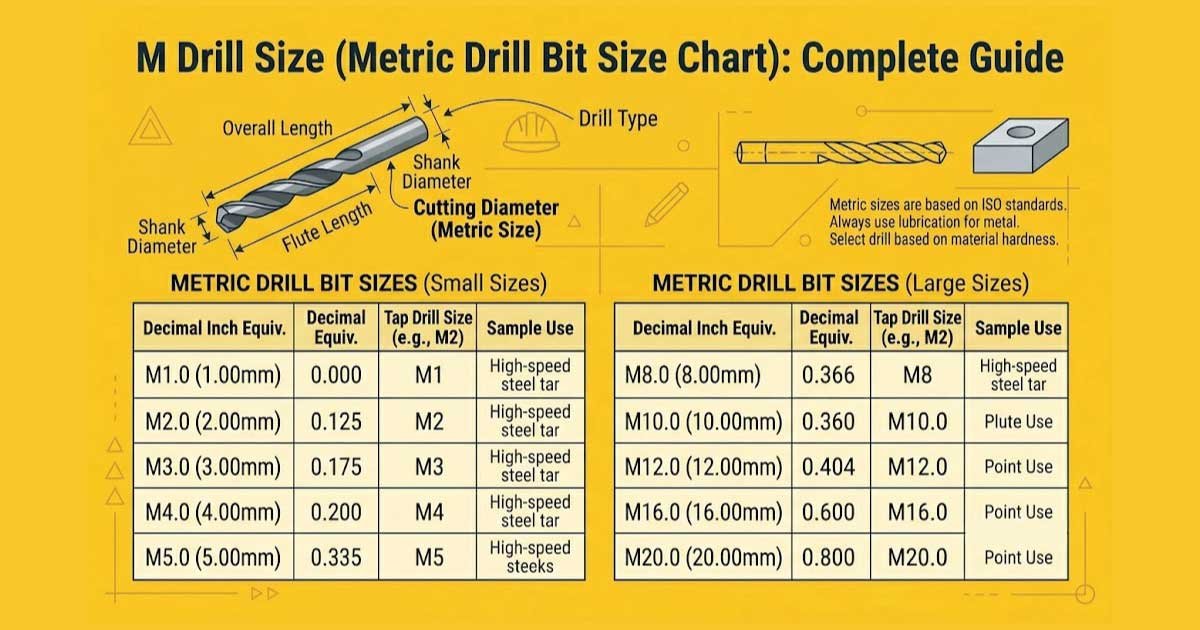
Metric drill bits are essential tools used in machining, metalworking, woodworking, and mechanical fabrication. Among them, M drill sizes (metric drill sizes for tapping) are especially important because they ensure correct hole diameter before cutting threads for metric screws and bolts.
If the drill size is incorrect—even by 0.1 mm—the thread strength can weaken, bolts may loosen, or the entire assembly can fail. That’s why understanding the M drill size chart is critical for engineers, mechanics, and DIY users.
This detailed guide explains everything about metric drill bit sizes, M-series tapping drill charts, how to choose the right size, and practical examples for real-world applications.
Why M Drill Size Is Important
Using the correct M drill size is essential in any threading or machining operation because it directly affects the quality, strength, and reliability of the final threaded joint. If the drilled hole is not accurate, the tap cannot form proper threads, which can lead to weak connections or tool damage during the process. Precision ensures smooth production and long-term durability of mechanical assemblies.
1. Proper thread engagement
The correct drill size allows the tap to cut threads at the right depth and profile. This ensures that the bolt engages properly with the internal threads, providing a secure and stable connection between components.
2. Strong bolt holding capacity
Accurate drilling helps achieve full thread strength, allowing the bolt to hold maximum load without stripping or loosening. This is especially important in high-stress mechanical and structural applications.
3. Smooth tapping process
When the drill size matches the recommended standard, the tapping process becomes smooth and controlled. This reduces friction and ensures clean, uniform threads without damage to the material.
4. No broken taps
Incorrect drill sizes increase the risk of tap breakage due to excessive cutting force. Proper sizing reduces stress on the tool, improving efficiency and extending tool life.
5. Long-lasting mechanical joints
Correctly sized threads create strong and reliable joints that can withstand vibration, load, and repeated use over time without failure.
If the hole is too small → the tap may break due to excessive resistance.
If the hole is too large → the threads become weak and lose holding strength.
That’s why precision is critical in selecting the correct M drill size for every application.
Standard Metric Drill Size Chart (M Series)
Below is a complete M drill size chart used in workshops and industries worldwide.
Metric Tap Drill Size Chart (Coarse Thread)
| Thread Size (M) | Pitch (mm) | Drill Size (mm) |
|---|---|---|
| M1 | 0.25 | 0.75 |
| M1.6 | 0.35 | 1.25 |
| M2 | 0.40 | 1.60 |
| M2.5 | 0.45 | 2.05 |
| M3 | 0.50 | 2.50 |
| M4 | 0.70 | 3.30 |
| M5 | 0.80 | 4.20 |
| M6 | 1.00 | 5.00 |
| M7 | 1.00 | 6.00 |
| M8 | 1.25 | 6.80 |
| M10 | 1.50 | 8.50 |
| M12 | 1.75 | 10.20 |
| M14 | 2.00 | 12.00 |
| M16 | 2.00 | 14.00 |
| M18 | 2.50 | 15.50 |
| M20 | 2.50 | 17.50 |
Fine Thread Metric Drill Size Chart
Fine threads are used where higher strength and vibration resistance are required.
| Thread Size (M) | Pitch (mm) | Drill Size (mm) |
|---|---|---|
| M6 × 0.75 | 0.75 | 5.25 |
| M8 × 1.0 | 1.0 | 7.00 |
| M10 × 1.25 | 1.25 | 8.80 |
| M12 × 1.5 | 1.5 | 10.50 |
| M16 × 1.5 | 1.5 | 14.50 |
| M20 × 1.5 | 1.5 | 18.50 |
How to Calculate M Drill Size
The M drill size can be calculated using a simple and widely used machining formula. This helps machinists and engineers determine the correct drill bit diameter before tapping a metric thread, ensuring accurate threading and strong mechanical joints.
Drill Size Formula
Explanation of the Formula
The formula shows that the drill size is obtained by subtracting the thread pitch from the major diameter of the bolt. This gives the correct hole size needed before tapping, allowing the tap to cut threads properly without breaking or creating weak engagement.
Example 1: M10 × 1.5
- Major diameter = 10 mm
- Pitch = 1.5 mm
10 − 1.5 = 8.5 mm drill size
Example 2: M8 × 1.25
- Major diameter = 8 mm
- Pitch = 1.25 mm
8 − 1.25 = 6.75 mm → rounded to 6.8 mm
Where This Formula Is Used
This calculation is commonly applied in:
- CNC machining
- Manual tapping operations
- Mechanical fabrication
- Industrial manufacturing
Using the correct M drill size ensures smooth tapping, strong thread engagement, and prevents tool breakage during machining.
Types of Metric Drill Bits Used for M Sizes
Different types of drill bits are used for M drill sizes depending on the material being drilled and the required precision. Each type has its own strength, durability, and heat resistance level, making it suitable for specific machining and fabrication applications. Choosing the correct drill bit improves accuracy, tool life, and overall machining performance.
1. HSS Drill Bits (High-Speed Steel)
High-speed steel drill bits are the most commonly used type in general machining work. They offer a good balance between cost, durability, and performance, making them suitable for everyday drilling tasks in workshops and fabrication units.
- Most common
- Used for steel, aluminum, and plastic
- Affordable and durable
2. Cobalt Drill Bits
Cobalt drill bits are stronger and more heat-resistant than standard HSS bits. They are designed for tougher materials and are widely used in applications where high friction and heat generation occur during drilling.
- Stronger than HSS
- Used for stainless steel and hard metals
- Heat resistant
3. Carbide Drill Bits
Carbide drill bits are industrial-grade tools designed for high-precision and high-speed machining. They offer excellent hardness and wear resistance, making them ideal for CNC machines and heavy-duty production environments.
- Industrial-grade
- Used in CNC machines
- Very high durability
Using the correct drill bit type for M sizes ensures better hole quality, longer tool life, and more efficient machining operations.
Also Read This:
Applications of M Drill Sizes
Metric drill sizes are widely used across almost all engineering and manufacturing industries because they provide standardized, accurate hole dimensions for threading operations. These drill sizes ensure proper bolt fitting, strong joints, and reliable performance in both light-duty and heavy-duty applications.
1. Automotive Industry
In the automotive sector, M drill sizes are essential for assembling engine parts, transmission systems, and structural components. Precision drilling ensures that bolts and fasteners fit securely, improving safety and performance under vibration and load conditions.
- Engine components
- Gearbox assembly
- Suspension parts
2. Construction
In construction projects, M drill sizes are used for creating strong bolted connections in steel structures and frameworks. Accurate drilling is critical to maintaining structural integrity and ensuring long-term durability of buildings and infrastructure.
- Steel structures
- Bolted joints
- Framework connections
3. Manufacturing
Manufacturing industries rely heavily on M drill sizes for producing machine parts and assembling equipment. CNC machines and manual tools use these standardized sizes to ensure precision and repeatability in production processes.
- CNC machining
- Machine assembly
- Tool production
4. Electronics
In electronics manufacturing, M drill sizes are used for creating precise holes in metal enclosures and device housings. These accurate drill sizes help in proper fitting of screws and components in compact assemblies.
- Metal enclosures
- Device housing
Companies such as Bosch manufacture precision drill bits used in industrial and workshop applications worldwide.
How to Choose the Correct M Drill Size
Selecting the correct M drill size is essential for achieving strong, accurate, and long-lasting threaded connections. The right choice depends on multiple engineering factors such as thread type, material hardness, load conditions, and the type of tapping process being used. Proper selection reduces tool wear, prevents thread failure, and ensures smooth assembly.
1. Thread Type
The type of thread plays a major role in determining the correct drill size. Coarse threads generally allow more tolerance and use standard drill sizes, while fine threads require more precision because they have smaller pitch distances and tighter engagement.
- Coarse threads → standard drill sizes
- Fine threads → require higher precision in drill size selection
2. Material Type
The material being drilled also affects the drill size selection. Softer materials like aluminum or plastic usually follow standard sizing, while harder materials may require slight adjustments to ensure smooth tapping and reduce tool stress.
- Soft materials → standard drill size
- Hard materials → slightly larger clearance
3. Load Requirement
The expected load on the threaded joint determines how strong the engagement needs to be. High-load applications require stronger thread contact for safety, while low-load applications can use standard fits without additional reinforcement.
- High load → stronger thread engagement
- Low load → standard fit is sufficient
4. Tap Type
Different tapping methods require different levels of precision. Hand tapping usually needs a bit more clearance to reduce tool stress, while machine tapping requires accurate drill sizing for consistent and precise results.
- Hand tap → more clearance needed
- Machine tap → precise sizing required
Choosing the correct M drill size based on these factors ensures reliable thread formation, improved joint strength, and reduced risk of tap breakage during machining operations.
Also Read This:
Common Mistakes When Using M Drill Sizes
Using the correct M drill size is essential for creating strong and accurate threads in metalworking. However, beginners often make mistakes that result in weak threads, broken taps, or poor-quality holes. Understanding these common errors helps improve accuracy, reduces tool damage, and ensures reliable fastening performance in mechanical applications.
1. Using Wrong Drill Size
One of the most common mistakes is selecting an incorrect drill size for the M thread. If the hole is too large, the threads become weak and may not hold properly. If it is too small, it can cause excessive stress on the tap, leading to breakage or damaged threads. Correct sizing is essential for strong and durable fastening.
2. Not Checking Pitch
Metric threads come in different pitches, and each pitch requires a specific drill size. Ignoring the thread pitch often leads to incorrect hole preparation and poor thread engagement. Even small differences in pitch can affect compatibility and strength. Always verify the pitch before drilling to ensure proper thread formation and secure fastening.
3. Ignoring Material Hardness
Different materials require different drilling approaches. Hard metals such as stainless steel need stronger drill bits and proper cutting speeds, while softer materials like aluminum require less force. Ignoring material hardness can result in tool wear, overheating, or damaged threads. Selecting the correct drill bit for the material ensures cleaner holes and longer tool life.
4. Poor Alignment
Incorrect drilling alignment is another major issue that leads to angled or uneven threads. If the drill is not perpendicular to the surface, the tap may cut improperly, resulting in weak or misaligned threads. Proper alignment ensures smooth thread cutting, better load distribution, and reliable fastening performance in mechanical assemblies.
Drill Size Tolerance in Engineering
In professional machining and manufacturing, tolerance plays a critical role in ensuring accuracy, consistency, and proper fit between threaded components. Even a slight deviation in drill size can affect thread quality, bolt engagement, and overall joint strength. That is why engineers always work within defined tolerance limits depending on the application and required precision.
1. Typical Tolerance Ranges
Different levels of accuracy are used based on the type of work being performed. High-precision industries require tighter tolerances, while structural or heavy fabrication work allows slightly wider variations.
- ±0.05 mm for precision work
- ±0.1 mm for general fabrication
- ±0.2 mm for structural work
2. Why Tolerance Matters
Maintaining proper tolerance ensures that the drilled hole matches the intended M drill size closely enough for the tap to form accurate threads. If the hole is too small, excessive stress can break the tap. If it is too large, the threads become weak and fail under load.
3. Impact on Thread Strength
Even small errors in drill size can significantly affect thread engagement and holding capacity. In high-stress applications such as automotive or industrial machinery, improper tolerance can lead to loosening, vibration issues, or complete joint failure.
For this reason, strict tolerance control is essential in CNC machining, fabrication workshops, and engineering design processes to ensure safe and reliable performance of threaded connections.
Also Read This:
Metric vs Imperial Drill Sizes
Drill sizes are measured using two main systems worldwide: the metric system and the imperial system. Both serve the same purpose—creating accurate holes for drilling and tapping—but they differ in measurement units and regional usage. Understanding both systems is important for engineers and machinists working with international designs and tools.
1. Metric System (M Drill Sizes)
The metric system is the most widely used standard across the world. It is based on millimeters and follows the ISO standard for threads and drilling. M drill sizes are commonly used in automotive, construction, and manufacturing industries because of their accuracy and global compatibility.
- Used in most countries
- Based on millimeters
- Standardized under ISO system
Example:
- M10 = 10 mm diameter
2. Imperial System
The imperial system is primarily used in the United States and a few other regions. It measures drill sizes in inches and fractions of an inch. This system is common in older machinery, workshops, and certain industrial applications.
- Uses inches
- Common in USA workshops
3. Example Comparison
To understand the difference, consider the following equivalent sizes:
- M10 ≈ 10 mm diameter
- Equivalent imperial drill ≈ 25/64 inch
Why Understanding Both Systems Matters
In modern engineering, global collaboration is common. Machines, tools, and components may come from different countries, so knowing both metric and imperial drill systems helps prevent errors, ensures compatibility, and improves accuracy in manufacturing and assembly processes.
Also Read This:
Tips for Perfect Drilling
Achieving accurate and clean holes in metal work requires proper technique and attention to detail. Following professional drilling practices not only improves precision but also extends the life of drill bits and ensures safer machining operations.
Professional Tips
- Always use a center punch before drilling
- Use cutting oil for metal drilling
- Start with pilot holes for large sizes
- Keep drill speed appropriate for material
- Use sharp drill bits only
These practices help reduce heat buildup, prevent drill wandering, and improve overall hole accuracy in both manual and CNC machining operations.
Importance of Proper M Drill Selection
Selecting the correct M drill size is critical for achieving strong and reliable threaded joints. Even small errors in drill selection can affect thread quality, fastening strength, and long-term performance of mechanical assemblies.
- Strong threaded joints
- Long-lasting assembly
- Reduced maintenance cost
- Improved machine safety
- Better load distribution
This is why engineers always refer to a metric drill size chart before tapping operations to ensure precision and structural reliability in every application.
Drill Size Standardization
The future of drilling and machining is rapidly evolving toward higher precision, automation, and intelligent manufacturing systems. As industries demand tighter tolerances and faster production, drill size standardization is becoming more important than ever. Modern technologies are significantly reducing human error while improving consistency, accuracy, and repeatability across all engineering sectors.
1. CNC Automation Improves Accuracy
Computer Numerical Control (CNC) machines are now widely used in industrial drilling operations. These systems follow programmed instructions with extreme precision, ensuring that every hole is drilled to the exact M drill size with minimal variation.
- High precision drilling
- Consistent repeatability
- Reduced manual errors
2. Laser Drilling Is Emerging
Laser drilling technology is becoming more common in advanced manufacturing. It allows extremely fine and accurate holes to be created without physical contact, reducing tool wear and improving precision for micro-scale applications.
- Non-contact drilling process
- High accuracy for small holes
- Ideal for advanced materials
3. Smart Tooling Systems Reduce Human Error
Modern smart tooling systems are equipped with sensors and monitoring technology that help control drill speed, pressure, and alignment in real time. This reduces operator mistakes and improves overall machining quality.
- Real-time monitoring
- Reduced operator error
- Improved process control
4. Advanced Coatings Improve Bit Life
New coating technologies such as titanium nitride and other heat-resistant layers help drill bits last longer by reducing friction and wear. This improves efficiency and lowers tool replacement costs in industrial production.
- Reduced friction and heat
- Longer tool life
- Lower maintenance cost
Industrial manufacturers like Sandvik Coromant are developing high-performance drilling systems that support precision engineering, increased efficiency, and longer tool life in modern manufacturing environments.
Also Read This:
Conclusion
The M drill size (metric drill bit size chart) is an essential reference for anyone involved in machining, fabrication, or mechanical assembly. It ensures correct hole preparation before tapping metric threads, which directly affects strength and durability.
By understanding drill size formulas, standard charts, material types, and proper selection techniques, you can avoid costly mistakes and achieve professional-quality results in any engineering project.
Whether you are working on small M3 screws or large M20 industrial bolts, using the correct drill size guarantees precision, safety, and long-term performance.