
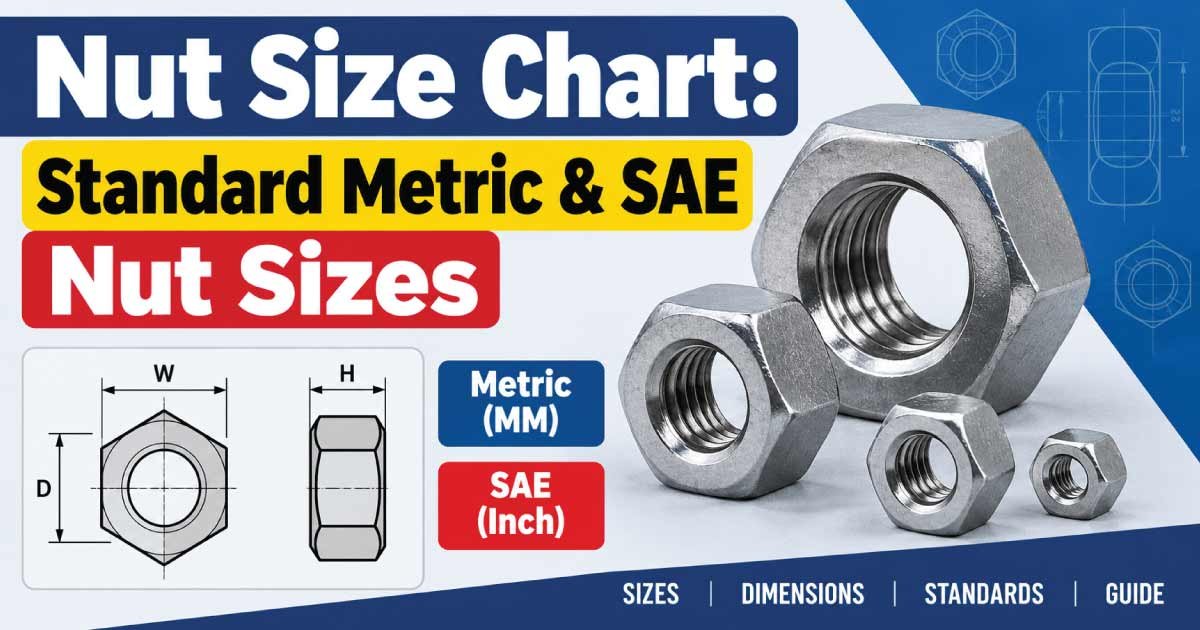
Choosing the correct nut is not simply a matter of finding one that looks like it will fit. The nut must match the bolt diameter, thread pitch, thread standard, nut type, and application. A nut with the wrong thread can damage the fastener or fail to tighten properly, while a nut with the wrong wrench size can create confusion during installation.
This nut size chart provides a practical reference for common metric and SAE nut sizes, including nominal thread diameter and typical wrench or across-flats dimensions. It also explains how nut sizes work, how to measure a nut, the difference between metric and SAE sizing, common nut types, and how to select the right nut for a bolt.
Because dimensions can vary by nut style, strength class, manufacturer, and applicable standard, the tables should be treated as a general identification and selection guide. For critical applications, always verify the manufacturer’s specifications or the relevant fastener standard.
What Is a Nut Size?
A nut size usually refers to the nominal thread diameter of the nut’s matching bolt, rather than the size of the wrench used to tighten it.
For example, an M10 nut is designed for an M10 bolt. The “10” represents the nominal metric thread diameter in millimeters. The outside dimension across the nut’s flat sides is larger and is commonly used to select a wrench or socket.
SAE nuts work differently because their nominal sizes are expressed in inches or fractions of an inch. A 1/2-inch SAE nut, for example, is intended for a bolt with a nominal 1/2-inch thread diameter.
A nut can therefore have several relevant dimensions:
- Nominal thread diameter: The basic size associated with the bolt.
- Thread pitch: The distance between adjacent threads in metric fasteners.
- Threads per inch (TPI): Used to describe many inch-based fasteners.
- Across flats (AF): The distance between two opposite flat sides of a hex nut.
- Nut thickness: The height of the nut measured along the bolt axis.
- Thread series: Such as coarse or fine thread.
- Strength/property class: Indicates mechanical requirements for applicable standardized nuts.
The most important rule is that the nut’s internal thread must match the bolt’s external thread.
Metric Nut Size Chart
Metric nuts are identified using an M designation, such as M6, M8, M10, or M12. The number generally represents the nominal thread diameter in millimeters.
The following chart gives common metric hex nut sizes and their typical across-flats dimensions. These dimensions are useful when choosing a wrench or socket.
| Metric Nut Size | Nominal Diameter (mm) | Typical Across Flats (mm) | Common Wrench Size (mm) |
|---|---|---|---|
| M3 | 3 | 5.5 | 5.5 |
| M4 | 4 | 7 | 7 |
| M5 | 5 | 8 | 8 |
| M6 | 6 | 10 | 10 |
| M8 | 8 | 13 | 13 |
| M10 | 10 | 17 | 17 |
| M12 | 12 | 19 | 19 |
| M14 | 14 | 22 | 22 |
| M16 | 16 | 24 | 24 |
| M18 | 18 | 27 | 27 |
| M20 | 20 | 30 | 30 |
| M22 | 22 | 34 | 34 |
| M24 | 24 | 36 | 36 |
| M27 | 27 | 41 | 41 |
| M30 | 30 | 46 | 46 |
| M33 | 33 | 50 | 50 |
| M36 | 36 | 55 | 55 |
| M39 | 39 | 60 | 60 |
| M42 | 42 | 65 | 65 |
| M45 | 45 | 70 | 70 |
| M48 | 48 | 75 | 75 |
These are representative dimensions for commonly encountered metric hex nuts. Nut dimensions can differ according to the applicable standard and nut style, so a specific DIN, ISO, or manufacturer drawing should be consulted when exact dimensions are required.
Metric Nut Thread Pitch
Unlike many SAE fasteners, metric fasteners normally identify thread spacing using millimeters per thread. For example, an M10 × 1.5 fastener has a nominal diameter of 10 mm and a 1.5 mm thread pitch.
A nut must match both the diameter and pitch.
Common examples include:
| Thread Designation | Nominal Diameter (mm) | Pitch (mm) | Typical Description |
|---|---|---|---|
| M6 × 1.0 | 6 | 1.0 | Standard coarse metric |
| M8 × 1.25 | 8 | 1.25 | Standard coarse metric |
| M10 × 1.5 | 10 | 1.5 | Standard coarse metric |
| M12 × 1.75 | 12 | 1.75 | Standard coarse metric |
| M16 × 2.0 | 16 | 2.0 | Standard coarse metric |
| M20 × 2.5 | 20 | 2.5 | Standard coarse metric |
Fine-pitch versions are also available. For example, M10 × 1.25 cannot simply be substituted with an M10 × 1.5 nut because the diameter is the same but the thread pitch is different.
SAE Nut Size Chart
SAE or inch-based fasteners use nominal dimensions expressed in inches. They are commonly found in older American machinery, automotive equipment, industrial hardware, agricultural machinery, and many U.S.-manufactured products.
For hex nuts, the wrench size is generally larger than the bolt’s nominal diameter.
The table below lists common finished hex nut sizes and their typical wrench sizes.
| SAE Nut Size | Nominal Diameter (in.) | Typical Wrench Size (in.) | Approx. Wrench Size (mm) |
|---|---|---|---|
| 1/4-20 | 1/4 | 7/16 | 11.1 |
| 5/16-18 | 5/16 | 1/2 | 12.7 |
| 3/8-16 | 3/8 | 9/16 | 14.3 |
| 7/16-14 | 7/16 | 5/8 | 15.9 |
| 1/2-13 | 1/2 | 3/4 | 19.1 |
| 9/16-12 | 9/16 | 7/8 | 22.2 |
| 5/8-11 | 5/8 | 15/16 | 23.8 |
| 3/4-10 | 3/4 | 1-1/8 | 28.6 |
| 7/8-9 | 7/8 | 1-5/16 | 33.3 |
| 1-8 | 1 | 1-1/2 | 38.1 |
The numbers following the dash indicate threads per inch (TPI). For example, 1/2-13 represents a 1/2-inch nominal diameter with 13 threads per inch.
Actual wrench dimensions can vary between standard nut series, including standard hex, heavy hex, and other specialized configurations.
Metric vs SAE Nut Sizes
The biggest difference between metric and SAE nuts is the measurement system and thread specification.
Metric nuts are normally identified by diameter in millimeters and pitch in millimeters. SAE/inch nuts are identified by diameter in inches and commonly use threads per inch.
| Feature | Metric Nuts | SAE Nuts |
|---|---|---|
| Measurement system | Millimeters | Inches |
| Diameter designation | M3, M6, M10, M12, etc. | 1/4, 3/8, 1/2, etc. |
| Thread spacing | Pitch in mm | Threads per inch |
| Example | M10 × 1.5 | 1/2-13 |
| Wrench sizes | Usually mm | Usually fractional inches |
| Common applications | Modern global equipment | Many U.S.-based or older machines |
Can Metric and SAE Nuts Be Interchanged?
Generally, no.
Some metric and SAE dimensions are close enough to cause confusion. A metric wrench may sometimes fit an inch nut, or vice versa, but that does not mean the fasteners are interchangeable.
For example, attempting to force an approximately similar nut onto a bolt with a different thread can:
- Cross-thread the fastener.
- Damage the bolt or nut.
- Produce an inaccurate clamping load.
- Make future removal difficult.
- Reduce the reliability of the joint.
Always identify the actual thread specification instead of selecting a nut based only on apparent size.
How to Measure a Nut
If you have an unidentified nut, measuring it systematically can help determine its size.
1. Measure Across the Flats
Place calipers across two opposite flat sides of the hex nut. This measurement is called the across-flats dimension.
For example, a measurement close to 17 mm is commonly associated with an M10 standard hex nut.
However, this measurement alone does not prove the thread size because different nut styles can have different outside dimensions.
2. Measure the Internal Thread
The internal thread diameter provides another useful clue. Measure the approximate inside diameter without damaging the threads.
Do not mistake the internal opening for the nominal bolt diameter. The nominal diameter describes the bolt’s basic thread size, while the actual minor diameter inside a threaded nut is smaller.
3. Determine the Thread Pitch
For metric nuts, use a metric thread pitch gauge or measure the distance between threads.
For inch fasteners, determine the threads per inch.
A thread pitch gauge is usually much more reliable than trying to count threads manually over a short distance.
4. Compare With a Nut Size Chart
Once you know the approximate diameter, pitch, and across-flats dimension, compare the measurements with a reliable fastener chart.
If the nut is part of safety-critical machinery, do not rely solely on visual matching. Confirm the thread and material requirements from the equipment documentation.
Common Types of Nuts
Not every nut is a standard six-sided hex nut. Different designs exist for different mechanical requirements.
Hex Nuts
The standard hex nut is the most familiar type. It has six flat sides and is tightened using a wrench or socket.
Hex nuts are widely used for general mechanical fastening and are available in numerous sizes, materials, finishes, and strength classes.
Heavy Hex Nuts
Heavy hex nuts have larger dimensions than standard hex nuts in corresponding thread sizes. They are commonly used where a larger bearing area or particular structural fastening specification is required.
They should not be confused with standard hex nuts simply because the thread size is the same.
Nylon Insert Lock Nuts
A nylon insert lock nut contains a non-metallic insert that increases resistance to loosening.
These nuts are useful in applications where vibration may cause an ordinary nut to loosen. The insert also means installation and removal characteristics differ from those of a standard nut.
All-Metal Lock Nuts
All-metal lock nuts use a specially formed thread or nut section to increase resistance to loosening without a nylon insert.
They are useful in applications where temperature, chemicals, or other conditions make a nylon insert unsuitable.
Flange Nuts
A flange nut has an integrated flange beneath the nut. The flange distributes the clamping load over a larger area and can reduce the need for a separate washer in suitable applications.
The exact suitability depends on the joint design and manufacturer’s specifications.
Wing Nuts
Wing nuts have projections that allow hand tightening without a conventional wrench.
They are useful where frequent adjustment or removal is required and where high clamping force is not the primary requirement.
Castle Nuts
Castle nuts have slots around their upper section. They are commonly used with a compatible hole and cotter-pin arrangement where a specified locking method is required.
They should be selected as part of the complete fastening system rather than as a generic replacement for a standard hex nut.
Square Nuts
Square nuts have four sides rather than six. Their geometry provides different engagement characteristics and can be useful in particular assemblies, channels, or legacy applications.
Discover More:
How to Choose the Correct Nut for a Bolt
Finding the correct nut involves more than matching the nominal diameter.
Match the Thread Diameter
Start by identifying the bolt diameter. A bolt marked or identified as M12 requires an M12-compatible nut, while a 1/2-inch bolt requires a compatible 1/2-inch nut.
Match the Thread Pitch or TPI
This is one of the most important steps.
An M12 nut can have different thread pitches. Likewise, a 1/2-inch bolt may use different thread series.
The nut must match the bolt’s actual thread specification.
Match the Thread System
Determine whether the fastener is metric or inch-based.
Do not select a nut solely because a wrench fits it. The wrench dimension and thread specification are separate characteristics.
Choose the Correct Nut Type
Select the nut according to the application.
Consider whether you need:
- A standard hex nut.
- A lock nut.
- A flange nut.
- A heavy hex nut.
- A castle nut.
- A wing nut.
- A specialized nut for a particular assembly.
Check Material and Strength
For structural, automotive, industrial, or high-load applications, the nut’s material and mechanical property class matter.
A nut should be appropriate for the bolt and joint. Replacing a specified high-strength nut with an ordinary hardware-store nut can change the performance of the assembly.
Consider Corrosion Resistance
For outdoor or corrosive environments, material and coating are important.
Common choices include zinc-coated steel and stainless steel, but the correct material depends on the environment, strength requirements, temperature, and compatibility with the mating fastener.
Discover More:
Nut Size vs Wrench Size: Why They Are Different
One of the most common mistakes when identifying nuts is assuming that the wrench size is the nut’s nominal size.
For example, an M10 standard hex nut commonly uses a 17 mm wrench, not a 10 mm wrench.
The M10 designation refers to the nominal thread diameter, while 17 mm describes the approximate distance across the nut’s flats.
Likewise, a 1/2-inch SAE nut may use a 3/4-inch wrench.
This distinction is important when searching for replacement fasteners. If you need an M10 nut, searching only for a “17 mm nut” can produce confusing results because 17 mm describes the wrench dimension rather than the thread designation.
Discover More:
Coarse Thread vs Fine Thread Nuts
Thread pitch affects how the nut engages with the bolt.
Coarse Threads
Coarse threads have greater spacing between adjacent threads.
They are widely used for general fastening and can be easier to assemble in many practical situations.
Fine Threads
Fine threads have smaller spacing between threads.
They can provide different adjustment and engagement characteristics and are used where the application specifically calls for them.
The important point is that coarse and fine nuts are not interchangeable when their thread pitches differ.
For example, an M10 × 1.5 nut should not be treated as interchangeable with an M10 × 1.25 nut simply because both are M10.
Common Nut Size Mistakes to Avoid
Even experienced DIY users can encounter problems when identifying fasteners.
Mistake 1: Matching Only the Wrench Size
A wrench that fits does not prove that the nut has the correct thread.
Always verify the thread specification.
Mistake 2: Mixing Metric and SAE Threads
Similar-looking dimensions can be misleading.
A close fit is not necessarily a correct fit. Never force a nut onto a bolt when it does not thread smoothly by hand.
Mistake 3: Ignoring Thread Pitch
Two nuts can have the same nominal diameter but different thread pitches.
Always verify pitch or TPI where there is any uncertainty.
Mistake 4: Using the Wrong Nut Grade or Property Class
For high-load applications, the nut must meet the required mechanical specification.
A visually identical nut can have very different performance characteristics.
Mistake 5: Replacing Specialized Nuts With Standard Nuts
Lock nuts, flange nuts, castle nuts, and other specialized designs serve particular purposes.
A standard hex nut is not automatically an equivalent replacement.
Nut Size Chart Quick Reference
For everyday identification, the following compact reference highlights several frequently encountered sizes.
| Fastener | Nominal Diameter | Typical Nut Wrench Size | Measurement System |
|---|---|---|---|
| M5 | 5 mm | 8 mm | Metric |
| M6 | 6 mm | 10 mm | Metric |
| M8 | 8 mm | 13 mm | Metric |
| M10 | 10 mm | 17 mm | Metric |
| M12 | 12 mm | 19 mm | Metric |
| M16 | 16 mm | 24 mm | Metric |
| M20 | 20 mm | 30 mm | Metric |
| 1/4-20 | 1/4 in. | 7/16 in. | SAE/Inch |
| 5/16-18 | 5/16 in. | 1/2 in. | SAE/Inch |
| 3/8-16 | 3/8 in. | 9/16 in. | SAE/Inch |
| 1/2-13 | 1/2 in. | 3/4 in. | SAE/Inch |
| 5/8-11 | 5/8 in. | 15/16 in. | SAE/Inch |
| 3/4-10 | 3/4 in. | 1-1/8 in. | SAE/Inch |
This table is intended as a quick identification aid, not as a substitute for the dimensional requirements of a specific fastener standard.
Frequently Asked Questions About Nut Sizes
What does M10 mean on a nut?
M10 identifies a metric nut intended for a bolt with a nominal thread diameter of approximately 10 mm. The complete thread designation may also need the pitch, such as M10 × 1.5.
What size wrench fits an M10 nut?
A commonly encountered standard M10 hex nut uses a 17 mm wrench or socket. However, the exact across-flats dimension can vary with nut design and standard.
Is a 17 mm nut the same as M10?
Not exactly. 17 mm normally describes the wrench or across-flats dimension, while M10 describes the nominal thread diameter. A 17 mm wrench size should not be used as the thread identification.
What size nut fits an M12 bolt?
An M12 bolt requires an M12 nut with the same thread pitch. A commonly encountered standard hex nut uses a 19 mm wrench.
What does 1/2-13 mean?
The designation 1/2-13 indicates an inch-based fastener with a nominal diameter of 1/2 inch and 13 threads per inch.
Can I use an SAE nut on a metric bolt?
Generally, no. The nut must have a matching thread diameter and thread pitch. Metric and SAE fasteners should not be mixed simply because their dimensions appear similar.
How do I know what size nut I have?
Measure the nut’s across-flats dimension, determine its approximate internal thread diameter, and identify the thread pitch or TPI. Then compare those measurements with a reliable fastener chart.
Does every M10 nut use a 17 mm wrench?
No. Nut dimensions vary according to design and standard. Standard hex nuts commonly use 17 mm across flats, but other nut styles may be larger or smaller.
Final Takeaway
A good nut size chart is useful for identifying fasteners, choosing the correct wrench, and finding replacement hardware. The key is to distinguish between nominal thread size and wrench size.
For metric fasteners, verify the M diameter and thread pitch. For SAE or inch fasteners, verify the diameter, thread series, and threads per inch. Then confirm the nut type, material, strength requirements, and dimensional standard when the application demands precise specifications.
For routine projects, the metric and SAE charts above provide a convenient starting point. For structural, pressure, automotive, lifting, or other critical applications, always use the applicable engineering specification or manufacturer’s documentation rather than relying on size alone.