
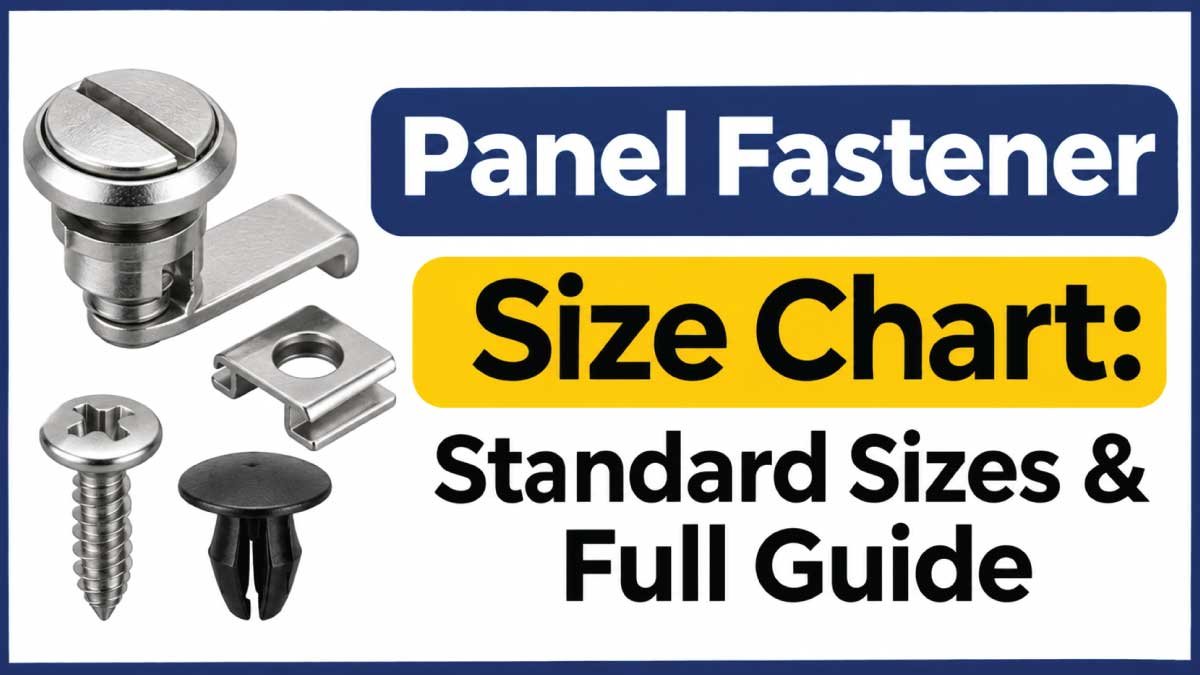
Panel fasteners are mechanical components used to secure panels, covers, access doors, enclosures, and removable equipment sections. They are commonly found in automotive assemblies, electrical cabinets, industrial machinery, appliances, aircraft interiors, and sheet metal fabrication.
Unlike conventional screws and bolts, many panel fasteners are designed for quick installation, repeated access, or tool-free operation. Depending on the design, they may use threads, clips, quarter-turn mechanisms, captive screws, push-in retainers, or locking pins.
Selecting the correct panel fastener size is important for achieving a secure fit and reliable operation. The fastener must match the panel thickness, mounting hole, required grip range, thread specification, and installation arrangement.
This Panel Fastener Size Chart explains common fastener dimensions, measurement methods, thread sizes, panel thickness considerations, fastener types, materials, and selection guidelines.
Panel fasteners do not follow one universal dimensional system. Their sizes and installation requirements vary by design and manufacturer, so always confirm the product drawing before ordering.
What Is a Panel Fastener?
A panel fastener is a fastening component designed to attach, secure, or retain a panel to another structure. It may hold two panels together or attach a removable cover to a frame, cabinet, or machine.
Some panel fasteners create permanent connections, while others allow panels to be removed for inspection, maintenance, or replacement.
Common panel fastener features include:
- Threaded bodies or mounting studs.
- Captive screws.
- Retaining clips.
- Locking pins.
- Quarter-turn mechanisms.
- Spring-loaded components.
- Washers and retaining rings.
- Panel-mounted receptacles.
The correct fastener depends on the panel material, thickness, required holding force, operating environment, and frequency of access.
Panel Fastener Size Chart: Important Dimensions
Panel fasteners are available in different designs, so the required measurements depend on the product type.
Main Panel Fastener Measurements
| Dimension | Description | Abbreviation |
|---|---|---|
| Panel thickness | Thickness of the panel being secured | PT |
| Mounting hole diameter | Diameter of the required installation hole | HD |
| Fastener diameter | Diameter of the fastener body or shank | D |
| Fastener length | Overall length or specified body length | L |
| Grip range | Panel thickness range the fastener can accommodate | GR |
| Thread size | Nominal thread diameter and specification | — |
| Thread pitch | Distance between adjacent threads | P |
| Head diameter | Width across the fastener head | H |
| Head height | Height or thickness of the head | HH |
| Receptacle depth | Depth of the receiving component, where applicable | RD |
Not every panel fastener uses all these measurements. For example, a captive screw requires thread and grip information, while a push-in panel retainer may be selected mainly by hole diameter and panel thickness.
Common Panel Fastener Thread Size Chart
Threaded panel fasteners are available in metric and imperial sizes. The thread must match the receiving nut, threaded receptacle, or other mating component.
Metric Thread Size Reference
| Thread Designation | Nominal Major Diameter | Common Applications |
|---|---|---|
| M3 | 3 mm | Small panels and electronic enclosures |
| M4 | 4 mm | Equipment covers and light assemblies |
| M5 | 5 mm | General panel fastening |
| M6 | 6 mm | Industrial panels and brackets |
| M8 | 8 mm | Larger covers and mounting assemblies |
| M10 | 10 mm | Heavy-duty panel mounting |
| M12 | 12 mm | Larger mechanical assemblies |
Imperial Thread Size Reference
| Thread Designation | Nominal Major Diameter |
|---|---|
| #4 | 0.1120″ |
| #6 | 0.1380″ |
| #8 | 0.1640″ |
| #10 | 0.1900″ |
| 1/4″ | 0.2500″ |
| 5/16″ | 0.3125″ |
| 3/8″ | 0.3750″ |
These are nominal thread diameters, not recommended mounting-hole sizes. Actual clearance holes and tapping holes depend on the thread specification, material, fit, and installation method.
Understanding Thread Pitch
Thread pitch is the distance between adjacent threads on metric fasteners. Imperial threads are commonly identified by threads per inch (TPI).
For example, M6 fasteners may be available with different thread pitches. A fastener must match the thread specification of its mating component.
Never assume that two fasteners are interchangeable just because their nominal diameters are similar.
Panel Thickness Reference Chart
Panel thickness is an important factor when selecting a panel fastener.
The fastener must accommodate the panel without leaving excessive looseness or preventing proper engagement.
Common Panel Thickness References
| Panel Thickness (mm) | Approximate Thickness (Inches) |
|---|---|
| 0.5 mm | 0.020″ |
| 0.8 mm | 0.031″ |
| 1.0 mm | 0.039″ |
| 1.2 mm | 0.047″ |
| 1.5 mm | 0.059″ |
| 2.0 mm | 0.079″ |
| 2.5 mm | 0.098″ |
| 3.0 mm | 0.118″ |
| 4.0 mm | 0.157″ |
| 5.0 mm | 0.197″ |
| 6.0 mm | 0.236″ |
| 8.0 mm | 0.315″ |
| 10.0 mm | 0.394″ |
This is a general material-thickness reference, not a universal compatibility chart for panel fasteners.
Why Panel Thickness Matters
Panel thickness affects:
- Fastener grip requirements.
- Thread engagement.
- Receptacle selection.
- Fastener length.
- Clamping force.
- Installation clearance.
- Panel deformation risk.
For captive screws and other adjustable fasteners, check the manufacturer’s specified grip range. For threaded fasteners, confirm the required thread engagement and the thickness of the receiving material.
Panel Fastener Mounting Hole Size
The mounting hole is another important measurement when selecting a panel fastener.
A hole that is too small may prevent installation or damage the fastener. A hole that is too large may cause movement or reduce retention.
Mounting Hole Measurement Reference
| Measurement | Description |
|---|---|
| Hole diameter | Width of the mounting hole |
| Hole shape | Round, square, rectangular, or specially shaped opening |
| Hole location | Position relative to panel edges and other components |
| Panel thickness | Thickness of the material around the hole |
| Hole tolerance | Permitted variation in the hole dimension |
| Edge distance | Distance from the hole to the nearest panel edge |
There is no single mounting-hole size for all panel fasteners. A captive screw receptacle, push-in retainer, and quarter-turn fastener can all require different hole dimensions.
Use the manufacturer’s installation drawing rather than selecting a hole based only on the nominal fastener diameter.
Types of Panel Fasteners
Panel fasteners are available in different designs to meet specific installation and access requirements.
1. Captive Panel Screws
Captive screws remain attached to the panel or assembly when loosened. This helps prevent the screw from being lost during maintenance.
They are commonly used in electrical cabinets, machinery covers, equipment enclosures, and removable access panels.
Important dimensions include:
- Thread diameter.
- Thread pitch.
- Grip range.
- Head diameter.
- Screw length.
- Receptacle compatibility.
2. Quarter-Turn Panel Fasteners
Quarter-turn fasteners secure panels through a short rotational movement, often approximately one quarter of a turn.
They are used where quick access is important, including equipment covers, automotive panels, and industrial enclosures.
Their sizing may involve stud length, stud diameter, receptacle type, panel thickness, and mounting-hole dimensions.
3. Push-In Panel Fasteners
Push-in fasteners attach panels or components by pressing a retaining section into a mounting hole.
They may use flexible legs, barbed sections, or expanding features to provide retention.
Important measurements include:
- Mounting-hole diameter.
- Panel thickness.
- Retaining-leg diameter.
- Head diameter.
- Fastener length.
4. Panel Retaining Clips
Panel retaining clips hold panels in position through spring pressure or mechanical engagement.
They are common in automotive trim, appliance panels, and sheet metal assemblies.
5. Screw-Mount Panel Fasteners
These fasteners use a conventional screw or bolt to secure a panel to a frame or supporting structure.
They may be used with washers, nuts, threaded inserts, or mounting brackets.
6. Toggle and Locking Panel Fasteners
Toggle-style and locking fasteners use a mechanical locking arrangement to hold panels or doors closed.
They are available in different sizes and load capacities depending on the application.
Panel Fastener Type Comparison
| Fastener Type | Main Function | Common Application |
|---|---|---|
| Captive screw | Secures removable panels without losing the screw | Equipment covers |
| Quarter-turn fastener | Provides quick panel access | Industrial enclosures |
| Push-in fastener | Attaches components through a mounting hole | Automotive and appliance panels |
| Retaining clip | Holds panels in position | Trim and sheet metal |
| Screw-mount fastener | Provides threaded fastening | Cabinets and machinery |
| Toggle fastener | Locks panels or doors closed | Access panels and equipment |
Panel Fastener Head Size Chart
The head size influences the area that contacts or covers the panel surface.
Different fastener designs use different head shapes, including flat, pan, button, countersunk, and low-profile heads.
Common Head Styles
| Head Type | General Characteristics | Typical Use |
|---|---|---|
| Pan head | Rounded top with a relatively flat underside | General panel fastening |
| Flat head | Designed for a flush or countersunk installation | Flush panel surfaces |
| Button head | Low rounded profile | Compact assemblies |
| Hex head | External hexagonal driving feature | Mechanical fastening |
| Low-profile head | Reduced height | Limited-clearance applications |
| Knurled head | Textured surface for hand operation | Tool-free access |
Head diameter and height vary by screw standard, product series, and manufacturer. Use the exact fastener drawing when checking clearance or selecting a replacement.
Read Latest Guide:
Panel Fastener Materials
Panel fasteners are manufactured from different materials according to their mechanical and environmental requirements.
1. Stainless Steel
Stainless steel is commonly selected where corrosion resistance is important.
It is used in equipment enclosures, industrial assemblies, and selected outdoor applications.
Different stainless steel grades have different strength and corrosion characteristics.
2. Carbon Steel
Carbon steel fasteners are used for general mechanical fastening.
They may receive zinc plating or another protective finish to improve corrosion resistance.
3. Aluminum
Aluminum fasteners are used in selected lightweight assemblies.
Their suitability depends on the required mechanical strength, corrosion conditions, and compatibility with surrounding materials.
4. Nylon
Nylon panel fasteners are lightweight and electrically insulating.
They are common in electronics, appliances, and lightweight panel assemblies.
5. Brass
Brass is used in selected panel fasteners and threaded components where its material properties and corrosion behavior are suitable.
Material Comparison
| Material | General Characteristics | Common Applications |
|---|---|---|
| Stainless steel | Corrosion resistance varies by grade | Industrial and outdoor equipment |
| Carbon steel | General mechanical strength | Machinery and sheet metal |
| Aluminum | Lightweight | Lightweight equipment assemblies |
| Nylon | Lightweight and electrically insulating | Electronics and appliances |
| Brass | Useful corrosion and electrical properties | Selected electrical and panel components |
How to Measure a Panel Fastener
Accurate measurements help identify the correct replacement and prevent installation problems.
Step 1: Identify the Fastener Type
Determine whether the component is a captive screw, quarter-turn fastener, push-in retainer, panel clip, or screw-mount fastener.
Step 2: Measure the Panel Thickness
Use a caliper or suitable measuring tool to check the thickness of the panel.
If the fastener passes through multiple layers, measure the complete grip stack.
Step 3: Measure the Mounting Hole
Check the hole diameter and shape.
For a special mounting arrangement, also record the distance from the hole to the panel edge.
Step 4: Identify the Thread Size
For threaded fasteners, determine the nominal diameter, thread pitch, and thread series.
Step 5: Measure the Fastener Length
Record the length using the manufacturer’s specified reference points.
Different fastener designs may define length differently, so avoid assuming that every measurement begins beneath the head.
Step 6: Measure the Head Dimensions
Check the head diameter, height, and shape.
This is especially important when the fastener must fit into a recessed area or cover an existing opening.
Step 7: Check the Grip Range
For captive and adjustable fasteners, verify the manufacturer’s grip-range specification.
Step 8: Compare the Product Drawing
Confirm all dimensions, tolerances, material specifications, and installation requirements before purchasing.
Read Latest Guide:
How to Choose the Correct Panel Fastener Size
Selecting a suitable panel fastener requires matching the product to the panel and the operating environment.
1. Determine the Panel Application
Identify whether the panel is removable, permanent, decorative, structural, or used for equipment access.
2. Measure Panel Thickness
Check the total thickness of the materials being fastened together.
3. Confirm the Mounting Hole
Match the hole diameter, shape, and tolerance to the selected fastener.
4. Select the Thread Specification
For threaded fasteners, match the diameter, pitch, and thread series to the mating component.
5. Check the Grip Range
For captive screws and quick-release fasteners, confirm that the specified grip range accommodates the complete panel stack.
6. Consider Access Requirements
Choose a captive screw or quarter-turn fastener when repeated access is required.
A conventional screw may be suitable for panels that are removed less frequently.
7. Select the Right Material
Consider moisture, temperature, vibration, chemicals, and the possibility of corrosion.
8. Verify the Installation Instructions
Check the manufacturer’s drawing for mounting dimensions, required tools, tightening instructions, and compatible accessories.
Read Latest Guide:
Panel Fastener Applications
Panel fasteners are used in many industries because they provide practical ways to attach covers, doors, and removable assemblies.
Automotive Industry
Automotive manufacturers use panel fasteners for interior trim, body panels, access covers, and selected equipment assemblies.
Push-in retainers and clips are particularly common in trim and interior applications.
Electrical Cabinets
Captive screws, threaded fasteners, and quarter-turn mechanisms secure electrical cabinet doors and removable covers.
Captive designs can reduce the risk of losing fasteners during maintenance.
Industrial Machinery
Panel fasteners hold machine guards, service covers, access panels, and equipment enclosures.
The correct fastener must account for vibration, access frequency, and operating conditions.
Appliance Manufacturing
Panel fasteners are used to attach removable covers, housings, and internal panels in household and commercial appliances.
Electronics
Small panel fasteners secure enclosures, equipment covers, mounting plates, and electronic assemblies.
Nylon and metal fasteners may be used depending on electrical and mechanical requirements.
Aerospace and Transportation
Specialized panel fasteners are used in selected transportation and aerospace assemblies. These applications require strict compliance with approved product specifications and engineering requirements.
Common Panel Fastener Sizing Mistakes
Incorrect fastener selection can cause loose panels, damaged mounting holes, poor thread engagement, and difficult maintenance.
Avoid these common mistakes:
- Ignoring panel thickness: The fastener may not provide the correct grip.
- Using the wrong mounting-hole diameter: Installation may become difficult or retention may be reduced.
- Confusing thread sizes: Similar-looking threads may not be compatible.
- Ignoring thread pitch: The fastener may damage the mating threads.
- Selecting the wrong length: The fastener may not engage properly or may interfere with components behind the panel.
- Overlooking head clearance: A large or tall head may obstruct nearby parts.
- Ignoring material compatibility: Certain material combinations can create corrosion or other compatibility problems.
- Using ordinary screws instead of captive fasteners: This may increase the risk of losing hardware during maintenance.
- Ignoring vibration: A fastener may loosen if it is unsuitable for the operating conditions.
- Assuming all panel fasteners are interchangeable: Different designs have different mounting and grip requirements.
Frequently Asked Questions
1. What is a panel fastener used for?
A panel fastener is used to secure panels, covers, access doors, and enclosures. Depending on its design, it may provide permanent fastening or allow quick removal for maintenance.
2. How do I measure a panel fastener?
Measure the fastener diameter, length, head dimensions, mounting-hole size, and panel thickness. For threaded fasteners, also identify the thread pitch and specification.
3. What is a captive panel fastener?
A captive panel fastener remains attached to the panel or assembly when loosened. This helps prevent the fastener from being lost during maintenance or inspection.
4. What is a quarter-turn panel fastener?
A quarter-turn fastener uses a short rotational movement to lock or release a panel. It is commonly used where quick access is required.
5. Are panel fasteners available in metric and imperial sizes?
Yes. Threaded panel fasteners are available in metric and imperial thread systems. The selected fastener must match the mating thread specification.
6. What is the grip range of a panel fastener?
Grip range is the panel thickness range that a fastener is designed to accommodate. It is especially important for captive screws and adjustable quick-release fasteners.
7. Can panel fasteners be reused?
Many panel fasteners are designed for repeated use, but reuse depends on the design and manufacturer’s instructions. Replace damaged, worn, or deformed components.
8. Which material is best for panel fasteners?
Stainless steel is useful where corrosion resistance is important, carbon steel is common for general mechanical fastening, aluminum supports lightweight designs, and nylon is used in lightweight or electrically insulating applications.
9. Do panel fasteners require special tools?
Some use standard screwdrivers, hex keys, or other common tools. Quarter-turn and tool-free designs may use a hand-operated mechanism, depending on the product.
10. Are all panel fastener sizes standardized?
No. Thread specifications may follow recognized standards, but overall dimensions, mounting requirements, and grip ranges vary by fastener type and manufacturer.
Conclusion
A Panel Fastener Size Chart helps identify the important measurements required for selecting a suitable fastening component. These include panel thickness, mounting-hole diameter, fastener length, thread size, head dimensions, and grip range.
The correct panel fastener depends on the panel design, installation method, access requirements, and operating environment. Before purchasing, identify the fastener type and compare its dimensions with the manufacturer’s technical drawing. Accurate sizing helps improve panel retention, installation quality, and long-term reliability.