
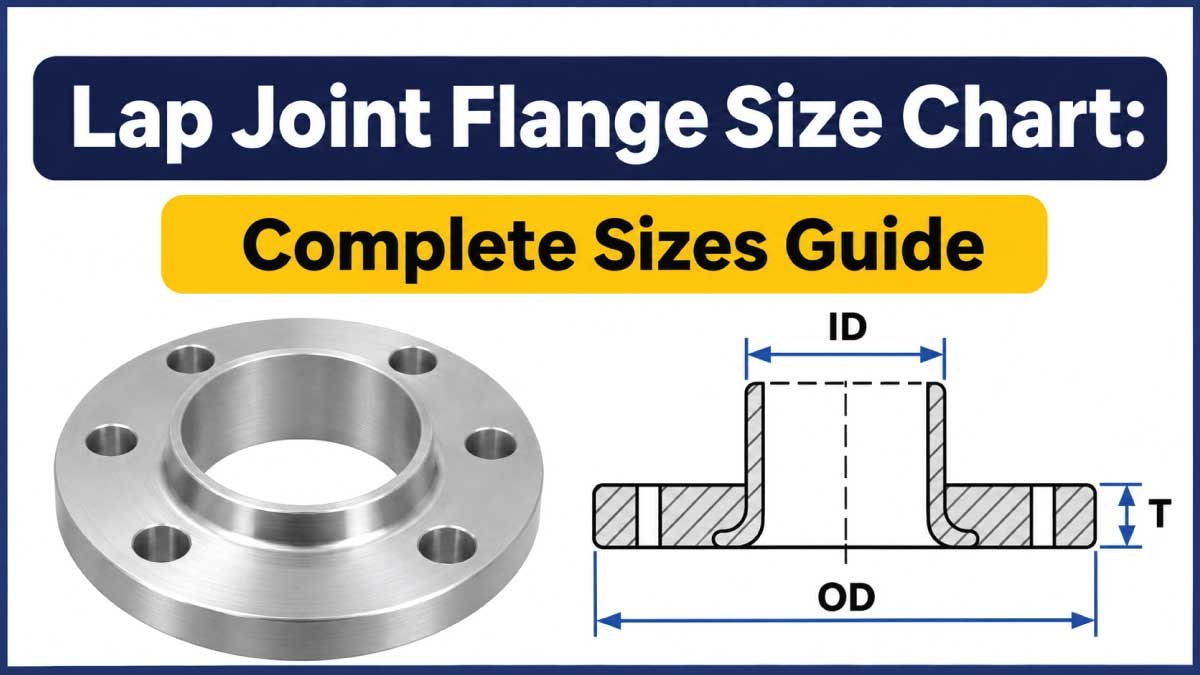
A lap joint flange is a type of pipe flange used with a stub end fitting to create a removable bolted connection. Unlike a weld neck or slip-on flange, the lap joint flange does not normally attach directly to the pipe. Instead, it fits over a stub end, which is welded to the pipe.
One of its main advantages is that the flange can rotate around the pipe before the bolts are tightened. This makes it easier to align bolt holes during installation, especially in piping systems with frequent maintenance requirements.
Choosing the correct lap joint flange requires checking several details, including nominal pipe size, flange outside diameter, thickness, bolt circle diameter, bolt-hole size, pressure class, facing arrangement, stub end type, and material compatibility.
This Lap Joint Flange Size Chart explains common NPS and DN designations, important dimensions, pressure classes, stub ends, materials, and selection considerations. It also covers measurement methods, applications, common sizing mistakes, and differences between lap joint and other flange types.
What Is a Lap Joint Flange?
A lap joint flange is a loose backing flange designed to work with a matching stub end. The stub end is welded to the pipe, while the lap joint flange slides over the pipe and rests behind the stub end’s flared end.
When two flanged pipe sections are connected, a gasket is placed between the appropriate sealing faces and the bolts are tightened. The flange provides the bolting force, while the stub end provides the gasket-contact surface.
The loose flange can rotate independently before tightening, helping installers align bolt holes without rotating the entire pipe assembly.
Main Features of a Lap Joint Flange
Important features include:
- Loose flange body: Fits over the pipe and can rotate around it before tightening.
- Stub end: A separate fitting welded to the pipe.
- Flared stub end: Provides the sealing face and supports the lap joint flange.
- Bolt holes: Allow connection to a matching flange.
- Bolt circle diameter: Determines the bolt-hole arrangement.
- Flange outside diameter: Defines the overall flange size.
- Flange thickness: Determines the thickness of the backing flange.
- Pressure class: Identifies the applicable pressure-temperature rating category.
The flange and stub end must be compatible with each other and with the piping system.
Lap Joint Flange Size Chart: NPS and DN
Lap joint flanges are commonly identified using Nominal Pipe Size (NPS) in ASME-based systems. Metric-based systems often use Nominal Diameter (DN).
NPS and DN are nominal designations. They do not represent the actual outside diameter of the flange or the exact internal diameter of the pipe.
Common Lap Joint Flange Nominal Sizes
| Nominal Pipe Size (NPS) | DN Designation | Nominal Size (inches) |
|---|---|---|
| 1/2″ | DN 15 | 0.5 |
| 3/4″ | DN 20 | 0.75 |
| 1″ | DN 25 | 1 |
| 1 1/4″ | DN 32 | 1.25 |
| 1 1/2″ | DN 40 | 1.5 |
| 2″ | DN 50 | 2 |
| 2 1/2″ | DN 65 | 2.5 |
| 3″ | DN 80 | 3 |
| 3 1/2″ | DN 90 | 3.5 |
| 4″ | DN 100 | 4 |
| 5″ | DN 125 | 5 |
| 6″ | DN 150 | 6 |
| 8″ | DN 200 | 8 |
| 10″ | DN 250 | 10 |
| 12″ | DN 300 | 12 |
| 14″ | DN 350 | 14 |
| 16″ | DN 400 | 16 |
| 18″ | DN 450 | 18 |
| 20″ | DN 500 | 20 |
| 24″ | DN 600 | 24 |
This table shows common nominal size equivalents. It is not a complete dimensional chart, and availability varies by standard, pressure class, material, and manufacturer.
Understanding NPS and DN
NPS is widely used in North American piping specifications, while DN is common in metric-based systems.
Some common equivalents include:
- NPS 1/2 = DN 15
- NPS 1 = DN 25
- NPS 1 1/2 = DN 40
- NPS 2 = DN 50
- NPS 3 = DN 80
- NPS 4 = DN 100
- NPS 6 = DN 150
- NPS 8 = DN 200
- NPS 10 = DN 250
- NPS 12 = DN 300
- NPS 16 = DN 400
- NPS 20 = DN 500
- NPS 24 = DN 600
These are nominal equivalents, not exact mathematical conversions. Always use the dimensions specified by the relevant piping standard.
Standard Lap Joint Flange Dimensions
Lap joint flange dimensions determine whether the backing flange can fit over the stub end and connect correctly to the mating flange.
The main measurements include outside diameter, thickness, bolt circle diameter, bolt-hole diameter, number of bolt holes, and bore dimensions.
Important Lap Joint Flange Measurements
| Dimension | Description | Abbreviation |
|---|---|---|
| Outside diameter | Overall diameter of the flange | OD |
| Flange thickness | Thickness of the backing flange | T |
| Bolt circle diameter | Circle passing through bolt-hole centers | BCD |
| Bolt-hole diameter | Diameter of each bolt opening | — |
| Number of bolt holes | Total number of fastening holes | — |
| Bore diameter | Opening through the flange assembly | — |
| Stub end length | Length of the stub end fitting | — |
| Stub end lap thickness | Thickness at the flared end | — |
| Lap outside diameter | Outside diameter of the stub end lap | — |
| Facing diameter | Diameter of the gasket-contact surface | — |
Exact measurements depend on the applicable standard, nominal size, pressure class, and stub end configuration.
Outside Diameter
The outside diameter is the measurement across the widest points of the backing flange.
It is useful when identifying an existing flange, but it cannot confirm compatibility by itself. Different pressure classes or dimensional standards may use different flange outside diameters for the same nominal pipe size.
Flange Thickness
Flange thickness refers to the thickness of the loose backing flange.
It is important to distinguish this measurement from the thickness of the stub end’s flared lap. These are separate components and have different dimensional requirements.
Bolt Circle Diameter
The bolt circle diameter, also called the pitch circle diameter, is an imaginary circle passing through the centers of the bolt holes.
The bolt circle must match the mating flange so the bolts can be installed correctly.
Bolt-Hole Diameter and Quantity
Bolt-hole diameter determines the size of the bolts that can pass through the flange. The number of holes determines the fastening arrangement.
Both must match the applicable flange standard and mating component.
Stub End Dimensions
The stub end is an essential part of the lap joint assembly.
Its length, bore, lap thickness, and outside diameter must be compatible with the backing flange and piping system. A backing flange that fits over the pipe does not necessarily fit the correct stub end.
Lap Joint Flange Pressure Classes
ASME B16.5 is a widely used standard for pipe flanges and flanged fittings within its specified size and pressure-class scope. Other standards may apply to larger flanges or different dimensional systems.
Common ASME pressure classes include:
| Pressure Class | General Application Context |
|---|---|
| Class 150 | Lower-pressure industrial and utility piping |
| Class 300 | Applications requiring a higher pressure class |
| Class 400 | Selected higher-pressure services |
| Class 600 | Higher-pressure industrial piping |
| Class 900 | High-pressure process systems |
| Class 1500 | Specialized high-pressure applications |
| Class 2500 | Very high-pressure applications within the standard’s scope |
These class numbers are not direct PSI pressure ratings. For example, Class 150 does not automatically mean a maximum working pressure of 150 PSI.
The allowable pressure depends on the material group and operating temperature.
How Pressure Class Affects Lap Joint Flange Selection
Pressure class can affect the backing flange dimensions and the overall connection requirements.
Depending on the applicable standard and size, differences may include:
- Flange outside diameter.
- Flange thickness.
- Bolt circle diameter.
- Bolt-hole diameter.
- Number of bolt holes.
- Facing dimensions.
- Required stub end configuration.
The stub end must also be suitable for the design conditions. Do not select a backing flange based only on its nominal size.
Selecting the Correct Pressure Class
Consider these factors before choosing a pressure class:
- Maximum design pressure.
- Operating temperature.
- Flange and stub end materials.
- Fluid characteristics.
- Applicable piping code.
- Pressure-temperature rating tables.
- Joint design and installation requirements.
For critical services, the complete flange assembly should be reviewed against the approved engineering specification.
Types of Lap Joint Flanges and Stub Ends
Lap joint flange assemblies use different stub end configurations. The correct combination depends on the piping standard, flange dimensions, and application.
Type A Stub End
A Type A stub end is commonly used with lap joint flanges. It has a specific lap thickness and geometry designed for the corresponding backing flange.
The backing flange is selected to accommodate the stub end’s lap and provide the required bolting arrangement.
Type B Stub End
Type B stub ends have different lap dimensions from Type A. Their use depends on the applicable dimensional specification and compatible backing flange arrangement.
Do not assume that a Type B stub end can be substituted for Type A without checking the relevant dimensions.
Type C Stub End
Type C stub ends are another configuration used in specified piping arrangements. They have their own dimensional requirements and must be matched with an appropriate flange.
Stub End Compatibility
| Component | What to Verify |
|---|---|
| Backing flange | Nominal size, class, bore, and dimensions |
| Stub end | Type, length, lap thickness, and bore |
| Pipe | Outside diameter, wall thickness, and material |
| Gasket | Facing compatibility, material, and dimensions |
| Bolting | Bolt diameter, length, grade, and quantity |
The type designation alone is not enough to confirm a compatible assembly. Always check the applicable dimensional tables.
Lap Joint Flange Materials
Material selection is important because the backing flange and stub end may experience different service conditions.
The material must be suitable for the operating pressure, temperature, fluid, corrosion environment, and mechanical requirements.
Carbon Steel
Carbon steel is widely used in general industrial piping.
ASTM A105 is a common specification for forged carbon steel flange products. Stub ends may use a suitable material specification based on the piping design.
Typical applications include:
- General industrial piping.
- Oil and gas facilities.
- Water and utility systems.
- Process equipment.
- Manufacturing plants.
Stainless Steel
Stainless steel is used where corrosion resistance is important.
Common stainless steel grades include 304 and 316. The exact product specification must be checked for the flange and stub end.
Typical applications include:
- Chemical processing.
- Water treatment.
- Food and beverage production.
- Pharmaceutical facilities.
- Selected corrosive environments.
Grade 316 generally provides better resistance to many corrosive environments than grade 304, but suitability depends on the actual fluid and operating conditions.
Read Latest Guide:
Alloy Steel
Alloy steel is used in specialized applications requiring particular mechanical or temperature properties.
The correct alloy and product specification should be selected according to the engineering design.
Material Comparison
| Material | General Characteristics | Common Applications |
|---|---|---|
| Carbon steel | General industrial strength | Oil, water, and utility piping |
| Stainless steel 304 | General corrosion resistance | Process and industrial systems |
| Stainless steel 316 | Improved resistance in many corrosive environments | Chemical and water systems |
| Alloy steel | Specialized mechanical and temperature properties | Selected industrial services |
The backing flange, stub end, pipe, gasket, and bolting should all be checked for compatibility.
Read Latest Guide:
Lap Joint Flange vs. Slip-On Flange
Lap joint and slip-on flanges may look similar because both can slide over a pipe during installation. However, their connection arrangements are different.
A lap joint flange works with a separate stub end, while a slip-on flange is normally attached directly to the pipe using fillet welds.
Main Differences
| Feature | Lap Joint Flange | Slip-On Flange |
|---|---|---|
| Pipe connection | Uses a separate stub end | Fits directly over pipe |
| Pipe-to-flange welding | Stub end is welded to pipe | Flange is generally fillet-welded |
| Flange rotation | Can rotate before tightening | Limited once installed |
| Main sealing surface | Stub end face | Flange facing |
| Maintenance | Backing flange can be removed separately | Usually requires disturbing the welded connection |
| Typical advantage | Easier bolt-hole alignment | Relatively straightforward welded installation |
When Is a Lap Joint Flange Useful?
A lap joint flange may be useful when:
- Frequent disassembly is expected.
- Bolt-hole alignment is difficult.
- The piping material is expensive and a compatible stub end can be used.
- The design benefits from a replaceable or reusable backing flange.
- The system requires a specific lap joint arrangement.
The choice must still meet the pressure, temperature, corrosion, and mechanical requirements of the service.
Read Latest Guide:
How to Measure a Lap Joint Flange
Accurate measurements help identify an existing backing flange and determine whether it matches the stub end and mating flange.
Use a vernier caliper, measuring tape, thread-free dimensional tools, and the relevant standard tables.
Step 1: Identify the Nominal Pipe Size
Check the pipe markings, drawings, or equipment documentation.
If the nominal size is unknown, measure the pipe outside diameter and compare it with the relevant pipe-size standard.
Step 2: Measure the Flange Outside Diameter
Measure across the widest points of the backing flange through its center.
Record the value in inches or millimeters.
Step 3: Measure Flange Thickness
Measure the thickness of the backing flange body.
Do not confuse it with the thickness of the stub end lap.
Step 4: Measure the Bolt Circle Diameter
Measure the distance between the centers of opposite bolt holes where possible.
Compare the result with the dimensional table for the relevant nominal size and pressure class.
Step 5: Count and Measure the Bolt Holes
Record the number of bolt holes and their diameters.
Check the bolt-hole arrangement against the mating flange.
Step 6: Measure the Bore
Measure the opening through the backing flange and compare it with the stub end and pipe dimensions.
The bore must allow the assembly to fit correctly without creating an unsuitable restriction or interference.
Step 7: Check the Stub End
Identify the stub end type and measure its length, lap thickness, lap outside diameter, and bore as required.
Step 8: Verify the Facing and Materials
Check the sealing surface, gasket arrangement, material markings, and product documentation.
A visual match alone is not sufficient to confirm the complete assembly is suitable.
How to Choose the Correct Lap Joint Flange
Selecting a lap joint flange requires checking the backing flange and stub end as a combined assembly.
1. Confirm the Nominal Pipe Size
Identify the correct NPS or DN from the piping drawing or equipment specification.
2. Select the Pressure Class
Check the design pressure, operating temperature, material group, and applicable pressure-temperature rating.
3. Match the Stub End Type
Identify the required stub end configuration and verify that the backing flange is designed for it.
4. Verify the Flange Dimensions
Check outside diameter, thickness, bolt circle diameter, bolt-hole diameter, and number of holes.
5. Check the Bore and Pipe Dimensions
Make sure the flange, stub end, and pipe dimensions are compatible.
6. Select Suitable Materials
Consider corrosion resistance, temperature, fluid compatibility, and mechanical requirements.
7. Confirm the Facing and Gasket
The stub end’s sealing face and gasket arrangement must match the mating flange and service conditions.
8. Review the Complete Assembly
Verify the flange, stub end, pipe, gasket, and bolting against the approved engineering specification.
Applications of Lap Joint Flanges
Lap joint flanges are used in piping systems where their rotating backing flange and removable bolted connection provide practical benefits.
Common applications include:
- Chemical processing: Selected process lines where compatible materials and maintenance access are important.
- Water treatment: Suitable utility and treatment piping.
- Food and beverage facilities: Systems using compatible corrosion-resistant materials.
- Petrochemical plants: Specified process and utility connections.
- Industrial equipment: Connections requiring convenient flange alignment.
- Maintenance systems: Piping arrangements that may need periodic disassembly.
- Corrosion-resistant piping: Selected systems where a suitable stub end material can be paired with a compatible backing flange.
Their suitability depends on the design conditions and applicable piping code.
Common Lap Joint Flange Sizing Mistakes
Incorrect sizing can create installation difficulties, gasket problems, or an unsuitable piping connection.
Avoid these common mistakes:
- Confusing NPS with actual pipe diameter: NPS is a nominal designation.
- Ignoring the stub end: A lap joint flange is not a complete assembly by itself.
- Mixing stub end types: Type A, B, and C configurations have different dimensional requirements.
- Checking only outside diameter: Thickness, bore, bolt circle, and hole size must also match.
- Selecting the wrong pressure class: Class numbers are not direct PSI ratings.
- Ignoring facing compatibility: The gasket-contact surfaces must be suitable for the mating flange.
- Using incompatible materials: The backing flange, stub end, pipe, and gasket must suit the service.
- Assuming every flange can rotate after installation: Rotation is useful during alignment, but the final bolted joint must be correctly assembled.
- Ignoring standard differences: ASME and EN dimensional systems should not be mixed without verification.
- Reusing damaged components: Inspect flange faces, stub ends, and bolting before reassembly.
Always confirm the complete assembly specification before purchasing or installing a lap joint flange.
Frequently Asked Questions
1. What is a lap joint flange used for?
A lap joint flange is used with a stub end to create a removable bolted pipe connection. Its loose backing flange can rotate before tightening, making bolt-hole alignment easier.
2. Does a lap joint flange require welding?
The backing flange itself is not normally welded to the pipe. The separate stub end is welded to the pipe and provides the sealing surface for the connection.
3. What is a stub end in a lap joint flange assembly?
A stub end is a short pipe fitting with a flared lap at one end. It is welded to the pipe and works with the loose backing flange.
4. What is the difference between a lap joint flange and a slip-on flange?
A lap joint flange uses a separate stub end and can rotate around the pipe before tightening. A slip-on flange fits directly over the pipe and is generally attached with fillet welds.
5. What standards cover lap joint flange dimensions?
ASME B16.5 covers many lap joint flange dimensions within its specified scope. Other standards, such as EN 1092-1, cover different flange systems and dimensional requirements.
6. Can a lap joint flange be reused?
A backing flange may be reusable if it is undamaged and remains suitable for the application. The stub end, gasket, and other components should be inspected, and damaged parts should be replaced according to the applicable requirements.
7. What pressure classes are available for lap joint flanges?
Common ASME pressure classes include 150, 300, 400, 600, 900, 1500, and 2500 within the applicable standard’s scope. Availability depends on size, material, and manufacturer.
8. Are lap joint flanges suitable for stainless steel piping?
Yes. They are used in selected stainless steel piping systems. The stub end and backing flange materials must be chosen to suit the fluid, temperature, pressure, and corrosion conditions.
9. How do I identify a lap joint flange size?
Check the nominal pipe size, flange outside diameter, thickness, bolt circle diameter, bolt-hole quantity, bore, pressure class, and compatible stub end dimensions.
10. What is the main advantage of a lap joint flange?
Its main advantage is the ability to rotate the backing flange before tightening. This makes bolt-hole alignment easier and can simplify maintenance in suitable piping systems.
Conclusion
A Lap Joint Flange Size Chart helps identify common NPS and DN designations, but correct selection requires more than matching the nominal pipe size.
The backing flange, stub end, pipe, gasket, and bolting must work together as a compatible assembly. Important details include flange outside diameter, thickness, bolt circle diameter, bolt-hole size, pressure class, stub end type, material, and facing.
Before purchasing or installing a lap joint flange, verify all dimensions against the applicable standard and approved piping specification. Correct sizing and component compatibility help support a reliable connection and simplify future maintenance.