
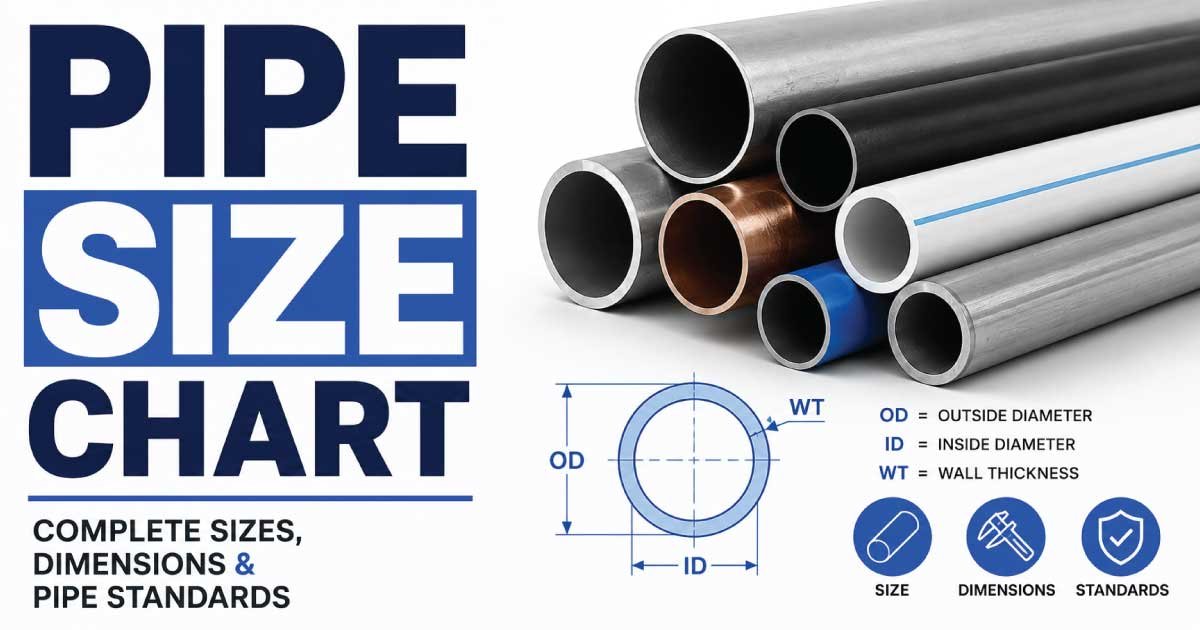
A pipe size chart is an essential reference for identifying pipe dimensions, nominal pipe size, outside diameter, wall thickness, inside diameter, and common pipe standards. Pipes are used in plumbing, water supply, drainage, HVAC systems, oil and gas, industrial processing, fire protection, irrigation, and many other applications.
One of the most confusing aspects of pipe sizing is that the nominal pipe size is not always the actual measured diameter. For example, a 2-inch nominal pipe does not necessarily have an outside diameter of exactly 2 inches. The actual outside diameter depends on the pipe standard, while the inside diameter changes according to wall thickness or schedule.
This comprehensive pipe size chart explains common pipe sizes in inches and millimeters, nominal pipe size (NPS), DN sizes, outside diameter, inside diameter, pipe schedule, wall thickness, metric pipe sizing, and common pipe standards.
What Is Pipe Size?
Pipe size is a standardized way of identifying a pipe based primarily on its nominal diameter. Depending on the pipe system, size may be expressed in inches, millimeters, NPS, or DN.
The term Nominal Pipe Size (NPS) is commonly used in North American pipe systems. NPS numbers such as 1/2, 3/4, 1, 1-1/2, 2, 3, 4, and 6 identify standardized pipe sizes.
In international and metric applications, DN (Diameter Nominal) is commonly used. DN values are expressed as dimensionless numbers that correspond approximately to the nominal internal diameter in millimeters.
Important pipe measurements include:
- Nominal pipe size
- Outside diameter
- Inside diameter
- Wall thickness
- Pipe schedule
- Pipe length
- Thread size where applicable
- Pressure rating
- Material
Understanding these measurements is essential when selecting pipes, fittings, valves, flanges, and other components.
Pipe Size Chart
The following pipe size chart provides common nominal pipe sizes and their approximate outside diameters.
| Nominal Pipe Size | NPS | Approx. Outside Diameter |
|---|---|---|
| 1/8 inch | 0.125 | 0.405 in |
| 1/4 inch | 0.250 | 0.540 in |
| 3/8 inch | 0.375 | 0.675 in |
| 1/2 inch | 0.500 | 0.840 in |
| 3/4 inch | 0.750 | 1.050 in |
| 1 inch | 1.000 | 1.315 in |
| 1-1/4 inch | 1.250 | 1.660 in |
| 1-1/2 inch | 1.500 | 1.900 in |
| 2 inch | 2.000 | 2.375 in |
| 2-1/2 inch | 2.500 | 2.875 in |
| 3 inch | 3.000 | 3.500 in |
| 3-1/2 inch | 3.500 | 4.000 in |
| 4 inch | 4.000 | 4.500 in |
| 5 inch | 5.000 | 5.563 in |
| 6 inch | 6.000 | 6.625 in |
| 8 inch | 8.000 | 8.625 in |
| 10 inch | 10.000 | 10.750 in |
| 12 inch | 12.000 | 12.750 in |
| 14 inch | 14.000 | 14.000 in |
| 16 inch | 16.000 | 16.000 in |
| 18 inch | 18.000 | 18.000 in |
| 20 inch | 20.000 | 20.000 in |
| 24 inch | 24.000 | 24.000 in |
The outside diameter values above are typical standardized dimensions for common steel pipe sizes. Exact dimensions should be verified against the applicable pipe standard and material specification.
Also Read: M Grub Screw Selection Guide: Full Size Chart
Why Nominal Pipe Size Is Different From Actual Pipe Diameter
One of the most important concepts in understanding pipe dimensions is that nominal pipe size is not necessarily the actual outside or inside diameter.
For example, a 1-inch nominal steel pipe has an outside diameter of approximately 1.315 inches, not exactly 1 inch.
Similarly, a 2-inch nominal pipe has an outside diameter of approximately 2.375 inches.
This naming system developed from historical pipe dimensions and became standardized so that pipes and fittings could be manufactured to compatible dimensions.
Therefore, when purchasing a pipe or fitting, do not assume that the nominal size is the same as the measured outside diameter.
Pipe Outside Diameter Chart
Outside diameter, commonly abbreviated as OD, is the actual distance across the outside of the pipe.
| Nominal Size | Outside Diameter in Inches | Outside Diameter in mm |
|---|---|---|
| 1/8 | 0.405 | 10.3 |
| 1/4 | 0.540 | 13.7 |
| 3/8 | 0.675 | 17.1 |
| 1/2 | 0.840 | 21.3 |
| 3/4 | 1.050 | 26.7 |
| 1 | 1.315 | 33.4 |
| 1-1/4 | 1.660 | 42.2 |
| 1-1/2 | 1.900 | 48.3 |
| 2 | 2.375 | 60.3 |
| 2-1/2 | 2.875 | 73.0 |
| 3 | 3.500 | 88.9 |
| 4 | 4.500 | 114.3 |
| 5 | 5.563 | 141.3 |
| 6 | 6.625 | 168.3 |
| 8 | 8.625 | 219.1 |
| 10 | 10.750 | 273.1 |
| 12 | 12.750 | 323.9 |
| 14 | 14.000 | 355.6 |
| 16 | 16.000 | 406.4 |
| 18 | 18.000 | 457.2 |
| 20 | 20.000 | 508.0 |
| 24 | 24.000 | 609.6 |
Outside diameter is particularly important when selecting pipe clamps, supports, sleeves, insulation, fabrication equipment, and compatible fittings.
Pipe Inside Diameter Chart
The inside diameter (ID) is the internal opening through which fluid, gas, air, or other material flows.
Unlike outside diameter, inside diameter can change considerably depending on the pipe’s wall thickness.
The basic relationship is:
Inside Diameter = Outside Diameter − 2 × Wall Thickness
For example, if a pipe has an outside diameter of 2.375 inches and a wall thickness of 0.154 inches:
ID = 2.375 − (2 × 0.154)
ID = 2.067 inches
This demonstrates why the same nominal pipe size can have different inside diameters when different schedules are used.
What Is Pipe Schedule?
Pipe schedule, commonly abbreviated as SCH, describes standardized pipe wall thickness.
Common schedules include:
- Schedule 5
- Schedule 10
- Schedule 20
- Schedule 30
- Schedule 40
- Schedule 60
- Schedule 80
- Schedule 100
- Schedule 120
- Schedule 140
- Schedule 160
For many common pipe sizes, Schedule 40 and Schedule 80 are frequently encountered.
As the schedule increases, the wall thickness generally increases for a given nominal pipe size. However, schedule numbers should not simply be treated as a direct wall-thickness measurement.
For example, Schedule 40 does not mean that the pipe wall is 40 mm or 40 thousandths of an inch thick.
Also Read: Set Screw Size Guide 2026: How to Choose Perfect Size
Schedule 40 Pipe Size Chart
Schedule 40 is one of the most commonly encountered pipe specifications for general piping applications.
| Nominal Size | Outside Diameter | Approx. Schedule 40 Wall Thickness |
|---|---|---|
| 1/2 inch | 0.840 in | 0.109 in |
| 3/4 inch | 1.050 in | 0.113 in |
| 1 inch | 1.315 in | 0.133 in |
| 1-1/4 inch | 1.660 in | 0.140 in |
| 1-1/2 inch | 1.900 in | 0.145 in |
| 2 inch | 2.375 in | 0.154 in |
| 2-1/2 inch | 2.875 in | 0.203 in |
| 3 inch | 3.500 in | 0.216 in |
| 4 inch | 4.500 in | 0.237 in |
| 5 inch | 5.563 in | 0.258 in |
| 6 inch | 6.625 in | 0.280 in |
| 8 inch | 8.625 in | 0.322 in |
| 10 inch | 10.750 in | 0.365 in |
| 12 inch | 12.750 in | 0.375 in |
These are common Schedule 40 dimensions for steel pipe and should be checked against the applicable standard for exact engineering work.
Schedule 80 Pipe Size Chart
Schedule 80 pipe has a thicker wall than Schedule 40 for many common nominal sizes.
| Nominal Size | Outside Diameter | Approx. Schedule 80 Wall Thickness |
|---|---|---|
| 1/2 inch | 0.840 in | 0.147 in |
| 3/4 inch | 1.050 in | 0.154 in |
| 1 inch | 1.315 in | 0.179 in |
| 1-1/4 inch | 1.660 in | 0.191 in |
| 1-1/2 inch | 1.900 in | 0.200 in |
| 2 inch | 2.375 in | 0.218 in |
| 2-1/2 inch | 2.875 in | 0.276 in |
| 3 inch | 3.500 in | 0.300 in |
| 4 inch | 4.500 in | 0.337 in |
| 5 inch | 5.563 in | 0.375 in |
| 6 inch | 6.625 in | 0.432 in |
| 8 inch | 8.625 in | 0.500 in |
| 10 inch | 10.750 in | 0.500 in |
| 12 inch | 12.750 in | 0.500 in |
Because the outside diameter remains standardized for a particular NPS, increasing wall thickness reduces the inside diameter.
Schedule 40 vs Schedule 80 Pipe
Schedule 40 and Schedule 80 pipes can have the same nominal size and outside diameter while having different wall thicknesses.
For example, both a 2-inch Schedule 40 and 2-inch Schedule 80 pipe have an outside diameter of approximately 2.375 inches.
However, Schedule 80 has a thicker wall.
This means:
- Schedule 40 generally has a larger inside diameter.
- Schedule 80 generally has a smaller inside diameter.
- Schedule 80 has greater wall thickness.
- The weight per unit length is generally greater for Schedule 80.
- Pressure capability depends on the material, dimensions, temperature, design code, and other factors.
The appropriate schedule should be selected based on the engineering requirements rather than simply choosing the thicker pipe.
Pipe Size in Millimeters
Pipe sizes are often converted from inches to millimeters for metric projects.
Common conversions include:
| Nominal Pipe Size | Approx. Outside Diameter |
|---|---|
| 1/2 inch | 21.3 mm |
| 3/4 inch | 26.7 mm |
| 1 inch | 33.4 mm |
| 1-1/4 inch | 42.2 mm |
| 1-1/2 inch | 48.3 mm |
| 2 inch | 60.3 mm |
| 2-1/2 inch | 73.0 mm |
| 3 inch | 88.9 mm |
| 4 inch | 114.3 mm |
| 5 inch | 141.3 mm |
| 6 inch | 168.3 mm |
| 8 inch | 219.1 mm |
| 10 inch | 273.1 mm |
| 12 inch | 323.9 mm |
| 14 inch | 355.6 mm |
| 16 inch | 406.4 mm |
| 18 inch | 457.2 mm |
| 20 inch | 508.0 mm |
| 24 inch | 609.6 mm |
These are outside-diameter conversions and should not be confused with DN designations.
Also Read: Aircraft Rivet Size: Complete Guide With Size Chart
What Is DN Pipe Size?
DN stands for Diameter Nominal. It is a standardized metric designation used widely in international piping systems.
Examples include:
- DN15
- DN20
- DN25
- DN32
- DN40
- DN50
- DN65
- DN80
- DN100
- DN125
- DN150
- DN200
- DN250
- DN300
DN does not always represent the exact measured inside or outside diameter.
For example, a nominal 2-inch pipe is commonly associated with approximately DN50.
A nominal 4-inch pipe is commonly associated with approximately DN100.
NPS to DN Pipe Size Chart
The following chart provides common approximate relationships between NPS and DN.
| NPS | Common DN Equivalent | Approx. Outside Diameter |
|---|---|---|
| 1/2 | DN15 | 21.3 mm |
| 3/4 | DN20 | 26.7 mm |
| 1 | DN25 | 33.4 mm |
| 1-1/4 | DN32 | 42.2 mm |
| 1-1/2 | DN40 | 48.3 mm |
| 2 | DN50 | 60.3 mm |
| 2-1/2 | DN65 | 73.0 mm |
| 3 | DN80 | 88.9 mm |
| 4 | DN100 | 114.3 mm |
| 5 | DN125 | 141.3 mm |
| 6 | DN150 | 168.3 mm |
| 8 | DN200 | 219.1 mm |
| 10 | DN250 | 273.1 mm |
| 12 | DN300 | 323.9 mm |
| 14 | DN350 | 355.6 mm |
| 16 | DN400 | 406.4 mm |
| 18 | DN450 | 457.2 mm |
| 20 | DN500 | 508.0 mm |
| 24 | DN600 | 609.6 mm |
These are commonly used nominal correspondences, not direct conversions of actual pipe diameter.
Nominal Pipe Size vs Actual Pipe Size
The difference between nominal size and actual dimensions is one of the most important concepts in piping.
A nominal pipe size provides a standardized identification.
The outside diameter is a defined physical dimension.
The wall thickness depends on the pipe schedule or specification.
The inside diameter is calculated from the outside diameter and wall thickness.
Therefore, two pipes can have:
- The same nominal size
- The same outside diameter
- Different wall thicknesses
- Different inside diameters
- Different weights
- Different flow characteristics
This is why pipe schedules are important when calculating flow capacity, pressure loss, weight, and other engineering characteristics.
How to Measure Pipe Size
If you have an unknown pipe and need to determine its size, begin by measuring the outside diameter.
Step 1: Measure Outside Diameter
Use a caliper or tape measure to determine the outside diameter.
Step 2: Compare With a Pipe Size Chart
Compare your measurement with standardized NPS outside diameters.
For example, an outside diameter close to 60.3 mm commonly corresponds to a 2-inch NPS pipe.
Step 3: Measure Wall Thickness
Use a pipe wall thickness gauge or suitable measuring method.
Step 4: Determine Inside Diameter
If necessary, calculate the approximate inside diameter using:
ID = OD − 2 × Wall Thickness
Step 5: Identify the Standard
Determine whether the pipe follows an applicable ASME, ASTM, ISO, API, or other specification.
This is especially important for industrial and pressure applications.
How to Choose the Correct Pipe Size
Selecting pipe size depends on more than the outside diameter.
Important factors include:
- Required flow rate
- Fluid type
- Operating pressure
- Operating temperature
- Pipe material
- Wall thickness
- Pressure rating
- Corrosion allowance
- Installation environment
- Required fittings
- Velocity requirements
- Applicable building or engineering codes
For plumbing systems, pipe sizing may depend on fixture demand and local plumbing requirements. Industrial systems require more detailed engineering calculations.
Pipe Size and Flow Capacity
Inside diameter has a direct effect on fluid flow.
For the same pipe length and general conditions, a larger internal diameter can carry more fluid with lower velocity and potentially lower friction losses.
However, simply selecting the largest available pipe is not always the best solution.
An oversized pipe can increase material costs, installation costs, and system volume.
A properly designed piping system balances:
- Flow requirements
- Pressure loss
- Velocity
- Cost
- Available space
- Material
- Operating conditions
Therefore, pipe size should be selected based on the complete system rather than nominal diameter alone.
Pipe Wall Thickness
Pipe wall thickness affects the inside diameter, pipe weight, strength characteristics, and pressure capability.
For the same nominal pipe size, a thicker wall generally reduces the internal opening.
For example, a 2-inch pipe may be available in multiple schedules.
The outside diameter remains approximately 2.375 inches, but the wall thickness changes.
This means the internal diameter changes as well.
Wall thickness is especially important in:
- High-pressure piping
- Steam systems
- Oil and gas
- Industrial processing
- Structural applications
- High-temperature service
The appropriate wall thickness should be determined according to the relevant engineering requirements.
Common Pipe Materials
Different pipe materials have different dimensions, standards, applications, and installation methods.
Steel Pipe
Steel pipe is widely used in industrial, structural, fire protection, mechanical, and process applications.
Stainless Steel Pipe
Stainless steel provides strong corrosion resistance and is commonly used in chemical processing, food processing, pharmaceutical systems, and demanding environments.
Copper Pipe
Copper is widely used in plumbing, refrigeration, HVAC, and water distribution.
PVC Pipe
PVC pipe is common in drainage, water, irrigation, and other applications where its material properties are suitable.
CPVC Pipe
CPVC is commonly used in certain hot- and cold-water applications.
HDPE Pipe
High-density polyethylene pipe is used in water supply, gas distribution, drainage, and other applications.
The dimensions of plastic pipes should be checked against the applicable plastic pipe standard because they do not necessarily follow the same dimensional system as steel NPS pipe.
Pipe Size Standards
Pipe dimensions are controlled by various standards depending on the application and material.
Common standards and specifications encountered in piping include:
- ASME standards
- ASTM specifications
- API specifications
- ISO standards
- ANSI-related dimensional systems
- EN standards
Different standards may address:
- Outside diameter
- Wall thickness
- Tolerances
- Materials
- Pressure requirements
- Manufacturing processes
- Testing
- Mechanical properties
When purchasing pipe for an engineering project, always verify the exact standard and material specification.
Pipe Fittings and Pipe Size
Pipe fittings must be compatible with the pipe’s dimensional system.
Common fittings include:
- Elbows
- Tees
- Reducers
- Couplings
- Unions
- Flanges
- Caps
- Plugs
- Adapters
- Valves
For example, a fitting intended for 2-inch NPS steel pipe is designed around the standardized outside diameter of approximately 2.375 inches.
This is why fittings can be labeled by nominal pipe size even though their actual opening or outside dimensions may differ.
Pipe Size vs Tube Size
Pipe and tube are not always sized using the same system.
Pipe is commonly identified by nominal size and schedule.
Tube is often specified directly by outside diameter and wall thickness.
For example, a tube might be described as:
2 inches OD × 0.125 inches wall
while a pipe might be described as:
2-inch Schedule 40
These descriptions are not automatically equivalent.
When ordering material, always specify whether you need pipe or tube and provide the applicable dimensional standard.
Large Pipe Size Chart
Larger pipe sizes are commonly used in industrial, municipal, water, energy, and infrastructure projects.
| Nominal Pipe Size | DN | Approx. Outside Diameter |
|---|---|---|
| 8 in | DN200 | 219.1 mm |
| 10 in | DN250 | 273.1 mm |
| 12 in | DN300 | 323.9 mm |
| 14 in | DN350 | 355.6 mm |
| 16 in | DN400 | 406.4 mm |
| 18 in | DN450 | 457.2 mm |
| 20 in | DN500 | 508.0 mm |
| 24 in | DN600 | 609.6 mm |
| 30 in | DN750 | 762.0 mm |
| 36 in | DN900 | 914.4 mm |
| 42 in | DN1050 | 1066.8 mm |
| 48 in | DN1200 | 1219.2 mm |
Large-diameter pipe dimensions should always be confirmed using the applicable standard because wall thickness and manufacturing tolerances can vary.
Small Pipe Size Chart
Small pipe sizes are frequently used in plumbing, instrumentation, compressed air, mechanical systems, and other applications.
| Nominal Size | Approx. Outside Diameter |
|---|---|
| 1/8 inch | 0.405 in |
| 1/4 inch | 0.540 in |
| 3/8 inch | 0.675 in |
| 1/2 inch | 0.840 in |
| 3/4 inch | 1.050 in |
| 1 inch | 1.315 in |
| 1-1/4 inch | 1.660 in |
| 1-1/2 inch | 1.900 in |
| 2 inch | 2.375 in |
| 2-1/2 inch | 2.875 in |
These common sizes are frequently encountered in general piping and mechanical systems.
Common Pipe Size Mistakes
Mistake 1: Measuring Only the Inside Diameter
Inside diameter changes with wall thickness, so it may not identify the nominal pipe size accurately.
Mistake 2: Assuming a 2-Inch Pipe Measures 2 Inches
A 2-inch NPS steel pipe has an outside diameter of approximately 2.375 inches.
Mistake 3: Ignoring Schedule
Different schedules can have different wall thicknesses and inside diameters.
Mistake 4: Confusing Pipe With Tube
Pipe and tube use different sizing conventions in many applications.
Mistake 5: Treating DN as Exact Diameter
DN is a nominal designation and should not automatically be interpreted as an exact measured diameter.
Mistake 6: Selecting Pipe Based Only on Diameter
Flow, pressure, temperature, material, wall thickness, and application requirements must also be considered.
Frequently Asked Questions About Pipe Sizes
What is a pipe size chart?
A pipe size chart provides standardized information about nominal pipe size, outside diameter, inside diameter, wall thickness, schedule, and related dimensions.
What is the most common pipe size?
There is no single pipe size that is most common across every industry. Sizes such as 1/2 inch, 3/4 inch, 1 inch, 2 inch, 3 inch, and 4 inch are frequently encountered in different plumbing and mechanical applications.
What is the actual diameter of a 1-inch pipe?
A common 1-inch NPS steel pipe has an outside diameter of approximately 1.315 inches, or about 33.4 mm.
What is the actual diameter of a 2-inch pipe?
A common 2-inch NPS steel pipe has an outside diameter of approximately 2.375 inches, or about 60.3 mm.
What is the actual diameter of a 4-inch pipe?
A common 4-inch NPS steel pipe has an outside diameter of approximately 4.500 inches, or 114.3 mm.
What does NPS mean in pipe sizing?
NPS means Nominal Pipe Size. It is a standardized designation used to identify pipe sizes.
What does DN mean?
DN means Diameter Nominal. It is a metric-based nominal pipe designation used widely in international piping systems.
What does Schedule 40 mean?
Schedule 40 is a standardized pipe wall-thickness designation. It does not mean the pipe wall is exactly 40 units thick.
What is the difference between Schedule 40 and Schedule 80?
For many common sizes, Schedule 80 has a thicker wall than Schedule 40. Both can have the same nominal size and outside diameter, but Schedule 80 generally has a smaller internal diameter.
How do I measure pipe size?
Measure the outside diameter, determine the wall thickness if necessary, and compare the measurements with a standardized pipe size chart.
Is pipe size the inside diameter or outside diameter?
Nominal pipe size is neither necessarily the exact inside diameter nor the exact outside diameter. It is a standardized designation. Actual OD is standardized for many pipe systems, while ID varies with wall thickness.
Final Pipe Size Chart Reference
A pipe size chart is one of the most useful references for anyone working with plumbing, construction, mechanical systems, industrial piping, HVAC, irrigation, or fabrication. The most important point to remember is that nominal pipe size is not always the same as the actual measured diameter.
For common NPS steel pipe, the outside diameter is standardized. For example, a 1-inch pipe has an outside diameter of approximately 33.4 mm, a 2-inch pipe has an outside diameter of approximately 60.3 mm, and a 4-inch pipe has an outside diameter of approximately 114.3 mm.
The pipe schedule then determines the wall thickness for many common steel pipe systems. Increasing wall thickness reduces the inside diameter while generally increasing pipe weight.
When selecting pipe, consider:
- Nominal pipe size
- NPS or DN designation
- Outside diameter
- Inside diameter
- Wall thickness
- Pipe schedule
- Material
- Pressure requirements
- Temperature
- Flow requirements
- Pipe fittings
- Applicable standards
- Installation conditions
For general identification, a pipe size chart provides an excellent starting point. For engineering, pressure, structural, or safety-critical applications, exact dimensions and ratings should always be confirmed against the applicable manufacturer specification and industry standard.
Understanding pipe sizes, pipe dimensions, NPS, DN, outside diameter, inside diameter, wall thickness, Schedule 40, Schedule 80, metric pipe sizes, and pipe standards makes it much easier to identify the correct pipe and compatible fittings for almost any piping project.