
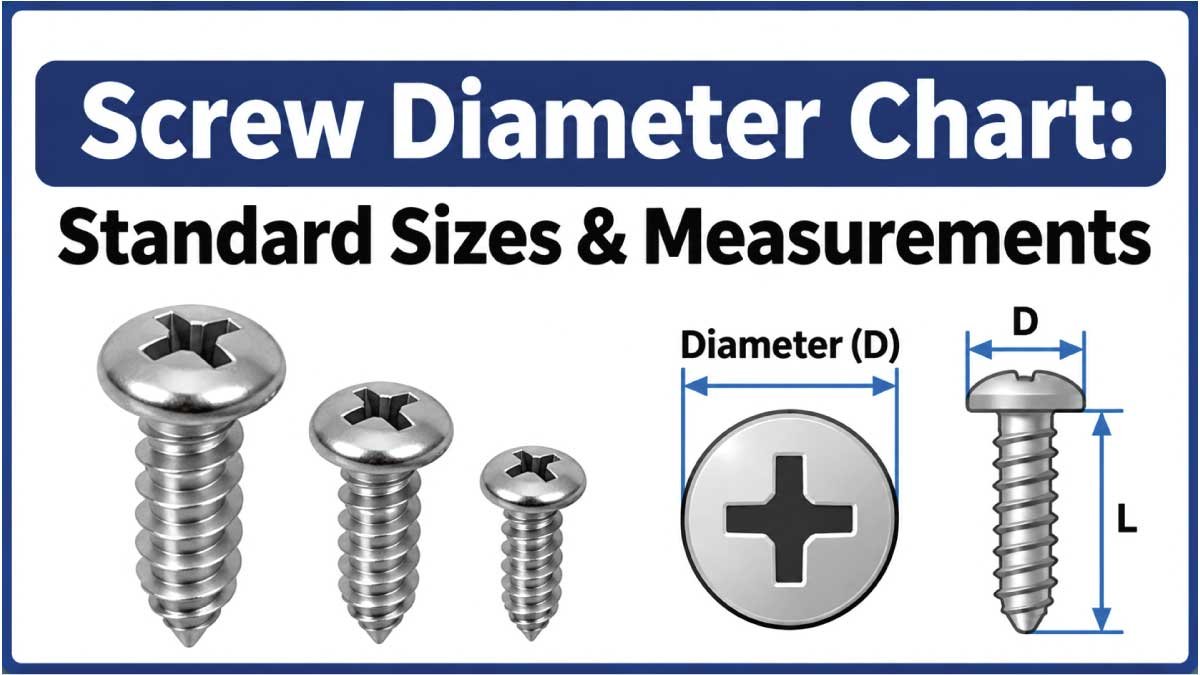
Choosing the correct screw starts with understanding diameter. A screw that is too small may not provide enough holding strength, while one that is too large can damage the material or prevent proper assembly. The challenge is that screw diameters are identified differently in metric and imperial systems.
This screw diameter chart explains common screw sizes, nominal and major diameters, metric and imperial measurements, thread terminology, and practical measurement methods. You will also learn how screw diameter differs from length, how to identify an unknown screw, and how to select the right diameter for an application.
Whether you are replacing a fastener, designing a joint, working on machinery, or simply trying to match a screw to a nut or threaded hole, the charts below provide a useful starting reference.
What Is Screw Diameter?
Screw diameter is the measurement across the threaded portion of a screw. For most standard threaded screws, the diameter refers to the nominal diameter, which identifies the screw’s basic size.
For example, an M6 screw has a nominal diameter of 6 mm. An M8 screw has a nominal diameter of 8 mm. In an imperial system, a screw may be identified by a number such as #8 or by a fractional diameter such as 1/4 inch.
The actual measurement over the thread crests can vary slightly because of manufacturing tolerances and the particular thread standard.
Major Diameter vs. Nominal Diameter
Several diameter terms can appear in technical screw specifications:
- Nominal diameter: The basic diameter used to identify the screw size.
- Major diameter: The largest diameter of an external thread, measured approximately over the thread crests.
- Minor diameter: The smallest diameter of the threaded section, measured near the thread roots.
- Pitch diameter: An engineering dimension used to describe the effective diameter of a threaded connection.
For everyday screw selection, the nominal diameter is usually the most useful measurement. For precision engineering, thread tolerances and pitch diameter become much more important.
Metric Screw Diameter Chart
Metric screws are generally identified using the letter M followed by the nominal diameter in millimeters. Thus, M4 means approximately 4 mm nominal diameter, while M10 means approximately 10 mm.
The following chart shows commonly encountered metric screw diameters.
| Metric Size | Nominal Diameter (mm) | Nominal Diameter (in) | Typical General Use |
|---|---|---|---|
| M2 | 2.0 | 0.079 | Small electronics and precision work |
| M2.5 | 2.5 | 0.098 | Small assemblies |
| M3 | 3.0 | 0.118 | Electronics and light assemblies |
| M4 | 4.0 | 0.157 | General light-duty fastening |
| M5 | 5.0 | 0.197 | Equipment and general assembly |
| M6 | 6.0 | 0.236 | Machinery and structural components |
| M8 | 8.0 | 0.315 | General machinery and heavier assemblies |
| M10 | 10.0 | 0.394 | Machinery and substantial joints |
| M12 | 12.0 | 0.472 | Heavy-duty fastening |
| M14 | 14.0 | 0.551 | Large mechanical assemblies |
| M16 | 16.0 | 0.630 | Heavy equipment and structural applications |
| M18 | 18.0 | 0.709 | Large machinery |
| M20 | 20.0 | 0.787 | Heavy-duty mechanical applications |
The inch values are approximate conversions from the nominal metric diameters. They should not be used to substitute an imperial screw for a metric screw in a precision threaded hole.
Common Metric Screw Diameters
Among general-purpose metric fasteners, M3, M4, M5, M6, M8, M10, and M12 are particularly common.
However, diameter alone does not completely identify a metric screw. For example, two M8 screws can have different thread pitches. An M8 coarse-thread screw and an M8 fine-thread screw have the same nominal diameter but different thread geometry.
Imperial Screw Diameter Chart
Imperial screw identification can be more complicated because machine screws may use numbered sizes, while larger fasteners are often identified by fractional inch diameters.
For numbered screw sizes, the number does not directly represent the diameter in inches. A higher gauge number generally corresponds to a larger diameter within the numbered screw range.
| US Screw Size | Approx. Major Diameter (in) | Approx. Diameter (mm) | Common Identification |
|---|---|---|---|
| #0 | 0.060 | 1.52 | Very small screws |
| #2 | 0.086 | 2.18 | Small assemblies |
| #4 | 0.112 | 2.84 | Light-duty fastening |
| #6 | 0.138 | 3.51 | General small screws |
| #8 | 0.164 | 4.17 | General-purpose screws |
| #10 | 0.190 | 4.83 | General assembly |
| #12 | 0.216 | 5.49 | Larger general-purpose screws |
| 1/4 in | 0.250 | 6.35 | Machine and structural fastening |
| 5/16 in | 0.3125 | 7.94 | Heavier fastening |
| 3/8 in | 0.375 | 9.53 | Heavy-duty applications |
| 7/16 in | 0.4375 | 11.11 | Large mechanical assemblies |
| 1/2 in | 0.500 | 12.70 | Heavy-duty fastening |
The numbered screw diameters shown above are approximate major diameters for common nominal sizes. Exact dimensions can vary according to the applicable screw and thread standard.
Numbered Screw Sizes Explained
A common mistake is assuming that a #10 screw has a 10 mm diameter. It does not.
The number is a US screw gauge designation. For example:
- #6 is approximately 0.138 inch in major diameter.
- #8 is approximately 0.164 inch.
- #10 is approximately 0.190 inch.
- #12 is approximately 0.216 inch.
Therefore, when replacing an imperial screw, use the complete size designation rather than guessing the diameter from the screw number.
Metric vs. Imperial Screw Diameter
Metric and imperial screw sizes should not be treated as interchangeable simply because their diameters appear close.
For example, an M6 screw has a nominal diameter of 6 mm, which converts to about 0.236 inch. A 1/4-inch screw has a nominal diameter of 6.35 mm. Although these diameters are relatively close, their threads can be completely different.
| Metric Size | Nominal Diameter (mm) | Approx. Imperial Equivalent (in) |
|---|---|---|
| M3 | 3.0 | 0.118 |
| M4 | 4.0 | 0.157 |
| M5 | 5.0 | 0.197 |
| M6 | 6.0 | 0.236 |
| M8 | 8.0 | 0.315 |
| M10 | 10.0 | 0.394 |
| M12 | 12.0 | 0.472 |
| M16 | 16.0 | 0.630 |
| M20 | 20.0 | 0.787 |
These are diameter conversions, not thread-compatible equivalents.
If a threaded hole is designed for M8, for example, selecting a screw solely because its diameter appears similar is not sufficient. Thread pitch, profile, and tolerance must also match.
How to Measure Screw Diameter
Measuring an unknown screw is relatively simple if you have a ruler, caliper, or screw gauge. A digital caliper provides the most useful general-purpose measurement.
1. Measure Across the Threads
Place the jaws of the caliper across the threaded section of the screw.
For an external thread, measure approximately from the crest on one side to the crest on the opposite side. This gives an indication of the major diameter.
Do not measure the head when trying to determine screw diameter. Head width and head diameter are separate dimensions.
2. Compare the Measurement With a Chart
Suppose the measured diameter is close to:
- 3 mm → potentially M3
- 4 mm → potentially M4
- 5 mm → potentially M5
- 6 mm → potentially M6
- 8 mm → potentially M8
- 10 mm → potentially M10
For an imperial screw, a measurement near 0.164 inch may indicate a #8 screw, while approximately 0.190 inch may indicate a #10 screw.
3. Identify the Thread Pitch
Diameter alone is not enough for many machine screws.
Metric thread pitch is measured as the distance between adjacent thread crests in millimeters. Imperial threads are commonly identified by threads per inch (TPI).
For example, an M8 screw can be identified as M8 × 1.25 when using a 1.25 mm pitch. Another M8 thread may use a different pitch.
4. Check the Length
After identifying diameter and thread pitch, measure screw length according to the type of screw and its applicable convention.
A complete identification may therefore look like:
M8 × 1.25 × 40 mm
This indicates an M8 nominal diameter, 1.25 mm thread pitch, and 40 mm nominal length, with the exact length measurement convention depending on the head style.
Screw Diameter and Thread Pitch
Diameter and thread pitch work together to identify a threaded fastener.
Diameter tells you how large the screw is. Pitch tells you how closely the threads are spaced.
For metric fasteners, a designation such as M10 × 1.5 means:
- M10: 10 mm nominal diameter
- 1.5: 1.5 mm thread pitch
For inch fasteners, a designation may include the screw size and a threads-per-inch value, such as 1/4-20, meaning a nominal 1/4-inch diameter and 20 threads per inch.
Coarse and Fine Threads
A given diameter can be available with different thread pitches.
Coarse threads generally have fewer threads per unit length and deeper thread spacing. They are commonly used for general-purpose fastening.
Fine threads have more closely spaced threads. They are used in applications where the thread specification, adjustment, engagement, or material characteristics make a finer pitch appropriate.
Neither coarse nor fine should automatically be considered better. The correct choice depends on the application and specified standard.
Screw Diameter vs. Screw Length
Screw diameter and screw length describe different dimensions.
Diameter determines the basic size of the threaded shaft. Length describes how far the screw extends according to the applicable measurement convention.
For example, two screws can both be M6 but have completely different lengths:
- M6 × 20 mm
- M6 × 40 mm
- M6 × 60 mm
All three have the same nominal diameter but different lengths.
This distinction is important when ordering replacements. Saying “I need an M6 screw” is usually incomplete. You may also need to specify:
- Thread pitch
- Length
- Head style
- Drive type
- Material
- Strength or property class
- Finish or coating
- Applicable standard
Also Read:
Common Screw Diameter Sizes and Applications
Different diameters are selected for different types of work. However, diameter should never be used alone to determine how much load a screw can safely carry.
Small-Diameter Screws
Sizes such as M2, M2.5, M3, #2, and #4 are commonly found in smaller assemblies.
Potential applications include:
- Electronics
- Small enclosures
- Precision equipment
- Small brackets
- Instrumentation
- Light mechanical assemblies
The surrounding material and required thread engagement can be more important than simply selecting a larger screw.
Medium-Diameter Screws
M4 through M10 and similar imperial sizes cover a broad range of general fastening applications.
They can be found in:
- Machinery
- Equipment assemblies
- Furniture hardware
- Automotive components
- Metal brackets
- General maintenance
The appropriate size depends on the joint design, material, loads, and fastener specification.
Large-Diameter Screws
M12 and larger sizes, along with larger fractional-inch fasteners, are often used in substantial mechanical assemblies.
Applications can include:
- Heavy machinery
- Structural components
- Industrial equipment
- Large brackets
- Mechanical joints
For these applications, engineering specifications and applicable standards should be followed rather than selecting diameter based solely on appearance.
Also Read:
How to Choose the Correct Screw Diameter
The correct screw diameter is determined by more than the hole size. Consider the complete joint.
1. Check the Existing Thread
If replacing a machine screw, identify the existing thread first. The new fastener should match the required diameter and thread specification.
2. Consider the Material
Different materials provide different levels of thread engagement and resistance to stripping. A diameter suitable for steel may not automatically be suitable for softer materials.
3. Determine Required Thread Engagement
The screw needs adequate engagement with the mating thread or material. The required engagement depends on factors such as material strength, screw properties, joint design, and loading.
4. Consider the Applied Load
Tension, shear, vibration, impact, and repeated loading can all influence fastener selection.
For critical applications, the screw diameter should be selected through an appropriate engineering calculation or specification rather than a general size chart.
5. Match the Thread
A correct diameter with the wrong pitch is still the wrong screw.
Always verify:
- Nominal diameter
- Thread pitch or TPI
- Thread form
- Thread tolerance where applicable
- Mating component specification
Also Read:
Common Mistakes When Identifying Screw Diameter
Even a simple screw measurement can produce an incorrect identification.
Mistake 1: Measuring the Head
The screw head is not the same as the threaded diameter. Always measure the threaded shaft when identifying nominal screw size.
Mistake 2: Confusing Metric and Imperial Sizes
M6 and 1/4-inch screws have relatively similar diameters, but they are not automatically interchangeable.
Mistake 3: Ignoring Thread Pitch
Two screws can have the same nominal diameter but different pitches.
Mistake 4: Assuming the Number Equals the Diameter
A #8 screw does not have an 8 mm diameter. Numbered US screw sizes use a gauge system.
Mistake 5: Choosing Diameter Without Considering Length
A screw can have the correct diameter but still be too short or too long for the joint.
Mistake 6: Using a Chart as a Substitute for a Standard
Charts are excellent for identification and general reference. Precision or safety-critical applications should be checked against the applicable fastener standard and manufacturer documentation.
Screw Diameter Measurement Tools
Several tools can be used to identify screw dimensions.
| Tool | Best Use | Measurement Capability |
|---|---|---|
| Ruler | Quick approximate measurement | Diameter and length |
| Digital caliper | General identification | Diameter, length, head dimensions |
| Micrometer | Precise external measurement | High-precision diameter |
| Thread pitch gauge | Identifying thread pitch | Metric pitch or TPI, depending on gauge |
| Screw thread checker | Fast size identification | Common metric and imperial sizes |
For routine workshop identification, a digital caliper plus thread pitch gauge is a particularly useful combination.
Major Diameter, Minor Diameter, and Pitch Diameter
For technical work, screw diameter involves more than one measurement.
The major diameter is associated with the outermost portion of an external thread. The minor diameter is measured closer to the thread roots. The pitch diameter represents the effective diameter used in determining how mating threads engage.
These dimensions matter when designing or inspecting threaded components because a screw is not simply a smooth cylindrical rod with a spiral cut into it.
Thread geometry includes:
- Thread angle
- Crest
- Root
- Pitch
- Major diameter
- Minor diameter
- Pitch diameter
- Thread tolerance
For ordinary replacement screws, you usually do not need to calculate these dimensions manually. The relevant screw standard and manufacturer’s specification provide the necessary limits.
Screw Diameter Chart for Quick Reference
The following condensed chart is useful when you need a fast reference for common nominal diameters.
| Size | System | Nominal Diameter | Approx. Inch Value |
|---|---|---|---|
| M2 | Metric | 2.0 mm | 0.079 in |
| M3 | Metric | 3.0 mm | 0.118 in |
| M4 | Metric | 4.0 mm | 0.157 in |
| M5 | Metric | 5.0 mm | 0.197 in |
| M6 | Metric | 6.0 mm | 0.236 in |
| M8 | Metric | 8.0 mm | 0.315 in |
| M10 | Metric | 10.0 mm | 0.394 in |
| M12 | Metric | 12.0 mm | 0.472 in |
| #4 | Imperial | ≈2.84 mm | ≈0.112 in |
| #6 | Imperial | ≈3.51 mm | ≈0.138 in |
| #8 | Imperial | ≈4.17 mm | ≈0.164 in |
| #10 | Imperial | ≈4.83 mm | ≈0.190 in |
| #12 | Imperial | ≈5.49 mm | ≈0.216 in |
| 1/4 in | Imperial | 6.35 mm | 0.250 in |
| 5/16 in | Imperial | 7.94 mm | 0.3125 in |
| 3/8 in | Imperial | 9.53 mm | 0.375 in |
| 1/2 in | Imperial | 12.70 mm | 0.500 in |
Use this chart for initial identification, not as a substitute for the exact thread specification.
Frequently Asked Questions About Screw Diameter
What is the most common screw diameter?
There is no single universal screw diameter. Common sizes depend on the industry and application. Metric systems frequently use sizes such as M3, M4, M5, M6, M8, and M10, while imperial applications commonly use numbered screws and fractional-inch sizes.
Is screw diameter measured over the threads?
For practical identification of an external threaded screw, the diameter is generally checked across the thread crests to determine the approximate major diameter. The nominal diameter is the designated basic size.
Is M6 the same as 1/4 inch?
No. M6 has a nominal diameter of 6 mm, while 1/4 inch equals 6.35 mm. Their thread dimensions can also differ, so they should not be assumed interchangeable.
How do I know what size screw I have?
Measure the threaded diameter, identify the thread pitch or TPI, measure the length, and determine the head and drive style. Comparing these measurements with a screw size chart or thread gauge can help identify the fastener.
Does a larger screw diameter always mean a stronger screw?
No. Diameter is one factor affecting fastener capacity, but material, grade or property class, thread engagement, joint design, loading direction, installation, and other factors also matter.
Can I use a metric screw in an imperial threaded hole?
You should not assume that metric and imperial threads are interchangeable. Even when diameters appear similar, the thread pitch and profile may not match.
What is the difference between screw diameter and thread size?
Screw diameter describes the basic size of the threaded portion, while a complete thread designation may include diameter, pitch, tolerance, and thread form. For example, M8 × 1.25 provides more information than simply M8.
Final Tips for Using a Screw Diameter Chart
A screw diameter chart is most useful when combined with accurate measurement and complete fastener identification.
Before purchasing or installing a replacement, verify:
- Diameter
- Thread pitch or threads per inch
- Screw length
- Head style
- Drive type
- Material
- Strength or property class where applicable
- Finish or coating
- Thread standard and tolerance when required
For ordinary repairs, a caliper and thread gauge can quickly narrow down the correct size. For machinery, structural joints, pressure equipment, or other critical applications, follow the engineering specification and applicable fastener standard.
Conclusion
Understanding screw diameter makes it much easier to identify, compare, and select threaded fasteners. Metric sizes such as M3, M4, M5, M6, M8, and M10 are identified by nominal diameter in millimeters, while imperial screws may use numbered gauges or fractional-inch diameters.
The most important point is that diameter alone does not fully identify a screw. Thread pitch, length, head style, material, strength classification, and the applicable standard can all affect whether a fastener is suitable.
Use the screw diameter chart as a practical reference, measure unknown screws carefully, and verify the complete specification whenever thread compatibility, performance, or safety is important.