
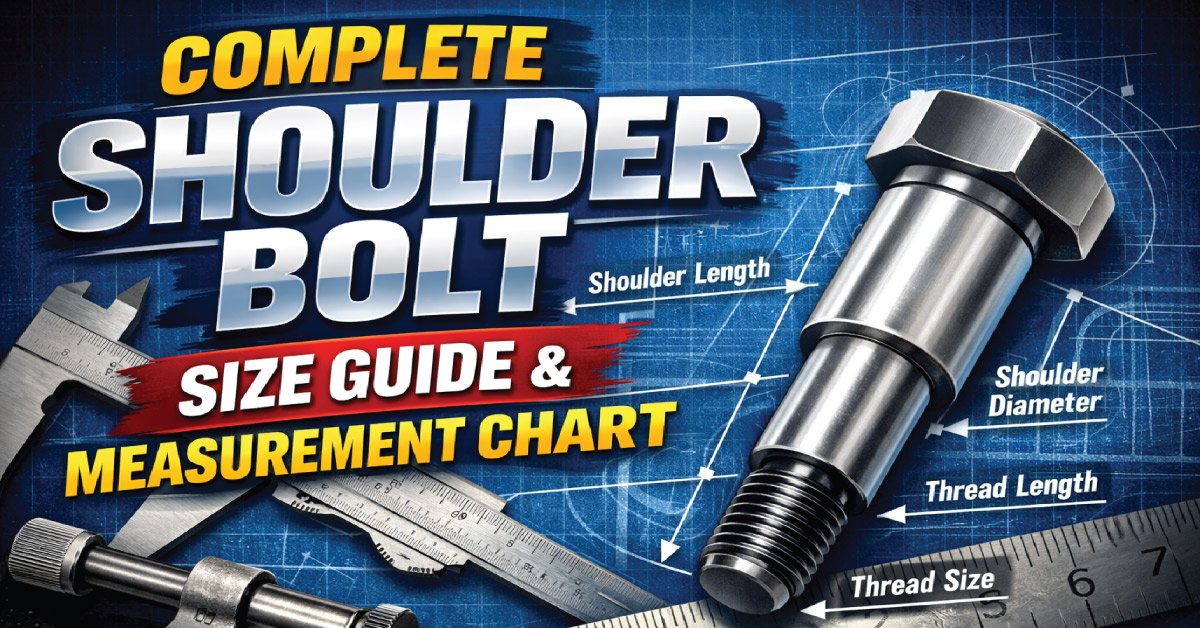
Shoulder bolts, also known as stripper bolts or shaft bolts, are specialized fasteners widely used in machinery, automotive assemblies, electronics, and various industrial applications. Unlike standard bolts, they feature a smooth, unthreaded shoulder between the head and threaded portion, providing a precise shaft or pivot for components. Choosing the correct shoulder bolt size is essential for proper alignment, load capacity, and reliable operation. This Shoulder Bolt Size Guide details types, materials, sizing standards, applications, torque recommendations, and includes reference charts for easy selection.
What Is a Shoulder Bolt?
A shoulder bolt is a specialized fastener consisting of three main parts: a head—typically hex or socket—for tightening, a smooth, precision-ground shoulder, and a threaded portion for fastening to a nut or tapped hole. The shoulder provides a precise shaft that allows components to rotate or slide freely while maintaining accurate spacing and alignment.
Head – Usually a hex or socket head for tightening
Shoulder – Smooth, precision-ground section
Threaded portion – For fastening to a nut or tapped hole
The shoulder allows components to rotate or slide freely while maintaining precise spacing.
Why Shoulder Bolt Sizing Matters
Selecting the correct shoulder bolt size is essential for proper function and reliability. Proper sizing ensures accurate shaft alignment, smooth rotation or sliding of moving parts, adequate load-bearing capacity, and a proper assembly fit. Using an undersized shoulder can cause wobble, misalignment, or premature wear, while an oversized shoulder may not fit the mating component correctly.

Accurate shaft alignment
Smooth rotation or sliding of moving parts
Adequate load-bearing capacity
Proper assembly fit
Undersized shoulders cause wobble, misalignment, or premature wear, while oversized shoulders may not fit the mating component.
Common Applications of Shoulder Bolts
Shoulder bolts are widely used in applications requiring precise alignment and smooth movement. They serve as pivot points in hinges or levers, components in tools and dies, machinery shafts and bearings, automotive assemblies, and robotics or linear motion guides. Their precision shoulders allow controlled rotation or sliding while maintaining accurate spacing between parts.
Pivot points in hinges or levers
Tool and die components
Machinery shafts and bearings
Automotive assemblies
Robotics and linear motion guides
Shoulder Bolt Terminology
Understanding shoulder bolt terminology is essential for proper sizing and selection. Key dimensions determine fit, load capacity, and functionality in assemblies. Terms such as shoulder diameter, shoulder length, thread diameter, thread length, and head type define the bolt’s geometry and performance characteristics, ensuring precise alignment, smooth motion, and reliable fastening in mechanical, automotive, and industrial applications.
1-Shoulder Diameter
The shoulder diameter refers to the width of the smooth, unthreaded portion of the bolt. This dimension is critical because it determines how well the bolt can act as a shaft or pivot. Correct shoulder diameter ensures proper alignment, smooth rotation or sliding of components, and adequate load distribution without causing wobble or wear.
2-Shoulder Length
Shoulder length is the distance from the bolt head to the start of the threaded portion. This length defines how far the bolt can serve as a shaft or pivot for moving parts. Selecting the correct shoulder length ensures proper spacing between components, smooth operation, and secure assembly fit.
3-Thread Diameter
Thread diameter refers to the width of the threaded section of the shoulder bolt. It determines compatibility with nuts or tapped holes and affects the bolt’s load-bearing capacity. Choosing the correct thread diameter ensures secure fastening and prevents stripping or failure under operational loads.
4-Thread Length
Thread length is the portion of the bolt that engages with a nut or tapped hole. Adequate thread length is necessary for secure fastening, proper torque application, and maintaining assembly integrity. Selecting the right thread length ensures reliable performance without excessive protrusion or insufficient engagement.
5-Head Type
Shoulder bolts can feature various head types, such as hex, socket, or button heads. The head type affects how the bolt is installed and tightened, as well as clearance and tool access. Choosing the correct head type ensures ease of installation, proper torque application, and compatibility with surrounding components
Shoulder Bolt Materials
Shoulder Bolt Standards
Shoulder bolts follow established standards to ensure consistent dimensions, tolerances, and thread specifications. Common standards include ANSI/ASME B18.3 for hex socket shoulder screws, DIN 608 for metric shoulder bolts, ISO 7379/7379-1 for shoulder screws, and ASTM F835 for aerospace or high-strength applications. Adhering to these standards ensures compatibility, safety, and reliable performance across assemblies.

ANSI / ASME B18.3 – Hex socket shoulder screws
DIN 608 – Metric shoulder bolts
ISO 7379 / 7379-1 – Shoulder screws
ASTM F835 – Aerospace and high-strength shoulder bolts
Determining Shoulder Diameter
Selecting the correct shoulder diameter is essential for proper function, clearance, and alignment of components. The diameter ensures that rotating or sliding parts move smoothly without interference while maintaining precise spacing. Common shoulder diameters range from 4 mm to 25 mm in metric sizes and 1/8″ to 1″ in imperial sizes, accommodating a wide variety of applications.
Metric: 4 mm – 25 mm
Imperial: 1/8″ – 1″
Choosing the correct diameter prevents interference and ensures proper shaft alignment.
Determining Shoulder Length
Choosing the correct shoulder length is vital for proper fit and function in assemblies. The shoulder must fully support or span the mating component without exceeding design tolerances, ensuring smooth operation and accurate spacing. Shoulder lengths commonly range from 6 mm (1/4″) to over 100 mm (4″) in industrial and machinery applications.
Minimum: Should cover the mating part fully
Maximum: Should not exceed design tolerance
Shoulder lengths often range from 6 mm (1/4″) to over 100 mm (4″) for industrial applications.
Also Read:
Threaded Portion Sizing
The threaded section of a fastener is critical for securing bolts and maintaining joint integrity. Proper sizing ensures sufficient thread engagement—typically 1 to 1.5 times the bolt diameter—while providing the required load-bearing capacity. Thread diameters are often matched proportionally to shoulder diameters, balancing strength and durability according to the specific load requirements of the application.
Adequate thread engagement (1–1.5x diameter minimum)
Load-bearing capacity
Thread diameters commonly match shoulder diameters in proportion to load requirements.
Shoulder Bolt Size Chart – Metric (Table)
This table provides standard metric dimensions for shoulder bolts, including shoulder diameter and length, thread diameter and length, along with typical applications. It serves as a reference for selecting bolts that meet both mechanical strength and assembly requirements.
| Shoulder Diameter (mm) | Shoulder Length (mm) | Thread Diameter (mm) | Thread Length (mm) | Typical Applications |
|---|---|---|---|---|
| 4 | 8 – 20 | M3 | 6 – 12 | Small electronics |
| 6 | 10 – 25 | M4 | 8 – 15 | Light machinery |
| 8 | 12 – 40 | M5 | 10 – 20 | Automotive parts |
| 10 | 15 – 50 | M6 | 12 – 25 | Robotics, tools |
| 12 | 20 – 60 | M8 | 15 – 30 | Heavy machinery |
Shoulder Bolt Size Chart – Imperial (Table)
This table lists common imperial dimensions for shoulder bolts, showing shoulder diameter and length, thread size, thread length, and typical uses. It is a practical reference for selecting bolts suited to specific load requirements and applications.
| Shoulder Diameter (in) | Shoulder Length (in) | Thread Diameter (in) | Thread Length (in) | Typical Use |
|---|---|---|---|---|
| 1/8 | 1/4 – 3/4 | #6-32 | 1/4 – 1/2 | Electronics, small tools |
| 3/16 | 3/8 – 1 | #10-24 | 3/8 – 5/8 | Machinery, hinges |
| 1/4 | 1/2 – 1-1/2 | 1/4-20 | 1/2 – 3/4 | Automotive, robotics |
| 5/16 | 3/4 – 2 | 5/16-18 | 3/4 – 1-1/4 | Heavy-duty machines |
| 3/8 | 1 – 2-1/2 | 3/8-16 | 1 – 1-1/2 | Industrial machinery |
Shoulder Bolt Head Types
The head type of a shoulder bolt influences both function and appearance. Common options include socket head cap screws for high strength, button heads for a low-profile finish, flat or countersunk heads for flush mounting, and hex heads for easy torque application. Proper head selection ensures adequate assembly clearance and meets aesthetic or design requirements.

Socket Head Cap Screws – Most common, high strength
Button Head – Lower profile, smooth finish
Flat Head / Countersunk – Flush surface
Hex Head – Easy torque application
Head selection impacts assembly clearance and aesthetics.
Shoulder Bolt Tolerances
Tolerances are critical for ensuring a precise fit and reliable performance. Standard shoulder diameter tolerances are h6 or h7, while thread diameters typically follow 6g or 6H for ISO metric bolts. Shoulder length tolerances range from ±0.1 mm to ±0.25 mm. Applications involving bearings or rotation often require tighter tolerances to maintain alignment and smooth operation.
Shoulder diameter tolerance: h6 / h7
Thread diameter tolerance: 6g / 6H (ISO metric)
Shoulder length tolerance: ±0.1 mm to ±0.25 mm
Tighter tolerances are required for bearing or rotational applications.
Shoulder Bolt Torque Guidelines
Proper torque on the threaded section is essential for secure clamping and reliable performance. Over-torquing can bend the shoulder or strip threads, while under-torquing may cause loosening. Torque requirements depend on bolt material and diameter, and reference charts are typically provided to ensure correct tightening without compromising strength or safety.
Over-torque: shoulder may bend or thread may strip
Under-torque: bolt may loosen
Typical torque chart is provided by material and diameter.
Also Read:
Shoulder Bolt Torque Chart (Table)
This table provides recommended torque values for shoulder bolts based on diameter and material. Following these guidelines ensures proper clamping, prevents thread stripping or shoulder bending, and maintains joint integrity. Torque values are given in both metric (Nm) and imperial (ft-lb) units for practical reference.
| Shoulder Diameter | Material | Recommended Torque (Nm) | Recommended Torque (ft-lb) |
|---|---|---|---|
| 4 mm / 5/32″ | Stainless Steel | 2 – 3 | 1.5 – 2.2 |
| 6 mm / 1/4″ | Alloy Steel | 5 – 7 | 3.7 – 5.2 |
| 8 mm / 5/16″ | Stainless Steel | 9 – 12 | 6.6 – 8.8 |
| 10 mm / 3/8″ | Alloy Steel | 18 – 22 | 13.3 – 16.2 |
| 12 mm / 1/2″ | Carbon Steel | 28 – 35 | 20.6 – 25.8 |
Shoulder Bolt Material Selection Tips
Selecting the right material is key to balancing strength, durability, and cost. Stainless steel offers corrosion resistance with moderate strength, alloy steel provides high strength for heavy loads, titanium is lightweight and strong but expensive, and carbon steel is cost-effective for low-load applications. Material choice should align with load, environment, and budget requirements.

Stainless Steel: Corrosion-resistant, moderate strength
Alloy Steel: High-strength, heat-treated for heavy loads
Titanium: Lightweight and strong, expensive
Carbon Steel: Budget-friendly, good for low-load applications
Shoulder Bolt Installation Tips
Proper installation ensures performance and prevents damage. Use washers when recommended to distribute the load evenly, align the shoulder precisely with the mating component, and tighten threads according to manufacturer torque specifications. Avoid applying lateral loads, as these can bend the shoulder or compromise joint integrity, particularly in precision or rotating applications.
Use washers if recommended to distribute load
Ensure shoulder aligns with mating component
Tighten threads to manufacturer torque spec
Avoid lateral loads that may bend the shoulder
Shoulder Bolt Applications by Industry
Shoulder bolts are widely used across industries for precise alignment and secure assembly. In automotive applications, they support engine components and linkages; robotics use them for pivot points and linear slides; tooling requires them in die sets and molds; machinery uses them for shafts and bearings; and aerospace relies on them for control linkages and assembly fixtures.
Automotive: Engine components, linkages, mounts
Robotics: Pivot points, linear slides
Tooling: Die sets, jigs, molds
Machinery: Shafts, bearings, rotating parts
Aerospace: Control linkages, assembly fixtures
Common Shoulder Bolt Mistakes
Errors in shoulder bolt selection or installation can compromise performance and safety. Common mistakes include using an incorrect shoulder diameter, selecting a shoulder that is too short for the application, over-torquing threads, choosing the wrong material for the operating environment, and ignoring head clearance. Awareness of these issues helps ensure proper function and longevity of assemblies.
Using incorrect shoulder diameter
Shoulder too short for application
Over-torquing threads
Using the wrong material for environment
Ignoring head clearance
Also Read:
Advantages of Correctly Sized Shoulder Bolts
Using properly sized shoulder bolts ensures components operate smoothly and reliably. Correct sizing provides precise alignment, supports rotational movement, minimizes wear, and enhances overall assembly performance. It also simplifies maintenance by allowing easy disassembly without damaging components, making shoulder bolts an essential element in precision machinery and equipment.
1-Smooth, Precise Rotation of Moving Parts
When the shoulder diameter and length are correctly chosen, moving components such as shafts, pulleys, or slides rotate smoothly with minimal friction. Proper fit reduces wobble or binding, ensuring consistent motion and extending the life of both the bolt and the moving part. This is especially critical in bearings and rotational assemblies.
2-Accurate Alignment of Components
Correctly sized shoulder bolts maintain precise spacing between parts, ensuring proper alignment in assemblies. This prevents misalignment-related wear, vibration, or mechanical failures. Accurate alignment is vital in robotics, machinery, and tooling where tight tolerances are required for operational accuracy and repeatability.
3-Reduced Wear and Tear
Properly sized shoulder bolts distribute loads evenly and prevent lateral stress on shafts or mating components. This reduces abrasion, deformation, and premature failure, extending the service life of both the bolts and the connected parts. It is particularly important in high-cycle or heavy-load applications.
4-Improved Assembly Reliability
Using bolts with the correct shoulder and thread dimensions ensures secure clamping and consistent performance. This minimizes the risk of loosening, bending, or thread stripping, enhancing overall reliability and safety of mechanical systems. Reliable assemblies reduce downtime and maintenance costs.
5-Easy Disassembly for Maintenance
Shoulder bolts with proper sizing allow components to be removed without difficulty, even after prolonged use. Accurate shoulder length and alignment prevent parts from sticking or binding, simplifying maintenance, inspection, or replacement. This feature is particularly beneficial in machinery, tooling, and automotive applications where routine service is required.
Custom Shoulder Bolts
For specialized applications, standard shoulder bolts may not meet specific requirements. Custom machining allows for non-standard shoulder lengths, uncommon diameters, specialized thread types, or unique materials and coatings. Tailoring these features ensures precise fit, optimal performance, and durability in applications with unusual geometries, extreme loads, or specialized environmental conditions.

Non-standard shoulder lengths
Uncommon diameters
Special thread types
Unique materials or coatings
Final Thoughts
Choosing the correct shoulder bolt size involves considering shoulder diameter, length, thread dimensions, material, torque, and application requirements. By using this Shoulder Bolt Size Guide, engineers and designers can ensure proper alignment, smooth operation, and reliable performance. Correctly sized shoulder bolts reduce wear, simplify maintenance, and enhance the efficiency of moving components in any assembly.
Also Read:
Wheel Lug Nut Size Chart (2026): Complete Guide
FAQs:
What are shoulder bolt dimensions?
Shoulder bolt dimensions usually include the shoulder diameter, shoulder length, thread size, and overall length. The shoulder is the unthreaded portion and is precision-ground for accurate alignment. These dimensions are critical for applications requiring smooth rotation, spacing, or load support without movement issues.
What is the difference between a shoulder bolt and a screw?
A shoulder bolt has a smooth, unthreaded shoulder designed for alignment or rotation, while a regular screw is fully threaded for fastening only. Shoulder bolts are used where movement or spacing is required, whereas screws mainly provide clamping force between two components.
What are shoulder bolt screw sizes?
Shoulder bolt screw sizes are defined by shoulder diameter, shoulder length, and thread size. Common sizes range from small precision bolts for machinery to larger industrial applications. Selecting the correct size ensures proper load distribution, smooth motion, and prevents excessive wear in mechanical assemblies.
What is the purpose of shoulder bolts?
The main purpose of shoulder bolts is to provide precise alignment, act as a pivot point, or maintain accurate spacing between components. They are commonly used in machinery, automotive parts, and tooling applications where controlled movement and stability are more important than simple fastening.
What is the difference between a shoulder bolt and a regular bolt?
A shoulder bolt has a smooth shoulder section for alignment or rotation, while a regular bolt is fully threaded and mainly used for clamping parts together. Shoulder bolts are ideal for moving parts, whereas regular bolts are better suited for fixed, load-bearing connections.
What are shoulder bolts used for?
Shoulder bolts are used in applications such as hinges, pulleys, cams, guide rollers, and machinery assemblies. They provide smooth movement, accurate spacing, and reduce friction between parts. Their design makes them suitable for both light-duty and heavy-duty mechanical systems.
How do shoulder bolts work?
Shoulder bolts work by using the smooth shoulder as a bearing surface while the threaded portion secures the bolt in place. This design allows parts to rotate or slide smoothly around the shoulder, ensuring precise alignment and reducing wear during repeated movement.