
If you have ever worked on a vehicle, assembled furniture, repaired machinery, or completed a DIY project, you’ve probably encountered an M8 bolt. While the name may sound technical, understanding what an M8 bolt is and how to identify its size is actually quite simple.
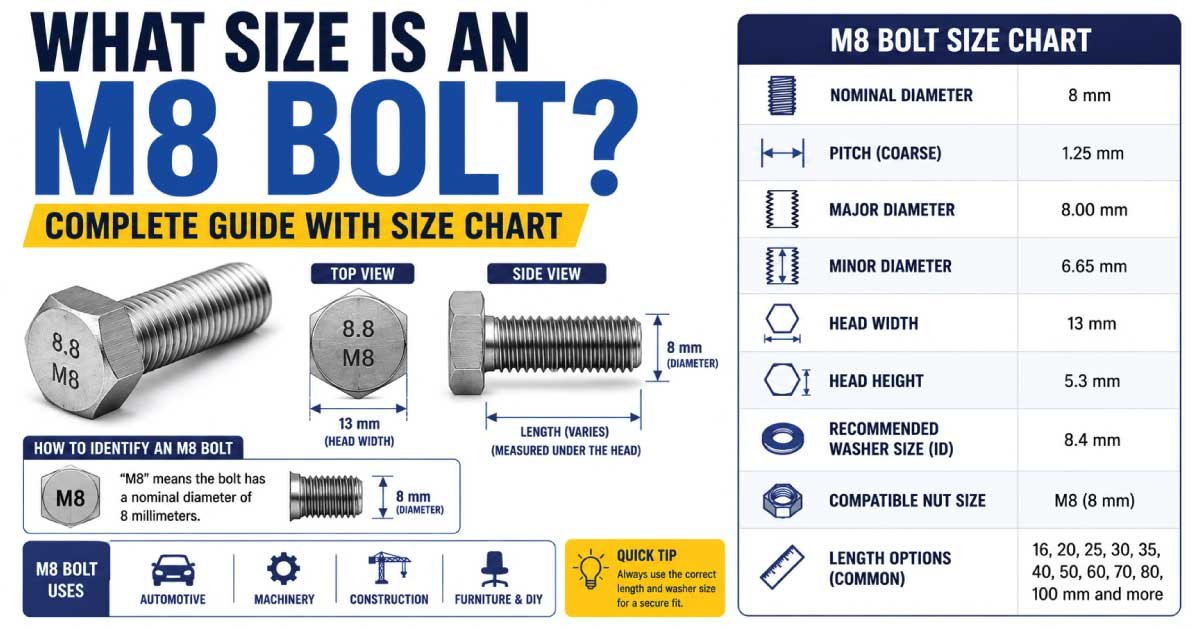
The “M” stands for metric, while the number 8 represents the bolt’s outside diameter of 8 millimeters. However, that’s only part of the story. An M8 bolt also has different thread pitches, lengths, head sizes, and strength grades that determine where and how it should be used.
In this complete guide, you’ll learn everything you need to know about M8 bolts, including standard dimensions, thread sizes, wrench sizes, drill sizes, common applications, and a detailed size chart.
What Does M8 Mean?
The term M8 is part of the ISO metric fastening system used worldwide for bolts and screws.
- M stands for Metric thread system
- 8 refers to the nominal diameter of the bolt, which is 8 mm
Unlike imperial fasteners measured in inches, metric bolts are measured in millimeters for diameter, making them easier to standardize globally.
Examples of metric sizing include:
- M6 = 6 mm diameter
- M8 = 8 mm diameter
- M10 = 10 mm diameter
- M12 = 12 mm diameter
An important point is that M8 always refers to the thread diameter, not the length of the bolt. An M8 bolt can come in many different lengths, but its diameter remains approximately 8 mm.
Standard M8 Bolt Dimensions
M8 bolts follow standardized measurements to ensure compatibility across industries and applications.
| Specification | Measurement |
|---|---|
| Thread Diameter | 8 mm |
| Standard Thread Pitch | 1.25 mm |
| Fine Thread Pitch | 1.0 mm |
| Extra Fine Pitch | 0.75 mm |
| Hex Head Size | 13 mm |
| Socket Allen Size | 6 mm |
| Common Lengths | 10–150 mm |
These dimensions make M8 bolts one of the most commonly used fasteners in automotive, construction, and machinery applications.
M8 Bolt Size Chart
The M8 size chart helps summarize the most important technical specifications for quick reference and selection.
| Feature | Standard Value |
|---|---|
| Nominal Diameter | 8 mm |
| Diameter in Inches | 0.315 in |
| Standard Pitch | 1.25 mm |
| Fine Pitch | 1.0 mm |
| Extra Fine Pitch | 0.75 mm |
| Across Flats (Hex Head) | 13 mm |
| Head Height | About 5.3 mm |
| Tap Drill Size (Coarse) | 6.8 mm |
| Clearance Hole (Close Fit) | 8.4 mm |
| Clearance Hole (Normal Fit) | 9.0 mm |
| Clearance Hole (Loose Fit) | 10 mm |
These measurements are essential when drilling holes, selecting nuts, or replacing bolts in mechanical systems.
M8 Bolt Thread Pitch Explained
Thread pitch is one of the most important characteristics of an M8 bolt. It defines the distance between one thread and the next, affecting strength, grip, and application suitability.
M8 bolts are commonly available in three different thread pitches:
M8 × 1.25 (Standard Coarse Thread)
This is the most widely used version of M8 bolts.
It is popular because it:
- Installs quickly and easily
- Is more resistant to cross-threading
- Works well in steel, aluminum, and general materials
- Is widely available in hardware stores
Coarse threads are ideal for general-purpose fastening in construction, automotive, and machinery applications.
M8 × 1.0 (Fine Thread)
Fine-thread M8 bolts have a smaller distance between threads, meaning more threads are engaged over the same length.
Key advantages include:
- Higher resistance to vibration loosening
- Better clamping force distribution
- More precise adjustment capability
These are commonly used in automotive engines, precision machinery, and mechanical assemblies where vibration resistance is important.
M8 × 0.75 (Extra Fine Thread)
Extra-fine M8 bolts are less common but are used in specialized applications requiring high precision.
Typical uses include:
- Hydraulic systems
- Aerospace components
- Precision instruments and machinery
These threads provide very fine adjustment and tight fastening control, making them suitable for engineering applications where accuracy is critical.
M8 Clearance Hole Size
When an M8 bolt is used in a through-hole application, it does not thread into the material but simply passes through it. In such cases, a clearance hole is required to allow smooth insertion and proper alignment.
The standard clearance hole sizes for M8 bolts are:
| Fit Type | Hole Size |
|---|---|
| Close Fit | 8.4 mm |
| Normal Fit | 9 mm |
| Loose Fit | 10 mm |
A 9 mm clearance hole is the most commonly used size in general fabrication and mechanical assembly because it provides a good balance between ease of installation and minimal movement.
Choosing the correct clearance fit depends on the application. Tight fits are used for precision alignment, while loose fits are preferred where easy assembly or vibration tolerance is needed.
Common Strength Grades
M8 bolts are available in different strength classes, which determine their load-bearing capacity, tensile strength, and suitable applications.
Grade 8.8
Grade 8.8 is the most commonly used structural bolt grade in general engineering applications.
It is widely used in:
- Vehicles
- Machinery
- Construction equipment
- General industrial assemblies
This grade provides a good balance between strength and cost, making it suitable for everyday mechanical use.
Grade 10.9
Grade 10.9 bolts offer significantly higher tensile strength compared to 8.8.
They are commonly used in:
- Automotive suspension systems
- Heavy-duty machinery
- Industrial equipment
- High-load mechanical joints
These bolts are designed for applications where higher stress and vibration resistance are required.
Grade 12.9
Grade 12.9 is a very high-strength alloy steel bolt used in demanding engineering environments.
Typical applications include:
- Performance engines
- Heavy mechanical assemblies
- Precision industrial tools
- High-stress fastening systems
This grade provides maximum strength but may be less flexible under extreme stress compared to lower grades.
Read our newest article here: M6 Bolt Size Chart: Complete Guide 2026 with Pdf
Materials Used for M8 Bolts
M8 bolts are manufactured using different materials depending on the required strength, corrosion resistance, and application environment.
1. Stainless Steel
Stainless steel M8 bolts are highly resistant to corrosion and ideal for outdoor or moisture-prone environments.
Key advantages include:
- Excellent rust resistance
- Suitable for outdoor use
- Safe for food-related applications
- Long service life
Common grades include:
- A2-70
- A4-80
These are widely used in marine, food processing, and architectural applications.
2. Zinc-Plated Steel
Zinc-plated M8 bolts are cost-effective and commonly available in hardware stores.
They are suitable for:
- Indoor applications
- Light mechanical assemblies
- General-purpose fastening
The zinc coating provides moderate corrosion resistance, but they are not ideal for long-term outdoor exposure.
3. Alloy Steel
Alloy steel M8 bolts are designed for high-strength applications where durability and load-bearing capacity are critical.
They are commonly used in:
- Heavy industrial machinery
- Automotive systems
- Structural assemblies
This material offers excellent mechanical strength but typically requires protective coatings to prevent corrosion.
4. Brass
Brass M8 bolts are used in specialized applications where corrosion resistance and electrical conductivity are important.
Common uses include:
- Decorative fittings
- Electrical components
- Low-load mechanical assemblies
Although not as strong as steel, brass is valued for its non-corrosive and aesthetic properties.
Where Are M8 Bolts Used?
M8 bolts are among the most commonly used fasteners in mechanical, industrial, and everyday applications because they offer a strong balance of size, strength, and versatility.
They are widely used in several industries:
Automotive
- Engine components
- Exhaust systems
- Seat mounts
- Brake assemblies
Construction
- Steel structures
- Support brackets
- Framework connections
- Mounting hardware
Manufacturing
- CNC machines
- Conveyor systems
- Industrial equipment assemblies
Furniture
- Beds and bed frames
- Office chairs
- Shelving units
- Tables and storage systems
DIY Projects
- Garden equipment repairs
- Bicycle maintenance
- Workshop fixtures
- Home improvement assemblies
Because of their moderate size and strong load capacity, M8 bolts are often considered a “standard utility bolt” across multiple industries.
How to Measure an M8 Bolt
Accurately measuring an M8 bolt ensures proper replacement and correct fitting in mechanical applications.
Step 1
Measure the outside diameter of the threaded section using a caliper.
It should be approximately 8 mm, confirming it is an M8 bolt.
Step 2
Measure the bolt length carefully.
For standard hex bolts, measure from under the head to the tip of the threaded end, not including the head itself.
Step 3
Check the thread pitch using a:
- Thread gauge
- Digital caliper
- Metric thread checker
This ensures compatibility with matching nuts or threaded holes.
Step 4
Identify the head type of the bolt, which affects tool selection and application.
Common types include:
- Hex head
- Socket head
- Button head
- Countersunk head
- Flange head
Each design serves different mechanical and space requirements.
Read our newest article here: Steel Pipe Size Chart: A Complete Guide
M8 vs M6 vs M10
Different metric bolt sizes are used depending on strength requirements and application needs. The M8 bolt sits in the middle, offering a balanced solution.
| Feature | M6 | M8 | M10 |
|---|---|---|---|
| Diameter | 6 mm | 8 mm | 10 mm |
| Standard Pitch | 1.0 mm | 1.25 mm | 1.5 mm |
| Hex Head Size | 10 mm | 13 mm | 17 mm |
| Common Uses | Furniture | Automotive | Structural Steel |
M6 bolts are generally used for lighter applications, while M10 bolts are used for heavier structural loads. M8 provides an ideal middle ground for general-purpose mechanical use.
Tips for Choosing the Right M8 Bolt
Selecting the correct M8 bolt is important for safety, durability, and performance in any assembly.
Consider the following factors:
- Required bolt length for proper engagement
- Correct thread pitch for compatibility
- Material type based on environment
- Strength grade for load capacity
- Corrosion resistance for outdoor use
- Suitable head type for tool access
- Operating environment (indoor or outdoor)
Choosing the right combination ensures long-term reliability and reduces the risk of mechanical failure.
Common Mistakes to Avoid
Many problems in mechanical assembly occur due to simple but avoidable mistakes when working with M8 bolts.
Avoid the following:
- Using the wrong thread pitch, which can damage threads
- Mixing metric and imperial fasteners
- Over-tightening, which may strip threads or damage components
- Using an incorrect wrench or socket size
- Selecting a bolt that is too short for proper engagement
- Ignoring the required strength grade for the application
- Reusing damaged, stretched, or corroded bolts
Avoiding these errors helps ensure a secure, long-lasting, and safe mechanical connection.
Final Thoughts
The M8 bolt is one of the most commonly used metric fasteners across automotive, industrial, construction, and DIY applications. Its 8 mm diameter, 13 mm hex head, and 1.25 mm standard thread pitch make it a versatile and reliable choice for countless projects.
Understanding dimensions, thread pitch, wrench size, drill size, and strength grades helps you select the right bolt for the job and avoid costly mistakes. Whether you’re replacing a worn fastener, assembling machinery, or tackling a home improvement project, knowing the specifications of an M8 bolt ensures a secure and long-lasting connection.
FAQs:
Is an M8 bolt exactly 8 mm?
Yes. An M8 bolt has a nominal outside thread diameter of 8 mm, which is where its designation comes from. However, the actual measured diameter may vary slightly due to manufacturing tolerances. The “M” indicates a metric thread, while “8” refers to the bolt’s nominal diameter.
What size socket fits an M8 bolt?
Most standard M8 hex bolts require a 13 mm socket or wrench to fit the hex head. Although the bolt thread measures 8 mm in diameter, the head is larger to allow proper tightening. Always confirm the bolt type, as flange or specialty bolts may use different head sizes.
What is the standard thread pitch for M8?
The standard coarse thread pitch for an M8 bolt is 1.25 mm, meaning each thread is spaced 1.25 millimeters apart. Fine-thread versions, such as M8 × 1.0, are also available for specialized applications requiring improved vibration resistance or more precise adjustment.
What drill bit should I use for an M8 tap?
For tapping a standard M8 × 1.25 thread, use a 6.8 mm drill bit before cutting the threads with an M8 tap. Using the correct tap drill size ensures proper thread engagement, reduces the risk of breaking the tap, and produces strong, accurate internal threads.
Is M8 stronger than M6?
Generally, yes. An M8 bolt has a larger diameter and greater cross-sectional area than an M6 bolt, allowing it to handle higher tensile and shear loads. Assuming both bolts are made from the same material and strength grade, the M8 provides greater load-carrying capacity and overall strength.