
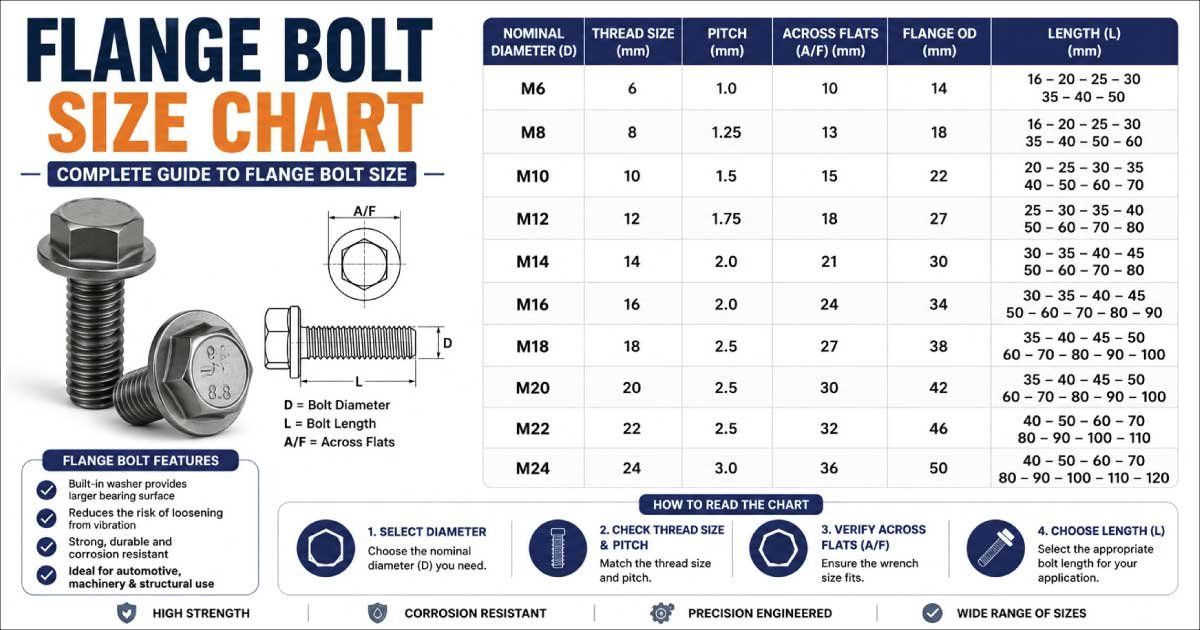
Flange bolts are among the most commonly used fasteners in the automotive, construction, manufacturing, and heavy equipment industries. Unlike standard hex bolts, flange bolts feature a built-in circular flange under the head, which acts like an integrated washer. This design distributes the clamping force over a larger surface area, reducing the need for a separate washer while improving load distribution and vibration resistance.
Whether you’re replacing bolts on a vehicle, assembling industrial machinery, or working on a DIY project, understanding flange bolt sizes is essential. Choosing the wrong size can lead to loose connections, damaged threads, or premature equipment failure.
This complete guide explains everything you need to know about flange bolt dimensions, metric and SAE sizes, thread pitches, wrench sizes, materials, strength grades, and includes an easy-to-read flange bolt size chart.
What Is a Flange Bolt?
A flange bolt is a type of fastener that has a hexagonal head with an integrated circular flange built directly underneath it. This flange acts like a built-in washer, meaning no separate washer is usually required during installation.
Flange bolts are widely used in automotive, machinery, and structural applications because they provide strong, stable, and vibration-resistant fastening.
The main functions of the flange include:
- Spreading clamping force evenly over a larger surface area
- Eliminating the need for a separate flat washer
- Preventing damage to softer materials like aluminum or plastic
- Increasing resistance to loosening under vibration
- Improving load distribution and stability
Some flange bolts feature a smooth flange, while others have a serrated flange that grips the surface more firmly and helps prevent loosening.
Parts of a Flange Bolt
A typical flange bolt is made up of several key components, each serving a specific purpose in the fastening system.
- Hex head (for tool engagement)
- Integrated flange (load distribution surface)
- Shank (smooth or partially threaded body)
- Threaded portion (engages with nut or tapped hole)
- Chamfered end (helps guide installation into threads)
The flange diameter is always larger than the bolt head, which allows it to spread pressure over a wider area and reduce surface damage. This makes flange bolts especially useful in high-vibration or load-sensitive applications.
Metric Flange Bolt Size Chart
Metric flange bolts come in a wide range of sizes to suit different mechanical and structural applications. The table below shows the most commonly used sizes:
| Bolt Size | Thread Pitch | Hex Head Size | Flange Diameter | Common Lengths |
|---|---|---|---|---|
| M5 | 0.8 mm | 8 mm | 11–12 mm | 10–40 mm |
| M6 | 1.0 mm | 10 mm | 13–14 mm | 10–60 mm |
| M8 | 1.25 mm | 13 mm | 17–18 mm | 12–100 mm |
| M10 | 1.5 mm | 15–17 mm | 21–24 mm | 16–120 mm |
| M12 | 1.75 mm | 18–19 mm | 25–28 mm | 20–150 mm |
| M14 | 2.0 mm | 21 mm | 30–32 mm | 25–180 mm |
| M16 | 2.0 mm | 24 mm | 34–36 mm | 25–200 mm |
| M20 | 2.5 mm | 30 mm | 42–45 mm | 30–250 mm |
These sizes are commonly used in automotive engines, machinery assemblies, and industrial equipment where strong and reliable fastening is required.
SAE Flange Bolt Size Chart
In imperial (SAE) systems, flange bolts are also widely used, especially in automotive and mechanical applications in the United States.
| Bolt Diameter | Threads (UNC) | Wrench Size |
|---|---|---|
| 1/4″ | 20 TPI | 7/16″ |
| 5/16″ | 18 TPI | 1/2″ |
| 3/8″ | 16 TPI | 9/16″ |
| 7/16″ | 14 TPI | 5/8″ |
| 1/2″ | 13 TPI | 3/4″ |
| 9/16″ | 12 TPI | 13/16″ |
| 5/8″ | 11 TPI | 15/16″ |
| 3/4″ | 10 TPI | 1-1/8″ |
These sizes are commonly used in engines, suspension systems, and heavy-duty mechanical assemblies where strong fastening and vibration resistance are essential.
Metric Thread Pitch Chart
Flange bolts are available in both coarse and fine thread pitches, depending on the application requirements.
| Bolt Size | Coarse Pitch | Fine Pitch |
|---|---|---|
| M6 | 1.0 mm | 0.75 mm |
| M8 | 1.25 mm | 1.0 mm |
| M10 | 1.5 mm | 1.25 mm |
| M12 | 1.75 mm | 1.5 mm |
| M14 | 2.0 mm | 1.5 mm |
| M16 | 2.0 mm | 1.5 mm |
Coarse threads are generally used for everyday applications because they are easier to install and more resistant to damage. Fine threads, on the other hand, provide improved clamping force and better resistance to vibration, making them suitable for precision and high-stress environments.
Common Flange Bolt Lengths
Flange bolts are available in a broad range of standardized lengths to suit different mechanical and structural applications. The correct length ensures proper thread engagement and secure fastening without bottoming out or leaving excess exposed threads.
Common metric flange bolt lengths include:
- 10 mm
- 12 mm
- 16 mm
- 20 mm
- 25 mm
- 30 mm
- 35 mm
- 40 mm
- 45 mm
- 50 mm
- 60 mm
- 70 mm
- 80 mm
- 90 mm
- 100 mm
- 120 mm
- 150 mm
- 200 mm
Flange bolt length is measured from under the flange (bearing surface) to the tip of the threaded end, since the flange itself acts as the reference point instead of the bolt head underside. This measurement method ensures accurate selection for assemblies where precise clamping depth is critical.
Standard Wrench Sizes
Selecting the correct wrench or socket size is essential for avoiding damage to flange bolt heads and ensuring proper torque application.
| Bolt Size | Wrench Size |
|---|---|
| M5 | 8 mm |
| M6 | 10 mm |
| M8 | 13 mm |
| M10 | 15–17 mm |
| M12 | 18–19 mm |
| M14 | 21 mm |
| M16 | 24 mm |
| M20 | 30 mm |
While these sizes are standard across most applications, slight variations may occur depending on the manufacturer or design of the flange head. In automotive applications especially, compact flange heads may require precise socket matching to ensure a secure grip without rounding.
Strength Grades
Flange bolts are manufactured in different strength grades to handle varying levels of stress, load, and vibration.
Grade 8.8
Grade 8.8 is a commonly used medium-strength bolt grade suitable for general engineering and structural applications.
It is widely used in:
- Machinery assemblies
- General construction projects
- Light to medium-duty equipment
This grade provides a good balance of strength, durability, and cost-effectiveness.
Grade 10.9
Grade 10.9 bolts offer significantly higher tensile strength and are designed for more demanding mechanical applications.
Common uses include:
- Automotive suspension systems
- Engine components
- Heavy-duty industrial equipment
These bolts are preferred in environments where vibration, torque, and mechanical stress are higher.
Grade 12.9
Grade 12.9 represents one of the highest-strength steel bolt classifications used in standard industrial applications.
It is commonly used in:
- High-performance machinery
- Precision industrial equipment
- Motorsport and racing applications
This grade provides maximum strength but is typically used where safety and engineering precision are strictly controlled.
Materials
Flange bolts are produced using different materials depending on environmental exposure, strength requirements, and cost considerations.
Carbon Steel
Carbon steel is one of the most widely used materials for flange bolts due to its strength and affordability.
Key features include:
- High mechanical strength
- Cost-effective production
- Suitable for general-purpose applications
It is commonly used in everyday machinery and structural assemblies where corrosion exposure is limited.
Zinc-Plated Steel
Zinc-plated steel flange bolts provide improved corrosion resistance compared to raw carbon steel.
They are ideal for:
- Indoor environments
- Light industrial applications
- General hardware use
The zinc coating helps slow down rust formation, extending service life under moderate conditions.
Stainless Steel
Stainless steel flange bolts are highly resistant to rust and corrosion, making them suitable for harsh environments.
Common applications include:
- Marine environments
- Outdoor installations
- Food-processing equipment
- Chemical exposure areas
They offer excellent durability and long-term reliability, especially in moisture-rich conditions.
Alloy Steel
Alloy steel flange bolts are engineered for high strength and durability in demanding applications.
They are commonly used in:
- Heavy-duty industrial machinery
- Structural load-bearing systems
- High-stress mechanical assemblies
This material provides superior tensile strength and performance under extreme mechanical loads.
Read our newest article here: Gas Pipe Size Chart: Complete Guide 2025 + Pdf Free
Serrated vs. Non-Serrated Flange Bolts
Flange bolts are available in two main designs: serrated and non-serrated, and each type is suited for different applications depending on grip, surface protection, and vibration conditions.
1. Serrated Flange Bolts
Serrated flange bolts have small teeth or ridges on the underside of the flange. These serrations are designed to bite into the mating surface when tightened, creating a stronger locking effect.
Advantages:
- Better resistance to vibration loosening
- Improved grip under dynamic loads
- Reduced risk of fastener back-off
- Excellent performance in automotive and machinery applications
Because of their biting action, serrated flange bolts are often used in environments where vibration or movement is constant, such as engines and suspension systems.
Important Note:
Serrated flange bolts should not be used on finished, painted, or soft surfaces, as the serrations can damage coatings, aluminum parts, or delicate materials during tightening.
2. Non-Serrated Flange Bolts
Non-serrated flange bolts have a smooth underside on the flange, meaning they distribute force evenly without biting into the surface.
Advantages:
- Reusable without surface damage
- Safer for soft metals like aluminum
- Ideal for painted or coated surfaces
- Provides clean, uniform load distribution
These bolts are preferred when protecting the surface finish is more important than maximum anti-vibration locking force.
Common Applications
Flange bolts are widely used across multiple industries due to their strength, stability, and ease of installation.
1. Automotive
Flange bolts are heavily used in vehicles where vibration resistance and compact fastening are required.
Common uses include:
- Engine assemblies
- Exhaust systems
- Brake components
- Suspension systems
- Transmission mounts
2. Construction
In construction, flange bolts provide strong structural connections in heavy-duty environments.
Applications include:
- Steel structures
- Bridges
- Roof framing systems
- Heavy construction equipment
3. Manufacturing
Flange bolts are essential in industrial machinery where consistent load and vibration resistance are required.
Used in:
- Conveyor systems
- CNC machines
- Industrial equipment assemblies
- Hydraulic systems
4. Agriculture
Agricultural machinery relies on durable fasteners that can withstand harsh outdoor conditions and heavy workloads.
Common applications include:
- Tractors
- Harvesters
- Farm implements
- Soil processing equipment
5. Home Projects
Flange bolts are also popular in DIY and household applications due to their strength and built-in washer design.
Examples include:
- Metal furniture assembly
- Storage racks
- Garden equipment
- Workshop benches
Flange bolts remain one of the most versatile fastening solutions because they combine strength, stability, and ease of use in a single integrated design.
Read our newest article here: Hydraulic Hose Size Chart: A Complete Guide
How to Measure a Flange Bolt
Measuring a flange bolt accurately is a fundamental skill in mechanical work, automotive repair, and industrial assembly. A flange bolt is designed with a built-in washer-like flange that distributes load evenly, but incorrect sizing can still lead to vibration, loosening, or structural failure. Proper measurement ensures compatibility with mating parts, correct torque application, and long-lasting performance under different load conditions.
Understanding how to measure each part of a flange bolt—thread, length, pitch, flange size, and head dimensions—helps avoid installation errors. It also ensures the bolt matches industry standards, whether metric or SAE. Even a small mistake in measurement can affect safety and efficiency in critical applications.
Follow these simple steps:
- Measure the thread diameter with a caliper.
- Measure the bolt length from under the flange to the tip.
- Determine the thread pitch using a thread gauge.
- Measure the flange diameter.
- Measure the hex head across the flats to identify the correct wrench size.
Each of these steps plays a crucial role in identifying the correct flange bolt size. When done carefully, they ensure proper fitment, reliable fastening, and safe mechanical performance in all types of assemblies.
Final Thoughts
Flange bolts are a reliable fastening solution for applications where secure clamping and even load distribution are essential. Their built-in flange simplifies assembly by reducing the need for separate washers while helping to minimize vibration-related loosening. By understanding bolt diameter, thread pitch, head size, flange diameter, material, and strength grade, you can confidently choose the right flange bolt for automotive, industrial, construction, or DIY projects. Keeping a flange bolt size chart on hand makes selecting the correct fastener faster, easier, and more accurate.
Frequently Asked Questions
What is the purpose of a flange bolt?
A flange bolt features a built-in washer-like flange beneath the head that increases the bearing surface against the connected material. This design distributes clamping force more evenly, reduces the chance of surface damage, improves joint stability, and often eliminates the need for a separate flat washer in many applications.
Do flange bolts need washers?
In most applications, no. The integrated flange acts like a built-in flat washer by spreading the clamping load over a larger area. However, certain specialized applications or manufacturer specifications may still require additional washers for sealing, spacing, or other engineering purposes, so always follow the recommended guidelines.
What wrench fits an M8 flange bolt?
Most standard M8 flange bolts use a 13 mm socket or wrench, the same as a standard M8 hex bolt. However, some automotive manufacturers use specialty flange bolts with different head dimensions. Always measure the bolt head or consult the service manual before selecting the appropriate tool.
Are flange bolts stronger than regular bolts?
No. The flange itself does not increase the bolt’s tensile or shear strength. A bolt’s strength is determined by its material and property class, such as 8.8, 10.9, or 12.9. The flange simply improves load distribution, reduces surface damage, and helps the joint resist loosening.
Can flange bolts be reused?
Yes. Flange bolts can often be reused if they are free from stretching, damaged threads, corrosion, or other signs of wear. However, some automotive engines, suspension systems, and structural assemblies use torque-to-yield or single-use bolts that should always be replaced after removal according to manufacturer recommendations.