

Jet engine turbine blades are among the most critical and precisely engineered components in modern aviation. Their size, shape, and material directly affect engine efficiency, thrust, fuel consumption, and safety.
Whether you are an aerospace student, aviation engineer, or aviation enthusiast, understanding turbine blade sizes is essential for grasping how jet engines operate at extreme temperatures and speeds.
This comprehensive jet engine turbine blade size guide explains blade dimensions, sizing standards, design factors, materials, and real-world applications.
You will also find multiple comparison tables and clear explanations to make complex concepts easy to understand.
Jet Engine Turbine Blade Sizes: Guide, Dimensions & Performance
When I first visited an aircraft maintenance workshop, I could not stop staring at the rows of turbine blades lined up on the benches. Each blade, some barely larger than my hand and others nearly a foot long, seemed ordinary at first glance.
But once an engineer explained that even a 0.05 mm difference in length or chord width could impact engine efficiency, fuel consumption, and safety, I realized how critical precise turbine blade sizing truly is.
Working with jet engines is a lesson in precision. These blades endure temperatures hotter than molten metal, spin at thousands of revolutions per minute, and convert the fiery energy of combustion into smooth, efficient thrust.
I learned that a high-pressure turbine blade might be tiny but must withstand extreme thermal stress, while a low-pressure blade is larger, optimized for torque and airflow management. Understanding blade dimensions, material choices, and cooling technologies isn’t just for engineers—it’s essential for anyone fascinated by how modern aviation works.
Over the years, I have studied blade designs across commercial, military, and auxiliary engines. I discovered how nickel-based superalloys, ceramic composites, and internal cooling passages allow blades to be thinner, lighter, and more efficient, without compromising strength. Even tip clearance—a tiny gap between blade tip and casing—can make or break performance, affecting thrust, vibration, and fuel efficiency.
This guide is designed to take you through the full spectrum of jet engine turbine blade sizing, from typical dimensions and stage-specific blades to material impact, manufacturing tolerances, and future trends in aerospace technology.
Whether you are an aviation student, engineer, or enthusiast, by the end, you will understand why every millimeter counts and how precise engineering powers flight safely and efficiently.
What Is a Jet Engine Turbine Blade?
A turbine blade is a curved aerodynamic component mounted on a turbine disk inside a jet engine. Its primary role is to extract energy from high-temperature, high-pressure gases produced in the combustion chamber.
As hot gases flow over the blades, they cause the turbine to rotate. This rotation powers the compressor at the front of the engine and, in turbofan engines, contributes to thrust generation.
Why Turbine Blade Size Matters
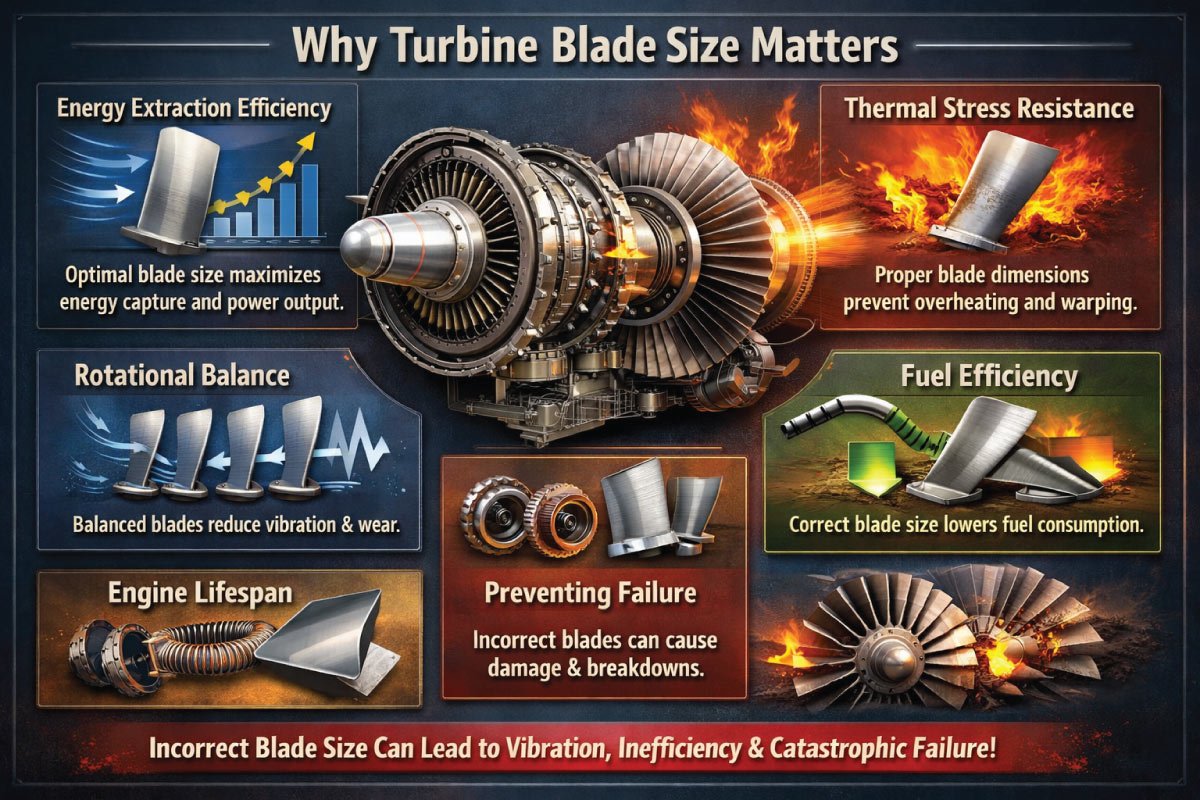
Turbine blade size is critical for optimal engine performance, efficiency, and longevity. Even small deviations in length, width, or shape can impact energy extraction, thermal resistance, and balance.
Understanding why blade dimensions matter helps engineers design safer, more efficient turbines while preventing vibration, fuel inefficiency, or potential catastrophic failures.
1. Energy Extraction Efficiency
Turbine blades convert fluid or gas flow into rotational energy. Blade size directly affects the amount of energy captured from the flow.
Oversized or undersized blades reduce efficiency, lowering overall power output. Correct sizing maximizes energy extraction, improves engine performance, and ensures the turbine operates at its designed efficiency levels.
2. Thermal Stress Resistance
Blades operate under extreme temperatures, especially in gas turbines. Size and thickness influence heat absorption and dissipation. Incorrectly sized blades may overheat or warp under thermal stress.
Proper dimensions allow for effective thermal management, maintaining structural integrity and preventing deformation or premature material failure during high-temperature operation.
3. Rotational Balance
Turbine blades must be perfectly balanced to avoid vibration. Uneven sizing disrupts rotational symmetry, creating oscillations that stress bearings and shafts.
Maintaining precise blade dimensions ensures smooth rotation, reduces mechanical wear, and minimizes noise while protecting the turbine from fatigue and structural damage caused by imbalance.
4. Fuel Efficiency
Blade size impacts the aerodynamic flow of gases through the turbine. Oversized or undersized blades can reduce combustion efficiency, leading to higher fuel consumption.
Proper sizing optimizes flow dynamics, allowing the engine to extract maximum energy per unit of fuel, improving overall efficiency and lowering operational costs.
5. Engine Lifespan
Incorrect blade sizing increases stress on the rotor, bearings, and casings, accelerating wear and reducing service life. Correctly sized blades maintain mechanical balance and distribute loads evenly.
This ensures the engine operates within safe limits, minimizing maintenance needs and extending the lifespan of the turbine and its components.
6. Preventing Catastrophic Failure
Even minor deviations in blade size can cause vibrations, blade collisions, or material failure. Such failures can damage the turbine or engine irreparably.
Ensuring precise blade dimensions is essential for safe operation, protecting both equipment and personnel from accidents due to imbalance or structural failure.
Incorrect blade sizing can cause vibration, efficiency loss, or catastrophic engine failure.
Basic Components of a Turbine Blade
Turbine blades are engineered with multiple critical sections, each serving a specific function in energy conversion and engine performance.
The root, airfoil, tip, and platform must meet precise dimensional and material specifications.
Understanding these components helps ensure proper attachment, airflow management, thermal resistance, and overall turbine efficiency
Root – Attaches the blade to the turbine disk
Airfoil – Curved section that interacts with hot gases
Tip – The outermost edge, often coated for wear resistance
Platform – Seals airflow between blades
Each section has specific dimensional requirements depending on engine type.
Typical Jet Engine Turbine Blade Size Ranges
Turbine blade sizes differ widely based on engine type, stage, and operating conditions.
High-pressure and low-pressure stages, as well as small jet engines versus large commercial engines, require blades with specific lengths, widths, and thicknesses.
Understanding typical size ranges helps in design, maintenance, and performance optimization of turbine systems.
General Turbine Blade Size Ranges
Turbine blade dimensions vary depending on engine type, stage, and operating conditions.
Table summarizes typical blade length, width, and maximum operating temperatures for small turbojets, commercial turbofans, military engines, and auxiliary power units (APUs).
These ranges help engineers and maintenance teams select, inspect, and replace blades effectively.
| Engine Type | Blade Length | Blade Width | Operating Temperature |
|---|---|---|---|
| Small turbojet | 25–50 mm | 10–20 mm | 900–1,100°C |
| Turbofan (commercial) | 50–120 mm | 20–45 mm | 1,200–1,500°C |
| Military jet engine | 40–90 mm | 15–35 mm | 1,400–1,700°C |
| Auxiliary power unit (APU) | 20–45 mm | 8–18 mm | 800–1,000°C |
Turbine Blade Size by Engine Stage
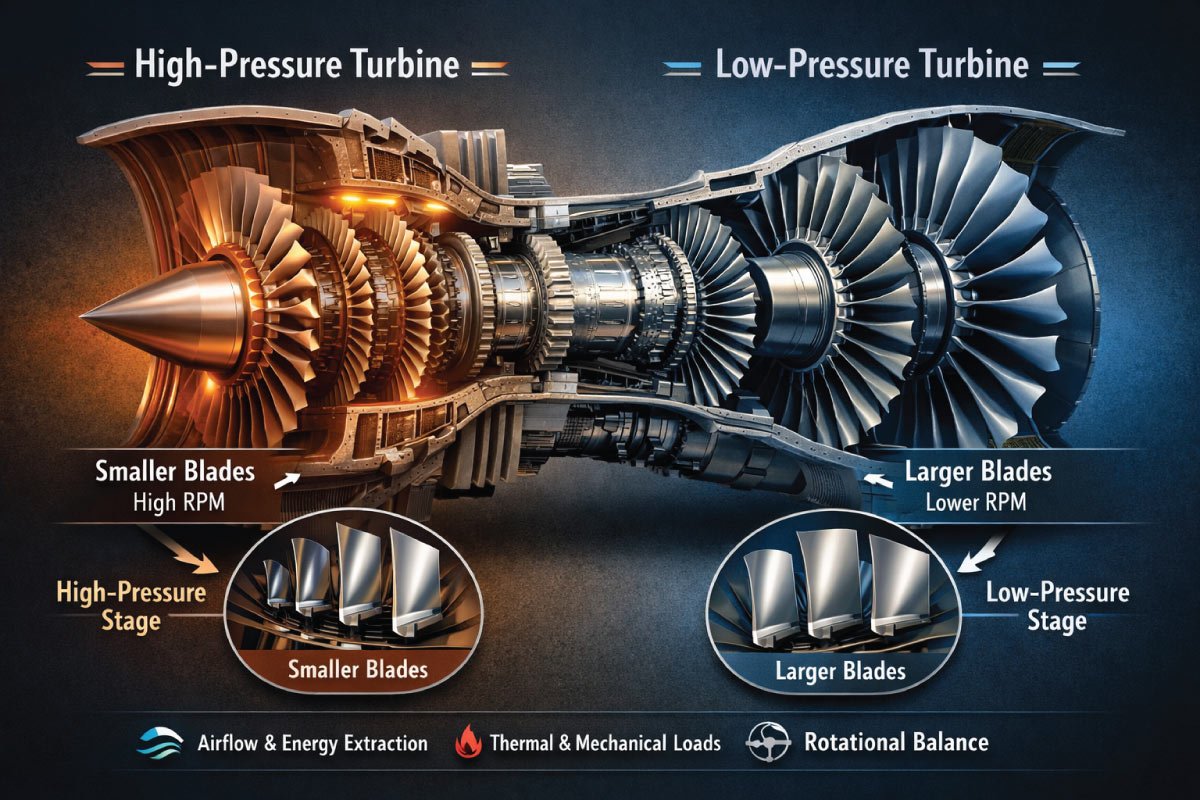
Jet engine turbines are divided into multiple stages, including high-pressure and low-pressure sections, each designed for specific airflow and energy extraction. Blade dimensions vary between stages to optimize efficiency, manage thermal and mechanical loads, and maintain rotational balance. Understanding stage-specific sizes is critical for performance and reliability.
Turbine Blade Dimensions by Stage
Turbine blade size varies across different stages to meet specific aerodynamic and mechanical requirements.
Table shows typical blade lengths and primary functions for high-pressure, intermediate, and low-pressure turbine stages.
Smaller HPT blades withstand higher temperatures, while larger LPT blades optimize torque, ensuring efficient energy transfer throughout the engine.
| Turbine Stage | Blade Length | Primary Function |
|---|---|---|
| High-pressure turbine (HPT) | 30–70 mm | Drives compressor |
| Intermediate turbine | 60–100 mm | Balances power output |
| Low-pressure turbine (LPT) | 90–160 mm | Drives fan in turbofans |
HPT blades are smaller but face the highest temperatures, while LPT blades are larger and optimized for torque.
Blade Length vs Blade Chord Explained
Turbine performance depends heavily on blade dimensions. Two critical factors, blade length and chord length, determine efficiency, power output, and structural integrity.
While blade length measures the span from root to tip, chord length measures the width of the airfoil from leading to trailing edge.
Understand these dimensions ensures optimal energy extraction and reliable operation in turbines.
1. Blade Length Definition
Blade length refers to the distance from the root, where the blade connects to the hub, to the tip. Longer blades cover a larger swept area, capturing more wind or water energy.
However, increasing blade length also raises mechanical stress, requiring stronger materials and support.
Designers balance length with efficiency, cost, and structural safety to maximize turbine performance.
2. Chord Length Definition
Chord length is the width of the turbine blade measured from the leading edge to the trailing edge of the airfoil.
Wider chords provide better structural support, reducing bending stress at high speeds. They also improve airflow management, allowing for smoother rotation and higher efficiency.
Proper chord sizing is crucial for both aerodynamic performance and long-term durability of the turbine.
Materials Used and Their Impact on Size
The materials used in turbine blades play a crucial role in determining their size, thickness, and performance.
Advanced materials such as nickel-based superalloys, single-crystal alloys, and ceramic matrix composites (CMC) allow engineers to design thinner, lighter blades without compromising strength.
Optimizing material choice enhances efficiency, reduces weight, and ensures durability under extreme temperatures and mechanical stress.
Common turbine blade materials:
Nickel-based superalloys
Single-crystal alloys
Ceramic matrix composites (CMC)
Advanced materials allow thinner blades without sacrificing strength, improving efficiency.
Cooling Technology and Blade Size
Cooling technology is essential in modern turbine blades to withstand extreme temperatures. Features like internal air passages, film cooling holes,
And thermal barrier coatings slightly increase blade thickness but significantly enhance heat resistance and durability.
By integrating these cooling methods, engineers can maintain structural integrity and extend blade lifespan while optimizing aerodynamic performance.
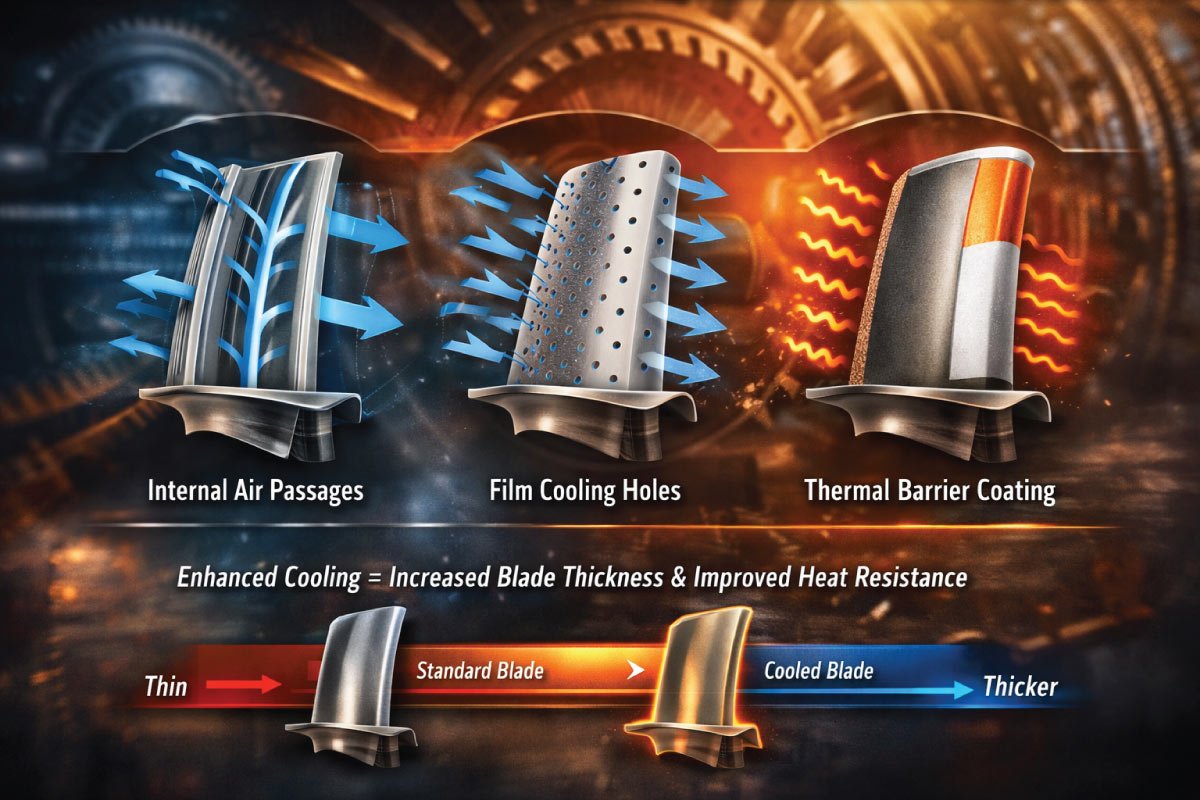
Cooling methods include:
Internal air passages
Film cooling holes
Thermal barrier coatings
These features increase blade thickness slightly but dramatically improve heat resistance and lifespan.
Manufacturing Tolerances in Turbine Blade Sizing
Turbine blades, especially for jet engines, are produced with extremely tight manufacturing tolerances to ensure optimal performance and safety.
Even minor deviations in size or shape can impact airflow, efficiency, and mechanical balance.
Precision manufacturing ensures that each blade meets exact specifications, maintaining aerodynamic efficiency, structural integrity, and long-term reliability under high-temperature and high-speed conditions.
Typical Manufacturing Tolerances
Turbine blades are manufactured to extremely precise dimensions. Even microscopic deviations can lead to imbalance, vibration, or reduced efficiency, potentially affecting the entire engine or turbine system.
Maintaining tight tolerances ensures proper airflow, structural integrity, and reliable performance under high rotational speeds and temperatures.
Engineers carefully control blade length, chord width, root fit, and tip clearance to achieve optimal operation and longevity.
| Dimension | Tolerance Range |
|---|---|
| Blade length | ±0.05 mm |
| Chord width | ±0.03 mm |
| Root fit | ±0.01 mm |
| Tip clearance | ±0.02 mm |
Even microscopic deviations can cause imbalance or efficiency loss.
Discover More:
Turbine Blade Size Differences: Commercial vs Military Engines
Turbine blade sizing varies significantly between commercial and military jet engines due to differing performance priorities.
Commercial engines focus on fuel efficiency, low noise, and longevity, while military engines prioritize maximum thrust, high-speed operation, and extreme temperature tolerance.
These differing requirements influence blade length, chord width, materials, and cooling designs, resulting in noticeable size and structural variations between the two types.
Commercial vs Military Blade Size Comparison
Commercial and military jet engines prioritize turbine blade characteristics differently.
Commercial engines use larger blades to maximize fuel efficiency and long-term reliability, operating at moderate to high temperatures with standard cooling systems.
Military engines favor compact, reinforced blades capable of withstanding extreme temperatures and thrust, often with advanced cooling technology.
These design choices reflect the balance between performance, durability, and operational demands for each engine type.
| Feature | Commercial Jet | Military Jet |
|---|---|---|
| Blade size | Larger overall | Compact, reinforced |
| Temperature tolerance | Moderate-high | Extremely high |
| Lifespan focus | Long service life | Shorter, performance-focused |
| Cooling complexity | Medium | Very advanced |
Military engines often use smaller but stronger blades designed for extreme thrust conditions.
Blade Tip Clearance and Its Role
Blade tip clearance—the small gap between the turbine blade tip and engine casing—plays a critical role in efficiency and performance.
Smaller clearances reduce gas leakage and improve energy extraction, but require precise manufacturing and thermal management.
Incorrect sizing can lead to blade rub, damage, or reduced lifespan, making tip clearance a vital consideration in turbine design.
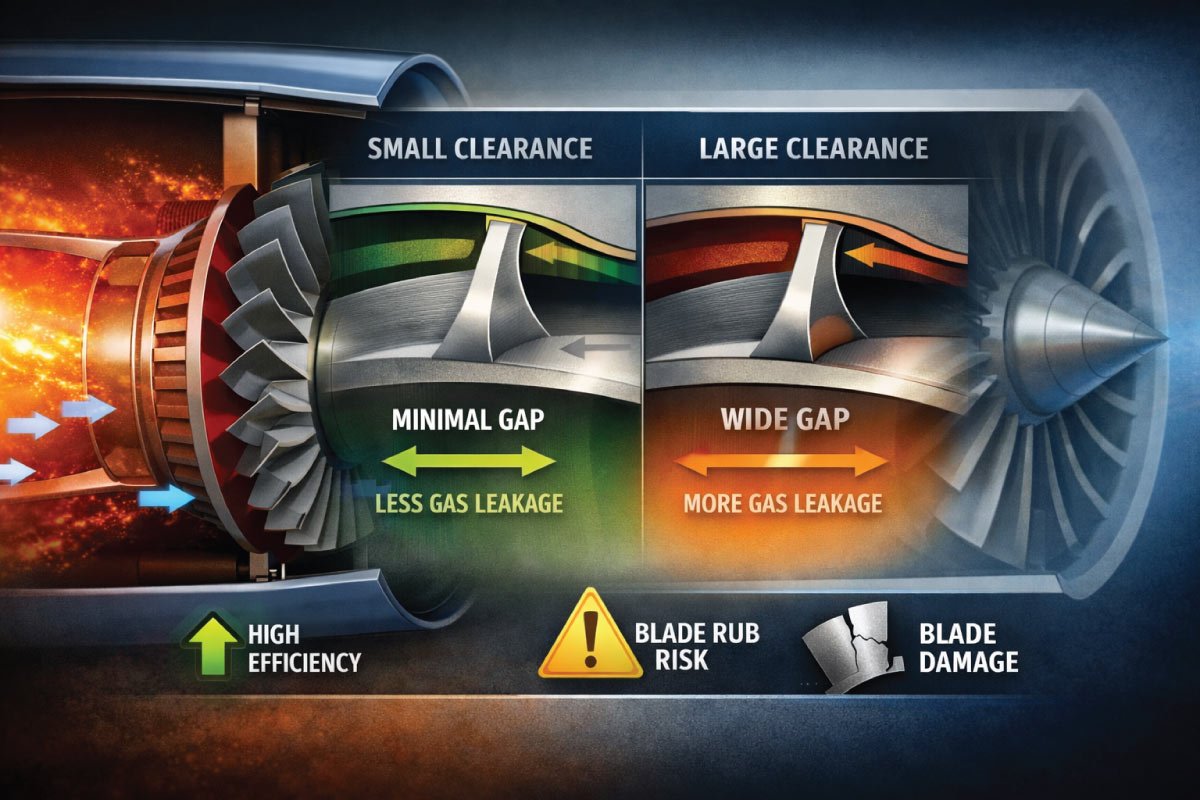
Smaller clearance:
Improves efficiency
Reduces gas leakage
However, it requires precise sizing to avoid blade rub during thermal expansion.
Discover More:
How Turbine Blade Size Affects Engine Efficiency
Turbine blade size directly impacts engine efficiency, performance, and emissions.
Properly sized blades optimize energy extraction, improve thermal efficiency, and reduce fuel consumption, while oversized or undersized blades can compromise performance.
By balancing blade length, chord width, and structural strength, engineers achieve smoother engine operation, longer component life, and lower environmental impact in both commercial and military turbine systems.
1. Impact on Thermal Efficiency
Blade size affects how effectively a turbine converts thermal energy into mechanical energy.
Longer and correctly proportioned blades capture more airflow, improving energy transfer from hot gases.
Oversized blades can create unnecessary drag, while undersized blades fail to extract sufficient energy.
Optimizing blade dimensions ensures maximum thermal efficiency, reducing wasted energy and enhancing overall engine performance.
2. Influence on Fuel Consumption
Proper blade sizing allows turbines to operate more efficiently, directly lowering fuel consumption.
Larger swept areas with well-designed chord widths capture more energy, reducing the fuel needed for the same power output.
Conversely, undersized or inefficiently shaped blades require more fuel to maintain thrust, making precise blade sizing essential for cost-effective and environmentally friendly engine operation.
3. Effect on Emissions
Optimized turbine blades reduce fuel wastage, which directly lowers harmful emissions like CO₂ and NOx.
Efficient energy extraction ensures complete combustion, improving the environmental footprint of the engine.
Undersized or improperly designed blades increase residual energy losses, forcing higher fuel consumption and higher emissions.
Blade sizing thus plays a vital role in meeting modern emission standards while maintaining performance.
4. Contribution to Smoother Engine Operation
Blade size influences the balance and vibration characteristics of turbines.
Properly sized blades maintain uniform airflow and reduce pressure fluctuations, leading to smoother rotation and quieter operation.
Oversized blades add weight, creating stress on bearings and shafts, while undersized blades can cause uneven loading.
Optimal sizing ensures stable performance, minimizes wear, and improves reliability and longevity of engine components.
5. Consequences of Oversized Blades
Oversized turbine blades may increase mechanical stress, weight, and centrifugal forces on the rotor.
This can lead to structural fatigue, higher maintenance requirements, and reduced rotational efficiency.
While they may capture more airflow at low speeds, the added mass often outweighs the benefits, decreasing overall energy extraction efficiency.
Blade length and chord must be carefully optimized to balance strength and performance.
6. Consequences of Undersized Blades
Undersized blades fail to extract sufficient energy from the hot gases passing through the turbine.
This reduces thrust or power output, lowers thermal efficiency, and forces the engine to burn more fuel for the same performance.
Additionally, smaller blades may disrupt airflow patterns, increasing turbulence and vibration. Correct sizing ensures the blade interacts efficiently with gas flow to maximize energy conversion.
Discover More:
Future Trends in Turbine Blade Sizing
Advancements in aerospace technology are revolutionizing turbine blade design and sizing.
Emerging trends like additive manufacturing, ultra-thin airfoils, ceramic composite materials, and adaptive blade geometries allow engineers to optimize blade dimensions for maximum efficiency.
These innovations improve strength-to-weight ratios, enhance performance, and enable turbines to operate reliably under higher temperatures and more demanding aerodynamic conditions.
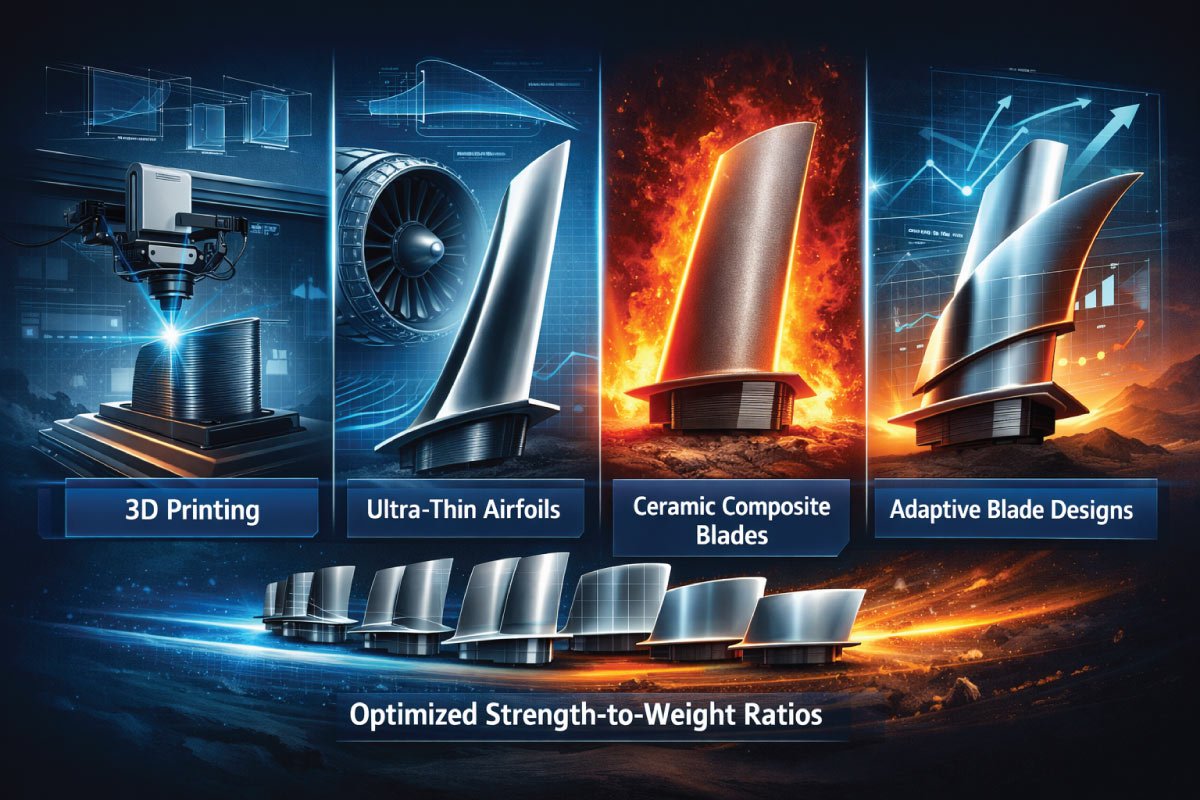
Emerging trends include:
Additive manufacturing (3D printing)
Ultra-thin airfoil designs
Ceramic composite blades
Adaptive blade geometries
These innovations allow optimized blade sizes with improved strength-to-weight ratios.
Final Thoughts
Jet engine turbine blade sizing is a perfect blend of aerodynamics, materials science, and precision engineering. From tiny high-pressure blades enduring extreme heat to large low-pressure blades delivering torque, every dimension is carefully optimized.
Understanding turbine blade size helps engineers design safer, more efficient engines and gives aviation enthusiasts a deeper appreciation of the technology that powers modern flight.
If you are building an aviation-focused blog, this jet engine turbine blade size guide provides a strong foundation for both technical readers and curious learners.