
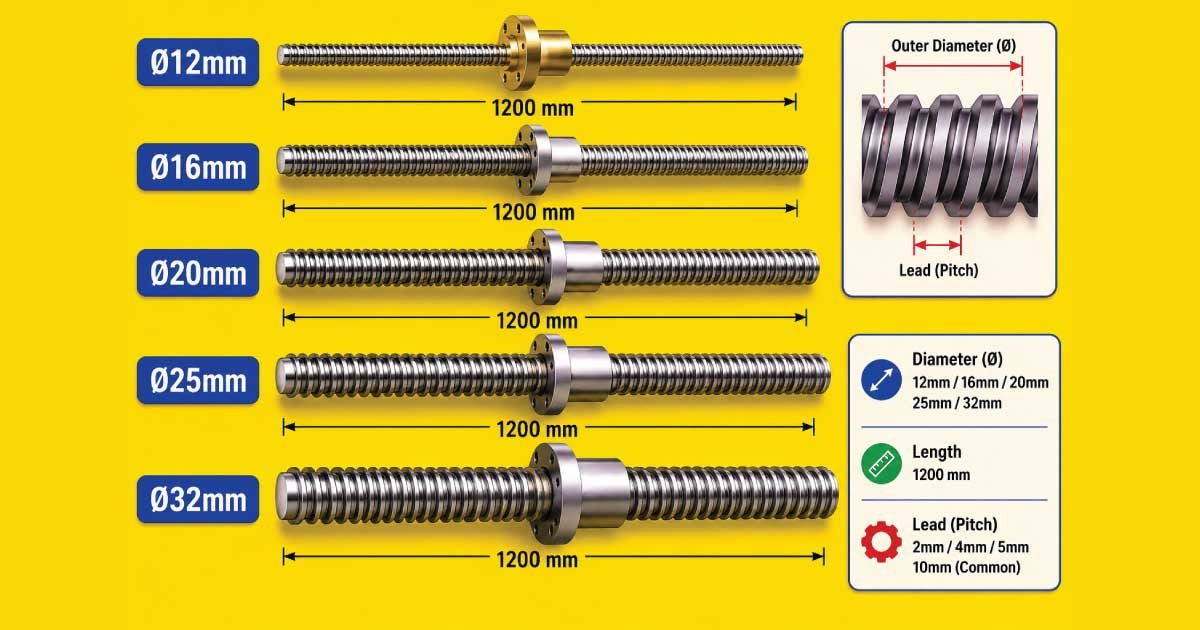
Lead screws are essential mechanical components used in machinery, automation systems, CNC machines, 3D printers, linear actuators, and industrial equipment. They convert rotational motion into precise linear movement, making them one of the most common power transmission devices in engineering and manufacturing.
Selecting the correct lead screw size is critical for achieving accuracy, efficiency, load capacity, and long service life. A screw that is too small may bend or wear prematurely, while an oversized screw can increase costs and reduce efficiency.
This complete lead screw size chart guide explains standard lead screw dimensions, thread sizes, lead and pitch calculations, common applications, material options, and tips for choosing the right lead screw for your project.
What Is a Lead Screw?
A lead screw is a mechanical component designed to convert rotary motion into precise linear motion. It consists of a threaded shaft that works with a matching nut. When the screw rotates, the nut moves along the threads in a controlled linear direction, making it ideal for positioning and motion control applications.
How It Works
A lead screw operates through direct sliding contact between the screw threads and the nut. As the shaft rotates, the nut travels forward or backward depending on the direction of rotation. This simple mechanism allows accurate and predictable movement in mechanical systems.
Key Advantages
Lead screws are widely used because they offer reliable performance in a simple and cost-effective design. They are commonly found in automation, machinery, and precision equipment.
They offer:
- High positioning accuracy
- Simple design
- Low maintenance
- Reliable performance
- Cost-effective operation
Lead Screw vs Ball Screw
Unlike ball screws, which use rolling elements to reduce friction, lead screws rely on sliding contact between the nut and screw threads. While this results in higher friction, it also provides smoother control, simpler construction, and lower overall cost, making lead screws ideal for many general-purpose applications.
How a Lead Screw Works
The operation of a lead screw is based on a simple mechanical principle that converts rotational motion into precise linear movement. This makes it highly useful in systems where controlled positioning is required, such as machinery, automation equipment, and mechanical actuators.
1. Nut Engages the Screw Threads
When the lead screw begins to rotate, the threaded nut engages with the screw’s helical threads. This engagement creates a guided path that forces the nut to follow the thread profile as the shaft turns.
2. Rotation Converts to Linear Motion
As the screw continues rotating, the nut is pushed along the length of the threads. This process directly converts rotational motion into smooth and controlled linear travel, without the need for complex mechanisms.
3. Direction of Movement Changes
The direction of the nut’s movement depends on the rotation of the screw. Clockwise rotation moves the nut in one direction, while counterclockwise rotation moves it in the opposite direction, allowing reversible linear motion.
4. Precise Positioning Control
Lead screws allow accurate and repeatable positioning because each rotation produces a predictable amount of linear travel. This makes them suitable for applications where precision is more important than high speed.
5. Integration With Mechanical Systems
Lead screws are commonly used with electric motors, handwheels, gearboxes, and automation systems. These combinations allow efficient control of movement in industrial machines, CNC systems, and various mechanical devices.
Why Lead Screw Size Matters
Lead screw size is a critical factor in the performance of machines such as CNC systems, lathes, and automated linear motion equipment. The correct size ensures smooth movement, accurate positioning, and long-term durability. If a lead screw is undersized or improperly selected, it can lead to deflection, reduced precision, higher wear, and inefficient operation. Proper sizing directly improves reliability and overall machine efficiency.
1. Load Capacity
The diameter and design of a lead screw determine how much load it can safely carry. Larger lead screws have greater strength and resistance to bending, making them suitable for heavy-duty applications. If the screw is too small for the applied load, it may deform or fail over time. Proper sizing ensures stable operation and prevents structural damage under stress.
2. Accuracy
Lead screw size plays a major role in positioning accuracy and repeatability. A correctly selected screw reduces backlash and maintains consistent movement along the axis. This is especially important in precision machinery like CNC machines, where even small errors can affect output quality. Proper sizing ensures smoother motion control and better machining results.
3. Speed
The diameter and lead (thread pitch) of a lead screw directly influence how fast a machine’s components can move. A properly sized lead screw balances speed and control, allowing efficient travel without sacrificing stability. Incorrect sizing may result in slow movement or loss of control at higher speeds, reducing overall productivity and machine performance.
4. Efficiency
A correctly sized lead screw reduces friction between the screw and nut assembly, allowing smoother motion with less energy consumption. When components are properly matched, the system requires less power to operate. This improves mechanical efficiency, reduces heat generation, and helps maintain consistent performance during long operating cycles, especially in automated systems.
5. Service Life
Proper lead screw sizing minimizes uneven wear and excessive stress on threads and mating components. When the load, speed, and application requirements are correctly matched, the screw operates under optimal conditions. This significantly extends service life, reduces maintenance needs, and ensures long-term reliability of the entire mechanical system.
Standard Lead Screw Size Chart (Metric)
The following chart shows common metric lead screw sizes used in automation, CNC machines, and industrial applications.
| Screw Diameter | Common Lead | Typical Application |
|---|---|---|
| 8 mm | 2 mm | 3D printers |
| 10 mm | 2 mm | Light automation |
| 12 mm | 3 mm | Small CNC systems |
| 16 mm | 4 mm | Linear actuators |
| 20 mm | 4 mm | Medium-duty machinery |
| 25 mm | 5 mm | Industrial automation |
| 32 mm | 6 mm | Heavy machinery |
| 40 mm | 7 mm | Manufacturing equipment |
| 50 mm | 10 mm | High-load systems |
| 63 mm | 12 mm | Large industrial machines |
These sizes cover most commercial and industrial applications.
Standard Lead Screw Size Chart (Inch)
Imperial lead screws remain common in North America.
| Screw Diameter | Threads Per Inch (TPI) | Typical Lead |
|---|---|---|
| 1/4″ | 20 TPI | 0.050″ |
| 3/8″ | 16 TPI | 0.0625″ |
| 1/2″ | 10 TPI | 0.100″ |
| 5/8″ | 8 TPI | 0.125″ |
| 3/4″ | 6 TPI | 0.167″ |
| 1″ | 5 TPI | 0.200″ |
| 1-1/4″ | 4 TPI | 0.250″ |
| 1-1/2″ | 4 TPI | 0.250″ |
| 2″ | 3 TPI | 0.333″ |
These dimensions are frequently found in machine tools and industrial equipment.
Common Lead Screw Thread Forms
Lead screws are manufactured using different thread profiles, each designed to suit specific performance requirements such as load capacity, efficiency, wear resistance, and manufacturing cost. The choice of thread form directly affects how smoothly the screw operates and how much force it can transmit in mechanical systems.
1. Acme Threads
Acme threads are one of the most widely used thread forms in lead screw applications, especially in industrial machinery. They feature a trapezoidal shape that provides a strong balance between durability, load capacity, and ease of production.
Advantages:
- High strength
- Easy manufacturing
- Good load capacity
- Widely available
Common applications include machine tools, lathes, and general industrial equipment.
2. Trapezoidal Threads
Trapezoidal threads are commonly used in metric lead screw systems, especially in European machinery. They are similar to Acme threads but follow metric standards and are designed for smoother motion and improved efficiency.
Benefits:
- Smooth operation
- High efficiency
- Excellent load support
Frequently found in CNC machines, automation systems, and industrial equipment.
3. Square Threads
Square threads are designed for maximum efficiency because their geometry minimizes friction during operation. They are ideal for applications where smooth power transmission is more important than manufacturing simplicity.
Advantages:
- Reduced friction
- High power transmission efficiency
Disadvantages:
- Difficult manufacturing
- Higher cost
Used in specialized machinery and precision motion systems.
4. Buttress Threads
Buttress threads are designed to handle heavy loads in one direction, making them ideal for applications involving lifting or pressing forces. Their asymmetric shape provides high strength where pressure is applied from a single direction.
Applications include:
- Presses
- Lifting equipment
- Heavy machinery
These thread forms are commonly used in high-load industrial systems where directional force is critical.
Browse Our Detailed Guide:
Common Applications of Lead Screws
Lead screws are widely used in mechanical and automation systems because they provide precise, controlled linear motion at a relatively low cost. Their ability to convert rotary motion into accurate movement makes them essential in industries where positioning, stability, and reliability are important.
1. CNC Machines
Lead screws play a critical role in CNC machines by ensuring accurate and repeatable movement of machine components. They help maintain precision during cutting, shaping, and engraving processes where even small errors can affect final output.
Applications include:
- Milling machines
- Routers
- Engravers
- Cutting systems
2. 3D Printers
In 3D printers, lead screws are commonly used for vertical (Z-axis) movement. They provide smooth and controlled lifting of the print bed or extruder assembly, ensuring accurate layer alignment.
Benefits include:
- Accurate positioning
- Smooth operation
- Cost-effective design
3. Linear Actuators
Lead screws are a key component in linear actuators, where they convert motor rotation into precise linear motion. This makes them ideal for controlled movement applications in compact systems.
Used in:
- Robotics
- Automation equipment
- Medical devices
4. Industrial Automation
Industrial automation systems rely on lead screws for positioning, alignment, and controlled movement of machine parts. They are essential in improving production accuracy and efficiency.
Manufacturing systems use them for:
- Positioning mechanisms
- Assembly systems
- Material handling equipment
5. Lifting Systems
Lead screws are commonly used in lifting and load-bearing systems due to their strength and self-locking ability. This makes them safer for applications where controlled lifting and holding positions are required.
Used in:
- Jacks
- Lift tables
- Positioning platforms
Their self-locking characteristics improve safety and prevent unwanted movement under load.
Browse Our Detailed Guide:
Advantages of Lead Screws
Lead screws are widely used in mechanical systems, CNC machines, and automation equipment because they offer a simple, reliable, and cost-effective solution for linear motion. Despite the availability of advanced alternatives like ball screws, lead screws remain popular due to their durability, stability, and ease of maintenance in many industrial and workshop applications.
1. Cost Effective
Lead screws are generally more affordable than other linear motion systems such as ball screws. Their simpler manufacturing process and fewer precision components make them a budget-friendly option for many machines. This cost advantage makes them ideal for applications where high precision is not the only priority and overall affordability is important.
2. Self-Locking Capability
One of the key advantages of lead screws is their self-locking feature in many designs. This means they resist back-driving, so the load stays in place even when power is removed. In practical use, this eliminates the need for additional braking systems in many applications, improving safety and reducing mechanical complexity.
3. Simple Design
Lead screws have a straightforward construction with fewer moving parts compared to more complex systems. This simplicity makes them easier to install, maintain, and repair. With fewer components subject to wear or failure, operating costs remain lower over time, and troubleshooting mechanical issues becomes faster and more manageable for technicians.
4. Reliable Performance
Lead screws perform consistently well in demanding and harsh industrial environments. They are capable of handling dust, vibration, and heavy workloads without requiring highly sensitive maintenance procedures. Their robust design ensures stable linear motion, making them suitable for applications where durability and dependable performance are more important than ultra-high speed or precision.
5. Quiet Operation
Compared to many alternative motion systems, lead screws typically produce less noise during operation. Their sliding contact design results in smoother and quieter movement, especially at lower speeds. This makes them suitable for applications where noise reduction is important, such as laboratory equipment, medical devices, and precision positioning systems in controlled environments.
Lead Screw vs Ball Screw
Engineers often compare lead screws and ball screws when designing motion systems because both are used to convert rotary motion into linear motion. However, they differ significantly in design, efficiency, cost, and performance characteristics. The choice between them depends on accuracy requirements, load conditions, speed, and budget constraints.
1. Lead Screw
Lead screws operate using sliding contact between the screw threads and the nut. This simple mechanism makes them reliable, cost-effective, and suitable for many general-purpose applications where moderate speed and self-locking ability are important.
Advantages:
- Lower cost
- Self-locking
- Simpler design
- Easier maintenance
Disadvantages:
- Higher friction
- Lower efficiency
- More wear
2. Ball Screw
Ball screws use recirculating ball bearings between the screw and nut to reduce friction. This design allows smoother motion, higher efficiency, and improved accuracy, making them ideal for high-performance and precision applications.
Advantages:
- Higher efficiency
- Faster operation
- Greater precision
- Reduced wear
Disadvantages:
- Higher cost
- More complex design
- Requires better lubrication
3. Key Difference
The main difference between the two systems lies in how motion is transferred. Lead screws rely on sliding friction, while ball screws use rolling elements. This results in lead screws being more economical and self-locking, while ball screws offer higher speed, efficiency, and precision for advanced applications.
The choice depends on performance requirements, operating conditions, and overall budget.
Browse Our Detailed Guide:
Signs of Lead Screw Wear
Lead screw wear can significantly affect machine accuracy, efficiency, and overall performance. Since lead screws are responsible for precise linear motion, even small amounts of wear can lead to noticeable operational issues. Regular inspection helps detect early warning signs, preventing costly breakdowns and maintaining smooth, reliable machine operation.
1. Increased Backlash
One of the most common signs of lead screw wear is increased backlash, which refers to excessive movement between the screw and the nut. As components wear down, the tight engagement loosens, creating play in the system. This results in reduced control over positioning and can negatively affect machining precision and repeatability.
2. Reduced Accuracy
Worn lead screws often lead to positioning errors during operation. As threads degrade, the smooth and consistent movement is disrupted, causing slight deviations in travel distance. Over time, this reduced accuracy can impact product quality, especially in CNC machines and precision equipment where exact movement is essential for proper results.
3. Unusual Noise
Grinding, squeaking, or knocking sounds during operation are strong indicators of lead screw problems. These noises usually occur due to insufficient lubrication, contamination, or uneven wear between the screw and nut. Ignoring these sounds can lead to further damage, increased friction, and eventual failure of the lead screw system.
4. Visible Thread Damage
Physical inspection can reveal clear signs of wear on the lead screw threads. Look for wear marks, cracks, corrosion, or deformation along the screw surface. Damaged threads reduce the effectiveness of motion transfer and can accelerate wear on mating components. Early detection of visible damage helps prevent major mechanical failures.
5. Increased Vibration
Excessive vibration during machine operation often indicates misalignment or uneven wear in the lead screw assembly. As components degrade, smooth motion becomes unstable, causing oscillations in the system. This vibration not only affects performance but can also damage surrounding parts if the issue is not corrected promptly.
Safety Considerations
Working with lead screw systems requires proper safety practices to ensure reliable operation and prevent mechanical failure. Because these systems often operate under load and continuous motion, ignoring safety guidelines can lead to wear, misalignment, or even equipment damage. Following correct procedures improves both performance and operator safety.
1. Follow Manufacturer Recommendations
Always follow the manufacturer’s guidelines for installation, operation, and maintenance. These instructions are designed to ensure the lead screw system operates within safe limits and achieves optimal performance. Follow manufacturer recommendations for correct usage and handling.
2. Avoid Exceeding Load Ratings
Every lead screw is designed with specific load limits. Exceeding these limits can cause bending, thread damage, or complete system failure, especially in high-stress applications. Avoid exceeding load ratings to prevent mechanical failure and unsafe operation.
3. Maintain Proper Lubrication
Lubrication reduces friction and heat buildup, ensuring smooth motion and reducing wear. Lack of lubrication can significantly shorten the lifespan of both the screw and nut components. Maintain proper lubrication to ensure smooth and efficient operation.
4. Inspect Components Regularly
Routine inspections help identify early signs of wear, misalignment, or damage. Early detection allows timely repairs and prevents unexpected breakdowns during operation. Inspect components regularly to maintain system reliability and safety.
5. Use Appropriate Guards and Covers
Protective guards and covers help prevent accidental contact with moving parts and reduce exposure to dust, debris, and contaminants. This improves both operator safety and system longevity. Use appropriate guards and covers to enhance protection and operational safety.
Conclusion
A lead screw size chart is an essential reference for engineers, machinists, technicians, and automation professionals. Understanding screw diameter, lead, pitch, thread form, and load capacity helps ensure proper selection and optimal machine performance.
Whether you’re building a CNC machine, designing an automated system, upgrading a 3D printer, or maintaining industrial equipment, choosing the correct lead screw size improves accuracy, efficiency, durability, and reliability. By using the charts and guidelines in this guide, you can confidently select the ideal lead screw for virtually any application.
FAQs:
What is a lead screw and how does it work
A lead screw is a mechanical device that converts rotational motion into linear motion using threaded engagement between the screw and nut. When the screw rotates, the nut moves in a straight line along the threads, providing controlled and precise movement for machinery, CNC systems, and automation equipment.
How do I choose the correct lead screw size for my application
Choose based on load, travel length, speed, and accuracy requirements. Heavier loads need larger diameters, while precision work requires smaller lead and pitch. Also consider environmental conditions like dust or moisture. Proper selection ensures smooth motion, reduces wear, improves efficiency, and increases the overall lifespan of the mechanical system.
What is the difference between lead and pitch in a lead screw
Pitch is the distance between two adjacent threads, while lead is the linear distance traveled in one full rotation. In single-start screws, both are equal. In multi-start screws, lead is greater than pitch. Lead mainly affects speed, while pitch controls thread spacing and positioning accuracy in mechanical systems.
Which materials are best for lead screws in industrial use
Common materials include carbon steel, stainless steel, alloy steel, and hardened steel. Carbon steel is affordable and strong, stainless steel offers corrosion resistance, and alloy steel provides high load capacity. Hardened steel is used for precision and heavy-duty applications where durability, wear resistance, and long service life are essential.
What are the common applications of lead screws in machines
Lead screws are widely used in CNC machines, 3D printers, linear actuators, robotics, and industrial automation systems. They are also found in lifting equipment and positioning systems. Their ability to provide precise linear motion makes them essential for applications requiring accuracy, repeatability, and controlled mechanical movement.
How do I know if my lead screw is worn or needs replacement
Signs include increased backlash, reduced accuracy, unusual noise, visible thread damage, and vibration during operation. Worn lead screws affect precision and efficiency. Regular inspection helps detect early issues. If performance drops or movement becomes inconsistent, replacement or maintenance is necessary to restore smooth and accurate system operation.