
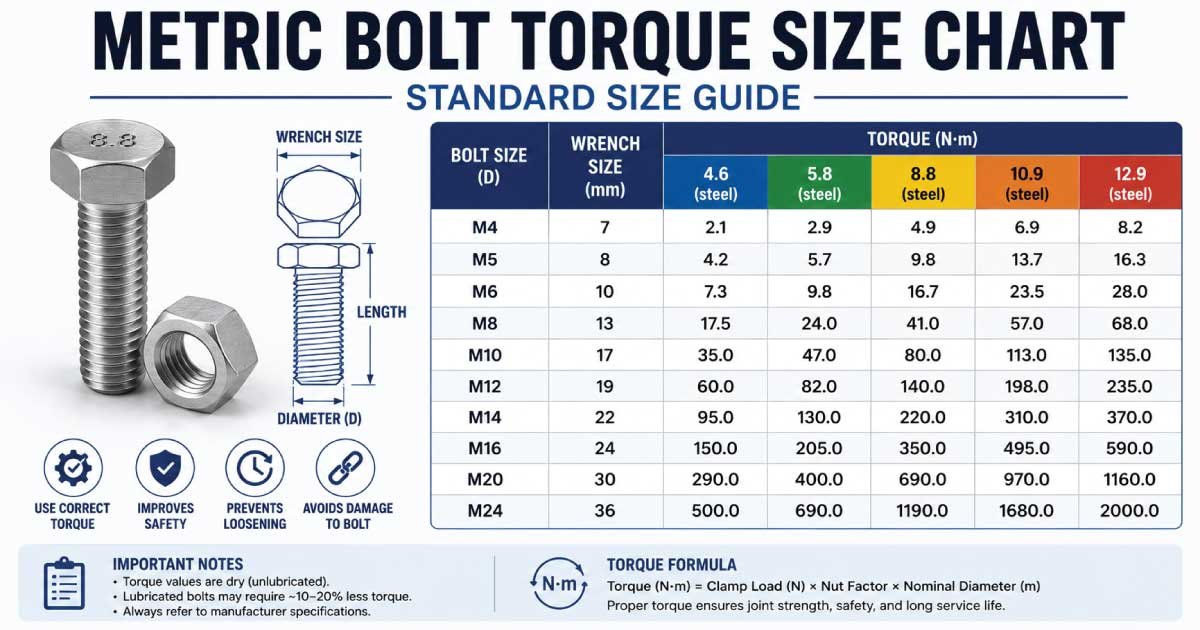
Properly tightening a bolt is just as important as choosing the correct bolt size. Whether you’re repairing a car, assembling machinery, building steel structures, or working on a DIY project, using the correct torque specification ensures a safe, secure, and long-lasting connection.
Many people ask, “What is the correct torque for an M8 bolt?” or “How tight should an M10 bolt be?” The answer depends on the bolt size, thread pitch, material, lubrication, and strength grade. Using too little torque may cause the joint to loosen, while excessive torque can stretch or even break the bolt.
This complete guide explains metric bolt torque values, torque wrench sizes, strength grades, and includes an easy-to-read metric bolt torque chart for the most common bolt sizes.
What Is Bolt Torque?
Bolt torque refers to the amount of rotational force applied to tighten a bolt or nut during installation. This force is essential because it directly creates the clamping pressure that holds two or more components together securely. Without proper torque, joints may become loose, fail under load, or suffer from vibration-related issues.
Torque is applied using tools like torque wrenches, impact wrenches, or calibrated tightening equipment, depending on the application. The goal is not just to tighten the bolt, but to achieve the correct balance between tightness and material safety. Too little torque leads to weak joints, while excessive torque can damage threads or even break the bolt.
Torque is commonly measured in:
- Newton-meters (Nm)
- Foot-pounds (ft-lbs)
- Inch-pounds (in-lbs)
Each unit represents rotational force, and different industries may prefer different measurement systems depending on regional standards and equipment types.
The main purpose of torque is to generate proper clamping force without damaging the fastener or the material being joined. Correct torque ensures that the bolt stretches slightly within its elastic limit, maintaining tension and keeping the joint tight under working conditions.
Why Correct Torque Matters
Applying the correct torque is critical in mechanical, automotive, and industrial systems because it directly affects safety, reliability, and performance. Proper torque ensures that every fastened joint functions as designed without unexpected loosening or failure.
Correct torque provides several important benefits:
- Prevents loose fasteners
- Avoids stripped threads
- Reduces bolt failure
- Ensures proper clamping force
- Improves equipment safety
- Extends component life
- Prevents vibration-related loosening
Each of these benefits plays a key role in maintaining system integrity. When torque is correctly applied, mechanical assemblies remain stable even under heavy loads, vibration, and changing environmental conditions. This reduces maintenance needs and helps prevent costly breakdowns or safety hazards in critical applications.
Metric Bolt Torque Size Chart (Grade 8.8 – Dry Threads)
The table below provides general tightening torque values for standard coarse-thread metric bolts made from Grade 8.8 steel with dry threads. These values are commonly used as reference points in engineering and mechanical assembly work.
| Bolt Size | Thread Pitch | Torque (Nm) | Torque (ft-lbs) |
|---|---|---|---|
| M4 | 0.7 mm | 3 Nm | 2 ft-lbs |
| M5 | 0.8 mm | 6 Nm | 4 ft-lbs |
| M6 | 1.0 mm | 10 Nm | 7 ft-lbs |
| M8 | 1.25 mm | 25 Nm | 18 ft-lbs |
| M10 | 1.5 mm | 49 Nm | 36 ft-lbs |
| M12 | 1.75 mm | 85 Nm | 63 ft-lbs |
| M14 | 2.0 mm | 135 Nm | 100 ft-lbs |
| M16 | 2.0 mm | 210 Nm | 155 ft-lbs |
| M18 | 2.5 mm | 290 Nm | 214 ft-lbs |
| M20 | 2.5 mm | 410 Nm | 302 ft-lbs |
| M22 | 2.5 mm | 560 Nm | 413 ft-lbs |
| M24 | 3.0 mm | 710 Nm | 524 ft-lbs |
Important Note
These values are general reference guidelines for standard Grade 8.8 coarse-thread bolts with dry threads. Actual torque requirements may vary depending on lubrication, surface condition, joint design, and manufacturer specifications. Always refer to official technical data for critical or safety-sensitive applications.
Metric Bolt Torque by Strength Grade
Different bolt strength grades are designed to handle different levels of stress and load. As the strength grade increases, the bolt’s tensile strength improves, allowing it to safely withstand higher tightening torque values. Choosing the correct grade is essential for maintaining joint integrity, preventing failure, and ensuring safe mechanical performance in demanding applications.
Strength Grade vs Applications
- 8.8 – General machinery, automotive, construction
- 10.9 – Heavy machinery, suspension systems, engines
- 12.9 – High-performance equipment, industrial machinery
As the strength grade increases, the recommended tightening torque generally increases as well. Higher-grade bolts can handle greater clamping force without deforming or failing, making them suitable for heavy-duty and high-stress environments where reliability is critical.
Common Metric Bolt Sizes
Metric bolts are standardized and widely used across industries ranging from household equipment to large industrial machines. These sizes are selected based on load requirements, design constraints, and assembly type.
- M4
- M5
- M6
- M8
- M10
- M12
- M14
- M16
- M20
- M24
These sizes are found in everything from furniture and bicycles to heavy industrial equipment. Smaller sizes are typically used for lightweight assemblies, while larger diameters are used in structural, automotive, and machinery applications where higher strength and durability are required.
Recommended Torque Wrench Drive Sizes
Using the correct torque wrench size is just as important as selecting the correct torque value. A properly matched wrench ensures accuracy, reduces tool strain, and improves tightening consistency.
| Torque Range | Common Drive Size |
|---|---|
| 2–25 Nm | 1/4-inch |
| 20–100 Nm | 3/8-inch |
| 40–250 Nm | 1/2-inch |
| 200–700 Nm | 3/4-inch |
| Over 700 Nm | 1-inch |
Always use a torque wrench with a working range that places your target torque near the middle of the tool’s scale for the best accuracy. This ensures precise tightening and reduces the risk of over-torquing or under-torquing critical fasteners.
Factors That Affect Torque Values
Torque values are not fixed and can vary depending on several mechanical and environmental conditions. Understanding these factors is essential for achieving accurate tightening and reliable joint performance.
1. Bolt Material
Different materials such as steel, stainless steel, brass, and titanium have varying strength levels and friction properties. These differences directly influence how much torque is needed to achieve proper clamping force.
2. Strength Grade
Higher strength grades allow bolts to withstand greater loads. For example, a Grade 12.9 bolt can safely handle significantly more torque than a Grade 8.8 bolt of the same size, making it suitable for heavy-duty applications.
3. Lubrication
Lubricated threads reduce friction between mating surfaces. This means that applying the same torque produces a higher clamping force. In many cases, torque values must be reduced when using oil or anti-seize compounds.
4. Thread Pitch
Thread pitch affects how force is distributed along the bolt. Fine-thread bolts generally provide higher clamping force at the same torque compared to coarse-thread bolts, making them ideal for precision applications.
5. Surface Finish
The condition of the threads plays an important role in torque accuracy. Clean, dry threads provide consistent results, while rusted, dirty, or damaged threads can cause incorrect torque readings and unreliable fastening performance.
Read our newest article here: Hose Size Chart: Complete Guide + Free PDF
How to Use a Torque Wrench Correctly
Using a torque wrench properly is essential for achieving accurate bolt tension and preventing damage to fasteners or components. A correctly applied torque ensures that the bolt is tightened to the manufacturer’s specification, providing safe and reliable performance in mechanical assemblies.
Follow these steps for accurate tightening:
- Clean the bolt and nut threads.
- Inspect for damage or corrosion.
- Lubricate only if specified.
- Set the torque wrench to the required value.
- Tighten the bolt smoothly until the wrench clicks or indicates the set torque.
- Do not continue tightening after reaching the specified torque.
- Reset adjustable torque wrenches to their minimum setting before storage.
Each step plays an important role in maintaining accuracy and extending tool life. Smooth and controlled tightening helps ensure that the correct clamping force is achieved without over-stressing the bolt or damaging the joint.
Dry vs. Lubricated Threads
Thread condition has a major impact on torque accuracy and final clamping force. One of the most common installation mistakes is ignoring whether threads are dry or lubricated, which can significantly change the tightening result.
Dry Threads
- Higher friction
- Require higher torque values
- Most general torque charts assume dry threads
Dry threads are commonly used in standard applications where no oils or compounds are applied. Because of higher friction, more torque is needed to achieve the desired clamping force, and this is what most standard charts are based on.
Lubricated Threads
- Lower friction
- Produce greater clamping force
- Often require reduced torque values
Lubricated threads reduce resistance between mating surfaces, meaning the same torque creates more clamping force. This can easily lead to over-tightening if standard dry torque values are used without adjustment. Always check specifications when lubrication or anti-seize compounds are applied to ensure proper tightening.
Always follow the equipment manufacturer’s recommendations when lubricants or anti-seize compounds are used, as incorrect torque adjustment can lead to bolt failure or joint damage.
Common Applications
Metric bolt torque specifications are widely used across many industries where safety, precision, and structural integrity are critical. Proper torque ensures that components remain secure under vibration, load, and environmental stress.
1. Automotive
- Engine cylinder heads
- Wheel hubs
- Brake calipers
- Suspension systems
In automotive systems, correct torque is essential for safety and performance. Over-tightening or under-tightening can lead to part failure or dangerous driving conditions.
2. Construction
- Structural steel
- Heavy equipment
- Building frameworks
Construction applications rely on high-strength bolts to support heavy loads. Accurate torque ensures structural stability and long-term durability in buildings and infrastructure.
3. Manufacturing
- CNC machines
- Industrial presses
- Conveyor systems
In manufacturing environments, precision is critical. Proper torque helps maintain alignment, reduce machine vibration, and ensure consistent production performance.
4. Home Projects
- Workbenches
- Metal shelving
- Furniture assembly
- Garden equipment
Even in home applications, correct torque improves safety and prevents loosening over time. It helps extend the life of furniture, tools, and outdoor equipment by maintaining secure and stable connections.
Read our newest article here: Drill Tap Chart: Complete Guide With Pdf
Common Torque Mistakes to Avoid
Improper torque application is one of the leading causes of fastener failure, joint loosening, and mechanical breakdown. Even small errors during tightening can significantly reduce the strength and reliability of a bolted connection. Understanding these common mistakes helps ensure safer and more durable assemblies in automotive, industrial, and construction applications.
Avoid these common errors:
- Guessing bolt tightness without a torque wrench
- Overtightening fasteners
- Ignoring the bolt’s strength grade
- Mixing dry and lubricated torque values
- Using damaged or stretched bolts
- Failing to tighten bolts in the proper sequence where required
Each of these mistakes can negatively affect clamping force and joint stability. In critical applications, even a slight deviation from correct torque procedures can lead to thread stripping, bolt fatigue, or complete structural failure over time.
These mistakes can reduce joint reliability and increase the risk of fastener failure by creating uneven stress distribution, weakening the bolt structure, or causing improper load transfer between components.
Tips for Accurate Torque
Achieving accurate torque is essential for maintaining consistent fastening quality and ensuring long-term performance of mechanical joints. Proper technique, correct tools, and attention to detail all contribute to reliable results.
Use a calibrated torque wrench.
Always ensure your torque wrench is properly calibrated before use. A calibrated tool provides accurate readings and helps prevent under-tightening or over-tightening, which can compromise joint integrity.
Tighten bolts gradually and evenly.
Apply torque in controlled, incremental steps rather than tightening in one continuous motion. This helps distribute load evenly and reduces the risk of uneven stress or component distortion.
Check torque specifications before assembly.
Always refer to manufacturer guidelines or technical charts before tightening bolts. Using the correct torque specification ensures compatibility with material strength and application requirements.
Replace damaged fasteners.
Never reuse bolts that show signs of stretching, corrosion, or thread damage. Damaged fasteners cannot maintain proper clamping force and may fail under load.
Avoid using extensions unless allowed by the tool manufacturer.
Extensions or adapters can affect torque accuracy by changing leverage. Only use them when specifically approved, and adjust calculations if required by the tool guidelines.
Recheck torque after initial operation if recommended.
Some applications require torque rechecking after initial use due to settling, vibration, or material compression. Rechecking ensures the joint remains secure and maintains proper clamping force over time.
Final Thoughts
Using the correct torque is essential for creating a safe and durable bolted joint. A reliable metric bolt torque size chart helps you select the proper tightening value for common metric bolts from M4 to M24, reducing the risk of loose fasteners, stripped threads, or bolt failure. Remember that torque values are only guidelines unless a manufacturer provides specific specifications. Always consider bolt size, strength grade, thread condition, and lubrication to ensure the correct clamping force and long-term performance.
Read our newest article here: M10 Tap Drill Size: Complete Guide With Pdf free
Frequently Asked Questions
What is the torque for an M8 bolt?
A standard Grade 8.8 M8 coarse-thread bolt with clean, dry threads is commonly tightened to approximately 25 Nm (18 ft-lbs). However, the correct torque depends on factors such as the bolt grade, lubrication, and application. Always follow the manufacturer’s recommended torque specification whenever one is provided.
Does lubrication affect torque?
Yes. Lubricating bolt threads reduces friction between the threads and under the bolt head, allowing more clamping force to be generated with the same torque. As a result, lubricated bolts usually require a lower tightening torque than dry bolts to prevent over-tightening and potential fastener damage.
What size torque wrench should I use for M10 and M12 bolts?
A 3/8-inch drive torque wrench is suitable for many M10 applications, while a 1/2-inch drive torque wrench is commonly preferred for M12 bolts requiring higher torque. Choose a torque wrench whose operating range closely matches the manufacturer’s specified torque value for the most accurate results.
Can I tighten bolts without a torque wrench?
Yes, but only for non-critical applications where precise clamping force is not essential. For automotive, machinery, structural, or safety-related fasteners, a torque wrench should always be used. Proper torque ensures reliable performance, prevents loose fasteners, and reduces the risk of thread or component damage.
Why do manufacturers specify different torque values?
Manufacturers specify different torque values because the correct tightening force depends on several factors, including bolt grade, material, thread pitch, lubrication, joint design, gasket type, and required clamping force. Following the specified torque helps ensure safety, reliability, and the proper performance of the assembled components.