
Open spanners are among the most commonly used hand tools in automotive repair, mechanical engineering, construction, and home maintenance. Whether you’re tightening a bolt on a bicycle, repairing an engine, or assembling machinery, choosing the correct open spanner size is essential for preventing damage to nuts and bolts while ensuring efficient work.
One of the most common questions beginners and professionals ask is, “Which open spanner fits an M bolt?” The answer depends on the metric thread size and the width across flats (AF) of the nut or bolt head. While many metric fasteners follow ISO and DIN standards, the required spanner size varies with the bolt diameter.
This complete guide explains M-series bolt sizes, matching open spanner sizes, how to measure bolts correctly, and practical tips for selecting the right tool.
What Is an M Bolt?
The letter “M” in bolt sizing stands for Metric, indicating that the fastener uses the metric system for its dimensions and thread design. M bolts are standardized worldwide under ISO metric thread standards, making them one of the most commonly used fasteners in engineering, automotive, and construction applications.
Each M bolt size represents the diameter of the threaded portion in millimeters, not the tool size required to tighten it. For example, an M6 bolt has a 6 mm outer thread diameter, while the actual wrench size used to tighten it is larger.
Common examples include:
- M4 = 4 mm thread diameter
- M6 = 6 mm thread diameter
- M8 = 8 mm thread diameter
- M10 = 10 mm thread diameter
It is important to remember that the “M” rating refers only to the bolt’s thread size and not the head size or spanner size needed for installation.
What Is an Open Spanner?
An open spanner, also known as an open-end wrench, is a hand tool designed with a U-shaped opening that grips two opposite sides of a nut or bolt head. This allows the user to tighten or loosen fasteners quickly, especially in tight or restricted spaces where a full ring spanner cannot fit.
Unlike enclosed tools, an open spanner provides faster engagement but slightly less grip, making it ideal for quick adjustments rather than high-torque applications.
Open spanners are commonly used in:
- Automotive repair and maintenance
- Bicycle servicing and assembly
- Plumbing installations
- Mechanical equipment repair
- Agricultural machinery work
- Industrial maintenance tasks
- General DIY home projects
Because of their versatility and ease of use, open spanners are a standard part of almost every professional and home tool kit.
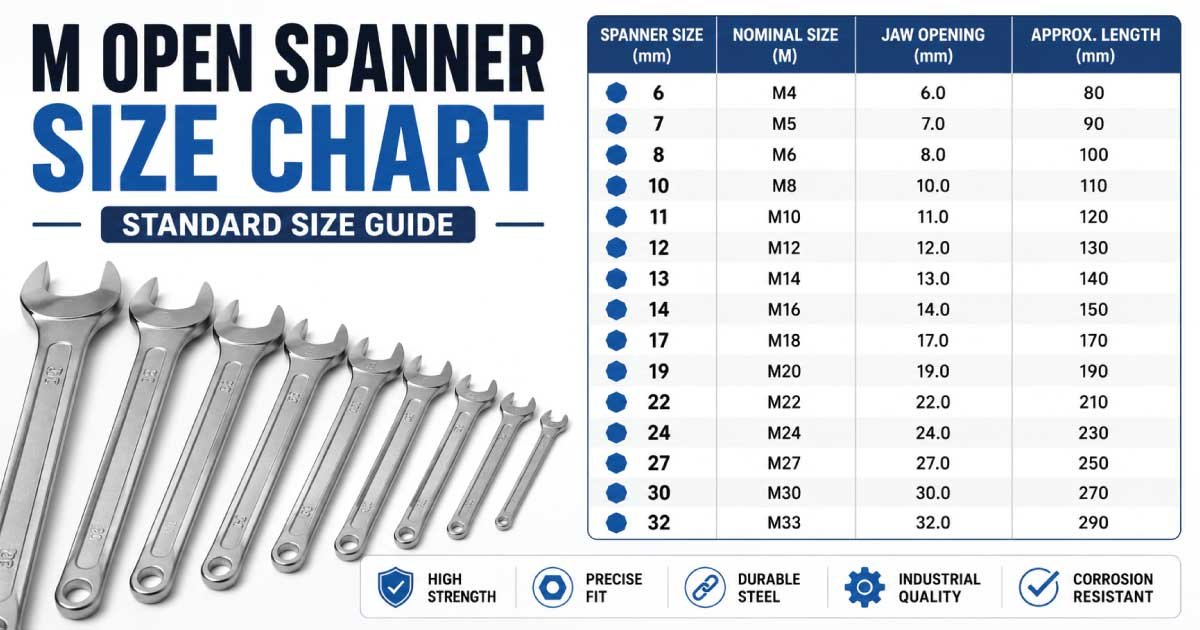
M Open Spanner Size Chart
The table below shows the standard relationship between common metric bolt sizes, their thread diameters, and the corresponding open spanner sizes used to tighten them.
| Metric Bolt Size | Thread Diameter | Standard Hex Size (Across Flats) | Open Spanner Size |
|---|---|---|---|
| M3 | 3 mm | 5.5 mm | 5.5 mm |
| M4 | 4 mm | 7 mm | 7 mm |
| M5 | 5 mm | 8 mm | 8 mm |
| M6 | 6 mm | 10 mm | 10 mm |
| M8 | 8 mm | 13 mm | 13 mm |
| M10 | 10 mm | 17 mm | 17 mm |
| M12 | 12 mm | 19 mm | 19 mm |
| M14 | 14 mm | 22 mm | 22 mm |
| M16 | 16 mm | 24 mm | 24 mm |
| M18 | 18 mm | 27 mm | 27 mm |
| M20 | 20 mm | 30 mm | 30 mm |
| M22 | 22 mm | 32 mm | 32 mm |
| M24 | 24 mm | 36 mm | 36 mm |
| M27 | 27 mm | 41 mm | 41 mm |
| M30 | 30 mm | 46 mm | 46 mm |
This chart helps users quickly match bolt sizes with the correct open spanner, ensuring proper tightening without damaging the fastener head.
Note: Some older or specialty fasteners may use slightly different hex dimensions depending on manufacturer standards or regional variations.
Common Open Spanner Sizes
Most standard open spanner sets are designed to cover the most frequently used metric fasteners found in everyday mechanical and household applications. These sets ensure users can handle a wide range of repair and assembly tasks without needing specialized tools.
Common sizes include:
- 6 mm
- 7 mm
- 8 mm
- 10 mm
- 11 mm
- 12 mm
- 13 mm
- 14 mm
- 15 mm
- 17 mm
- 19 mm
- 22 mm
- 24 mm
- 27 mm
- 30 mm
- 32 mm
These sizes cover the majority of applications in passenger vehicles, motorcycles, bicycles, home appliances, and industrial machinery, making them essential for both professionals and DIY users.
How to Determine the Correct Open Spanner Size
Choosing the correct open spanner size is essential for avoiding damage to bolts and ensuring safe, efficient tightening or loosening. If you are unsure about the bolt size, you can accurately identify the correct spanner size using a few simple measurement methods.
1. Measure the Bolt Thread
Start by measuring the diameter of the threaded section using a caliper or measuring tool. This helps you identify the metric bolt size.
Common examples include:
- 6 mm thread = M6
- 8 mm thread = M8
- 10 mm thread = M10
This step gives you the basic bolt classification, which is useful for understanding the overall fastener size.
2. Measure the Bolt Head
Next, measure the distance across the flat sides of the bolt head or nut. This is known as the “across flats” measurement and directly determines the correct spanner size.
For example:
- 13 mm across flats = 13 mm spanner
- 17 mm across flats = 17 mm spanner
- 19 mm across flats = 19 mm spanner
This measurement is the most important factor when selecting an open spanner because it ensures a proper grip without slipping or rounding the bolt head.
3. Check Manufacturer Specifications
Some machines, vehicles, or industrial equipment may use non-standard or specialized fasteners. In such cases, always refer to the manufacturer’s service manual or technical documentation.
This helps ensure you are using the correct tool size and prevents damage caused by guesswork or incorrect tool selection.
Read our newest article here:
Metric Bolt Size vs. Spanner Size
A common misunderstanding is that the spanner size matches the bolt size. For example, many assume an M10 bolt requires a 10 mm spanner, but this is not correct in most cases.
In reality, the spanner size refers to the width across the flats of the bolt head, not the thread diameter.
Typical examples include:
- M6 bolt → 10 mm spanner
- M8 bolt → 13 mm spanner
- M10 bolt → 17 mm spanner
- M12 bolt → 19 mm spanner
Understanding this difference is important because using the wrong spanner size can lead to slipping, rounded bolt heads, or difficulty tightening and loosening fasteners. Correct tool selection ensures faster work, better safety, and longer fastener life.
Open Spanner vs. Ring Spanner
Both open spanners and ring spanners are essential hand tools used for tightening and loosening nuts and bolts, but they are designed for different working conditions. Understanding their differences helps you choose the right tool for better grip, safety, and efficiency during mechanical or household tasks.
| Feature | Open Spanner | Ring Spanner |
|---|---|---|
| Contact Points | Two sides | Six or twelve sides |
| Grip | Moderate | Excellent |
| Access | Better in tight spaces | Best where full access is available |
| Slipping Risk | Higher | Lower |
| Torque Capacity | Moderate | High |
Open spanners are best for quick access in narrow spaces, while ring spanners provide stronger grip and are better suited for high-torque applications where slipping must be avoided. Many professionals prefer combination spanners, which include an open end on one side and a ring end on the other for maximum versatility.
Tips for Using an Open Spanner
Using an open spanner correctly improves safety, efficiency, and tool life. Proper technique also reduces the risk of damaging fasteners.
- Always use the correct size to prevent rounding off bolt heads
- Pull the spanner toward you instead of pushing when possible for better control
- Ensure the jaws are fully seated on the fastener before applying force
- Avoid using extension pipes (“cheater bars”) as they can damage both tool and bolt
- Clean rusty or dirty fasteners before loosening to improve grip and reduce slippage
Following these simple tips helps ensure smoother operation and reduces the chance of injury or equipment damage.
Read our newest article here: Tube Size Chart | Complete Guide 2026 | Pdf
Common Mistakes to Avoid
Many users damage tools or fasteners by making simple but avoidable mistakes when using open spanners. Being aware of these issues helps improve both safety and efficiency.
Common mistakes include:
- Using an oversized spanner that slips and damages the bolt head
- Confusing bolt thread diameter with spanner size
- Mixing metric and SAE tools on the same fasteners
- Applying excessive force when a ring spanner or socket would be more suitable
- Ignoring worn or damaged spanners that increase the risk of slipping
Avoiding these mistakes ensures better performance, longer tool life, and safer working conditions during repairs or assembly tasks.
Conclusion
Understanding the relationship between metric bolt sizes and open spanner sizes makes mechanical work faster, safer, and more efficient. Remember that the M designation refers to the thread diameter, while the open spanner size matches the width across the flats of the bolt head or nut.
For most everyday maintenance tasks, a metric spanner set ranging from 6 mm to 24 mm will cover the majority of common fasteners. By referring to the M open spanner size chart and using the correct tool, you can avoid damaging fasteners, improve efficiency, and complete repairs with confidence.
Read our newest article here: Sheet Metal Screw Size Chart | Pdf | 2026 Guide
Frequently Asked Questions
Does an M8 bolt use an 8 mm spanner?
No. Although the bolt has an 8 mm thread diameter, a standard M8 hex bolt typically requires a 13 mm open spanner or wrench to fit the bolt head. The thread size and the hex head size are different measurements, so always choose the spanner based on the bolt head.
What size spanner fits an M10 bolt?
A standard M10 hex bolt usually requires a 17 mm open spanner or wrench. This size is common for ISO and DIN metric fasteners used in automotive, construction, and machinery applications. Always verify the bolt type, as some specialty fasteners may use different head dimensions.
Are all metric bolt heads the same size?
No. While most ISO and DIN metric bolts follow standardized hex head dimensions, not every metric fastener uses the same head size. Flange bolts, stainless steel fasteners, high-strength bolts, and specialty hardware may have larger or smaller heads depending on their design and intended application.
Can I use an adjustable wrench instead of an open spanner?
Yes. An adjustable wrench can be used when the correct spanner is unavailable, but it is not always the best option. A properly sized open spanner provides a tighter grip, reduces the risk of slipping, and helps prevent damage or rounding of the fastener’s corners during use.