
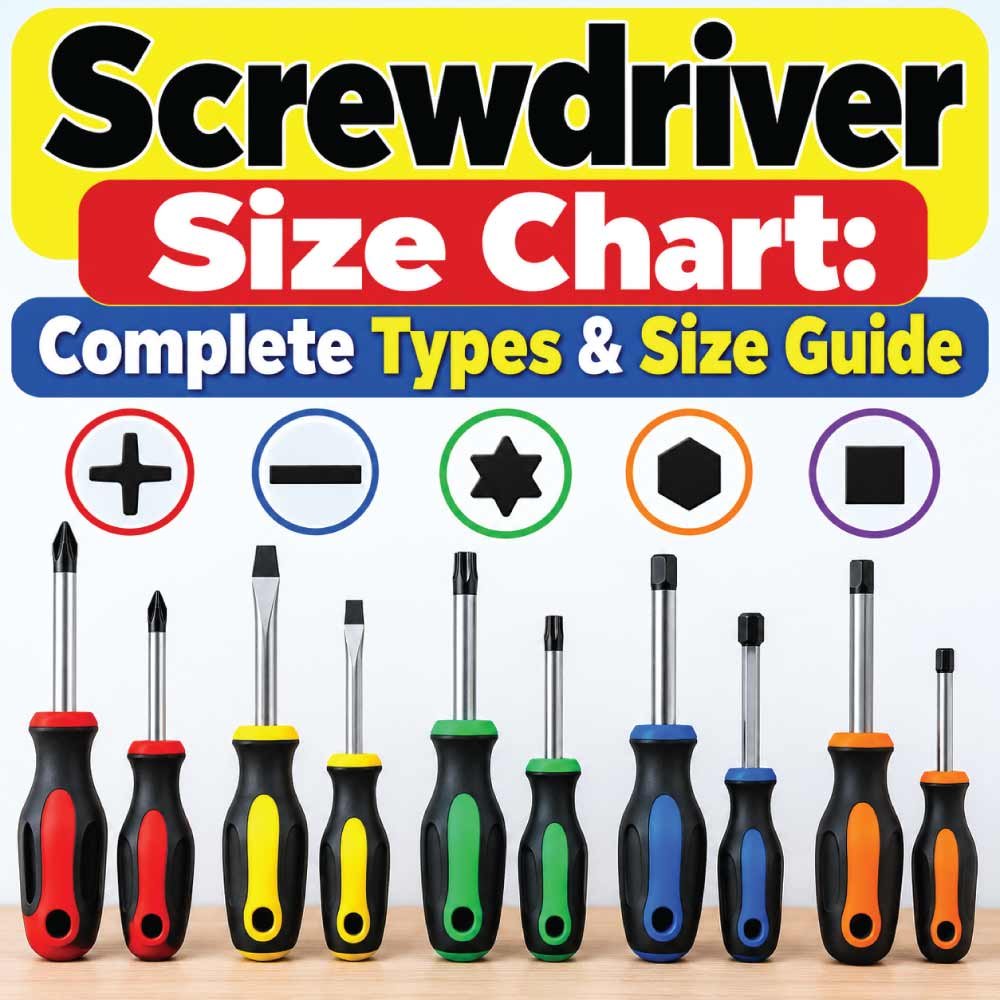
Choosing the correct screwdriver is more than picking a tool that looks like it fits the screw. The screwdriver tip must match the screw drive, and both the tip size and shape affect grip, torque, and the risk of damaging the fastener.
A reliable screwdriver size chart makes it easier to identify common Phillips, slotted, Pozidriv, Torx, hex, and other screwdriver types. However, there is no universal screwdriver sizing system. Different drive designs use different size markings, and manufacturers may offer several tip lengths and handle styles for the same drive size.
This guide explains the most common screwdriver sizes and types, how screwdriver sizes are identified, which sizes are commonly used for electronics, automotive work, household repairs, and machinery, and how to choose the right screwdriver for a particular fastener.
What Is a Screwdriver Size?
A screwdriver size describes the dimensions of the working tip that engages with a screw head. The exact meaning of “size” depends on the screwdriver type.
For example, Phillips screwdrivers commonly use numbered sizes such as PH0, PH1, PH2, and PH3. Slotted screwdrivers are generally described by the tip width and thickness, such as 4 mm × 0.6 mm. Torx screwdrivers use T-number designations, such as T10, T15, T20, and T25.
Screwdriver size should not be confused with the overall tool length.
Screwdriver Tip Size vs. Overall Length
A screwdriver can have:
- A specific tip size
- A particular shaft length
- A particular handle length
- A specific shaft diameter
- A specialized tip profile
Two screwdrivers can have the same tip size while having completely different shaft lengths.
For example, a PH2 screwdriver may be available with a short shaft for confined spaces or a longer shaft for recessed screws. The PH2 designation remains the same because it identifies the tip profile and size.
Common Screwdriver Types and Size Systems
Different screw drives require different screwdriver designs. The most important distinction is the shape of the tip rather than simply the physical size of the tool.
| Screwdriver Type | Common Size Markings | Typical Applications |
|---|---|---|
| Phillips | PH000–PH4 | General repairs, electronics, appliances |
| Slotted | Width × thickness | Household, machinery, electrical |
| Pozidriv | PZ0–PZ4 | Construction and general fastening |
| Torx | T1–T100+ | Automotive, electronics, machinery |
| Security Torx | T-size with center hole | Electronics, appliances, equipment |
| Hex | Metric or inch | Machinery, furniture, bicycles |
| JIS | JIS sizes | Japanese equipment and electronics |
| Robertson | #0–#4 | Woodworking and construction |
| Tri-Wing | Y-size | Electronics and specialty equipment |
| Spanner | Various security sizes | Tamper-resistant applications |
The ranges shown are common designations rather than a universal size list. Availability varies by manufacturer and tool series.
Phillips Screwdriver Size Chart
Phillips screwdrivers are among the most widely recognized screwdriver types. They have a cross-shaped tip designed for Phillips screw heads.
Phillips sizes are normally identified using PH followed by a number.
| Phillips Size | Designation | Typical Application |
|---|---|---|
| Extra small | PH000 | Precision electronics |
| Small | PH00 | Small electronics |
| Small | PH0 | Small screws |
| Medium | PH1 | Electronics and general repair |
| Common | PH2 | General-purpose fastening |
| Large | PH3 | Larger screws and equipment |
| Extra large | PH4 | Large industrial fasteners |
PH2 is one of the most commonly encountered Phillips sizes in general repair work, but the correct size always depends on the screw head.
How Phillips Sizes Work
The number is not simply a measurement in millimeters or inches. It represents a standardized drive size designation.
As the number increases, the intended Phillips drive generally becomes larger.
A PH2 tip should not be forced into a screw designed for PH1 or PH3. Even if the screwdriver appears to engage, an incorrect fit can damage both the tip and screw head.
Flathead or Slotted Screwdriver Size Chart
Slotted screwdrivers use a straight blade rather than a cross-shaped or star-shaped tip.
Unlike Phillips screwdrivers, slotted screwdrivers are generally described using the tip width and blade thickness.
| Tip Width | Common Description | Typical Use |
|---|---|---|
| 2.0 mm | Small precision | Electronics |
| 2.5 mm | Small | Small hardware |
| 3.0 mm | Small-medium | General repair |
| 4.0 mm | Medium | Household equipment |
| 5.5 mm | Medium-large | General mechanical work |
| 6.5 mm | Large | Larger fasteners |
| 8.0 mm | Extra large | Heavy-duty applications |
These sizes are representative examples of common slotted screwdriver dimensions. Exact combinations of width and thickness vary between manufacturers.
Why Blade Thickness Matters
A slotted screwdriver is not properly matched simply because its blade is wide enough.
The blade thickness must also fit the slot. A blade that is too thin may have excessive movement inside the screw head, while a blade that is too thick may not enter the slot completely.
For a secure fit, choose a blade that fills the slot as closely as practical without forcing it.
Pozidriv Screwdriver Size Chart
Pozidriv is a cross-shaped screw drive that resembles Phillips but uses additional features designed to improve engagement.
Pozidriv screwdrivers are identified using PZ numbers.
| Pozidriv Size | Designation | Typical Application |
|---|---|---|
| Very small | PZ0 | Small fastening |
| Small | PZ1 | Small hardware |
| Common | PZ2 | Construction and general fastening |
| Large | PZ3 | Larger fasteners |
| Extra large | PZ4 | Heavy-duty applications |
One important point is that Phillips and Pozidriv tips are not identical, even though they can look similar.
Using a Phillips screwdriver in a Pozidriv screw, or vice versa, may result in poor engagement and premature damage.
Torx Screwdriver Size Chart
Torx screwdrivers have a distinctive six-point star-shaped tip. They are widely used in automotive, electronics, appliances, machinery, and industrial equipment.
Torx sizes are identified with a T followed by a number.
| Torx Size | Designation | Common Application Examples |
|---|---|---|
| Small | T5 | Electronics |
| Small | T6 | Electronics |
| Small | T8 | Electronics |
| Small-medium | T10 | Electronics and equipment |
| Medium | T15 | Electronics and appliances |
| Medium | T20 | General mechanical work |
| Medium | T25 | Automotive and equipment |
| Medium-large | T27 | Machinery |
| Large | T30 | Automotive and machinery |
| Large | T40 | Automotive and equipment |
| Large | T45 | Automotive |
| Large | T50 | Larger mechanical fasteners |
The actual screw size and application can vary significantly, so the T-number should be matched directly to the screw head rather than guessed from the size of the fastener.
Security Torx Sizes
Security Torx, sometimes called tamper-resistant Torx, has a center hole in the screwdriver tip. This allows the tool to engage Torx screws with a central security pin.
Security Torx is commonly found in:
- Electronics
- Appliances
- Equipment housings
- Automotive components
- Public or commercial equipment
A standard Torx screwdriver without the required center hole cannot properly engage a security Torx screw with a pin.
Hex Screwdriver and Hex Key Sizes
Hex fasteners use a six-sided recess. They are commonly operated with a hex key, Allen key, hex bit, or hex screwdriver, depending on the application.
Hex sizes can be specified in millimeters or inches.
Common Metric Hex Sizes
| Hex Size | Typical Use |
|---|---|
| 1.5 mm | Small hardware |
| 2 mm | Small equipment |
| 2.5 mm | Electronics and machinery |
| 3 mm | General assembly |
| 4 mm | Furniture and machinery |
| 5 mm | General mechanical work |
| 6 mm | Machinery and bicycles |
| 8 mm | Larger fasteners |
| 10 mm | Large mechanical fasteners |
The sizes above are common examples, not a universal specification for every hex fastener.
Metric vs. Inch Hex Sizes
Metric and inch hex tools should not automatically be substituted for one another. A tool that appears close may not fully engage the internal hex recess.
Using an incorrectly sized hex tool can round the internal corners and make later removal difficult.
JIS Screwdriver Size Guide
JIS, or Japanese Industrial Standard, screwdrivers are designed for JIS cross-recess screws.
They can resemble Phillips screwdrivers, but the drive geometry is different.
JIS tools are particularly relevant when working with certain:
- Japanese motorcycles
- Cameras
- Electronics
- Small engines
- Older Japanese equipment
A Phillips screwdriver may sometimes appear to fit a JIS screw, but using the intended JIS tool provides the proper interface.
When working on equipment known to use JIS fasteners, a dedicated JIS screwdriver set can prevent unnecessary damage.
Robertson Screwdriver Size Chart
Robertson screwdrivers have a square-shaped tip. They are especially associated with construction, woodworking, cabinetry, and other applications where square-drive screws are used.
| Robertson Size | Typical Use |
|---|---|
| #0 | Small screws |
| #1 | Small hardware |
| #2 | General-purpose fastening |
| #3 | Larger fasteners |
| #4 | Large specialty applications |
The correct size depends on the screw specification. A properly fitted Robertson tip should sit securely in the square recess without excessive movement.
How to Choose the Correct Screwdriver Size
Choosing a screwdriver should begin with the screw head, not the handle.
1. Identify the Drive Type
Look at the recess in the screw head.
It may be:
- A straight slot
- A Phillips cross
- A Pozidriv cross
- A six-point Torx star
- A hexagonal recess
- A square recess
- A specialty security pattern
Identifying the drive pattern eliminates many incorrect tools immediately.
2. Select the Correct Size
Once the drive type is known, choose the corresponding size.
For example:
- Phillips screw → PH-size screwdriver
- Pozidriv screw → PZ-size screwdriver
- Torx screw → T-size screwdriver
- Slotted screw → blade width and thickness
- Hex recess → matching metric or inch hex size
3. Check the Fit
Place the tip into the screw head before applying significant force.
A good fit should:
- Seat fully
- Have minimal side-to-side movement
- Engage the drive surfaces evenly
- Allow controlled turning
If the screwdriver rocks significantly, try the correct size rather than forcing it.
4. Choose the Appropriate Shaft Length
The shaft length is separate from the tip size.
Use a:
- Short shaft for confined spaces
- Standard shaft for general repair
- Long shaft for recessed or difficult-to-reach screws
A longer screwdriver does not automatically provide a better grip on the screw.
How to Measure a Screwdriver
Measuring an unknown screwdriver can help identify its dimensions, but the method depends on the tip type.
Measuring a Slotted Screwdriver
For a flat-blade screwdriver, measure:
- Tip width
- Blade thickness
- Shaft length, if required
The tip can therefore be described using dimensions such as width × thickness.
Identifying Phillips and Pozidriv Sizes
Phillips and Pozidriv sizes are generally identified by their markings rather than by measuring the cross shape with a ruler.
Look for markings such as:
- PH0
- PH1
- PH2
- PH3
- PZ1
- PZ2
- PZ3
If the marking is missing, compare the tip with a known-size tool or the manufacturer’s specifications.
Identifying Torx Sizes
Torx tips are identified by their T-number, such as T10, T15, T20, or T25.
Because Torx dimensions are associated with a particular drive specification, using a size chart alone to estimate the size from a photograph or ruler is not always reliable.
Also Read:
Screwdriver Size Chart for Common Applications
Different jobs tend to require different screwdriver sizes and drive types.
| Application | Common Screwdriver Types | Frequently Encountered Sizes |
|---|---|---|
| Electronics | Phillips, Torx, precision slotted | PH0, PH00, T5–T10 |
| Household repair | Phillips, slotted, Torx | PH1, PH2, 4–6.5 mm, T15–T25 |
| Automotive | Phillips, Torx, hex | PH2, T20–T50, various hex |
| Furniture | Phillips, Pozidriv, hex | PH2, PZ2, 4–6 mm hex |
| Machinery | Slotted, Phillips, Torx, hex | Medium and large sizes |
| Construction | Phillips, Pozidriv, Robertson | PH2, PZ2, #2 Robertson |
These are general examples rather than universal requirements. The fastener specification should always take priority.
Precision Screwdriver Sizes
Precision screwdrivers are designed for small fasteners found in electronics, instruments, watches, cameras, computers, and other compact products.
Common precision drives include:
- PH000
- PH00
- PH0
- Small slotted tips
- T5
- T6
- T8
- Small hex tips
- Specialty security drives
Precision work requires careful tip selection because small screw heads can be damaged quickly by an incorrectly sized tool.
Why Precision Fit Matters
Small screws have relatively small drive surfaces. A loose tip can slip out of the recess and damage the fastener.
For delicate work:
- Use the exact drive type.
- Select the smallest appropriate size.
- Keep the screwdriver aligned with the screw.
- Apply controlled pressure.
- Avoid excessive torque.
Screwdriver Size and Shaft Length
When purchasing screwdrivers, buyers often focus on tip size and overlook shaft length.
Shaft length matters when accessibility is limited.
Short Screwdrivers
Short or stubby screwdrivers are useful for:
- Tight spaces
- Low-clearance assemblies
- Cabinet work
- Automotive access points
Long Screwdrivers
Long-shaft screwdrivers can help reach:
- Deeply recessed screws
- Narrow openings
- Components located behind other parts
However, the correct shaft length should be selected according to access requirements rather than assuming longer is always better.
Also Read:
Screwdriver Bit Sizes vs. Screwdriver Sizes
A screwdriver bit and a complete screwdriver perform the same basic function, but they are different tool formats.
A screwdriver has an integrated shaft and handle. A bit is a removable tip designed for a compatible bit holder, drill/driver, or ratchet handle.
Common bit drive sizes include:
- Phillips
- Pozidriv
- Torx
- Slotted
- Hex
- Square
- Security variants
A bit’s drive size still needs to match the screw. A compatible bit holder does not make an incorrectly sized bit suitable for the fastener.
Common Screwdriver Problems and Mistakes
Using the Wrong Drive Type
A Phillips and Pozidriv tip may look similar, but they are different designs. Always identify the drive before selecting the screwdriver.
Using the Wrong Size
A screwdriver that is too small may move inside the recess. One that is too large may not seat properly.
Both situations can damage the fastener.
Applying Excessive Force
If the screwdriver does not fit correctly, applying more force usually makes the problem worse.
Instead, stop and verify:
- Drive type
- Size
- Fastener condition
- Tool alignment
Using a Worn Tip
A heavily worn screwdriver tip may no longer provide proper engagement. Replace damaged tools when the tip has become rounded, chipped, or otherwise deformed.
Ignoring Security Fasteners
If a screw contains a center pin or unusual recess, it may require a specialized security screwdriver rather than a standard tool.
Also Read:
Tips for Using Screwdrivers Correctly
Good technique helps protect both the tool and fastener.
- Keep the screwdriver straight and aligned with the screw.
- Select the exact drive type and size whenever possible.
- Apply firm pressure toward the screw while turning.
- Avoid using a screwdriver as a pry bar unless it is specifically designed for that purpose.
- Replace tips that are significantly worn or damaged.
- For delicate electronics, use controlled force and appropriate precision tools.
- Follow the equipment manufacturer’s instructions for critical fasteners.
- Use a torque-controlled tool when a specified tightening torque is required.
Frequently Asked Questions About Screwdriver Sizes
What is the most common screwdriver size?
For general-purpose Phillips screwdriving, PH2 is one of the most commonly encountered sizes. However, there is no single screwdriver size that works for every screw.
What size screwdriver do I need for a Phillips screw?
Identify the Phillips drive size, such as PH0, PH1, PH2, or PH3. The tip should fit the recess firmly without excessive movement.
Is PH2 the same as PZ2?
No. PH2 and PZ2 are different drive designs. Although they look similar, their geometry is not identical.
What size screwdriver is used for electronics?
Electronics often require small Phillips, slotted, Torx, hex, or specialty security drivers. Common examples include PH00, PH0, T5, T6, and T8, depending on the device.
How do I know what size Torx screwdriver I need?
Look for the size specified by the manufacturer or match the tool to the screw head. Torx sizes are identified by markings such as T10, T15, T20, T25, and T30.
How are flathead screwdrivers sized?
Flathead or slotted screwdrivers are generally specified by tip width and blade thickness, rather than a numbered system like Phillips or Torx.
Can I use a smaller screwdriver if the correct size is unavailable?
It is better to wait for the correct size. A smaller screwdriver may not fully engage the screw and can damage the recess, particularly when significant torque is required.
Are screwdriver sizes universal?
No. Different screwdriver families use different sizing conventions. Phillips, Pozidriv, Torx, slotted, hex, and specialty drives should be interpreted according to their respective sizing systems.
Final Takeaway
A good screwdriver size chart helps you identify the right tool quickly, but the most important factor is always the relationship between the screw drive and screwdriver tip.
For Phillips screws, look for the appropriate PH size. For Pozidriv, use the corresponding PZ size. Torx uses T-number designations, while slotted screwdrivers are typically selected by blade width and thickness. Hex tools may use either metric or inch dimensions.
The safest approach is to identify the screw-drive type first, select the exact size, check the fit, and then apply controlled force. When a manufacturer’s specifications are available, use them as the primary reference—especially for specialized, delicate, or safety-critical equipment.
A well-chosen screwdriver should fit the fastener securely without excessive movement. Using the correct size not only makes the job easier but also helps prevent stripped screw heads, damaged tools, and unnecessary repair problems.