
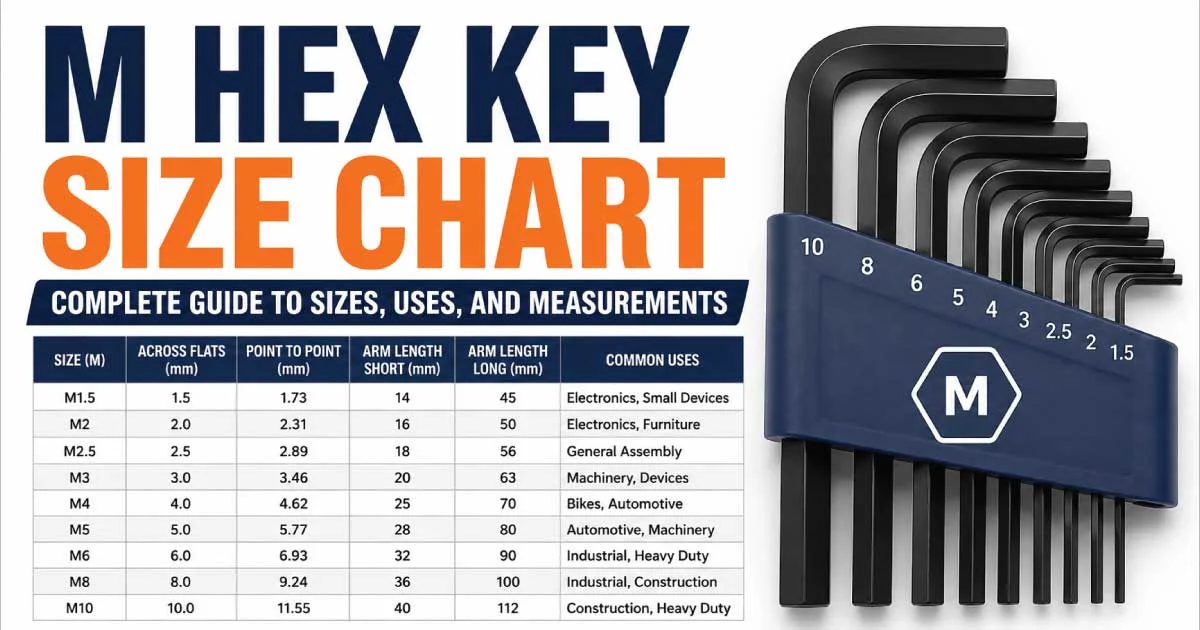
Metric hex keys, commonly called Allen keys, are essential tools for tightening and loosening fasteners with hexagonal recessed sockets. They are widely used in automotive repairs, furniture assembly, bicycles, machinery, electronics, and construction projects. Choosing the correct key size helps prevent rounded fasteners, damaged tools, and poor fit.
This metric hex key size chart explains common Allen key dimensions in millimeters, how hex key sizes are measured, which fasteners they fit, and how metric sizes differ from SAE sizes. It also covers L-shaped keys, ball-end keys, long-arm designs, and practical tips for choosing the correct tool.
What Is a Metric Hex Key?
A metric hex key is a hand tool with a hexagonal cross-section designed to fit the internal hexagonal socket of a compatible screw or bolt. It is commonly made from hardened tool steel, alloy steel, or other materials selected for strength and wear resistance.
The term Allen key comes from a widely recognized name associated with hex socket fasteners. Other common names include hex wrench, hex key wrench, and internal hex wrench.
Metric hex keys are sized in millimeters. For example, a 5 mm hex key is designed to fit a compatible fastener with a nominal 5 mm hex socket.
Metric hex keys are commonly used for:
- Furniture assembly and cabinet hardware
- Bicycle components and accessories
- Motorcycle and automotive maintenance
- Industrial machinery and equipment
- Power tools and workshop fixtures
- Plumbing fittings and mechanical assemblies
- Electronics and precision equipment
The correct key must fit the socket closely. A key that is too small may slip and round the socket, while one that is too large will not enter the fastener properly.
Metric Hex Key Size Chart in Millimeters
The following chart lists commonly encountered metric hex key sizes. Availability varies by manufacturer and tool set, and not every size is used in every application.
| Metric Hex Key Size (mm) | Approximate Size (inches) | Common Use Examples |
|---|---|---|
| 0.7 mm | 0.028 in | Specialized miniature fasteners |
| 0.9 mm | 0.035 in | Precision applications |
| 1.0 mm | 0.039 in | Small instrument fasteners |
| 1.5 mm | 0.059 in | Small hardware and electronics |
| 2.0 mm | 0.079 in | Small mechanical assemblies |
| 2.5 mm | 0.098 in | Compact equipment and accessories |
| 3.0 mm | 0.118 in | Furniture and small machinery |
| 3.5 mm | 0.138 in | Selected specialized fasteners |
| 4.0 mm | 0.157 in | Furniture, equipment, and hardware |
| 4.5 mm | 0.177 in | Specialized applications |
| 5.0 mm | 0.197 in | Bicycles, furniture, and machinery |
| 5.5 mm | 0.217 in | Selected metric fasteners |
| 6.0 mm | 0.236 in | Machinery, automotive, and hardware |
| 7.0 mm | 0.276 in | Specialized mechanical assemblies |
| 8.0 mm | 0.315 in | Larger fasteners and equipment |
| 10.0 mm | 0.394 in | Heavy-duty mechanical applications |
| 12.0 mm | 0.472 in | Large industrial fasteners |
| 14.0 mm | 0.551 in | Specialized large fasteners |
| 17.0 mm | 0.669 in | Large machinery and equipment |
Important: This is a general reference chart, not a universal fastener specification. Some listed sizes are less common than others. Always verify the socket size required by the specific fastener or consult its manufacturer.
The approximate inch values are conversions from millimeters and are not recommendations to substitute an SAE hex key.
Common Metric Allen Key Sizes and Their Uses
Certain metric hex key sizes appear frequently in everyday repairs and maintenance. However, the required size depends on the fastener design, its nominal diameter, and the manufacturer’s specification.
1.5 mm to 2.5 mm Hex Keys
These smaller keys are often used for miniature hardware and compact mechanical assemblies.
Typical applications include:
- Small adjustment screws
- Precision equipment
- Certain electronics and instrument fasteners
- Small bicycle accessories
Because the keys are small, excessive force can twist or damage them. Use a properly fitting key and avoid applying unnecessary leverage.
3 mm to 5 mm Hex Keys
This range is common in general household repairs, furniture, accessories, and some bicycle components.
Examples include:
- Flat-pack furniture fasteners
- Cabinet fittings
- Bicycle accessory bolts
- Small machine covers
- Selected equipment adjustment screws
A 4 mm or 5 mm hex key is often included in multipurpose metric tool sets. Nevertheless, the size should always be checked against the actual socket.
6 mm to 8 mm Hex Keys
These larger keys are used for a range of mechanical and structural assemblies.
Potential applications include:
- Furniture frame connections
- Machine brackets
- Selected automotive components
- Equipment mounting hardware
- Larger mechanical fasteners
The fastener’s material, thread size, and required tightening torque matter just as much as the key size.
10 mm and Larger Hex Keys
Large metric hex keys are generally associated with larger socket fasteners and specialized maintenance work.
They may be used on industrial equipment, machinery, or heavy mechanical assemblies. Such fasteners can require long-arm hex keys, T-handle tools, or dedicated hex bits, depending on accessibility and torque requirements.
Hex Key Dimensions: How Are Allen Key Sizes Measured?
The nominal size of a hex key is the distance across two opposite flat sides of its hexagonal cross-section. This measurement is commonly called the width across flats (AF).
For example, a nominal 6 mm hex key measures approximately 6 mm across its opposite flat faces, subject to the applicable dimensional tolerances.
Width Across Flats
Width across flats is the defining dimension used to identify a standard hex key size.
To measure it accurately:
- Use a suitable caliper or micrometer.
- Place the measuring faces against two opposite flat sides of the key.
- Keep the tool perpendicular to the measurement direction.
- Read the result in millimeters.
- Compare the measurement with the manufacturer’s stated size and tolerances.
Do not measure diagonally across the corners when identifying the nominal key size. The diagonal dimension is larger than the across-flats measurement.
Hex Key Length
Hex keys also vary in overall length. Two tools with the same nominal size may have different lengths and provide different reach or leverage.
| Hex Key Style | Main Dimension to Check | Typical Advantage |
|---|---|---|
| Short-arm L-key | Short and long leg lengths | Compact access |
| Long-arm L-key | Extended working length | Greater reach and leverage |
| Extra-long hex key | Overall reach | Access to recessed fasteners |
| T-handle hex key | Handle width and shaft length | Comfortable repeated turning |
| Folding hex key set | Individual key reach | Convenient storage and portability |
| Hex bit | Bit length and drive interface | Compatibility with a screwdriver or power tool |
There is no single universal length for each metric hex key size. Length depends on tool design and manufacturer specifications.
Also Read:
Metric Hex Key Size vs. SAE Allen Key Sizes
Metric and SAE hex keys use different measurement systems. Metric sizes are specified in millimeters, while SAE sizes are specified in fractions of an inch.
Some sizes are close numerically, but a near match is not necessarily a safe fit.
| Metric Size (mm) | Exact Inch Equivalent (approx.) | Potentially Confused SAE Size |
|---|---|---|
| 1.5 mm | 0.0591 in | 1/16 in = 0.0625 in |
| 2.0 mm | 0.0787 in | 5/64 in = 0.0781 in |
| 2.5 mm | 0.0984 in | 3/32 in = 0.0938 in |
| 3.0 mm | 0.1181 in | 1/8 in = 0.1250 in |
| 4.0 mm | 0.1575 in | 5/32 in = 0.1563 in |
| 5.0 mm | 0.1969 in | 3/16 in = 0.1875 in |
| 6.0 mm | 0.2362 in | 1/4 in = 0.2500 in |
| 8.0 mm | 0.3150 in | 5/16 in = 0.3125 in |
| 10.0 mm | 0.3937 in | 3/8 in = 0.3750 in |
The values in the middle column are mathematical conversions, while the final column identifies potentially confusing SAE sizes rather than guaranteed substitutes.
Can You Use an SAE Allen Key on a Metric Fastener?
It is best to use the correct measurement system and nominal size for the fastener.
A key that is slightly too small may move inside the socket and damage its corners. A key that is too large will not fit. Even a close nominal match may have insufficient contact to transmit the required torque safely.
If a metric socket fastener requires a 5 mm key, use a correctly fitting 5 mm metric tool rather than assuming a nearby fractional-inch size will work.
Also Read:
Types of Metric Hex Keys
Metric hex keys are available in several designs. The best option depends on access, required torque, frequency of use, and working conditions.
L-Shaped Hex Keys
L-shaped hex keys have one short arm and one long arm.
The short arm is useful in restricted spaces, while the long arm offers additional reach and can provide more leverage when used appropriately.
Many general-purpose metric hex key sets contain multiple L-shaped keys in a range of sizes.
Ball-End Hex Keys
Ball-end hex keys have a rounded end designed to engage the socket at an angle within the manufacturer’s permitted operating range.
They can be helpful when a fastener is difficult to access directly. However, ball-end engagement typically provides less contact than a straight hex end.
Use the straight end for initial loosening or final tightening when possible, especially when the fastener requires substantial torque.
T-Handle Hex Keys
T-handle keys have a crossbar-shaped handle that allows a comfortable grip and efficient repeated turning.
They are useful for workshop tasks and maintenance jobs involving multiple fasteners of the same size.
The increased leverage can also make it easier to apply excessive torque, so follow the fastener manufacturer’s tightening requirements.
Folding Hex Key Sets
Folding sets store multiple hex keys in a compact handle. They are convenient for carrying in a bicycle repair kit, toolbox, or maintenance bag.
Their main advantage is portability, although the handle may restrict access in tight spaces compared with individual L-shaped keys.
Hex Bits and Power Tool Attachments
Hex bits fit compatible screwdriver handles, ratchets, or powered drivers.
Before using a powered tool, verify that the bit, socket, and fastener are compatible and that the torque setting is appropriate. Excessive powered torque can damage the socket or fastener threads.
Also Read:
How to Choose the Correct Metric Allen Key Size
Choosing the right key begins with identifying the fastener, then checking the tool’s dimensions and working conditions.
Step 1: Inspect the Socket
Clean dirt, paint, grease, or debris from the recessed socket. Contamination can prevent a hex key from seating fully.
Inspect the socket for rounded corners, corrosion, or other damage.
Step 2: Test the Fit
Insert the key straight into the socket. A correct size should seat fully and fit closely without noticeable rocking.
Do not force a key that does not fit. Try the correct size using a metric set rather than guessing based on appearance.
Step 3: Consider Access
Choose a short-arm key for compact spaces or a long-arm tool when additional reach is needed. A ball-end key may help with angled access, but it should not automatically be used for high-torque work.
Step 4: Follow Torque Requirements
The required tightening torque depends on the fastener’s thread size, material, lubrication, grade, and application.
Do not assume that a larger hex key means the fastener should be tightened as hard as possible. For critical assemblies, use the manufacturer’s torque specification and an appropriate torque tool.
Step 5: Check Tool Quality
A well-made key should have accurately formed flats, a suitable finish, and material strength appropriate to its intended use.
Poorly sized or worn keys can slip and damage fasteners. Replace tools that are rounded, twisted, cracked, or visibly worn.
Common Metric Hex Key Problems and Mistakes
Even a suitable tool can cause damage if it is used incorrectly.
- Using the wrong size: A loose-fitting key can round the socket.
- Confusing metric and SAE tools: Similar-looking dimensions are not necessarily interchangeable.
- Failing to seat the key fully: Partial engagement concentrates force on the socket edges.
- Applying excessive leverage: Overloading a small key can twist the tool or damage the fastener.
- Using a ball end for high torque: The angled contact may provide less engagement than the straight end.
- Ignoring socket damage: A worn socket may not securely engage even the correct key.
- Using a damaged tool: Rounded or bent keys increase the risk of slipping.
- Guessing the tightening torque: Excessive force can strip threads or damage components.
If a fastener is stuck, clean the socket, use the correct straight-end key, and consider an appropriate penetrating product if suitable for the material and application. Avoid methods that could damage surrounding components.
Frequently Asked Questions About Metric Hex Key Sizes
What are the most common metric Allen key sizes?
Common sizes include 2 mm, 2.5 mm, 3 mm, 4 mm, 5 mm, 6 mm, and 8 mm. The sizes needed for a particular job depend on the fasteners used in the equipment or assembly.
How is a metric hex key size measured?
It is measured across two opposite flat sides of the hexagonal cross-section, not diagonally across the corners.
Is a 5 mm Allen key the same as a 5 mm bolt?
No. The key size refers to the width across its flats. A bolt’s nominal thread diameter is a separate measurement, and the relationship between thread diameter and socket size varies by fastener design and standard.
Can I use a 3/16-inch Allen key instead of a 5 mm key?
A 3/16-inch key measures 4.7625 mm, so it is smaller than a nominal 5 mm key. It should not be assumed to fit safely. Use the specified key size.
What is the difference between a ball-end and a standard hex key?
A standard hex end has flat faces that engage the socket directly. A ball-end design permits angled access within its intended operating limits, but it may provide less effective engagement under high torque.
Do all metric hex keys have the same length?
No. Hex key length varies by design and manufacturer. Short-arm, long-arm, extra-long, T-handle, and folding designs can all use the same nominal hex size.
How can I prevent an Allen bolt from rounding?
Use the exact key size, clean the socket, seat the tool fully, keep it aligned where possible, and follow the specified tightening torque. Replace damaged tools and inspect worn fasteners before applying force.
Conclusion
A metric hex key size chart helps identify the correct Allen key for common fasteners, but accurate selection also requires attention to fit, socket condition, tool length, and application requirements.
Measure the key across its flat faces, use millimeter-sized tools for metric sockets, and avoid substituting a nearby SAE size without confirming compatibility. Choosing a properly fitting metric Allen key reduces the risk of slipping, rounded sockets, and damaged fasteners.