
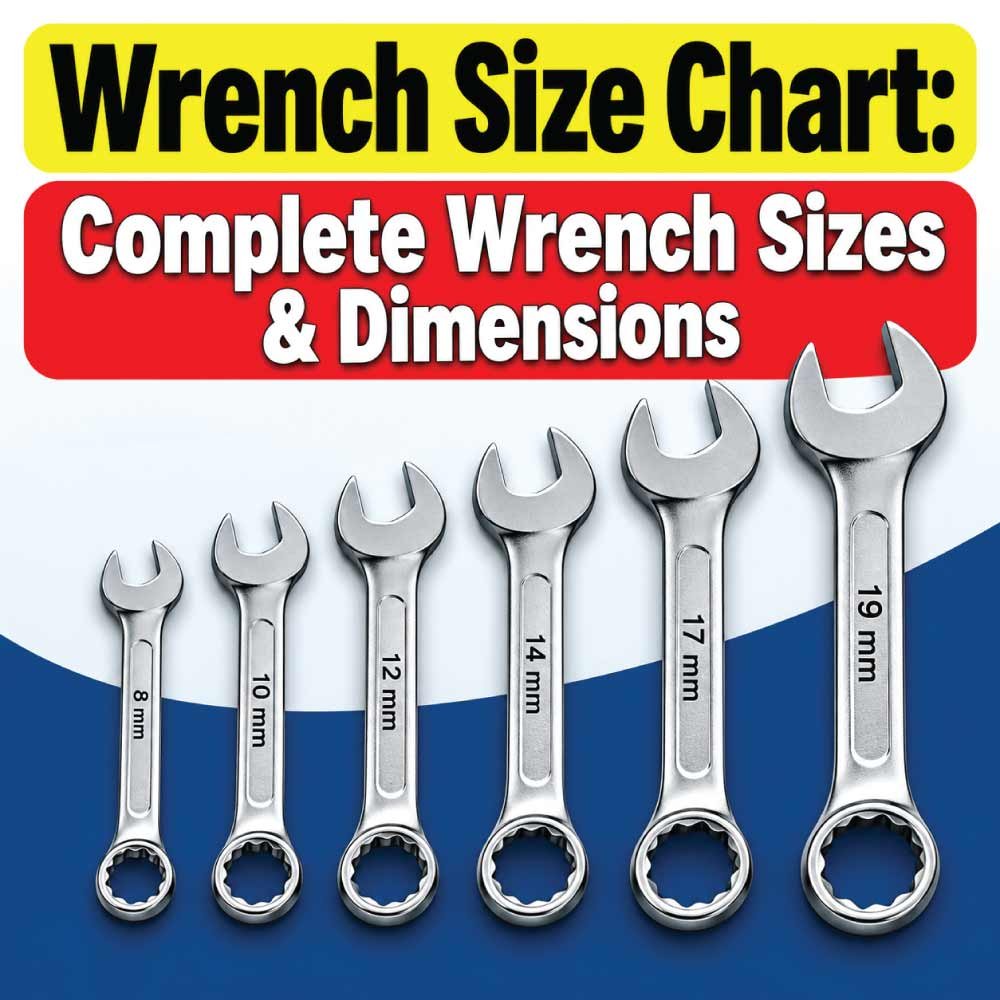
Finding the correct wrench size can save time, prevent damaged fasteners, and make mechanical work much easier. A wrench size chart provides a quick reference for matching the wrench opening to the corresponding nut or bolt head.
Wrenches are commonly measured in millimeters (metric) or inches (standard/SAE). Although the two systems may have sizes that appear close, they are not interchangeable in every situation. Using the wrong size can cause slipping, rounded fastener edges, or unnecessary wear.
This guide covers common metric and standard wrench sizes, wrench dimensions, SAE-to-metric conversions, common wrench types, how wrench sizes are measured, and practical tips for selecting the correct tool.
What Is a Wrench Size?
A wrench size refers to the distance across the flats of the fastener that the wrench is designed to fit. For an open-end or combination wrench, this measurement is the width of the wrench opening.
For example, a 10 mm wrench is designed to fit a fastener with approximately 10 mm across its flats. Similarly, a 1/2-inch wrench is designed for a fastener measuring approximately 1/2 inch across the flats.
The wrench size does not normally refer to the overall length of the wrench. A longer wrench may have the same opening size as a shorter wrench but provides different leverage.
Wrench Size vs. Wrench Length
These measurements should not be confused:
- Wrench size: The opening that fits the fastener.
- Overall length: The physical length of the wrench.
- Head thickness: The thickness of the wrench head.
- Jaw width: The width of the open-end portion.
- Drive size: Used primarily with sockets and ratchets rather than traditional fixed wrenches.
The size stamped on a wrench generally identifies the fastener size it is intended to fit, not the total dimensions of the tool.
Metric Wrench Size Chart
Metric wrenches are measured in millimeters and are widely used on modern automobiles, machinery, bicycles, appliances, industrial equipment, and general hardware.
The following chart lists common metric wrench sizes.
| Metric Wrench Size | Approx. Inch Equivalent | Common Use |
|---|---|---|
| 6 mm | 0.236 in | Small hardware |
| 7 mm | 0.276 in | Small fasteners |
| 8 mm | 0.315 in | Automotive and machinery |
| 9 mm | 0.354 in | Small mechanical work |
| 10 mm | 0.394 in | Automotive and general repair |
| 11 mm | 0.433 in | Mechanical applications |
| 12 mm | 0.472 in | Automotive and machinery |
| 13 mm | 0.512 in | Automotive and hardware |
| 14 mm | 0.551 in | Automotive and machinery |
| 15 mm | 0.591 in | Automotive applications |
| 16 mm | 0.630 in | Machinery and automotive |
| 17 mm | 0.669 in | Automotive and equipment |
| 18 mm | 0.709 in | Automotive and machinery |
| 19 mm | 0.748 in | Automotive and heavy equipment |
| 21 mm | 0.827 in | Automotive and machinery |
| 22 mm | 0.866 in | Larger fasteners |
| 24 mm | 0.945 in | Machinery and heavy-duty work |
| 27 mm | 1.063 in | Large mechanical fasteners |
| 30 mm | 1.181 in | Heavy equipment |
| 32 mm | 1.260 in | Large machinery |
| 36 mm | 1.417 in | Heavy-duty applications |
These are conversion equivalents, not necessarily direct substitutes. A metric wrench should generally be used with a metric fastener, and an SAE wrench should be used with an SAE fastener whenever possible.
Common Metric Wrench Sizes
For general repair work, some particularly common metric sizes include:
- 8 mm
- 10 mm
- 12 mm
- 13 mm
- 14 mm
- 15 mm
- 17 mm
- 19 mm
The exact sizes required depend on the equipment and fastener specifications.
Standard SAE Wrench Size Chart
Standard or SAE wrenches are measured in fractions of an inch. The term SAE is commonly used to distinguish inch-based fastener sizes from metric sizes.
Here are common SAE wrench sizes arranged from smaller to larger.
| SAE Wrench Size | Decimal Inches | Approx. Metric Equivalent |
|---|---|---|
| 1/4 in | 0.250 | 6.35 mm |
| 5/16 in | 0.313 | 7.94 mm |
| 3/8 in | 0.375 | 9.53 mm |
| 7/16 in | 0.438 | 11.11 mm |
| 1/2 in | 0.500 | 12.70 mm |
| 9/16 in | 0.563 | 14.29 mm |
| 5/8 in | 0.625 | 15.88 mm |
| 11/16 in | 0.688 | 17.46 mm |
| 3/4 in | 0.750 | 19.05 mm |
| 13/16 in | 0.813 | 20.64 mm |
| 7/8 in | 0.875 | 22.23 mm |
| 15/16 in | 0.938 | 23.81 mm |
| 1 in | 1.000 | 25.40 mm |
| 1-1/16 in | 1.063 | 26.99 mm |
| 1-1/8 in | 1.125 | 28.58 mm |
| 1-1/4 in | 1.250 | 31.75 mm |
| 1-3/8 in | 1.375 | 34.93 mm |
| 1-1/2 in | 1.500 | 38.10 mm |
Not every possible SAE size is included in this table. Manufacturers may offer different sets depending on the intended application.
Metric vs. SAE Wrench Sizes
The biggest difference between metric and SAE wrenches is their measurement system.
Metric wrenches use millimeters, while SAE wrenches use inches. A 10 mm wrench and a 3/8-inch wrench may look similar, but their openings are different.
For comparison:
- 10 mm = 0.394 inch
- 3/8 inch = 9.525 mm
That means a 10 mm wrench is about 0.475 mm larger than a 3/8-inch wrench.
Similarly:
- 13 mm = 0.512 inch
- 1/2 inch = 12.7 mm
These sizes are close, but they are not identical.
Can You Use SAE on Metric Fasteners?
Sometimes a nearby SAE size may physically fit a metric fastener, but this is generally not recommended when the correct metric wrench is available.
A slightly loose wrench can:
- Slip under load
- Round the fastener
- Damage wrench jaws
- Make removal more difficult
- Increase the risk of injury
The safest approach is to use the wrench size specified for the fastener.
SAE to Metric Wrench Conversion Chart
A conversion chart can help when identifying an unfamiliar fastener or selecting a replacement tool.
| SAE Size | Metric Equivalent | Difference / Relationship |
|---|---|---|
| 1/4 in | 6.35 mm | Near 6 mm |
| 5/16 in | 7.94 mm | Near 8 mm |
| 3/8 in | 9.53 mm | Near 10 mm |
| 7/16 in | 11.11 mm | Near 11 mm |
| 1/2 in | 12.70 mm | Near 13 mm |
| 9/16 in | 14.29 mm | Near 14 mm |
| 5/8 in | 15.88 mm | Near 16 mm |
| 11/16 in | 17.46 mm | Near 17 mm |
| 3/4 in | 19.05 mm | Near 19 mm |
| 13/16 in | 20.64 mm | Near 21 mm |
| 7/8 in | 22.23 mm | Near 22 mm |
| 15/16 in | 23.81 mm | Near 24 mm |
| 1 in | 25.40 mm | Near 25 mm |
| 1-1/16 in | 26.99 mm | Near 27 mm |
| 1-1/8 in | 28.58 mm | Near 29 mm |
| 1-1/4 in | 31.75 mm | Near 32 mm |
Important: “Near” does not mean interchangeable. Always choose the exact wrench size whenever possible.
How Wrench Sizes Are Measured
Wrench size is normally determined by measuring the distance between the opposing surfaces that contact the fastener.
For an open-end wrench, the measurement is taken across the jaws. For a box-end or combination wrench, the size corresponds to the internal opening that fits over the fastener.
Measuring a Wrench
If the wrench marking is worn or unreadable:
- Place the wrench on a flat surface.
- Measure the opening from one internal contact surface to the opposite surface.
- Use a ruler, caliper, or suitable measuring tool.
- Record the measurement in millimeters or inches.
- Compare it with a wrench size chart.
A digital caliper generally provides a more precise measurement than a standard ruler.
Measuring the Fastener
You can also identify the required wrench by measuring the fastener itself.
Place a caliper across the two opposite flat sides of the nut or bolt head. This gives the width across flats (AF).
For example, if the measured width across flats is approximately 13 mm, a 13 mm wrench may be the appropriate choice.
Types of Wrenches and Their Uses
Wrench size is only one part of selecting the correct tool. Different wrench designs are intended for different jobs.
Open-End Wrench
An open-end wrench has a U-shaped opening that fits around two sides of a fastener.
Advantages:
- Easy to position around accessible fasteners
- Useful where space is limited
- Can be placed over a fastener from the side
Its main limitation is that it contacts fewer surfaces than a box-end wrench.
Box-End Wrench
A box-end wrench surrounds the fastener and generally provides more contact than an open-end design.
It is useful when:
- The fastener is accessible from above
- Greater contact is desired
- The fastener requires substantial turning force
Combination Wrench
A combination wrench has an open end on one side and a box end on the other.
This makes it one of the most practical general-purpose wrench designs because one tool provides two different access options.
Adjustable Wrench
An adjustable wrench has a movable jaw that allows it to accommodate different fastener sizes.
It is useful when working with multiple sizes or when the exact size is unknown. However, the movable jaw must be adjusted correctly to minimize movement and slipping.
Flare-Nut Wrench
A flare-nut wrench, also called a line wrench, partially surrounds the fastener while leaving an opening for tubing.
It is commonly used on:
- Brake lines
- Fuel lines
- Hydraulic lines
- Other tubing connections
Its design provides more contact than a typical open-end wrench while allowing it to slide over a line.
Also Read:
How to Choose the Correct Wrench Size
Selecting the correct wrench is straightforward when you follow a few basic principles.
1. Identify the Measurement System
Determine whether the fastener is metric or SAE.
If the equipment documentation specifies a metric fastener, start with metric wrenches. If it specifies an inch size, use SAE tools.
2. Match the Exact Size
Choose the wrench that fits the fastener closely without excessive movement.
A properly fitted wrench should sit securely against the flats.
3. Check the Fit Before Applying Force
Do not immediately apply maximum force. First make sure the wrench is completely seated.
A poor fit can cause the wrench to slip when torque is applied.
4. Consider Available Space
The best wrench design depends on access.
An open-end wrench may work where a box wrench cannot be positioned. A ratcheting combination wrench can be convenient where the tool has limited room to swing.
5. Consider the Fastener Condition
If a nut or bolt is damaged, corroded, or partially rounded, avoid forcing a poorly fitting wrench onto it.
A suitable specialty tool may be safer and more effective.
Also Read:
Common Wrench Size Mistakes
Even experienced DIY users can run into problems when choosing or using wrenches.
Using a Nearly Matching Size
One of the most common mistakes is assuming that a nearby metric and SAE size is “close enough.”
A close size may appear to fit but can slip when force is applied.
Using an Adjustable Wrench Incorrectly
An adjustable wrench should be positioned so that the movable jaw is properly supported by the fastener. The jaws should be adjusted snugly rather than left loose.
Pulling at an Unsafe Angle
Keep the wrench properly aligned with the fastener whenever possible. Poor positioning can increase the likelihood of slipping.
Ignoring Fastener Condition
Rust, paint, corrosion, and damaged corners can affect how securely a wrench fits.
If the fastener is already damaged, forcing the wrong wrench onto it can make the problem worse.
Also Read:
What Wrench Sizes Should a Basic Tool Set Include?
The ideal wrench set depends on the type of work you perform.
For general metric work, a useful collection commonly includes sizes such as:
- 8 mm
- 10 mm
- 12 mm
- 13 mm
- 14 mm
- 15 mm
- 17 mm
- 19 mm
For common SAE work, a practical range may include:
- 1/4 inch
- 5/16 inch
- 3/8 inch
- 7/16 inch
- 1/2 inch
- 9/16 inch
- 5/8 inch
- 11/16 inch
- 3/4 inch
- 7/8 inch
However, the best set is determined by your actual applications. Automotive, plumbing, industrial, agricultural, and household work can all require different sizes.
Wrench Size Chart for Automotive Work
Automotive applications commonly use both metric and SAE fasteners, depending on the vehicle, manufacturer, component, and age of the equipment.
Common metric sizes include:
- 10 mm for smaller automotive hardware
- 12 mm and 13 mm for various brackets and components
- 14 mm and 15 mm for many medium-sized fasteners
- 17 mm and 19 mm for larger components
Common SAE sizes may be encountered on older vehicles or equipment designed around inch-based hardware.
Always verify the exact fastener specification rather than choosing a wrench based solely on the vehicle type.
Wrench Size and Torque
Wrench size and torque are related to tool use, but they are not the same measurement.
Torque describes rotational force, commonly expressed in units such as newton-meters (N·m) or pound-feet (lb-ft). A wrench size identifies the fastener opening.
A longer wrench generally provides greater leverage, but that does not mean every fastener should be tightened as hard as possible.
For critical applications, follow the manufacturer’s specified torque value and use an appropriate torque wrench.
This is particularly important for components where incorrect tightening can affect safety or equipment performance.
Frequently Asked Questions About Wrench Sizes
Are metric and SAE wrench sizes interchangeable?
Not generally. Some sizes are physically close, but they are not identical. Using the wrong size can cause slipping and fastener damage.
What is the most common metric wrench size?
There is no single universal size. 10 mm, 12 mm, 13 mm, 14 mm, 17 mm, and 19 mm are among commonly encountered metric sizes, depending on the application.
What is the most common SAE wrench size?
Common SAE sizes include 1/2 inch, 9/16 inch, 5/8 inch, 3/4 inch, and 7/8 inch, but requirements vary by equipment.
What does 10 mm mean on a wrench?
A 10 mm marking indicates that the wrench is designed for a fastener measuring approximately 10 mm across the flats.
Is 13 mm the same as 1/2 inch?
No. 1/2 inch equals 12.7 mm, while 13 mm is slightly larger. Although they are close, they should not automatically be treated as interchangeable.
How do I know what wrench size I need?
Check the manufacturer’s specifications if available. Otherwise, measure the fastener across its flats with a suitable measuring tool and select the matching wrench.
Why does my wrench keep slipping?
Possible causes include:
- Incorrect wrench size
- Worn or damaged wrench jaws
- Rounded fastener edges
- Dirt, rust, or paint interfering with the fit
- The wrench not being fully seated
Stop if the tool repeatedly slips and reassess the size and condition of the fastener.
Final Takeaway
A reliable wrench size chart makes it much easier to identify the correct tool before starting a repair or maintenance task. The two major measurement systems are metric, measured in millimeters, and SAE, measured in inches.
The most important rule is simple: match the wrench to the exact fastener size whenever possible. Avoid relying on approximate metric-to-SAE substitutions, especially when significant force or safety-critical components are involved.
For routine work, keeping a well-organized set of common metric and SAE combination wrenches provides flexibility for automotive, mechanical, household, and maintenance projects. When exact specifications matter, always confirm the fastener dimensions and follow the equipment or manufacturer’s requirements.