
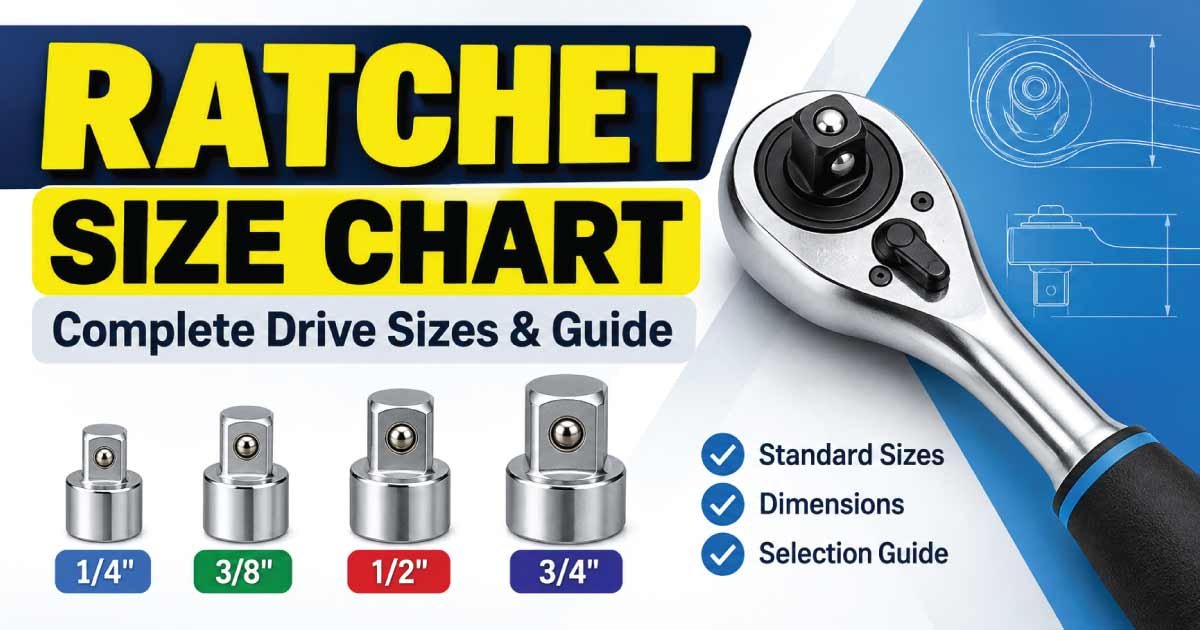
Choosing the correct ratchet can make fastening and loosening work faster, safer, and more efficient. The most important specification to understand is the drive size, which determines the size of socket the ratchet accepts.
The most common ratchet drive sizes are 1/4 inch, 3/8 inch, and 1/2 inch. Larger 3/4-inch and 1-inch drive ratchets are generally used for heavy-duty mechanical and industrial applications. Smaller drives provide better access in confined spaces, while larger drives are designed to work with larger sockets and fasteners.
This ratchet size chart explains common drive sizes, socket compatibility, typical applications, advantages, limitations, and practical selection tips. It also clarifies the difference between ratchet drive size, socket size, and fastener size, which are often confused.
What Is a Ratchet Drive Size?
A ratchet is a hand tool that uses a reversible mechanism to turn sockets. The drive size refers to the square drive on the ratchet where the socket attaches.
For example, a 3/8-inch drive ratchet accepts sockets with a 3/8-inch drive connection. It does not mean that the socket is necessarily 3/8 inch in fastener size.
This distinction is important because a 3/8-inch-drive ratchet can accept sockets in many different socket sizes.
Ratchet Drive Size vs Socket Size
These two measurements describe different parts of the tool system:
- Drive size: The square connection between the ratchet and socket.
- Socket size: The size of the socket opening that fits the fastener.
- Fastener size: The relevant dimension of the bolt or nut, depending on its design and specification.
For example, you might use a 3/8-inch drive ratchet with a 10 mm socket. The 3/8 inch refers to the ratchet’s drive, while 10 mm refers to the socket opening.
Ratchet Size Chart
The following chart covers the most commonly encountered ratchet drive sizes and their typical uses.
| Ratchet Drive Size | Drive in mm | Typical Applications | General Character |
|---|---|---|---|
| 1/4 inch | 6.35 mm | Small fasteners, electronics, light automotive work | Compact |
| 3/8 inch | 9.525 mm | General automotive, machinery, maintenance | Versatile |
| 1/2 inch | 12.7 mm | Automotive, larger machinery, heavy-duty work | High torque |
| 3/4 inch | 19.05 mm | Heavy equipment, industrial maintenance | Heavy duty |
| 1 inch | 25.4 mm | Large machinery and industrial applications | Very heavy duty |
These are drive dimensions, not socket opening sizes. Actual ratchet construction, mechanism, handle length, and torque capability vary by manufacturer and model.
1/4-Inch Drive Ratchet
The 1/4-inch drive ratchet is the smallest of the three common general-purpose drive sizes.
Its compact design makes it useful when working around crowded components where a larger ratchet may not fit.
Common Uses
A 1/4-inch ratchet is commonly useful for:
- Small automotive fasteners
- Interior trim and panels
- Electronics and equipment
- Small machinery
- Bicycle and recreational equipment
- Appliance maintenance
- Light-duty assembly work
It is particularly useful when access and control are more important than maximum torque.
Advantages of 1/4-Inch Drive
The main benefits include:
- Compact head size
- Easy access in restricted spaces
- Lightweight construction
- Good control for small fasteners
- Useful with small sockets and accessories
Limitations
A 1/4-inch drive should not automatically be treated as a substitute for a larger drive when substantial torque is required. Applying excessive force can damage the ratchet, socket, fastener, or drive connection.
3/8-Inch Drive Ratchet
The 3/8-inch drive ratchet is one of the most versatile choices for general mechanical work.
It provides a useful balance between compactness and torque capability, making it popular for automotive repair, equipment maintenance, and workshop tasks.
Common Uses
Typical applications include:
- Automotive maintenance
- Engine-bay work
- General mechanical repairs
- Machinery maintenance
- Household equipment
- Workshop assembly
- Medium-sized fasteners
A 3/8-inch drive is often a practical choice when one ratchet needs to cover a broad range of everyday jobs.
Why Choose 3/8 Inch?
Its main advantage is versatility.
It is generally smaller and easier to maneuver than a 1/2-inch drive while providing more capability than a 1/4-inch drive.
For someone building a basic socket set, a 3/8-inch drive ratchet can be an especially useful general-purpose option.
1/2-Inch Drive Ratchet
The 1/2-inch drive ratchet is designed for larger sockets and applications where greater torque may be required.
It is widely used in automotive and mechanical work, particularly for larger fasteners.
Common Applications
A 1/2-inch drive is commonly associated with:
- Automotive repair
- Suspension work
- Wheel-related service
- Larger machinery
- Equipment maintenance
- Heavy mechanical assemblies
- Larger bolts and nuts
The larger square drive provides a stronger connection to compatible sockets than smaller drive systems, although actual strength depends on the complete tool and socket specification.
When Should You Choose 1/2 Inch?
Choose a 1/2-inch drive when:
- The required socket sizes are larger.
- The application calls for more torque.
- You are working on heavy automotive components.
- A 3/8-inch setup is too small for the job.
- You need compatibility with larger sockets and accessories.
For controlled final tightening, use a properly rated torque wrench rather than relying on a standard ratchet as a torque-measuring instrument.
3/4-Inch Drive Ratchet
A 3/4-inch drive ratchet belongs to the heavy-duty category.
It is considerably larger than the common 1/4-, 3/8-, and 1/2-inch drives and is intended for larger sockets and demanding mechanical applications.
Typical Applications
3/4-inch drive tools may be used for:
- Heavy equipment
- Industrial machinery
- Large mechanical assemblies
- Construction equipment
- Commercial vehicle maintenance
- Large structural fasteners
Because applications at this scale can involve substantial loads, the manufacturer’s torque rating and operating instructions should be followed carefully.
1-Inch Drive Ratchet
The 1-inch drive ratchet is intended for very large sockets and heavy-duty applications.
It is generally unnecessary for ordinary household maintenance but can be valuable in industrial environments where large fasteners are routinely serviced.
Where 1-Inch Drive Is Used
Applications can include:
- Heavy industrial machinery
- Large construction equipment
- Mining equipment
- Large commercial vehicles
- Industrial maintenance
- Large mechanical assemblies
At this level, tool selection should be based on the exact fastener requirements, manufacturer ratings, and available working clearance rather than simply choosing the largest ratchet.
Ratchet Drive Size Comparison
Understanding the relationship between common drive sizes makes selection easier.
| Drive Size | Approx. Metric Drive | Best Suited For | Space Requirement |
|---|---|---|---|
| 1/4 inch | 6.35 mm | Small and light-duty work | Low |
| 3/8 inch | 9.53 mm | General-purpose work | Moderate |
| 1/2 inch | 12.70 mm | Larger automotive and mechanical work | Higher |
| 3/4 inch | 19.05 mm | Heavy equipment | High |
| 1 inch | 25.40 mm | Large industrial work | Very high |
The table provides a general guide rather than a universal torque classification. A ratchet’s actual capability depends on its design, materials, mechanism, handle, manufacturer rating, and intended use.
How to Choose the Right Ratchet Size
The best ratchet size depends on more than the size of the fastener.
Consider the socket size, available clearance, required torque, working environment, and tool rating.
1. Identify the Socket Size You Need
Start by identifying the socket required for the fastener.
Then select a ratchet with the matching drive size.
For example:
Fastener → 14 mm socket → 3/8-inch drive socket → 3/8-inch drive ratchet
The 14 mm measurement and 3/8-inch measurement describe different things.
2. Consider Working Space
If you’re working in a tight engine bay or around closely spaced components, a smaller ratchet head can be beneficial.
A 1/4-inch or 3/8-inch drive may provide better access than a larger tool.
3. Consider Required Torque
If the fastener requires substantial torque, select a suitable larger drive system and verify the tool’s specifications.
Do not assume that a larger ratchet is automatically safe for every application. The socket, extension, adapter, and fastener must also be suitable for the load.
4. Check the Manufacturer’s Specifications
Tool manufacturers may specify:
- Maximum torque
- Overall length
- Head dimensions
- Number of ratcheting positions
- Drive type
- Material
- Intended application
For professional or high-load work, these specifications are more useful than relying solely on general drive-size charts.
Ratchet Head Size and Handle Length
Drive size is important, but it is not the only measurement that affects how a ratchet performs.
Two ratchets with the same drive size can have different head dimensions and handle lengths.
Compact Ratchet Heads
A compact head can be advantageous in restricted areas.
The smaller profile may allow the ratchet to reach a fastener that would be difficult to access with a larger mechanism.
Long-Handle Ratchets
A longer handle can provide greater leverage, but increased leverage should not be used to exceed the tool’s rated capability.
Long handles can be useful when additional reach is needed, but a breaker bar may be a more appropriate tool for loosening stubborn fasteners.
Also Read:
Ratchet vs Breaker Bar
A ratchet and breaker bar may both work with sockets, but they serve different purposes.
A ratchet is designed primarily for efficient tightening and loosening through its reversible ratcheting mechanism.
A breaker bar has a non-ratcheting handle and is designed to provide controlled leverage for stubborn fasteners.
When to Use a Ratchet
Use a ratchet when:
- The fastener turns relatively freely.
- You need repeated tightening or loosening.
- Fast operation is useful.
- The working area allows the ratchet to swing.
When to Use a Breaker Bar
A breaker bar can be preferable when:
- A fastener is difficult to loosen.
- Greater leverage is required.
- The ratchet should not be exposed to excessive loading.
- The application is appropriate for a non-ratcheting tool.
Once a stubborn fastener has been loosened, a ratchet can often be used to remove it efficiently.
Ratchet vs Torque Wrench
A standard ratchet is not the same as a torque wrench.
A ratchet helps turn a fastener, while a torque wrench is designed to apply or measure a specified tightening torque according to its design.
If a manufacturer specifies a particular torque value, use an appropriate torque wrench and follow the relevant instructions.
This is especially important for critical assemblies where incorrect tightening can affect performance or safety.
Also Read:
What Socket Sizes Work With Each Ratchet?
A ratchet accepts sockets according to the drive connection, not according to the socket opening.
For example:
| Ratchet Drive | Compatible Socket Drive | Possible Socket Opening |
|---|---|---|
| 1/4 inch | 1/4 inch | Metric or SAE sizes |
| 3/8 inch | 3/8 inch | Metric or SAE sizes |
| 1/2 inch | 1/2 inch | Metric or SAE sizes |
| 3/4 inch | 3/4 inch | Metric or SAE sizes |
| 1 inch | 1 inch | Metric or SAE sizes |
This means a 3/8-inch drive ratchet can be used with both metric and SAE sockets, provided the sockets themselves have a 3/8-inch drive connection.
Can You Use an Adapter Between Ratchet Sizes?
Drive adapters can connect sockets and ratchets with different drive sizes.
For example, an adapter can allow a socket with one drive size to be used with a ratchet having another drive size.
However, adapters should be selected carefully.
Important Adapter Considerations
Keep these points in mind:
- Check the adapter’s size and rating.
- Make sure the connection locks securely.
- Do not assume an adapter increases the safe torque capacity.
- Avoid using unsuitable combinations for high-load applications.
- Follow the adapter manufacturer’s instructions.
An adapter can be convenient, but a correctly matched ratchet and socket are generally preferable when the required combination is regularly used.
Also Read:
Metric and SAE Ratchet Sockets
Ratchet drive sizes and socket measurement systems are separate considerations.
A 3/8-inch drive ratchet does not mean you need 3/8-inch sockets in terms of the fastener opening.
You can have:
- 3/8-inch drive × 10 mm socket
- 3/8-inch drive × 13 mm socket
- 3/8-inch drive × 1/2-inch socket
- 1/2-inch drive × 19 mm socket
- 1/2-inch drive × 3/4-inch socket
This is why socket sets are often organized by both drive size and socket measurement system.
Common Ratchet Sizes for Automotive Work
Automotive work frequently involves multiple ratchet drives rather than one universal size.
1/4-Inch Drive
Useful for smaller fasteners and confined spaces.
3/8-Inch Drive
A versatile choice for many general automotive repairs.
1/2-Inch Drive
Useful for larger fasteners and applications requiring more substantial torque capability.
3/4-Inch and Larger
Generally reserved for larger commercial, heavy-equipment, and industrial applications.
A well-equipped automotive toolbox may therefore contain more than one drive size rather than relying on a single ratchet for every task.
Common Ratchet Mistakes to Avoid
Using the correct drive size is only part of using a ratchet properly.
Avoid these common mistakes:
- Confusing drive size with socket size.
- Using a damaged socket or ratchet.
- Applying excessive force to a standard ratchet.
- Using an adapter without checking compatibility.
- Using the wrong socket measurement system.
- Failing to fully seat the socket.
- Using a ratchet when a breaker bar is more appropriate.
- Treating a standard ratchet as a torque-measuring tool.
- Ignoring manufacturer ratings.
- Using worn or damaged drive components.
A socket should fit the fastener properly, and the socket should be fully engaged with the ratchet’s square drive before force is applied.
Ratchet Size Selection Guide
If you’re deciding which ratchet to buy or add to a toolbox, this simplified guide can help.
Choose 1/4 Inch If:
- You work with small fasteners.
- Access is restricted.
- Compact tools are important.
- Most jobs are light duty.
Choose 3/8 Inch If:
- You want a versatile general-purpose ratchet.
- You perform automotive maintenance.
- You work with a broad range of medium-sized fasteners.
- You want a balance between access and capability.
Choose 1/2 Inch If:
- You regularly work with larger fasteners.
- Automotive or mechanical work is a major part of your workload.
- Greater torque capability is needed.
- You use larger sockets frequently.
Choose 3/4 Inch or 1 Inch If:
- You work with heavy equipment.
- Large industrial fasteners are common.
- Your applications require large sockets.
- The manufacturer’s specifications call for these larger drive systems.
Frequently Asked Questions About Ratchet Sizes
What are the most common ratchet drive sizes?
The most common general-purpose ratchet drives are 1/4 inch, 3/8 inch, and 1/2 inch. Larger 3/4-inch and 1-inch drives are commonly associated with heavier applications.
What is the best all-around ratchet size?
For many general mechanical and automotive tasks, 3/8-inch drive offers a useful balance between compactness and capability. However, the best size depends on the sockets and applications you use.
Is a 3/8-inch ratchet the same as a 3/8-inch socket?
The 3/8 inch describes the drive connection in both cases. It does not describe the socket opening. A 3/8-inch-drive socket can have a 10 mm, 13 mm, 15 mm, or other opening size.
Is a 1/2-inch ratchet stronger than a 3/8-inch ratchet?
A larger drive system is generally intended for larger sockets and higher-load applications, but actual strength depends on the specific ratchet, socket, materials, design, and manufacturer rating.
Can I use a 1/2-inch socket on a 3/8-inch ratchet?
Not directly if their drive connections differ. A suitable drive adapter can provide compatibility, but its rating and suitability should be checked before use.
What size ratchet do I need for a 10 mm socket?
A 10 mm socket can be manufactured with different drive sizes. You need to check the socket’s drive connection. For example, a 10 mm socket may be available in 1/4-inch or 3/8-inch drive.
Does a bigger ratchet always provide more torque?
Not necessarily. Drive size alone does not establish the safe torque capability of a particular ratchet. Always use the manufacturer’s specifications.
What is the difference between a ratchet and a socket wrench?
In everyday tool terminology, a ratchet is a type of socket wrench that uses a reversible ratcheting mechanism. The term socket wrench can also be used more broadly for tools designed to work with interchangeable sockets.
Conclusion
The right ratchet drive size depends on the application, socket requirements, available clearance, and required torque. The three most useful general-purpose sizes are 1/4 inch, 3/8 inch, and 1/2 inch, while 3/4-inch and 1-inch drives are better suited to larger mechanical and industrial applications.
Remember that ratchet drive size is not the same as socket opening size. A 3/8-inch-drive ratchet can work with many different metric and SAE socket sizes as long as the drive connections match.
For a versatile toolbox, a combination of drive sizes is often more useful than trying to make one ratchet handle every job. Select the tool based on the manufacturer’s specifications, the fastener requirements, working clearance, and the level of torque involved.