
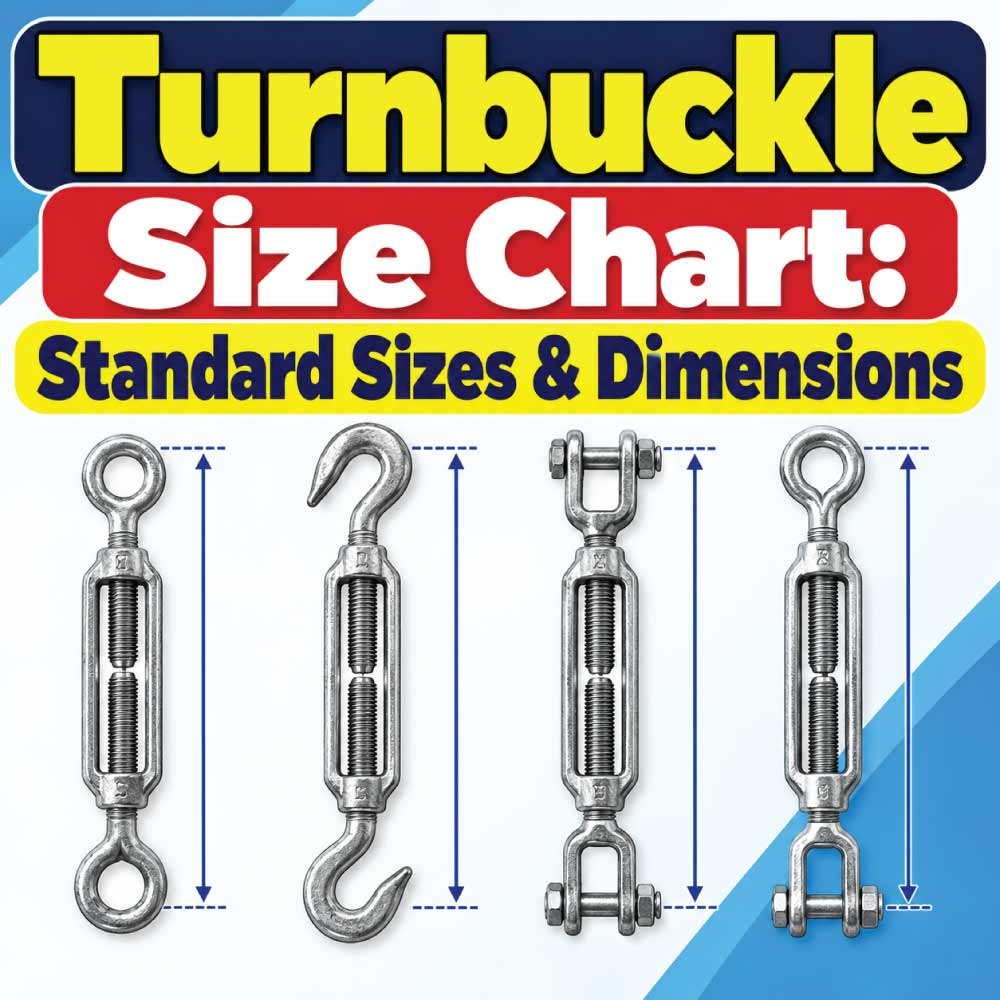
Choosing the right turnbuckle requires more than matching a thread diameter. The turnbuckle size also depends on its body length, adjustment range, end fitting, eye opening, material, thread type, and intended load. A small cable-tensioning application may use a compact turnbuckle, while structural or rigging applications require much larger components with verified working capacities.
This turnbuckle size chart explains common sizes and dimensions, including thread size, retracted length, adjustment range, extended length, and eye dimensions. It also covers turnbuckle types, how to measure an existing turnbuckle, material choices, and important selection considerations.
Because dimensions vary by manufacturer and design, the tables below should be treated as practical reference examples rather than a universal dimensional standard. Always verify the manufacturer’s specifications when an exact fit or rated load is important. For example, commercially available turnbuckles can be manufactured to ASTM F1145 Type 1, while lifting-rated models may additionally reference ASME B30.26.
What Is a Turnbuckle?
A turnbuckle is a mechanical tensioning device used to adjust the tension and overall length of a cable, wire rope, rod, guy wire, or similar tension member. It normally consists of a central body with threaded components at both ends.
By rotating the body, the threaded ends move inward or outward, allowing the installer to fine-tune tension without removing the connected cable or hardware.
Turnbuckles are commonly used in:
- Cable railing systems
- Fencing and agricultural structures
- Guy wires and support cables
- Marine rigging
- Architectural tension systems
- Shade structures
- Sign supports
- Antenna and tower systems
- General mechanical tensioning
A turnbuckle can have different end configurations, such as eye-to-eye, hook-to-eye, jaw-to-jaw, jaw-to-eye, and hook-to-hook. The end fitting is important because it determines how the turnbuckle connects to the surrounding hardware.
Turnbuckle Size Chart
There is no single turnbuckle size chart that applies to every manufacturer. Dimensions change according to the body design, material, fitting style, thread series, and intended application.
The following chart provides representative dimensions from commonly available turnbuckle configurations. The values illustrate how thread size, adjustment range, and overall length relate to one another.
| Thread Size | Retracted Length (in.) | Adjustment (in.) | Extended Length (in.) | Typical Eye ID (in.) |
|---|---|---|---|---|
| 1/4″-20 | 8.0 | 4.0 | 12.0 | 5/16 |
| 5/16″-18 | 9.25 | 4.5 | 13.75 | 7/16 |
| 3/8″-16 | 11.5 | 6.0 | 17.5 | 1/2 |
| 1/2″-13 | 13.0 | 6.0 | 19.0 | 3/4 |
| 5/8″-11 | 14.5 | 6.0 | 20.5 | 7/8 |
| 3/4″-10 | 16.25 | 6.0 | 22.25 | 1 |
These dimensions are representative of an ASTM F1145 Type 1 eye-to-eye configuration listed by McMaster-Carr. Other configurations and manufacturers can have different dimensions even when the thread size is identical.
The most important point is that thread diameter alone does not define the complete turnbuckle size.
Common Turnbuckle Dimensions Explained
Understanding the terminology used in a turnbuckle specification makes it easier to compare products.
Thread Size
Thread size identifies the diameter and thread pitch of the threaded end.
For example:
- 1/4″-20 = 1/4-inch nominal diameter with 20 threads per inch
- 5/16″-18 = 5/16-inch diameter with 18 threads per inch
- 3/8″-16 = 3/8-inch diameter with 16 threads per inch
- 1/2″-13 = 1/2-inch diameter with 13 threads per inch
- 5/8″-11 = 5/8-inch diameter with 11 threads per inch
Metric turnbuckles use designations such as M6, M8, M10, M12, or M16, with the thread pitch specified separately when necessary.
Retracted Length
The retracted length is the approximate overall length when the turnbuckle is adjusted toward its shortest usable position.
This dimension is important when the available installation space is limited.
Adjustment Range
The adjustment range indicates how much the overall length can change as the turnbuckle is adjusted.
For example, a turnbuckle with a 4-inch adjustment range provides substantially more tensioning flexibility than a similar model with only 1 or 2 inches of adjustment.
Extended Length
The extended length represents the approximate overall length when the available adjustment has been opened.
A basic relationship is:
Extended Length ≈ Retracted Length + Adjustment Range
Actual manufacturer dimensions can vary because of thread engagement, body construction, and end-fitting design.
Eye Inside Diameter
On an eye-type turnbuckle, the eye inside diameter indicates the opening through which a pin, hook, shackle, or other connector may pass.
The eye opening must be large enough for the intended connecting hardware, but the surrounding fitting must also be strong enough for the application.
Turnbuckle Types and Their Dimensions
Turnbuckles are available in several end configurations. Selecting the correct type is often just as important as selecting the correct thread size.
Eye-to-Eye Turnbuckles
Eye-to-eye turnbuckles have a closed eye at both ends.
They are commonly used with:
- Shackles
- Hooks
- Pins
- Cable assemblies
- Wire rope systems
The eye shape may be round or oval. Oval eyes can provide additional room for certain connecting hardware. McMaster-Carr lists both round- and oval-eye configurations in its turnbuckle range.
Hook-to-Eye Turnbuckles
A hook-to-eye turnbuckle has a hook on one end and an eye on the other.
This configuration can be convenient when one side needs a quick connection or removable attachment.
However, hooks require careful consideration because the hook opening, throat geometry, and intended load direction affect suitability.
Jaw-to-Jaw Turnbuckles
Jaw or clevis-style turnbuckles use forked fittings that connect with a pin.
They are useful where a pinned connection is preferred and are frequently seen in rigging and cable applications.
Jaw dimensions can include:
- Clevis inside width
- Pin diameter
- Eye opening
- Overall length
- Thread size
Commercial jaw turnbuckles may have clevis inside widths ranging from fractions of an inch upward depending on capacity and design.
Jaw-to-Eye Turnbuckles
This configuration combines a clevis or jaw fitting with an eye.
It can be useful when the two attachment points require different connection methods.
Hook-to-Hook Turnbuckles
Hook-to-hook designs provide hooks at both ends and are generally selected for applications where quick attachment is useful.
The hook opening and throat dimensions should be checked carefully before installation.
Turnbuckle Size Chart by End Type
The following comparison helps explain how the same general turnbuckle size can have different dimensions depending on the fitting.
| Turnbuckle Type | Typical End Fitting | Important Dimensions | Common Consideration |
|---|---|---|---|
| Eye-to-Eye | Closed eyes | Thread, eye ID, length | Connector compatibility |
| Hook-to-Eye | Hook + eye | Hook opening, eye ID, length | Hook engagement |
| Jaw-to-Jaw | Two clevises | Pin diameter, clevis width | Correct pin fit |
| Jaw-to-Eye | Clevis + eye | Pin size, eye ID | Mixed connections |
| Hook-to-Hook | Two hooks | Hook opening, throat | Secure hook engagement |
The correct choice depends on the attachment hardware rather than simply the nominal thread diameter.
Standard Turnbuckle Sizes in Inches
Imperial turnbuckles are commonly identified by their thread size. Common examples include 1/4-inch, 5/16-inch, 3/8-inch, 1/2-inch, 5/8-inch, and 3/4-inch thread sizes.
| Nominal Thread Diameter | Example Thread | Example Application Range |
|---|---|---|
| 1/4 in. | 1/4″-20 | Light-duty tensioning |
| 5/16 in. | 5/16″-18 | Small cable systems |
| 3/8 in. | 3/8″-16 | General tensioning |
| 1/2 in. | 1/2″-13 | Larger cable assemblies |
| 5/8 in. | 5/8″-11 | Heavy-duty applications |
| 3/4 in. | 3/4″-10 | Higher-capacity applications |
This table is a size reference, not a load-rating chart. Two turnbuckles with the same thread diameter can have very different capacities because material, body construction, fittings, and design all affect performance.
For example, McMaster-Carr lists ASTM F1145 Type 1 eye-to-eye turnbuckles with capacities from hundreds to several thousand pounds, depending on the specific design and size.
Also Read:
Metric Turnbuckle Sizes
Metric turnbuckles are identified primarily by nominal thread diameter and, where necessary, thread pitch.
Common metric thread sizes include:
- M6
- M8
- M10
- M12
- M16
- M20
However, these should not be treated as direct equivalents of imperial sizes. An M10 thread, for example, is not dimensionally identical to a 3/8-inch thread.
| Metric Size | Nominal Diameter | What to Verify |
|---|---|---|
| M6 | 6 mm | Pitch and fitting size |
| M8 | 8 mm | Pitch and fitting size |
| M10 | 10 mm | Pitch and fitting size |
| M12 | 12 mm | Pitch and fitting size |
| M16 | 16 mm | Pitch and fitting size |
| M20 | 20 mm | Pitch and fitting size |
When replacing a metric turnbuckle, measure the existing thread rather than assuming an imperial substitute will fit.
Also Read:
How to Measure a Turnbuckle
Measuring an existing turnbuckle is straightforward if you record each relevant dimension separately.
1. Measure the Thread Diameter
Use a caliper to measure the outside diameter of the male thread.
Do not rely solely on visual comparison because nearby thread sizes can look similar.
2. Identify the Thread Pitch
For imperial threads, determine the threads per inch (TPI).
For metric threads, determine the distance between adjacent thread peaks in millimeters.
A thread pitch gauge is the easiest tool for this measurement.
3. Measure the Retracted Length
Close or shorten the turnbuckle to the manufacturer’s intended reference position and measure its overall length from the appropriate end points.
Be consistent about where you measure from.
4. Measure the Maximum Adjustment
Record how far the threaded components can safely move through the usable adjustment range.
Do not assume that every visible thread can be used as adjustment.
5. Measure the End Fittings
Depending on the design, record:
- Eye inside diameter
- Eye outside dimensions
- Hook opening
- Clevis inside width
- Pin diameter
- Jaw length
These measurements can be critical when replacing a turnbuckle.
Also Read:
How to Choose the Correct Turnbuckle Size
Selecting a turnbuckle should start with the application rather than the available product size.
Determine the Required Length
First establish the distance between the two connection points.
Then determine how much adjustment is needed.
A useful approach is to select a turnbuckle that can accommodate the required installed length without operating at the extreme end of its adjustment range.
Determine the Required Capacity
For load-bearing applications, use the manufacturer’s stated working load limit or rated capacity.
Never select a turnbuckle solely because its thread appears large enough.
Capacity can depend on:
- Material
- Thread diameter
- Body construction
- End-fitting design
- Connection method
- Load direction
- Manufacturing standard
- Safety factors
For example, some commercially listed turnbuckles are specifically identified as not for lifting, while other products are designed for lifting and reference ASME B30.26.
Match the End Fittings
The turnbuckle must physically connect to the cable, rod, shackle, or other hardware.
Check the dimensions of the mating components before purchasing.
Consider the Environment
Material selection becomes particularly important outdoors or in corrosive environments.
Common choices include:
- Zinc-plated steel
- Galvanized steel
- Stainless steel
- Aluminum
316 stainless steel is commonly selected where higher corrosion resistance is needed, including marine or salt-water environments.
Open-Body vs Closed-Body Turnbuckles
Another important distinction is the body design.
Open-Body Turnbuckles
Open-body designs expose more of the threaded components.
Advantages can include:
- Easy visual inspection
- Simple adjustment
- Familiar construction
- Easy access to threads
They are common in many general-purpose tensioning applications.
Closed-Body Turnbuckles
A closed-body turnbuckle encloses more of the threaded mechanism.
The enclosed body can help protect the threads from dirt and physical damage while providing a more compact appearance. McMaster-Carr specifically describes closed-body designs as protecting threads from damage and debris and notes their usefulness where a slim profile is desirable.
Closed-body models can be useful where appearance, protection, or limited installation space matters.
Turnbuckle Materials and Finishes
The material should match the environment and required performance.
Galvanized Steel
Galvanized steel provides corrosion protection and is commonly used in outdoor applications.
It can be suitable for fencing, support systems, and many general exterior applications.
Zinc-Plated Steel
Zinc plating provides a degree of corrosion resistance and is frequently used for general-purpose hardware.
However, the level of corrosion resistance depends on the coating and environment.
Stainless Steel
Stainless steel is a popular choice where corrosion resistance and appearance are important.
316 stainless steel offers particularly good resistance to corrosion and is widely used where salt or chemicals may be present.
Aluminum
Aluminum turnbuckles can reduce weight and provide good corrosion resistance.
However, aluminum and steel turnbuckles should not be treated as interchangeable simply because their dimensions are similar. Material strength and application requirements must be considered.
Common Turnbuckle Applications
Turnbuckles are used across many industries because they provide controlled tension adjustment.
Typical applications include:
Cable railings: Maintaining tension in horizontal cables.
Fencing: Tightening wire and support cables.
Marine rigging: Adjusting tension in suitable rigging systems.
Guy wires: Tensioning support cables.
Architectural structures: Adjusting cable-supported components.
Shade structures: Maintaining appropriate cable tension.
Signs and supports: Fine adjustment of tension members.
Mechanical assemblies: Providing adjustable tension between fixed points.
The correct turnbuckle depends on the application’s mechanical requirements. A light decorative cable application should not automatically be treated the same as a structural or lifting application.
Common Turnbuckle Sizing Mistakes
Several mistakes can result in an incorrect or unsafe selection.
Choosing by Thread Diameter Alone
A 1/2-inch thread does not tell you the complete size, capacity, body length, or fitting dimensions.
Always check the complete manufacturer’s specification.
Ignoring Adjustment Range
A turnbuckle can have the correct thread size but still be unsuitable if it does not provide enough adjustment.
Measure the required installation distance first.
Using the Wrong End Fitting
An eye, hook, and jaw are not interchangeable connection methods.
Verify that the fitting matches the connecting hardware.
Confusing Rated Capacity With Thread Size
A larger thread generally does not provide enough information to determine capacity.
Always use the manufacturer’s rating for the exact product.
Using Non-Lifting Hardware for Lifting
Some turnbuckles are explicitly sold as not for lifting. Others are specifically manufactured and marked for lifting applications. These categories should never be assumed interchangeable.
Overextending the Threads
The manufacturer’s instructions should determine the permissible adjustment and minimum thread engagement.
Do not use exposed thread length as an invitation to extend a turnbuckle beyond its specified operating range.
Turnbuckle Size Selection Checklist
Before ordering a replacement or new turnbuckle, confirm the following:
Thread diameter
Thread pitch or threads per inch
Overall retracted length
Required adjustment range
Extended length
End-fitting type
Eye inside diameter or hook opening
Clevis width and pin diameter, if applicable
Material
Corrosion resistance
Required working load or rated capacity
Applicable standard or manufacturer specification
Whether the product is approved for the intended application
For critical applications, compare the complete product data sheet rather than relying on a generic size chart.
Frequently Asked Questions About Turnbuckle Sizes
What are the most common turnbuckle sizes?
Common imperial thread sizes include 1/4, 5/16, 3/8, 1/2, 5/8, and 3/4 inch, although manufacturers offer many other sizes. Metric options commonly include M6 through M20 and larger sizes depending on the product range.
How is a turnbuckle size measured?
A turnbuckle is normally specified using several dimensions, including thread size, thread pitch, retracted length, adjustment range, extended length, and end-fitting dimensions.
What does 1/2″-13 mean on a turnbuckle?
It means the threaded component has a nominal 1/2-inch diameter and 13 threads per inch. The designation describes the thread, not the complete physical dimensions or load capacity of the turnbuckle.
Are turnbuckle sizes universal?
No. A particular thread size does not guarantee identical body length, eye dimensions, adjustment range, or capacity between manufacturers.
What is the difference between a turnbuckle and a tensioner?
A turnbuckle is a specific mechanical tensioning device that normally uses opposing threaded components and a rotating body. “Tensioner” is a broader term that can describe many different mechanisms used to apply or maintain tension.
Can turnbuckles be used for lifting?
Only when the specific product is designed, rated, and approved for lifting. Some turnbuckles are explicitly identified as not for lifting, while certain products are manufactured for lifting and reference relevant requirements such as ASME B30.26.
Which is better: galvanized or stainless steel?
Neither is universally better. Galvanized steel can be an economical choice for many outdoor applications, while stainless steel is often preferred where corrosion resistance, appearance, or marine exposure is important.
Conclusion
A reliable turnbuckle size chart should be used as a starting point, not as a substitute for the manufacturer’s exact specifications. The correct turnbuckle depends on more than thread diameter. You should consider thread size, pitch, retracted length, adjustment range, extended length, end-fitting dimensions, material, and rated capacity.
For simple cable-tensioning applications, matching the physical dimensions and connection type may be the main concern. For structural, rigging, or lifting applications, the manufacturer’s rating and applicable standards become much more important.
Before purchasing a turnbuckle, measure the existing hardware carefully and compare every critical dimension with the manufacturer’s product data. This approach helps ensure the replacement fits correctly and is appropriate for the intended application.