
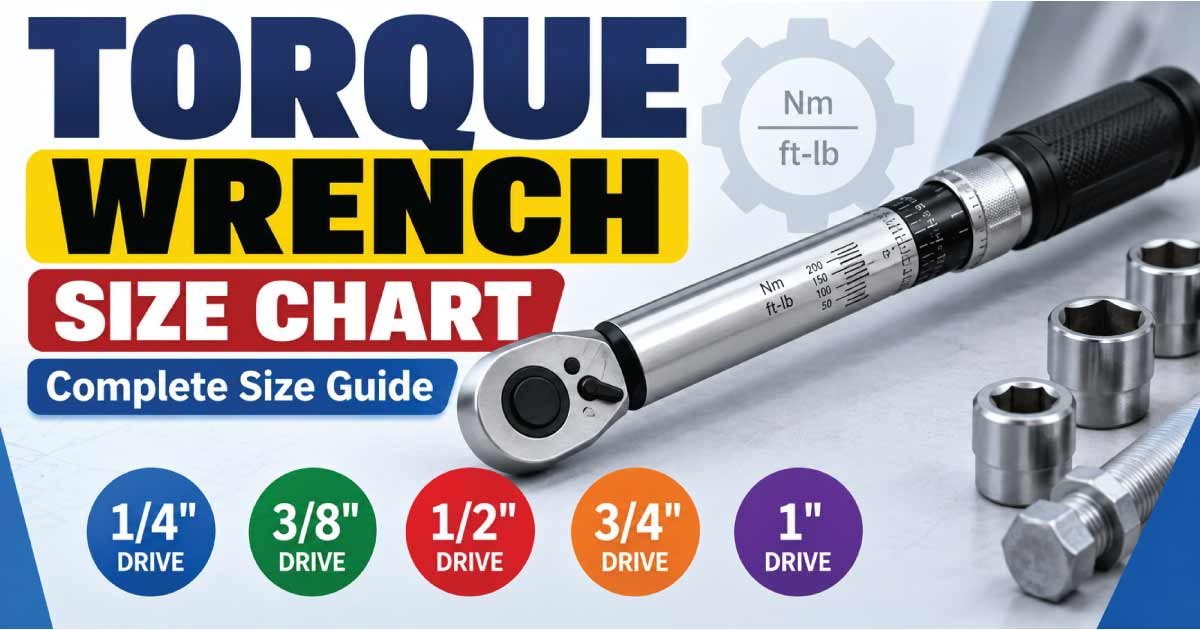
Torque wrench size can mean more than the square drive size on the end of the tool. When choosing a torque wrench, you also need to consider its torque range, measurement unit, wrench type, fastener size, and intended application.
This torque wrench size chart explains the most common drive sizes, where they are used, how torque ranges relate to applications, and how to choose the right wrench for accurate fastening. Whether you are working on a car, motorcycle, bicycle, machinery, or general repairs, the goal is to select a wrench that can accurately deliver the specified torque without being oversized or underpowered.
What Is a Torque Wrench?
A torque wrench is a precision hand tool designed to tighten a fastener to a specified torque value. Instead of simply tightening a nut or bolt until it feels tight, the tool helps apply a controlled amount of rotational force.
Torque is commonly measured in:
- Newton-meters (N·m)
- Pound-feet (lb-ft or ft-lb)
- Pound-inches (lb-in)
- Kilogram-force meters (kgf·m) on some older or regional equipment
The correct torque is normally specified by the vehicle, machine, component, or fastener manufacturer.
A torque wrench is particularly important where over-tightening can damage threads, distort components, crush gaskets, or stretch a fastener beyond its intended load. Under-tightening can also be a problem because the joint may loosen or fail to achieve the required clamping force.
The size of the torque wrench should therefore match the torque specification and access requirements, not simply the size of the bolt head.
Torque Wrench Size Chart
The most common way people describe torque wrench size is by the square drive size. The drive is the square-shaped connection where a socket attaches.
| Torque Wrench Drive Size | Common Applications | Typical Fastener Applications | Best Use |
|---|---|---|---|
| 1/4 inch | Bicycles, electronics, small machinery | Small fasteners | Low-torque work |
| 3/8 inch | Automotive, motorcycles, general repair | Small to medium fasteners | General-purpose work |
| 1/2 inch | Cars, trucks, equipment | Medium to large fasteners | Higher-torque automotive work |
| 3/4 inch | Heavy equipment, industrial machinery | Large fasteners | Heavy-duty applications |
| 1 inch | Large machinery, industrial equipment | Very large fasteners | High-torque industrial work |
These are general application categories rather than universal torque limits. A manufacturer’s torque range and accuracy specification should always take priority.
For many home mechanics, a 3/8-inch and 1/2-inch combination covers a wide variety of automotive and workshop jobs. Smaller precision work may call for a 1/4-inch drive, while heavy equipment can require 3/4-inch or 1-inch drive tools.
Understanding Torque Wrench Drive Sizes
1. 1/4-Inch Drive Torque Wrench
A 1/4-inch torque wrench is designed for relatively small fasteners and lower torque requirements. Its compact size makes it useful where space is limited or where excessive torque could easily damage a small fastener.
Common applications include:
- Bicycles
- Small engines
- Small machinery
- Electronics and equipment assemblies
- Motorcycle components
- Precision mechanical work
The main advantage is control. A small torque wrench can be easier to use accurately on delicate fasteners than a much larger tool.
However, it should not be used simply because the socket physically fits. The required torque must fall within the wrench’s specified operating range.
2. 3/8-Inch Drive Torque Wrench
The 3/8-inch drive is one of the most versatile sizes for general mechanical work.
It is commonly used for:
- Automotive engine components
- Motorcycle repairs
- Suspension components
- Brackets and mounts
- General workshop repairs
- Medium-sized fasteners
A 3/8-inch wrench is often a practical choice when you want one torque wrench for a broad range of moderate-duty tasks.
For automotive work, however, some applications require torque values beyond the range of a typical 3/8-inch wrench. In those cases, a 1/2-inch model may be more appropriate.
3. 1/2-Inch Drive Torque Wrench
The 1/2-inch torque wrench is widely used for automotive and heavier mechanical applications.
Typical uses include:
- Wheel and lug nut tightening
- Automotive suspension work
- Larger engine fasteners
- Trucks
- Machinery
- Heavy-duty repair work
The 1/2-inch drive accepts larger sockets and is generally associated with higher torque applications than smaller drives.
For vehicle maintenance, this is often the size people consider when they specifically need a torque wrench for wheel lug nuts or other high-torque fasteners. Always check the vehicle manufacturer’s specified torque rather than relying on a generic value.
4. 3/4-Inch Drive Torque Wrench
A 3/4-inch torque wrench is intended for larger fasteners and higher-torque applications.
It can be found in:
- Heavy trucks
- Construction equipment
- Agricultural machinery
- Industrial machinery
- Large mechanical assemblies
These tools are significantly larger than typical household or light automotive torque wrenches.
5. 1-Inch Drive Torque Wrench
A 1-inch drive torque wrench is generally associated with very large fasteners and high-torque industrial applications.
Typical environments include:
- Heavy equipment
- Industrial machinery
- Large mechanical assemblies
- Commercial vehicles
- Maintenance operations requiring substantial torque
For these applications, wrench selection becomes especially important because the torque values can be much higher and the consequences of incorrect fastening can be significant.
Torque Range Is More Important Than Drive Size
One of the most common misunderstandings is assuming that drive size determines the torque range.
It does not.
The drive size describes the socket connection, while the torque range describes how much torque the wrench is designed to measure or apply.
For example, two 1/2-inch drive torque wrenches can have substantially different torque ranges. One may be designed for relatively moderate automotive work, while another may be intended for considerably higher torque applications.
When selecting a torque wrench, check:
- Required torque value
- Wrench’s stated torque range
- Manufacturer’s accuracy specification
- Measurement unit
- Drive size
- Physical access requirements
- Required socket size
The target torque should be comfortably within the tool’s specified operating range. Do not select a wrench based only on the square drive.
Torque Wrench Torque Range Chart
Because manufacturers offer many different ranges, there is no single universal torque range for each drive size. The following chart shows how different torque levels generally correspond to applications without assigning unsupported limits to a particular drive.
| Torque Level | Common Applications | Suitable Wrench Category |
|---|---|---|
| Low torque | Small fasteners, bicycles, precision assemblies | Small torque wrench |
| Low to medium | Motorcycles, small automotive components | 1/4-inch or 3/8-inch drive |
| Medium | General automotive and machinery work | 3/8-inch or 1/2-inch drive |
| Medium to high | Wheel fasteners, suspension, larger machinery | 1/2-inch drive |
| High | Trucks, heavy equipment | 3/4-inch drive |
| Very high | Industrial and large machinery | 3/4-inch or 1-inch drive |
Always compare the actual required torque with the torque range printed or specified by the wrench manufacturer.
Torque Wrench Size by Application
Choosing a torque wrench becomes easier when you start with the job rather than the tool.
Automotive Torque Wrench
For general automotive repairs, 3/8-inch and 1/2-inch drives are especially useful.
A 3/8-inch wrench is suitable for many moderate-torque engine, chassis, and general repair tasks. A 1/2-inch wrench is more appropriate when the manufacturer’s torque specification is higher or larger sockets are required.
For automotive work, you may eventually want two torque wrenches because no single tool is ideal for every fastener.
Wheel Lug Nuts
Wheel lug nuts are a common reason people buy a torque wrench.
A 1/2-inch drive is commonly used for automotive wheel applications because it accommodates the larger sockets frequently required for lug nuts.
The important point is that the correct torque value depends on the specific vehicle and wheel application. Use the manufacturer’s specification rather than a generic torque number.
Motorcycle Work
Motorcycles can contain both small precision fasteners and larger chassis fasteners.
A useful setup may include:
- 1/4-inch drive for small, low-torque fasteners
- 3/8-inch drive for many general motorcycle repairs
- 1/2-inch drive when higher torque is required
The correct choice depends on the manufacturer’s specifications for each component.
Bicycle Repairs
Bicycles frequently use smaller fasteners and components where accurate low torque is important.
A small torque wrench, often using a 1/4-inch drive or a specialized bicycle torque tool, is generally more suitable than a large automotive wrench.
Carbon-fiber components are particularly sensitive to incorrect tightening, so follow the component manufacturer’s torque instructions carefully.
Heavy Equipment
Large machinery and commercial equipment can require substantially more torque than ordinary automotive applications.
For these jobs, 3/4-inch or 1-inch drive torque wrenches may be appropriate, depending on the manufacturer’s specified torque and socket requirements.
Torque Wrench Measurement Units
Torque specifications can appear in different units depending on the manufacturer, country, vehicle, or equipment.
The most common are N·m, lb-ft, and lb-in.
| Unit | Meaning | Common Use |
|---|---|---|
| N·m | Newton-meter | SI metric specifications |
| lb-ft | Pound-foot | Automotive and mechanical work |
| lb-in | Pound-inch | Lower torque applications |
| kgf·m | Kilogram-force meter | Older or regional specifications |
A torque wrench should be set using the same unit as the specification, or the value should be converted accurately.
Useful conversions include:
- 1 lb-ft = 1.35582 N·m
- 1 N·m = 0.73756 lb-ft
- 1 lb-in = 0.112985 N·m
- 1 N·m = 8.85075 lb-in
Always verify whether your wrench scale is showing lb-ft or lb-in. Confusing these units can result in a dramatically incorrect torque setting.
Also Read:
Types of Torque Wrenches
Torque wrench size is only one part of the selection process. The mechanism also matters.
Click Torque Wrench
A click torque wrench is one of the most common designs.
You set the desired torque on the handle, and the wrench produces a noticeable click when the preset value is reached.
Advantages include:
- Easy to use
- Widely available
- Practical for automotive repairs
- Simple torque adjustment
- Good general-purpose option
The manufacturer’s instructions should be followed for setting, storage, maintenance, and calibration.
Beam Torque Wrench
A beam torque wrench uses a pointer and scale to indicate the applied torque.
It is mechanically simple and does not rely on the same preset mechanism used by a click wrench.
Benefits include:
- Simple construction
- No preset click mechanism
- Direct visual reading
- Useful for basic torque applications
However, the user must read the scale correctly while applying torque.
Split-Beam Torque Wrench
A split-beam design uses a beam mechanism that allows the wrench to be set to a desired torque.
It is valued for its straightforward operation and can be useful for repeated mechanical work.
Electronic Torque Wrench
Electronic models display torque digitally and may provide additional features such as audible or visual alerts.
Depending on the model, they can offer:
- Digital torque readings
- Multiple measurement units
- Target torque alerts
- Data-related functions
They can be useful when precise monitoring and convenient readings are important.
Also Read:
How to Choose the Right Torque Wrench Size
Selecting the correct torque wrench does not have to be complicated. Follow these steps.
1. Find the Required Torque Specification
Start with the manufacturer’s instructions for the component.
Do not estimate torque simply from bolt diameter. Two fasteners that appear similar can have different torque requirements because of differences in material, grade, lubrication, joint design, or application.
2. Check the Torque Range
Find a wrench whose specified range includes your required torque.
For repeated work at a particular torque, a tool designed appropriately for that range is generally preferable to one that barely covers the value.
3. Select the Drive Size
Choose the drive based on the socket required for the fastener and the physical requirements of the job.
Common choices are:
- 1/4-inch for small fasteners
- 3/8-inch for general moderate-duty work
- 1/2-inch for many automotive and higher-torque jobs
- 3/4-inch for heavy equipment
- 1-inch for large industrial applications
4. Check Access
A larger torque wrench can be physically difficult to use in tight spaces.
Consider:
- Handle length
- Head size
- Socket clearance
- Extension requirements
- Working angle
A tool that has the correct torque range but cannot physically reach the fastener is not the right tool for the job.
5. Check Accuracy and Calibration Requirements
Torque wrenches are measuring instruments, not ordinary hand tools.
If accuracy is important, check the manufacturer’s accuracy specification, calibration instructions, service interval, and any applicable documentation.
Also Read:
Can You Use an Adapter to Change Torque Wrench Size?
Adapters can allow a socket with one drive size to be used with a torque wrench of another drive size.
For example, a drive adapter can connect a smaller-drive socket to a larger-drive wrench.
However, an adapter does not automatically make every torque wrench suitable for every application.
The main concern is whether the resulting setup remains appropriate for the required torque and socket arrangement.
Also distinguish between a simple drive adapter and a change in effective lever length. A standard inline square-drive adapter generally does not create the same torque multiplication issue as an extension that changes the effective distance from the drive axis to the socket.
When using unusual extensions or crowfoot-style attachments, follow the manufacturer’s guidance and account for any geometry that changes the effective lever arm.
Torque Wrench vs Regular Ratchet
A regular ratchet and a torque wrench serve different purposes.
A ratchet is primarily designed to tighten and loosen fasteners efficiently.
A torque wrench is designed to apply or indicate a controlled torque value.
For many repairs, the best workflow is:
- Use a ratchet or other suitable tool for initial tightening.
- Install the correct socket on the torque wrench.
- Set the specified torque.
- Apply torque smoothly according to the wrench manufacturer’s instructions.
- Stop at the specified indication or release point.
Using a torque wrench as a general-purpose breaker tool can damage or affect the instrument, depending on its design. Follow the manufacturer’s instructions rather than assuming it is suitable for loosening seized fasteners.
Common Torque Wrench Mistakes
Even a high-quality torque wrench cannot produce reliable results if it is used incorrectly.
Using the Wrong Torque Range
A wrench may physically accept the correct socket but still be unsuitable because the required torque falls outside its specified range.
Confusing lb-ft and lb-in
This is one of the easiest mistakes to make.
Always check the unit before setting the wrench.
Ignoring the Manufacturer’s Specification
Do not use a generic torque chart when the vehicle or component manufacturer provides a specific value.
The manufacturer’s specification should take priority.
Using the Wrong Socket
Use a properly fitting socket that matches the fastener. Poorly fitting sockets can damage fastener corners and create unsafe working conditions.
Pulling Too Quickly
Torque should generally be applied smoothly and according to the tool manufacturer’s instructions. Rapid or uncontrolled force can make it harder to achieve the intended result.
Using a Click Wrench Incorrectly
A click-type wrench should be operated according to its manufacturer’s instructions. Storage settings and calibration practices vary by design, so do not assume every model should be handled identically.
Torque Wrench Size Chart: Quick Selection Guide
Use this simplified guide when deciding where to start.
| Job Type | Common Drive Choice | Why |
|---|---|---|
| Small precision work | 1/4 in | Compact and suited to lower torque |
| Bicycle components | 1/4 in | Appropriate for many small fasteners |
| Motorcycle repairs | 1/4–3/8 in | Covers many small and medium applications |
| General automotive work | 3/8 in | Versatile for moderate torque |
| Automotive wheels | 1/2 in | Commonly accommodates larger sockets |
| Heavy automotive work | 1/2 in | Suitable when torque requirements are higher |
| Heavy equipment | 3/4 in | Designed for larger fasteners and applications |
| Industrial machinery | 3/4–1 in | Suitable for high-torque applications |
This chart is a starting point, not a substitute for the specified torque range of an individual wrench.
Do You Need More Than One Torque Wrench?
For occasional household repairs, one appropriately selected torque wrench may be enough.
For regular mechanical work, however, multiple torque wrenches can be more practical because torque specifications can span a wide range.
A useful workshop combination might include:
- Small torque wrench for low-torque precision work
- 3/8-inch drive for general mechanical applications
- 1/2-inch drive for automotive and higher-torque jobs
- 3/4-inch or larger for heavy equipment when required
The benefit is not simply having different drive sizes. Different tools allow you to work within their intended torque ranges rather than forcing one oversized or undersized wrench to handle everything.
Torque Wrench Maintenance and Storage
A torque wrench should be treated as a precision instrument.
Good practices include:
- Keep the tool clean and dry.
- Avoid dropping or abusing it.
- Follow the manufacturer’s storage instructions.
- Do not exceed its rated torque.
- Have it calibrated according to the manufacturer’s requirements or your organization’s procedures.
- Store it in a protective case when appropriate.
- Inspect it for damage before use.
For adjustable click-type torque wrenches, follow the specific manufacturer’s storage procedure. Many conventional designs have a recommended storage setting, but this is not universal enough to justify one setting for every model.
If a torque wrench has been dropped, overloaded, damaged, or otherwise subjected to unusual conditions, its accuracy should be evaluated before relying on it for critical fastening.
Frequently Asked Questions
What is the most common torque wrench size?
There is no single best size for every job. 3/8-inch and 1/2-inch drives are among the most useful choices for general automotive and mechanical work, while 1/4-inch models are valuable for lower-torque applications.
What size torque wrench do I need for lug nuts?
A 1/2-inch drive is a common choice for automotive lug nuts because it accommodates the larger sockets frequently used for wheels. However, the most important requirement is that the wrench’s torque range includes the vehicle manufacturer’s specified lug-nut torque.
Is a 3/8 or 1/2 torque wrench better?
Neither is universally better. A 3/8-inch model can be more convenient for moderate-torque work, while a 1/2-inch model is generally more appropriate for larger sockets and higher-torque automotive applications.
Does drive size determine torque?
No. Drive size describes the square connection between the wrench and socket. Torque range is a separate specification, and two wrenches with the same drive size can have different torque ranges.
Can I use a torque wrench as a normal ratchet?
It is generally better to use a regular ratchet or breaker bar for ordinary tightening and loosening. Follow the torque wrench manufacturer’s instructions regarding permitted uses, because misuse can affect the instrument.
How accurate are torque wrenches?
Accuracy varies by wrench type, manufacturer, model, torque range, condition, and calibration status. Always check the manufacturer’s published accuracy specification rather than assuming that all torque wrenches have the same accuracy.
What is the best torque wrench for a home mechanic?
For many home mechanics, a 3/8-inch torque wrench is a useful general-purpose option, while a 1/2-inch model can complement it for higher-torque automotive work. The correct choice ultimately depends on the torque specifications of the jobs you perform.
Final Takeaway
The right torque wrench size depends on more than the drive dimension. You need to match the required torque, wrench range, drive size, socket, measurement unit, access, and application.
For many users, 1/4-inch, 3/8-inch, and 1/2-inch torque wrenches cover a broad range of light, general, and automotive work. Larger 3/4-inch and 1-inch tools are intended for heavier applications where substantially larger fasteners and higher torque are required.
Before tightening any critical fastener, use the manufacturer’s specified torque and confirm that your torque wrench is designed for that value. When accuracy matters, proper calibration, correct technique, and appropriate tool selection are just as important as the wrench’s physical size.