
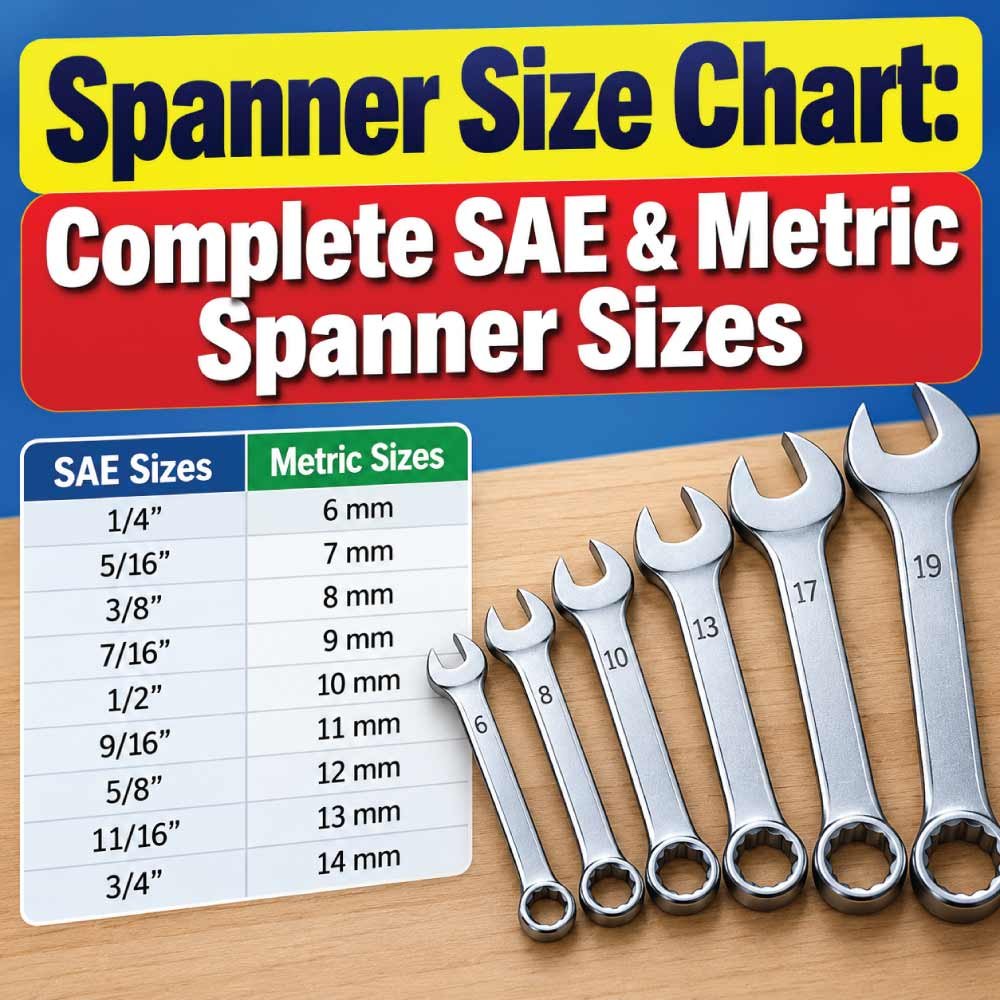
Finding the right spanner size is essential for tightening or loosening nuts and bolts without damaging the fastener. A spanner that is too large can slip, while one that is too small may not fit at all. The challenge becomes greater when a toolbox contains both metric and SAE spanners, because their sizes are measured differently.
This spanner size chart provides a practical reference for common metric and SAE sizes, approximate conversions, spanner types, and selection tips. It also explains the difference between metric and SAE measurements, how to identify the correct spanner size, and why similar-looking sizes should not automatically be treated as interchangeable.
Whether you work on automobiles, machinery, plumbing, bicycles, equipment, or household repairs, understanding spanner sizes makes everyday mechanical work easier and more reliable.
What Is a Spanner?
A spanner, commonly called a wrench in American English, is a hand tool designed to grip and turn nuts, bolts, and other fasteners. The working end of the tool is shaped to fit a particular fastener size.
Spanners are available in many designs, including:
- Open-end spanners
- Ring or box spanners
- Combination spanners
- Adjustable spanners
- Flare-nut spanners
- Ratcheting spanners
- Offset spanners
- Crowfoot spanners
The size marked on a conventional spanner normally refers to the nominal size of the fastener it is designed to fit, measured across the flats of a compatible hexagonal fastener.
For example, a 10 mm spanner is intended for a nominal 10 mm fastener head, while a 1/2-inch SAE spanner is intended for a nominal 1/2-inch fastener.
Metric Spanner Size Chart
Metric spanners are measured in millimeters (mm). They are widely used in modern vehicles, machinery, appliances, bicycles, industrial equipment, and general maintenance.
The following chart lists common metric spanner sizes with their approximate SAE dimensional equivalents.
| Metric Spanner Size | Approx. SAE Equivalent | Decimal Inch Equivalent |
|---|---|---|
| 4 mm | 5/32″ | 0.1575″ |
| 5 mm | 3/16″ | 0.1969″ |
| 6 mm | 1/4″ | 0.2362″ |
| 7 mm | 9/32″ | 0.2756″ |
| 8 mm | 5/16″ | 0.3150″ |
| 9 mm | 11/32″ | 0.3543″ |
| 10 mm | 3/8″ | 0.3937″ |
| 11 mm | 7/16″ | 0.4331″ |
| 12 mm | 15/32″ | 0.4724″ |
| 13 mm | 1/2″ | 0.5118″ |
| 14 mm | 9/16″ | 0.5512″ |
| 15 mm | 19/32″ | 0.5906″ |
| 16 mm | 5/8″ | 0.6299″ |
| 17 mm | 11/16″ | 0.6693″ |
| 18 mm | 11/16″ | 0.7087″ |
| 19 mm | 3/4″ | 0.7480″ |
| 21 mm | 13/16″ | 0.8268″ |
| 22 mm | 7/8″ | 0.8661″ |
| 24 mm | 15/16″ | 0.9449″ |
| 27 mm | 1-1/16″ | 1.0630″ |
| 30 mm | 1-3/16″ | 1.1811″ |
| 32 mm | 1-1/4″ | 1.2598″ |
The SAE entries are approximate dimensional comparisons, not recommendations for substitution. A converted size may be close without providing the correct fit.
SAE Spanner Size Chart
SAE spanners use inch-based measurements, traditionally expressed as fractions of an inch. They are still encountered on many American-made vehicles, older equipment, machinery, engines, and general-purpose hardware.
Here are common SAE spanner sizes and their metric equivalents.
| SAE Spanner Size | Decimal Inch | Approx. Metric Equivalent |
|---|---|---|
| 1/4″ | 0.250″ | 6.35 mm |
| 9/32″ | 0.281″ | 7.14 mm |
| 5/16″ | 0.313″ | 7.94 mm |
| 11/32″ | 0.344″ | 8.73 mm |
| 3/8″ | 0.375″ | 9.53 mm |
| 7/16″ | 0.438″ | 11.11 mm |
| 1/2″ | 0.500″ | 12.70 mm |
| 9/16″ | 0.563″ | 14.29 mm |
| 5/8″ | 0.625″ | 15.88 mm |
| 11/16″ | 0.688″ | 17.46 mm |
| 3/4″ | 0.750″ | 19.05 mm |
| 13/16″ | 0.813″ | 20.64 mm |
| 7/8″ | 0.875″ | 22.23 mm |
| 15/16″ | 0.938″ | 23.81 mm |
| 1″ | 1.000″ | 25.40 mm |
| 1-1/16″ | 1.063″ | 26.99 mm |
| 1-1/8″ | 1.125″ | 28.58 mm |
| 1-1/4″ | 1.250″ | 31.75 mm |
| 1-3/8″ | 1.375″ | 34.93 mm |
| 1-1/2″ | 1.500″ | 38.10 mm |
Metric values in this table are mathematical conversions from the SAE dimensions. They should not be interpreted as proof that the two sizes are interchangeable.
Metric vs SAE Spanner Sizes
The primary difference between metric and SAE spanners is the measurement system used to define the fastener size.
Metric spanners are identified in millimeters:
- 8 mm
- 10 mm
- 13 mm
- 17 mm
- 19 mm
- 22 mm
SAE spanners are identified in inches:
- 5/16″
- 3/8″
- 1/2″
- 5/8″
- 3/4″
- 7/8″
A useful conversion is:
1 inch = 25.4 mm
Therefore:
1/2 inch × 25.4 = 12.7 mm
And:
3/4 inch × 25.4 = 19.05 mm
These conversions help you understand the relationship between the two systems, but they do not mean a 19 mm spanner and a 3/4-inch spanner should automatically be swapped.
Why Close Sizes Can Cause Problems
Some metric and SAE sizes are very close. For example, 3/4 inch is 19.05 mm, making it only slightly larger than 19 mm.
That small difference may still matter when working with a tightly fitted hex fastener.
Using an incorrect spanner can:
- Slip off the fastener.
- Damage the corners of the nut or bolt.
- Make removal more difficult.
- Increase the risk of injury.
- Prevent proper torque from being applied.
Whenever possible, use the specified spanner size rather than choosing a size simply because it appears close.
Most Common Metric Spanner Sizes
A general-purpose metric spanner set usually contains a range of sizes rather than just one or two tools.
Some commonly encountered sizes include:
| Size | Common General Applications |
|---|---|
| 8 mm | Small mechanical fasteners |
| 10 mm | Automotive and equipment fasteners |
| 12 mm | General mechanical work |
| 13 mm | Automotive and machinery |
| 14 mm | Automotive and mechanical assemblies |
| 15 mm | Automotive components |
| 17 mm | Larger mechanical fasteners |
| 18 mm | Automotive and equipment |
| 19 mm | Medium-to-large fasteners |
| 21 mm | Larger automotive fasteners |
| 22 mm | Mechanical and automotive work |
| 24 mm | Larger fasteners |
The exact sizes required depend on the equipment. A mechanic working on a particular vehicle should use the vehicle’s service information rather than assuming that every fastener uses the same standard.
Most Common SAE Spanner Sizes
SAE spanners are particularly useful when working with inch-based fasteners.
Common sizes include:
- 1/4″
- 5/16″
- 3/8″
- 7/16″
- 1/2″
- 9/16″
- 5/8″
- 11/16″
- 3/4″
- 13/16″
- 7/8″
- 15/16″
- 1″
Larger SAE spanners are also available for industrial machinery, heavy equipment, engines, and other applications requiring larger fasteners.
A complete SAE set is useful when working on older machinery or equipment where inch-based hardware is common.
How to Measure a Spanner Size
Determining the size of a conventional spanner is relatively simple when the markings are missing or difficult to read.
Measuring a Standard Open-End Spanner
For an open-end spanner, the nominal size corresponds to the distance between the opposing working flats of the opening.
For a metric tool, the measurement is expressed in millimeters.
For an SAE tool, it is expressed in inches.
A digital caliper can provide a useful measurement, but the result should be interpreted carefully because tool geometry, manufacturing tolerances, wear, and the exact design of the spanner can affect what you measure.
Measuring the Fastener Instead
You can also measure the fastener itself across its flats.
The process is:
- Clean dirt or corrosion from the fastener.
- Position the measuring tool across two opposite flats.
- Take the measurement squarely.
- Determine whether the result corresponds to a metric or SAE size.
- Test the appropriate spanner for proper fit.
If the fastener is damaged or heavily corroded, measurement may not accurately represent its original nominal size.
Types of Spanners and Their Uses
Different spanner designs solve different access and fastening problems. Choosing the right style can be just as important as choosing the correct size.
Open-End Spanner
An open-end spanner has an open jaw that fits around two flats of the fastener.
Its major advantage is accessibility. You can place it over a nut from the side rather than sliding it over the entire fastener.
It is useful when:
- Access around the fastener is restricted.
- A pipe or cable prevents the use of a ring spanner.
- The fastener cannot be approached from the end.
The trade-off is that it generally provides less surrounding contact than a properly fitted ring-style tool.
Ring or Box Spanner
A ring spanner completely surrounds the fastener.
Because it engages more of the fastener head, it can be useful when greater engagement is desirable. Ring spanners are available in different profiles and configurations depending on the application.
Combination Spanner
A combination spanner has an open end on one side and a ring end on the other.
This makes it one of the most practical general-purpose tools because the two ends provide different ways to approach the same nominal size.
Adjustable Spanner
An adjustable spanner has a movable jaw that allows it to cover a range of fastener sizes.
It is convenient when carrying many fixed-size tools is impractical. However, the movable jaw must be adjusted correctly to minimize play and reduce the chance of slipping.
An adjustable spanner is not always the best replacement for a correctly sized fixed spanner, especially for high-torque work.
Flare-Nut Spanner
A flare-nut spanner, also called a line spanner, has an opening that surrounds most of the fastener while allowing it to pass around tubing.
It is commonly used on applications such as:
- Brake lines
- Hydraulic lines
- Fuel lines
- Other tubing connections
The design provides more engagement than a standard open-end spanner while retaining access around the line.
Ratcheting Spanner
A ratcheting spanner combines the profile of a spanner with a ratcheting mechanism.
Instead of removing the tool after every partial turn, the handle can move back while the mechanism allows continued operation.
This can save time in areas where the swing angle is limited.
Also Read:
How to Choose the Correct Spanner Size
Selecting the right spanner involves more than finding a tool that appears to fit.
1. Identify the Fastener Size
Start with the manufacturer’s specification when available. If the size is unknown, measure the fastener across its flats.
2. Determine Metric or SAE
A fastener may be metric or inch-based. Do not assume the system solely from the country where the equipment is being repaired.
3. Check the Fit
Place the spanner fully onto the fastener.
The fit should be secure, with minimal unwanted movement. The tool should not rock excessively on the fastener.
4. Choose the Right Spanner Style
Consider access before selecting the tool.
An open-end spanner may work where a ring spanner cannot be positioned. Conversely, a ring spanner may be preferable where full engagement is important.
5. Consider Torque Requirements
For high-torque or critical fastening applications, use the tool specified by the manufacturer or applicable procedure.
Where a precise tightening torque is required, a calibrated torque wrench is generally the appropriate tool rather than relying on the length of a conventional spanner or personal estimation.
Also Read:
Spanner Size Chart for Automotive Work
Automotive vehicles can use both metric and SAE fasteners. The exact arrangement varies by manufacturer, model, production year, component, and replacement hardware.
For general automotive work, a useful collection may include the following:
| Measurement System | Useful General Sizes | Typical Use |
|---|---|---|
| Metric | 8–15 mm | Smaller automotive fasteners |
| Metric | 16–19 mm | Medium fasteners |
| Metric | 21–24 mm | Larger automotive fasteners |
| SAE | 1/4″–1/2″ | Smaller inch-based hardware |
| SAE | 9/16″–3/4″ | Medium hardware |
| SAE | 13/16″–1″ | Larger inch-based hardware |
This is a general reference rather than a vehicle-specific specification. Always check the service documentation when working on a component that requires an exact tool size or torque procedure.
Spanner Size and Fastener Head Size
One important point is that the spanner size generally describes the fastener head size across the flats, not the diameter of the bolt shaft.
For example, a bolt may have a particular thread diameter while its hexagonal head has a different across-flats dimension.
This distinction is important because people sometimes measure the threaded portion and assume that measurement determines the spanner size.
When identifying a conventional hex fastener, the relevant measurement for choosing the spanner is normally the width across opposite flats of the head or nut.
Thread size and spanner size are therefore related to the same fastener but describe different characteristics.
Also Read:
Common Spanner Size Mistakes
Using the wrong tool can turn a simple repair into a damaged-fastener problem.
Using a Close SAE or Metric Size
A 19 mm and 3/4-inch tool are very close dimensionally, but they are not identical.
Always prefer the correct size.
Using an Adjustable Spanner Without Proper Adjustment
A loose adjustable spanner can move on the fastener and damage the corners.
Adjust the movable jaw so the tool fits securely before applying force.
Using an Open-End Tool When Full Engagement Is Needed
An open-end spanner is convenient, but some applications benefit from the greater engagement of a ring-style tool.
Ignoring Fastener Condition
Rust, paint, dirt, and previous damage can change how well a tool fits.
Clean the fastener where practical and inspect its flats before applying substantial force.
Applying Excessive Force
If a fastener will not move, increasing force indefinitely is not always the correct solution. Consider corrosion, thread damage, locking compounds, incorrect direction, or another mechanical cause.
How to Build a Useful Spanner Set
A good spanner collection should match the work you actually perform.
For General Home Repairs
A combination set covering common metric sizes is useful for many household and maintenance tasks. If you regularly work with older equipment or inch-based hardware, adding SAE sizes provides broader coverage.
For Automotive Work
A combination of metric and SAE tools can be valuable, especially when servicing different vehicles or equipment.
Useful additions may include:
- Combination spanners
- Deep-access tools where appropriate
- Flare-nut spanners
- Ratcheting spanners
- Larger sizes for suspension or equipment work
For Industrial or Heavy Equipment
Larger fixed-size spanners may be necessary. Tool selection should be based on the equipment manufacturer’s requirements and the size and type of fasteners being serviced.
Spanner Size Chart: Quick Conversion Reference
For quick reference, these commonly encountered pairs are useful to remember:
| SAE Size | Metric Equivalent | Difference From Exact Metric Size |
|---|---|---|
| 1/4″ | 6.35 mm | — |
| 5/16″ | 7.94 mm | — |
| 3/8″ | 9.53 mm | — |
| 7/16″ | 11.11 mm | — |
| 1/2″ | 12.70 mm | — |
| 9/16″ | 14.29 mm | — |
| 5/8″ | 15.88 mm | — |
| 3/4″ | 19.05 mm | 0.05 mm from 19 mm |
| 7/8″ | 22.23 mm | 0.23 mm from 22 mm |
| 1″ | 25.40 mm | 0.40 mm from 25 mm |
The comparison demonstrates why conversion charts should be used as reference tools rather than interchangeability charts.
Frequently Asked Questions About Spanner Sizes
What is the most common metric spanner size?
There is no single universal size, because requirements vary by application. However, sizes such as 10 mm, 12 mm, 13 mm, 14 mm, 17 mm, and 19 mm are commonly encountered in general mechanical and automotive work.
What is the most common SAE spanner size?
Common SAE sizes include 1/4″, 5/16″, 3/8″, 7/16″, 1/2″, 9/16″, 5/8″, and 3/4″. The exact sizes required depend on the equipment and fasteners.
Is a wrench the same as a spanner?
In everyday tool terminology, they generally refer to the same type of hand tool. Spanner is more common in British English, while wrench is widely used in American English.
Is a 19 mm spanner the same as 3/4 inch?
No. A 3/4-inch measurement equals 19.05 mm, while 19 mm is slightly smaller. Although the difference is small, the two sizes are technically different.
Can I use an SAE spanner on a metric nut?
Only if the tool is specifically appropriate for that fastener, and the fit is correct. Do not assume that a close SAE size is interchangeable with a metric size.
How do I know if a spanner is metric or SAE?
Look for markings on the tool. Metric spanners are normally marked in millimeters, such as 10, 13, or 19. SAE tools are generally marked in fractions of an inch, such as 3/8″, 1/2″, or 3/4″.
Which is better: open-end or ring spanner?
Neither is universally better. An open-end spanner offers easier side access, while a ring spanner generally provides more surrounding engagement with a conventional hex fastener. A combination spanner provides both options in one tool.
What size spanner do I need for a bolt?
The required size depends on the across-flats dimension of the bolt head or nut, not simply the diameter of the threaded shaft. Measure the fastener or consult its specification to identify the correct spanner.
Conclusion
A reliable spanner size chart makes it much easier to identify common SAE and metric sizes and understand how they relate to one another. The most important distinction is that metric sizes are measured in millimeters, while SAE sizes are based on inches.
When selecting a spanner, identify the fastener’s across-flats size, determine whether it is metric or SAE, and choose a tool that fits securely. Avoid forcing close-but-not-identical sizes onto fasteners, especially when significant torque is involved.
For general work, a quality combination of common metric and SAE spanners provides broad coverage. For specialized jobs, choose the spanner style and size specified for the particular application and follow manufacturer instructions whenever exact fastening requirements apply.