
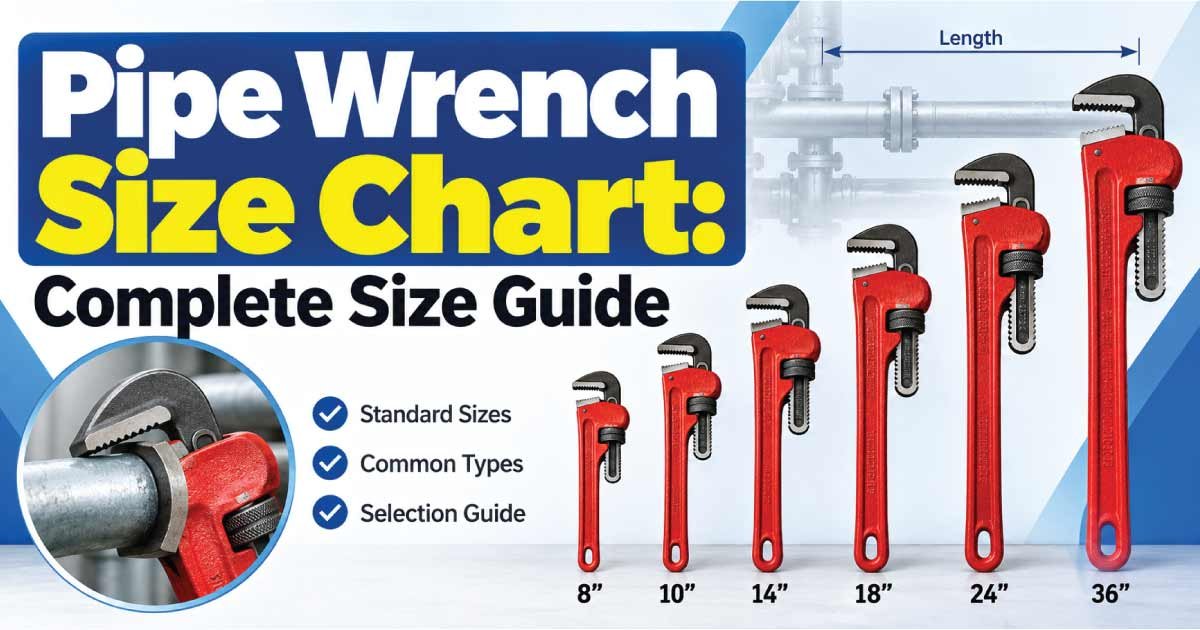
Choosing the correct pipe wrench is easier when you understand how wrench size relates to pipe capacity, jaw opening, handle length, and the amount of leverage available. A pipe wrench that is too small may not open wide enough for the fitting, while an unnecessarily large wrench can be difficult to control in confined spaces.
This pipe wrench size chart explains common wrench sizes, approximate pipe capacities, major pipe wrench types, how to measure them, and how to select the right tool for plumbing, maintenance, mechanical work, and general pipe fitting.
Pipe wrench sizes are commonly identified by the overall nominal wrench length, such as 8, 10, 12, 14, 18, 24, 36, or 48 inches. However, the stated wrench size does not directly mean that it can grip a pipe of the same diameter. The actual gripping capacity depends on the wrench design and manufacturer.
Pipe Wrench Size Chart
The table below provides a practical reference for common traditional straight pipe wrench sizes. Exact jaw capacity can vary between manufacturers and models, so the manufacturer’s specification should be checked when a precise maximum pipe diameter is important.
| Pipe Wrench Size | Approx. Length | Typical Use | General Application |
|---|---|---|---|
| 8 in | 8 in | Small fittings | Light plumbing work |
| 10 in | 10 in | Small to medium fittings | Plumbing and maintenance |
| 12 in | 12 in | Medium fittings | General-purpose plumbing |
| 14 in | 14 in | Medium fittings | Plumbing and mechanical work |
| 18 in | 18 in | Larger fittings | Heavy plumbing and maintenance |
| 24 in | 24 in | Large fittings | Heavy-duty pipe work |
| 36 in | 36 in | Very large fittings | Industrial pipe work |
| 48 in | 48 in | Extra-large fittings | Heavy industrial applications |
These are nominal wrench sizes, not universal pipe-size ratings. For example, two 18-inch pipe wrenches from different manufacturers may have different jaw capacities.
The right wrench is therefore selected using both its length and gripping capacity, rather than relying on length alone.
What Does Pipe Wrench Size Mean?
Pipe wrench size generally refers to the nominal overall length of the wrench. It is usually measured from the end of the handle to the end of the wrench head.
An important point is that wrench length and pipe diameter are different measurements.
A 12-inch pipe wrench is not designed exclusively for 12-inch pipe. Instead, the 12-inch designation describes the approximate size of the tool itself. Its jaws may accommodate a considerably smaller pipe or fitting depending on the wrench design.
Pipe Wrench Size vs. Pipe Size
Pipe dimensions can be confusing because nominal pipe size is not always equal to the pipe’s actual outside diameter. This is particularly important when working with steel pipe and threaded fittings.
When selecting a wrench, consider:
- The actual outside diameter of the pipe or fitting.
- The wrench’s maximum jaw opening.
- The wrench’s recommended pipe capacity.
- Available working space.
- Required leverage.
- The material and condition of the fitting.
Always avoid assuming that a wrench can handle a particular pipe simply because its size appears similar.
Common Pipe Wrench Types and Their Sizes
Pipe wrenches are available in several designs. The traditional straight pipe wrench is only one option.
1. Straight Pipe Wrench
The straight pipe wrench is the classic design used for gripping and turning threaded pipes and fittings.
It has a straight jaw arrangement and an adjustable upper jaw. The teeth are designed to bite into compatible pipe surfaces when force is applied.
Common sizes include:
- 8 inches
- 10 inches
- 12 inches
- 14 inches
- 18 inches
- 24 inches
- 36 inches
- 48 inches
Straight pipe wrenches are widely used for general plumbing, pipe installation, maintenance, and mechanical work.
2. Offset Pipe Wrench
An offset pipe wrench has a jaw positioned at an angle relative to the handle. This design can make it easier to access fittings where a straight wrench would interfere with surrounding components.
Offset models are especially useful around:
- Pipes close to walls
- Tight mechanical assemblies
- Parallel pipe runs
- Difficult-to-reach fittings
- Confined plumbing installations
The available sizes depend on the manufacturer and product range.
3. End Pipe Wrench
An end pipe wrench is designed to provide access to fittings located at the end of a pipe run or in areas where conventional positioning is difficult.
Its jaw arrangement can make it useful in specialized plumbing and maintenance situations.
4. Combination Pipe Wrench
Combination designs may incorporate features intended to improve versatility or provide access to different working positions. They are useful when a job involves several types of pipe arrangements.
5. Chain Pipe Wrench
A chain pipe wrench uses a chain around the pipe rather than conventional fixed teeth. It can be useful for gripping large or irregularly shaped cylindrical objects.
Chain wrenches are commonly associated with larger pipe applications where conventional jaw designs may not provide the desired contact.
Small Pipe Wrench Sizes
Small pipe wrenches are useful when working on plumbing fixtures, small threaded fittings, and installations where space is limited.
8-Inch Pipe Wrench
An 8-inch pipe wrench is compact and relatively easy to maneuver. It is commonly useful for lighter-duty work involving smaller pipe and fittings.
Its smaller handle also makes it more suitable for locations where a longer tool would be difficult to position.
10-Inch Pipe Wrench
A 10-inch model provides a useful balance between compactness and leverage. It can be a practical general-purpose choice for smaller plumbing and maintenance tasks.
12-Inch Pipe Wrench
The 12-inch pipe wrench is one of the most versatile sizes for general work. It provides more leverage than smaller models while remaining manageable in many residential and maintenance applications.
Medium Pipe Wrench Sizes
Medium-size pipe wrenches are often selected for general plumbing, mechanical maintenance, and larger threaded connections.
14-Inch Pipe Wrench
A 14-inch wrench offers additional handle length compared with a 12-inch model. This can provide increased leverage when dealing with tighter fittings.
However, greater leverage should be used carefully because excessive force can damage fittings or connected components.
18-Inch Pipe Wrench
An 18-inch pipe wrench is suited to heavier work where more leverage and a larger gripping range are needed.
It is commonly found in professional plumbing, maintenance, and mechanical tool collections.
Large Pipe Wrench Sizes
Large pipe wrenches are designed for applications where smaller tools cannot provide enough capacity or leverage.
24-Inch Pipe Wrench
A 24-inch pipe wrench provides substantial leverage and is appropriate for larger pipe and fittings within the tool’s rated capacity.
Because of its size, it requires more working space and should be handled carefully.
36-Inch Pipe Wrench
A 36-inch wrench is intended for heavy-duty applications. It is generally more appropriate for industrial, commercial, and large-scale pipe work than routine household repairs.
48-Inch Pipe Wrench
A 48-inch pipe wrench provides very high leverage and is used for large pipe and demanding applications. Its physical size makes it unsuitable for confined areas and unnecessary for small fittings.
Also Read:
How to Measure a Pipe Wrench
Understanding how a pipe wrench is measured can prevent confusion when comparing tools.
Measuring Overall Length
Place the wrench on a flat surface and measure approximately from the end of the handle to the opposite end of the wrench head.
The result is the wrench’s approximate overall length.
For example:
- A nominal 12-inch wrench is approximately 12 inches long.
- A nominal 18-inch wrench is approximately 18 inches long.
- A nominal 24-inch wrench is approximately 24 inches long.
The actual manufactured dimension can vary slightly.
Measuring Jaw Opening
Jaw opening is more important than overall length when determining whether a wrench can physically grip a particular pipe.
Open the adjustable jaw and measure the usable distance between the gripping surfaces. For accurate tool selection, however, use the manufacturer’s stated maximum capacity rather than relying only on a manual measurement.
Checking Pipe Diameter
If you need to identify the pipe itself, measure its outside diameter with a suitable measuring tool.
Do not assume that the outside diameter equals the pipe’s nominal size. Pipe standards can use nominal dimensions that differ from actual outside measurements.
How to Choose the Right Pipe Wrench Size
Selecting a pipe wrench should involve more than simply choosing the largest tool available.
1. Identify the Pipe or Fitting
First determine what you are trying to turn. Consider whether it is:
- Threaded steel pipe
- A threaded fitting
- A valve connection
- A coupling
- A nipple
- Another compatible cylindrical component
2. Check the Required Jaw Capacity
The jaws need to open sufficiently to grip the workpiece while maintaining proper tooth engagement.
If the jaws are opened excessively, the wrench may not grip properly.
3. Consider Available Leverage
Longer handles generally provide greater leverage. This can be useful for stubborn fittings, but more leverage also increases the possibility of damaging a fitting or applying excessive force.
Use the smallest wrench that provides sufficient capacity and leverage for the job.
4. Consider Working Space
A large 24-inch wrench may provide excellent leverage but be impractical inside a narrow cabinet.
For restricted spaces, a smaller or specially designed wrench may be more appropriate.
5. Consider the Pipe Material
Traditional toothed pipe wrenches can leave marks on the surface of the workpiece. If surface damage is unacceptable, a different wrench design may be preferable.
Also Read:
Pipe Wrench Size Comparison
The following comparison helps explain the practical difference between common wrench lengths.
| Wrench Size | Leverage | Maneuverability | Typical Role |
|---|---|---|---|
| 8 in | Low | Excellent | Small fittings |
| 10 in | Low–medium | Excellent | Light maintenance |
| 12 in | Medium | Very good | General plumbing |
| 14 in | Medium | Good | General/heavier work |
| 18 in | High | Moderate | Heavy plumbing |
| 24 in | High | Lower | Large fittings |
| 36 in | Very high | Limited | Industrial work |
| 48 in | Very high | Limited | Large industrial work |
This table is a general selection guide, not a substitute for the manufacturer’s rated capacity.
Pipe Wrench Size and Leverage
One of the main reasons wrench length matters is leverage.
A longer handle allows the user to generate more turning torque with the same applied hand force. This can be helpful when a fitting is tightly threaded or difficult to loosen.
However, more leverage is not always better.
Excessive force can:
- Damage threads
- Deform fittings
- Crack components
- Damage valves
- Distort pipe
- Cause the wrench to slip
- Create a safety hazard
For this reason, select an appropriately sized wrench instead of automatically reaching for the longest one.
Also Read:
Pipe Wrench vs. Adjustable Wrench
Pipe wrenches and adjustable wrenches serve different purposes.
A traditional pipe wrench uses toothed jaws designed to grip cylindrical surfaces. An adjustable wrench has smooth jaws designed primarily for gripping hexagonal fasteners and similar surfaces.
| Feature | Pipe Wrench | Adjustable Wrench |
|---|---|---|
| Jaw type | Toothed | Smooth |
| Main purpose | Pipe and threaded fittings | Nuts and bolts |
| Grip on round pipe | Strong | Poor |
| Surface marking | Possible | Less likely |
| Adjustability | Yes | Yes |
| Best use | Cylindrical pipe | Hexagonal fasteners |
Using the wrong tool can damage the workpiece. A pipe wrench should not be treated as a universal replacement for an adjustable wrench.
Pipe Wrench vs. Tongue-and-Groove Pliers
Tongue-and-groove pliers are useful for gripping various objects and can work well in many household plumbing situations. However, a traditional pipe wrench is designed specifically to develop a strong bite on compatible pipe surfaces.
Tongue-and-groove pliers may be preferable when:
- The workpiece is relatively small.
- Quick adjustment is important.
- You need a versatile gripping tool.
- The available space favors pliers.
A pipe wrench may be preferable when:
- A strong grip on threaded pipe is required.
- Significant turning force is needed.
- The workpiece is within the wrench’s rated capacity.
- The application is suited to toothed jaws.
Common Pipe Wrench Sizing Mistakes
Choosing a pipe wrench incorrectly can make a simple repair unnecessarily difficult.
Using Wrench Length as Pipe Capacity
A common mistake is assuming that a 12-inch wrench is designed for 12-inch pipe. The number generally identifies the wrench length, not the pipe diameter it can grip.
Choosing the Largest Wrench
A larger wrench does not automatically make the job safer or easier. It may be difficult to position and can provide more leverage than the fitting can safely withstand.
Ignoring Jaw Position
The adjustable jaw should be positioned correctly so the wrench grips securely. Poor positioning can reduce contact and increase the chance of slipping.
Using Excessive Force
If a fitting will not move, increasing wrench size indefinitely is not the only solution. Corrosion, damaged threads, improper installation, or another mechanical issue may be responsible.
Using a Pipe Wrench on Finished Surfaces
Traditional pipe wrench teeth can leave marks. Consider the workpiece’s surface requirements before applying a toothed wrench.
How to Use a Pipe Wrench Correctly
Proper positioning improves both grip and control.
Step 1: Select the Correct Size
Choose a wrench whose capacity is suitable for the pipe or fitting and whose handle length is practical for the working area.
Step 2: Position the Jaws
Place the wrench around the pipe and adjust the movable jaw until the teeth engage properly.
Step 3: Apply Force in the Correct Direction
Pipe wrench jaws are designed to grip when force is applied in the appropriate direction. Position the tool so that the handle movement causes the jaws to bite rather than release.
Step 4: Use Controlled Force
Apply steady force rather than sudden impacts unless the tool and procedure are specifically designed for such use.
Step 5: Inspect the Workpiece
After loosening or tightening, inspect the pipe, fitting, and threads for damage.
For plumbing systems, also check for leaks after the work is complete.
Pipe Wrench Safety Tips
A pipe wrench can generate considerable force, so basic precautions are important.
- Inspect the wrench before use.
- Do not use a wrench with damaged or excessively worn teeth.
- Keep the wrench properly adjusted.
- Wear appropriate eye protection.
- Keep your hands clear of pinch points.
- Do not use an extension pipe on the handle unless the tool manufacturer specifically permits it.
- Avoid using a damaged wrench.
- Use the correct tool for the workpiece.
- Do not exceed the tool’s intended application.
- Be especially careful around pressurized plumbing systems.
If a fitting is part of a pressurized system, isolate and depressurize the system according to the appropriate procedure before attempting repairs.
How to Build a Practical Pipe Wrench Set
You do not necessarily need every available size.
For general maintenance, a selection such as 10, 12, 14, and 18 inches can cover many common situations, while larger jobs may require 24-inch or larger models.
A practical collection can include:
- 8-inch: compact work
- 10-inch: small general-purpose jobs
- 12-inch: everyday plumbing
- 14-inch: additional capacity and leverage
- 18-inch: heavier work
- 24-inch: large fittings
- 36-inch and 48-inch: specialized heavy-duty applications
The ideal set depends on the pipe sizes, working environment, and type of maintenance you regularly perform.
Frequently Asked Questions About Pipe Wrench Sizes
What are the most common pipe wrench sizes?
Common sizes include 8, 10, 12, 14, 18, 24, 36, and 48 inches. Availability and exact capacities vary by manufacturer.
What size pipe wrench is best for home plumbing?
A 10-inch or 12-inch pipe wrench is often a practical starting point for general plumbing because it balances maneuverability and leverage. The correct choice still depends on the fitting and available space.
What size pipe can a 12-inch pipe wrench fit?
There is no universal answer. Pipe-gripping capacity varies by design and manufacturer. Check the manufacturer’s jaw-capacity specification rather than assuming the wrench length equals pipe diameter.
Does a bigger pipe wrench provide more torque?
A longer handle can provide greater mechanical leverage, allowing more torque for a given applied force. However, excessive torque can damage components or create a safety risk.
What is the difference between a 14-inch and 18-inch pipe wrench?
The 18-inch model generally provides a longer handle and therefore greater leverage than a 14-inch model. It is also physically larger and may have a different gripping capacity depending on the manufacturer.
Can a pipe wrench be used on nuts and bolts?
It can physically grip some shapes, but it is generally not the preferred tool for standard hexagonal nuts and bolts. A properly sized wrench or socket is normally better suited because its contact surfaces are designed for fasteners.
How do I know what size pipe wrench I need?
Identify the pipe or fitting diameter, check the wrench’s rated jaw capacity, consider available space, and choose enough handle length for the required leverage without unnecessarily oversizing the tool.
Key Takeaways From the Pipe Wrench Size Chart
The most important thing to remember is that pipe wrench size normally refers to the wrench’s approximate overall length, not the diameter of pipe it can grip.
For a good match:
- Check the manufacturer’s jaw capacity.
- Consider the pipe’s actual outside diameter.
- Choose a wrench that fits the working space.
- Use enough handle length for the required leverage.
- Avoid unnecessarily large wrenches.
- Consider whether toothed jaws could damage the workpiece.
- Use the correct wrench type for the pipe arrangement.
- Follow the manufacturer’s instructions for safe use.
A small wrench can be ideal for confined spaces, while a larger wrench may be necessary for heavy-duty pipe work. The best choice is always the tool that provides adequate gripping capacity and leverage while remaining controllable for the specific application.
Conclusion
A reliable pipe wrench size chart makes it easier to understand the relationship between wrench length, gripping capacity, leverage, and application. Common sizes range from compact 8-inch models to large 48-inch tools, with intermediate sizes covering most plumbing and maintenance requirements.
Remember that the nominal wrench size does not automatically indicate the maximum pipe diameter. Always check the manufacturer’s specifications for jaw capacity and choose a tool based on the actual fitting, working space, and required force. Selecting the right size improves control, reduces the chance of damage, and makes pipe work more efficient.