
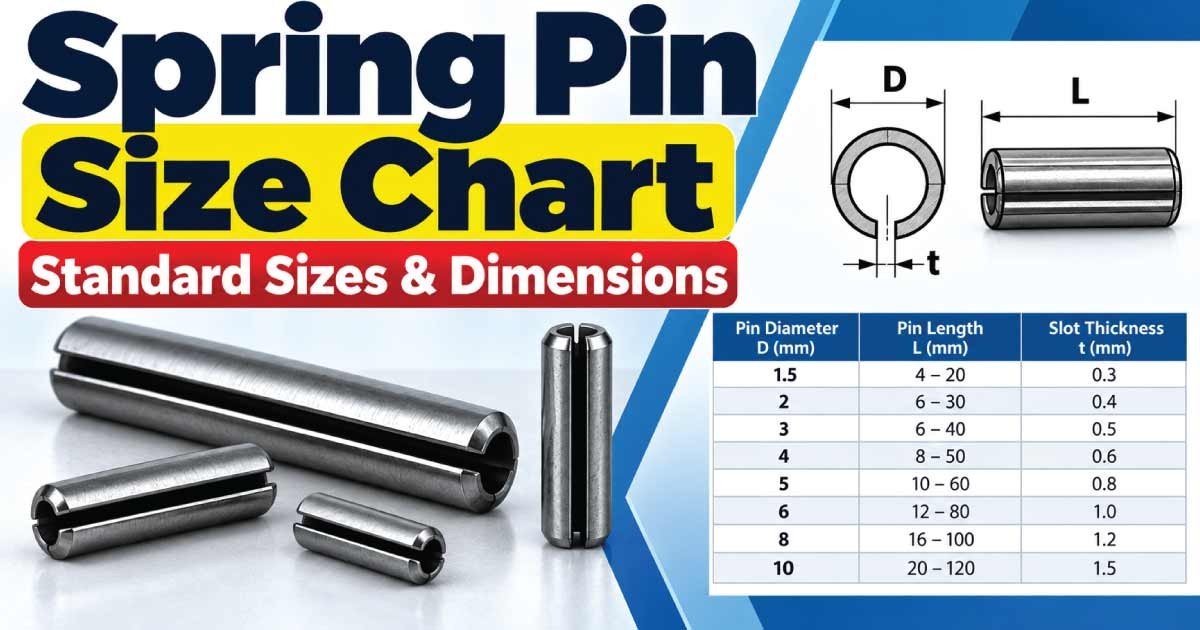
Choosing the correct spring pin starts with understanding its nominal diameter, length, pin type, and mating hole. Unlike a solid dowel pin, a spring pin is designed to flex or compress when installed, allowing it to maintain pressure against the sides of the hole.
This spring pin size chart covers common metric and inch sizes, standard dimensions, types, measuring methods, applications, and practical selection tips. It also explains why the pin diameter shown by a manufacturer should not automatically be treated as the exact diameter of the drilled hole.
Whether you are replacing a roll pin in machinery, selecting a slotted spring pin for an assembly, or trying to identify an unknown fastener, the information below provides a practical starting point. For critical applications, always verify the final dimensions against the applicable standard or manufacturer’s specification.
What Is a Spring Pin?
A spring pin is a cylindrical mechanical fastener that uses its elastic spring action to hold components together. Instead of being completely solid, many spring pins have a longitudinal slot or another flexible construction that allows the pin to compress during installation.
The term spring pin is commonly used for several related fastener designs, including slotted spring pins and coiled spring pins. A slotted spring pin is often called a roll pin, although terminology can vary between suppliers and industries.
Spring pins are commonly used for:
- Securing gears, levers, and pulleys
- Retaining shafts and components
- Joining mechanical parts
- Locating and retaining assemblies
- Hinges and linkage mechanisms
- Automotive and industrial equipment
- General machinery and repair work
Their main advantage is that the spring action helps the pin remain securely engaged without requiring threads, nuts, or other separate locking hardware.
How Spring Pins Work
When a spring pin enters a properly prepared hole, its body can compress or flex. This creates outward force against the hole wall.
That spring force helps maintain retention even when the assembly experiences vibration or movement.
A spring pin is therefore different from a conventional solid dowel pin. A dowel relies primarily on a close, controlled fit, while a spring pin uses elastic deformation and radial force as part of its retention mechanism.
Standard Spring Pin Sizes
Spring pins are manufactured in numerous diameters and lengths. The available sizes depend on the pin design, applicable standard, material, and manufacturer.
Metric spring pins are generally identified by their nominal diameter in millimeters, while inch-series pins are commonly identified by fractional or decimal inch dimensions.
Common Metric Spring Pin Sizes
The following table shows commonly encountered metric nominal diameters. It is intended as a practical size-reference chart rather than a complete dimensional schedule for every manufacturer.
| Nominal Diameter (mm) | Approx. Diameter (in.) | Typical Use Category |
|---|---|---|
| 1.5 | 0.059 | Small mechanisms |
| 2 | 0.079 | Light-duty assemblies |
| 2.5 | 0.098 | Small machinery |
| 3 | 0.118 | General mechanical work |
| 4 | 0.157 | General-purpose assemblies |
| 5 | 0.197 | Machinery and equipment |
| 6 | 0.236 | Medium-duty assemblies |
| 8 | 0.315 | Machinery and shafts |
| 10 | 0.394 | Heavy mechanical assemblies |
| 12 | 0.472 | Larger machinery |
| 14 | 0.551 | Heavy-duty applications |
| 16 | 0.630 | Large mechanical assemblies |
| 18 | 0.709 | Large machinery |
| 20 | 0.787 | Heavy-duty applications |
The nominal diameter is not the only dimension that matters. Length, wall construction, slot or coil configuration, material, hardness, and the mating-hole specification can all affect whether a particular spring pin is suitable.
Common Inch Spring Pin Sizes
Inch-series spring pins are available in many diameters. The following are representative sizes frequently encountered in mechanical hardware catalogs.
| Nominal Diameter (in.) | Approx. Diameter (mm) | Common Fractional Equivalent |
|---|---|---|
| 1/16 | 1.588 | 0.0625 |
| 3/32 | 2.381 | 0.0938 |
| 1/8 | 3.175 | 0.125 |
| 5/32 | 3.969 | 0.1563 |
| 3/16 | 4.763 | 0.1875 |
| 1/4 | 6.350 | 0.250 |
| 5/16 | 7.938 | 0.3125 |
| 3/8 | 9.525 | 0.375 |
| 7/16 | 11.113 | 0.4375 |
| 1/2 | 12.700 | 0.500 |
| 5/8 | 15.875 | 0.625 |
| 3/4 | 19.050 | 0.750 |
| 7/8 | 22.225 | 0.875 |
| 1 | 25.400 | 1.000 |
These values are nominal diameter conversions, not a claim that every listed diameter is available in every spring-pin design.
Spring Pin Dimensions Explained
A spring pin size is normally described using more than one measurement. Understanding each dimension makes identification and replacement much easier.
1. Nominal Diameter
The nominal diameter identifies the basic size of the pin.
For example, a metric spring pin listed as 6 mm × 40 mm is generally described by:
- 6 mm = nominal diameter
- 40 mm = nominal length
The actual free-state geometry can differ from the nominal dimension because the pin is designed to compress during installation.
2. Pin Length
Length is measured along the longitudinal axis of the pin.
Common spring-pin lengths vary substantially according to diameter and manufacturer. A short pin may be used for a thin lever or linkage, while longer versions can pass through multiple components.
The selected length should provide adequate engagement through the assembly without creating interference with nearby parts.
3. Wall Thickness
Wall thickness is particularly important for slotted spring pins and other hollow spring fasteners.
A heavier-wall construction generally provides different load and stiffness characteristics than a lighter construction. This is one reason two pins having the same nominal diameter and length should not automatically be considered interchangeable.
4. Slot or Coil Configuration
A slotted spring pin contains a longitudinal slot. The slot allows the cylindrical body to compress as it enters the hole.
A coiled spring pin, by comparison, is formed by rolling strip material into a spiral or coil. Its spring characteristics and installation behavior differ from a slotted design.
Metric Spring Pin Standards
For metric mechanical fasteners, ISO standards are commonly referenced. ISO 8752 is associated with slotted spring pins and provides dimensional requirements for standardized products.
Standards are important because they establish controlled characteristics rather than relying only on a generic product description.
When purchasing a replacement spring pin, check:
- Applicable standard
- Nominal diameter
- Nominal length
- Pin type
- Material
- Surface finish
- Mechanical requirements
- Manufacturer’s dimensional specification
A product advertised simply as a 6 mm roll pin may not provide enough information for a critical engineering application.
For safety-critical, highly loaded, or precision assemblies, use the engineering drawing or manufacturer’s specification rather than selecting a pin solely from a general size chart.
Slotted Spring Pin vs. Coiled Spring Pin
Although both products are spring-type fasteners, they are not identical.
| Feature | Slotted Spring Pin | Coiled Spring Pin |
|---|---|---|
| Construction | Cylindrical body with longitudinal slot | Material formed into a coil |
| Spring action | Primarily radial compression | Controlled radial spring action |
| Common name | Roll pin | Spiral/coiled spring pin |
| Installation | Pressed or driven into prepared hole | Installed into prepared hole |
| Typical use | General retention | Applications requiring controlled spring characteristics |
| Load behavior | Depends strongly on design and material | Depends on coil design and duty |
| Replacement | Match standard and dimensions | Match coil design and dimensions |
The correct choice depends on the application. A coiled spring pin should not automatically be substituted for a slotted pin simply because both have the same nominal diameter.
How to Measure a Spring Pin
Correct measurement is especially important when replacing an unknown or damaged pin.
Measure the Diameter
Use a micrometer or quality caliper to measure the pin diameter.
Because spring pins are flexible, take measurements carefully and avoid squeezing the pin enough to change its shape.
Measure the pin at several points if necessary. A damaged, worn, or distorted pin may no longer represent its original dimensions.
Measure the Length
Measure the overall usable pin length along its axis.
Do not confuse the pin’s length with the depth of the hole. The required pin length depends on the components being retained and the design of the assembly.
Identify the Construction
Look closely at the body:
- A single longitudinal opening usually indicates a slotted spring pin.
- A spiral or wrapped construction indicates a coiled spring pin.
- A completely solid cylindrical body is more likely to be a dowel or solid pin.
This distinction matters because different pin types have different installation and load characteristics.
Inspect the Hole
If the original pin has failed, inspect the mating hole for:
- Wear
- Elongation
- Burrs
- Cracks
- Corrosion
- Deformation
- Previous drilling or modification
Installing a new spring pin into a badly worn hole may not restore the original retention performance.
Discover More:
Spring Pin Hole Size and Fit
One of the most common mistakes is assuming that the drilled hole should simply equal the nominal spring-pin diameter.
Spring pins are designed to deform during installation, so their recommended hole dimensions depend on the particular pin design and applicable specification.
For that reason, there is no universal rule such as “a 6 mm spring pin always requires a 6 mm hole.”
The correct hole depends on factors including:
- Pin type
- Nominal diameter
- Material
- Wall thickness
- Standard
- Assembly material
- Required retention
- Manufacturing tolerances
Why the Hole Matters
A hole that is too small can make installation excessively difficult and may damage the pin or surrounding component.
A hole that is too large can reduce the radial interference and retention provided by the spring pin.
For production work, use the hole-size recommendation supplied with the specific spring pin standard or manufacturer’s data sheet.
How to Choose the Correct Spring Pin
Selecting a spring pin should be based on the complete assembly rather than diameter alone.
Consider the Following Factors
1. Diameter
Choose the nominal diameter appropriate for the existing design and loading conditions.
2. Length
The pin should engage the required components without excessive protrusion or interference.
3. Pin Type
Determine whether the application calls for a slotted spring pin, coiled spring pin, or another retaining pin.
4. Material
Common spring-pin materials include carbon steel and stainless steel. Stainless steel may be selected where corrosion resistance is important, but the mechanical properties should also be considered.
5. Strength and Loading
Consider shear loads, vibration, impact, rotation, and the forces acting on the joint.
6. Environment
Moisture, chemicals, outdoor exposure, temperature, and corrosion can influence material selection.
7. Standard
If the original assembly was designed to a recognized standard, use the corresponding standard replacement whenever possible.
Discover More:
Spring Pin Applications
Spring pins are used throughout mechanical equipment because they can provide compact and economical retention.
Common applications include:
- Automotive components: linkages, levers, mechanisms, and assemblies
- Industrial machinery: shafts, gears, couplings, and moving mechanisms
- Agricultural equipment: mechanical joints and linkage systems
- Power tools: handles, levers, and internal mechanisms
- Conveyors: rotating and adjustable components
- Small machinery: hinges, controls, and mechanical linkages
- General repairs: replacement of worn or missing retaining pins
The specific application determines the required pin size and construction. A pin suitable for a small hand-operated mechanism may be inappropriate for a heavily loaded rotating assembly.
Advantages and Limitations of Spring Pins
Spring pins have several practical advantages, but they are not the best solution for every joint.
Advantages
- Simple installation compared with threaded fasteners
- Compact design with no nut or bolt head
- Spring retention helps maintain contact with the hole
- Useful for vibration-prone assemblies
- Available in many sizes
- Generally economical
- Suitable for automated assembly in some applications
Limitations
- Improper hole dimensions can affect performance.
- Repeated removal and installation may damage the pin or hole.
- A worn hole can reduce retention.
- Different spring-pin designs are not necessarily interchangeable.
- Corrosion can affect service life.
- Critical load-bearing applications require engineering verification.
A spring pin should therefore be treated as an engineered fastener rather than simply a generic replacement for any cylindrical pin.
Discover More:
Spring Pin vs. Dowel Pin
Spring pins and dowel pins can both be used to join or locate mechanical components, but their operating principles are different.
| Characteristic | Spring Pin | Dowel Pin |
|---|---|---|
| Body | Flexible/slotted/coiled | Solid |
| Retention principle | Elastic spring force | Controlled interference or close fit |
| Installation | Generally driven or pressed | Often pressed into precision hole |
| Removal | Possible, depending on application | Possible but may require suitable tooling |
| Hole requirements | Application and standard dependent | Usually more closely controlled |
| Typical purpose | Retention and joining | Precision location and alignment |
If an assembly requires precise repeatable alignment, a solid precision dowel may be more appropriate. If the goal is economical retention with spring action, a spring pin may be preferable.
Common Spring Pin Selection Mistakes
Several mistakes can lead to loose joints, difficult installation, or premature failure.
Using Diameter Alone
A 5 mm pin is not necessarily interchangeable with every other 5 mm spring pin. Construction, standard, material, and length also matter.
Ignoring the Existing Hole
The condition and dimensions of the hole are critical. If the hole has become enlarged or oval-shaped, simply installing a new pin may not solve the problem.
Choosing the Wrong Length
A pin that is too short may not adequately engage the components. A pin that is too long may interfere with surrounding parts.
Mixing Metric and Inch Sizes
Metric and inch dimensions can appear close enough to fit, but a near match is not automatically an acceptable engineering fit.
For example, 6 mm is approximately 0.236 inch, whereas 1/4 inch is 6.35 mm. These are different nominal sizes.
Reusing a Damaged Spring Pin
A spring pin that has been heavily deformed during removal may not provide the same spring characteristics when installed again.
For many repair situations, replacing the old pin with a correctly specified new one is the better approach.
Spring Pin Size Conversion Chart
The following quick-reference chart converts several common metric nominal diameters to approximate inches.
| Metric Size (mm) | Approx. Inches | Nearest Common Inch Size |
|---|---|---|
| 2 | 0.079 | 5/64 in. |
| 2.5 | 0.098 | — |
| 3 | 0.118 | 1/8 in. |
| 4 | 0.157 | 5/32 in. |
| 5 | 0.197 | — |
| 6 | 0.236 | 1/4 in. |
| 8 | 0.315 | 5/16 in. |
| 10 | 0.394 | 3/8 in. |
| 12 | 0.472 | — |
| 16 | 0.630 | 5/8 in. |
| 20 | 0.787 | — |
The “nearest common inch size” column is provided only for identification and comparison. Do not substitute the nearest inch size without confirming the required engineering fit.
Installation Tips for Spring Pins
Correct installation helps prevent damage to both the pin and the assembly.
Prepare the Hole
Remove burrs, dirt, corrosion, and other debris. Confirm that the hole is suitable for the specified pin.
Align the Components
The holes in the mating components should be properly aligned before driving the pin.
Use Appropriate Tools
A suitable pin punch can help drive the spring pin while reducing the risk of damaging nearby surfaces.
Avoid using improvised tools that can mushroom the end of the pin or deform it excessively.
Drive the Pin Straight
Keep the tool aligned with the pin axis. Excessive sideways force can damage the pin or enlarge the hole.
Check Final Position
After installation, confirm that the pin is seated at the intended depth and does not interfere with moving components.
Frequently Asked Questions
What is the most common spring pin size?
There is no single universal most common size. 3 mm, 4 mm, 5 mm, 6 mm, and 8 mm metric sizes are frequently encountered in general mechanical work, while inch-series applications use their own standard sizes.
The appropriate size should always be based on the original design rather than popularity.
Is a spring pin the same as a roll pin?
Often, the terms are used interchangeably for slotted spring pins, particularly in general hardware and repair contexts. However, “spring pin” can also refer to other designs, such as coiled spring pins.
Always check the actual construction and product specification.
How do I know what size spring pin I need?
Measure the original pin’s nominal diameter and length, identify its construction, inspect the mating hole, and check the original equipment documentation if available.
For standardized assemblies, match the applicable standard and specification.
Can I use a larger spring pin?
Not without verifying the hole and surrounding material. A larger pin may require a larger hole, which could weaken or damage the component.
Do not enlarge a hole simply to accommodate a larger pin unless the modification has been properly engineered.
Can spring pins be reused?
Some pins can physically be reused, but reuse is not always advisable. Removal can deform the pin, alter its spring characteristics, or damage its surface.
For critical applications, use a new pin meeting the original specification.
Are metric and inch spring pins interchangeable?
Generally, they should not be treated as interchangeable merely because their dimensions appear similar. Even small dimensional differences can affect installation and retention.
Match the original measurement system and specification whenever possible.
Final Takeaway
A spring pin size chart is useful for identifying nominal diameters and comparing metric and inch fasteners, but diameter alone is not enough to select the correct pin. The pin type, length, construction, material, hole dimensions, and applicable standard all influence performance.
For general repairs, begin by measuring the original pin and inspecting the mating hole. For engineered or safety-critical assemblies, verify the complete specification against the applicable standard or manufacturer’s documentation.
When the correct diameter, length, construction, and fit are selected, a spring pin can provide a simple, compact, and reliable method of retaining mechanical components.