
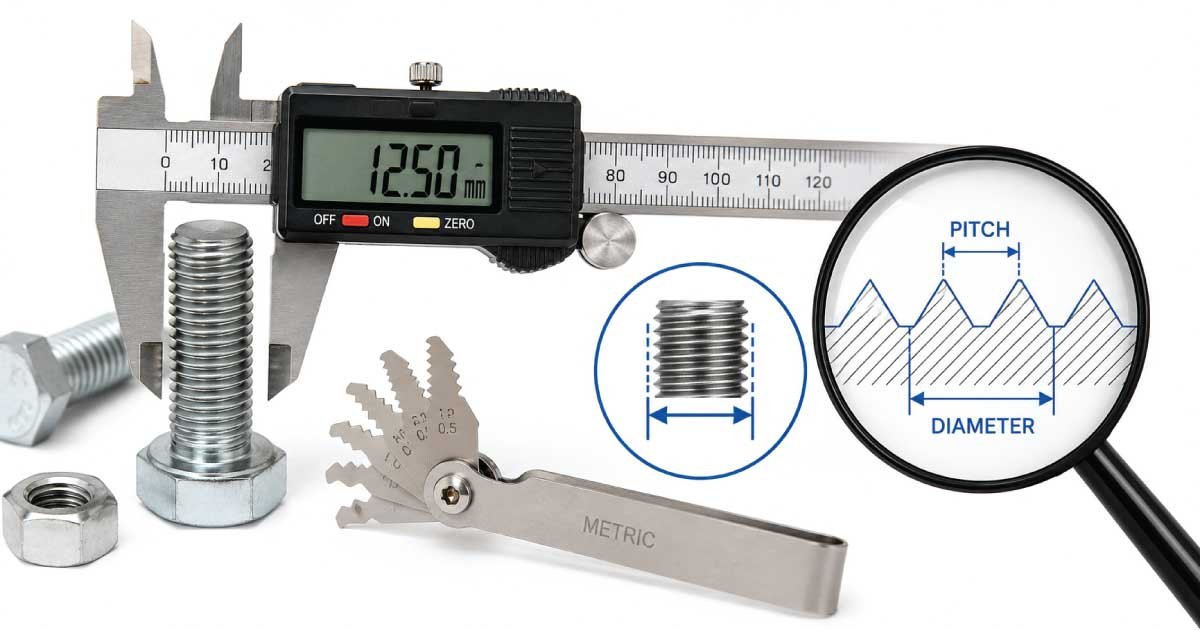
If you have ever needed to replace a missing bolt or match a fastener for a repair, you’ve probably wondered, “How do I measure bolt thread size?” It may seem confusing at first, especially with the different measurement systems and thread standards available. However, once you understand the basics, measuring bolt thread size becomes a straightforward process.
Whether you are working on a car, bicycle, machinery, home furniture, or a DIY project, using the correct bolt thread size ensures a secure fit, prevents damage to threaded holes, and improves safety.
In this guide, you will learn everything you need to know about measuring bolt thread size, including the tools you will need, step-by-step instructions, common thread standards, and mistakes to avoid.
What Is Bolt Thread Size?
Bolt thread size refers to the detailed measurements of the threaded portion of a bolt, which determine how it fits into a nut or threaded hole. It is not just one number but a combination of dimensions that ensure proper compatibility in mechanical assemblies. Understanding it is essential in engineering, repair work, and manufacturing tasks.
It includes three important measurements:
- Thread diameter
- Thread pitch (or threads per inch)
- Bolt length
Together, these measurements define the exact size and fit of a bolt. If even one value is incorrect, the bolt may not tighten properly or may fail under load, leading to mechanical issues or safety risks.
For example:
- M10 × 1.5 × 40 mm
- 1/4″-20 × 2″
Although both describe bolts, one follows the metric system and the other follows the imperial system. Both serve the same purpose but are used in different regions and industries.
Why Measuring Bolt Thread Size Matters
Accurate bolt measurement is essential because even small errors can lead to serious mechanical problems. A mismatched bolt may not hold components securely, leading to instability or complete failure of the assembly under pressure or vibration.
Using the wrong bolt size can cause several problems:
- Damaged threads
- Loose connections
- Reduced strength
- Equipment failure
- Costly repairs
These issues often appear gradually, especially in machinery or automotive applications, where vibration and load stress continuously affect fasteners.
Correct measurements ensure:
- Proper installation
- Safe operation
- Easy replacement
- Longer component life
Whether you’re replacing a single bolt in a household item or ordering bulk fasteners for industrial production, accurate sizing ensures performance, safety, and long-term reliability.
Tools You will Need
Measuring bolt thread size does not require highly advanced equipment, but using the right tools significantly improves accuracy and reduces guesswork. Most of these tools are commonly available in workshops or hardware stores.
Common tools include:
- Digital caliper
- Vernier caliper
- Steel ruler
- Thread pitch gauge
- Nut and bolt gauge
- Thread identification chart
Each tool plays a specific role in measurement. For example, calipers measure diameter and length precisely, while thread gauges help identify pitch patterns.
A digital caliper provides the most accurate measurements and is recommended for both beginners and professionals. It reduces human error and gives quick readings, making it ideal for both fieldwork and workshop environments.
Understand The Bolt Thread Measurements
Before measuring any bolt, it is important to understand the three key dimensions that define its size. Each measurement represents a different physical characteristic of the bolt and plays a role in ensuring proper fit and function.
1. Major Diameter
The major diameter refers to the outside width of the threaded portion of the bolt. It is the largest measurable diameter across the threads and is one of the most important identifiers of bolt size.
It is measured across the widest points of the threads, not the smooth shank or head.
For example:
- M6 bolt = approximately 6 mm diameter
- M8 bolt = approximately 8 mm diameter
This measurement helps quickly identify the basic size category of the bolt. Even a small difference in diameter can make a bolt incompatible with a threaded hole.
2. Thread Pitch
Thread pitch refers to the distance between two adjacent threads on a bolt. It determines how tightly or loosely the threads are spaced and affects how the bolt engages with a nut or tapped hole.
For metric bolts, pitch is measured in millimeters.
Examples:
- M6 × 1.0
- M8 × 1.25
- M10 × 1.5
The second number represents the thread pitch and is critical for proper matching. A wrong pitch may allow the bolt to start threading but will eventually cause damage.
3. Threads Per Inch (TPI)
Imperial bolts do not use metric pitch measurements. Instead, they are defined by Threads Per Inch (TPI), which counts how many threads are present in one inch of length.
Examples:
- 1/4″-20
- 3/8″-16
- 1/2″-13
The second number represents the number of threads per inch. A higher TPI means finer threads, while a lower TPI means coarser threads. This affects grip strength and application type.
Step 1: Measure the Bolt Diameter
The first and most important step in identifying a bolt size is measuring its outer diameter. This gives a quick reference to its general size category, such as M6, M8, or M10 in metric systems.
Using a Digital Caliper
A digital caliper provides the most accurate and easy method for this measurement.
- Open the caliper jaws
- Place them across the threads
- Close gently until they touch
- Read the measurement on the display
For best accuracy, ensure the caliper is perpendicular to the bolt axis.
Example:
If the diameter measures 8 mm, you likely have an M8 bolt.
If it measures approximately 10 mm, it is probably an M10 bolt.
This step helps narrow down the bolt type before confirming pitch or thread pattern.
Step 2: Measure the Thread Pitch
Once diameter is identified, the next step is measuring the thread pitch, which determines how closely spaced the threads are. This step is essential for ensuring compatibility with nuts or threaded holes.
For Metric Bolts
The most reliable method is using a thread pitch gauge.
- Match gauge teeth with bolt threads
- Try different blades until one fits perfectly
- Read the pitch value printed on the gauge
Example:
If the gauge reads 1.25, the bolt is M8 × 1.25.
Without a Thread Pitch Gauge
If a gauge is not available, manual measurement can be used.
- Measure the distance across 10 threads
- Divide the result by 10
Example:
10 threads measure 15 mm
15 ÷ 10 = 1.5 mm thread pitch
This method is slightly less precise but still effective for general identification.
Step 3: Measure Threads Per Inch
For imperial bolts, thread pitch is not used. Instead, threads per inch (TPI) must be measured to identify the correct specification.
How to Measure TPI
- Place a ruler alongside the bolt
- Count the number of threads in one inch
- Match the result with standard sizes
Examples:
- 20 threads = 1/4″-20
- 16 threads = 3/8″-16
- 13 threads = 1/2″-13
Higher thread counts indicate finer threads, which are often used in precision applications, while lower counts are used for heavy-duty fastening.
Step 4: Measure Bolt Length
Bolt length is measured differently depending on the head style, and incorrect measurement can lead to improper fitting in assemblies.
Hex Head Bolts
- Measure from under the head to the tip
- Do not include the head in the measurement
This is the standard method used in most mechanical applications.
Countersunk Bolts
- Measure from the top of the head to the tip
- The head is included because it sits flush with the surface
This ensures the total installed length is accurately represented in flush-fit designs.
Metric Bolt Thread Sizes
Metric bolt thread sizes are standardized measurements used globally, especially in engineering and manufacturing industries. They are defined using millimeters, where both diameter and thread pitch follow the metric system. These sizes help ensure consistent compatibility between bolts and threaded components.
Some common metric bolt sizes include:
| Bolt Size | Thread Pitch |
|---|---|
| M4 | 0.7 mm |
| M5 | 0.8 mm |
| M6 | 1.0 mm |
| M8 | 1.25 mm |
| M10 | 1.5 mm |
| M12 | 1.75 mm |
| M16 | 2.0 mm |
These sizes represent standard coarse threads, which are the most widely used because they are easier to install and more tolerant of minor alignment issues.
Fine thread versions are also available, and they use smaller pitch values for better precision and stronger clamping in specialized applications like automotive engines and machinery.
Imperial Bolt Thread Sizes
Imperial bolt thread sizes are commonly used in the United States and are based on inches rather than millimeters. Instead of thread pitch, they use Threads Per Inch (TPI), which indicates how many threads exist in one inch of bolt length.
Common imperial sizes include:
| Bolt Size | Threads Per Inch |
|---|---|
| 1/4″ | 20 TPI |
| 5/16″ | 18 TPI |
| 3/8″ | 16 TPI |
| 7/16″ | 14 TPI |
| 1/2″ | 13 TPI |
These sizes are widely used in construction, machinery, and general repair work.
Fine-thread versions exist as well, which have higher TPI values. These are preferred in applications requiring greater holding strength and resistance to vibration, such as engines and aerospace components.
Coarse vs Fine Threads
Not all bolts with the same diameter have identical thread spacing. The choice between coarse and fine threads depends on the application, material, and required strength.
1. Coarse Threads
Coarse threads have wider spacing between threads, making them easier to install and more forgiving in everyday applications. They are the most commonly used thread type in general mechanical work.
Features:
- Easier installation
- Better for softer materials
- More resistant to dirt and damage
- Faster assembly and disassembly
Common applications:
- Construction
- Automotive repair
- Heavy equipment
Coarse threads are ideal where speed, durability, and simplicity are more important than precision.
2. Fine Threads
Fine threads have closely spaced threads, providing more surface contact and greater precision. They are often used in applications where vibration resistance and tight fastening are critical.
Features:
- Stronger clamping force
- Better vibration resistance
- Greater adjustment precision
Common applications:
- Aerospace engineering
- Racing engines
- Precision machinery
Fine threads are preferred when maximum holding strength and accuracy are required, especially in high-performance environments.
 Advance your research now with
  Pipe Schedule Chart: A Complete Guide
How to Identify Metric and Imperial Bolts
Sometimes bolts do not have markings, making identification difficult. In such cases, careful measurement is required to determine whether a bolt is metric or imperial.
Metric bolts:
- Measured in millimeters
- Thread pitch in millimeters
- Marked with “M” (e.g., M10 × 1.5)
Metric bolts are widely used in Europe, Asia, and modern automotive systems. The measurement system is decimal-based, making it easier to calculate and standardize.
Imperial bolts:
- Measured in inches
- Threads per inch (TPI)
- Fractional diameter (e.g., 3/8″)
Imperial bolts are commonly used in the United States and older machinery systems. Confusing the two systems can lead to improper fitting and thread damage.
Common Thread Standards
Different industries follow different thread standards depending on regional practices and engineering requirements. These standards ensure uniformity in manufacturing and compatibility between parts.
Some of the most common include:
1. Metric ISO Threads
Metric ISO threads are the global standard for metric fasteners. They are widely used in modern engineering and manufacturing due to their consistency and simplicity.
Used worldwide in:
- Europe
- Asia
- Automotive manufacturing
These threads are preferred for international equipment and standardized machinery systems.
2. UNC (Unified National Coarse)
UNC threads are part of the Unified Thread Standard used mainly in the United States. They feature coarse thread spacing for general-purpose fastening.
Popular in:
- United States
- Construction
- General manufacturing
UNC threads are widely used where strength and ease of assembly are more important than precision.
2. UNF (Unified National Fine)
UNF threads are the fine-thread version of the Unified Thread Standard. They provide better strength and tighter fastening compared to coarse threads.
Used in applications requiring:
- Higher holding strength
- Better vibration resistance
- Precision alignment
Common in:
- Automotive industry
- Aerospace
- Precision engineering
Measuring a Bolt Without Special Tools
Even without professional tools, it is still possible to estimate bolt size with basic household items. While not highly precise, these methods are useful for quick identification and simple repairs.
You can use:
- A ruler
- A measuring tape
- A known matching nut
- Printable bolt-size charts
These tools help approximate diameter, length, and sometimes thread spacing.
Although less accurate than calipers or gauges, these methods are practical for emergency fixes or basic home maintenance tasks where perfect precision is not critical.
Advance your research now with Nut Size Chart: A Complete Guide
Common Mistakes When Measuring Bolt Thread Size
Many measurement errors happen due to simple misunderstandings of bolt structure. Avoiding these mistakes ensures correct identification and prevents damage to threads or components.
Avoid these errors:
- Measuring the head instead of the threads
Always measure the threaded shaft only. - Guessing the thread pitch
Even identical diameter bolts can have different pitch values. - Mixing metric and imperial bolts
For example, an M8 bolt is not the same as a 5/16-inch bolt. - Forgetting bolt length
Length is just as important as diameter and thread type for proper fitting.
Tips for Accurate Measurements
To ensure precise bolt identification, it is important to follow a careful and consistent measuring process. Small improvements in technique can significantly increase accuracy.
For best results:
- Clean dirty or rusted threads before measuring
- Use digital calipers whenever possible
- Measure multiple times for consistency
- Cross-check using a thread gauge
- Record all measurements before purchasing replacements
These steps help reduce errors and ensure that the correct bolt is selected for any application, whether in repair work or manufacturing.
Where Bolt Thread Size Is Important
Accurate bolt thread measurement is essential across many industries because improper sizing can lead to mechanical failure, safety risks, and equipment damage.
Examples include:
- Automotive repair
- Manufacturing
- Metal fabrication
- Mechanical engineering
- Plumbing systems
- Furniture assembly
- Bicycle maintenance
- Motorcycle repair
- Agricultural equipment
- Construction projects
In all these applications, selecting the correct bolt ensures structural integrity, improves safety, and extends the lifespan of equipment and assemblies.
Final Thoughts
Learning how to measure bolt thread size is a valuable skill for anyone involved in DIY projects, automotive repairs, manufacturing, or mechanical maintenance. By measuring the bolt diameter, identifying the thread pitch or threads per inch, and checking the overall length, you can confidently choose the correct replacement fastener and avoid costly mistakes.
Investing in simple tools such as a digital caliper and thread pitch gauge can make the process faster and far more accurate. With a little practice, you’ll be able to identify both metric and imperial bolts with confidence, ensuring every project is assembled securely and performs as intended.
Advance your research now with Spanner Size Chart: A Complete Guide
FAQS About How to Measure Bolt Thread Size:
Can I measure a bolt with a ruler?
Yes, you can measure a bolt with a standard ruler if you do not have precision measuring tools. A ruler is suitable for estimating the bolt’s overall length and approximate diameter. However, for accurate measurements, especially when matching replacement bolts, a digital caliper is recommended because it provides far more precise and reliable results.
What is the easiest way to measure thread pitch?
The easiest and most accurate method is to use a thread pitch gauge, which quickly identifies the correct thread spacing. If you don’t have one, measure the distance across several threads with a ruler or caliper, then divide that distance by the number of thread gaps to calculate the thread pitch accurately.
What is the difference between metric thread pitch and TPI?
Metric bolts measure thread pitch as the distance between adjacent threads in millimeters, such as 1.25 mm or 1.5 mm. Imperial bolts use Threads Per Inch (TPI), which counts how many threads fit within one inch. Understanding this difference is essential when selecting compatible fasteners or replacement bolts.
Why won’t my replacement bolt fit?
A replacement bolt may not fit even if the diameter appears correct because the thread pitch, thread standard, or bolt length may differ. Metric and imperial threads are not interchangeable. Always verify the bolt diameter, length, thread pitch, and thread type before purchasing to ensure a secure and proper fit.