
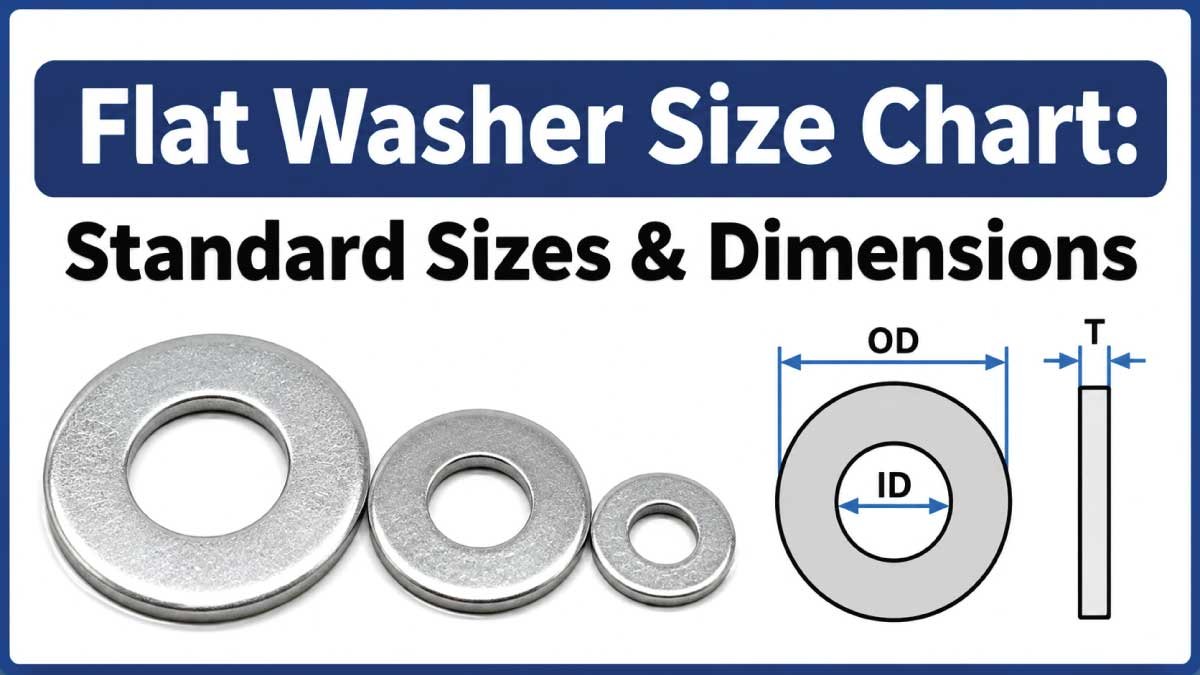
Choosing the correct washer is more than finding a metal disc that fits over a bolt. A flat washer must have an appropriate inside diameter, outside diameter, and thickness for the fastener and the material being clamped. Using the wrong size can reduce the washer’s ability to distribute load or cause clearance and fit problems.
This flat washer size chart provides commonly used metric dimensions and explains how flat washers are sized in both metric and SAE systems. You will also learn how to measure a washer, understand washer standards, choose the right size, and avoid common sizing mistakes.
Whether you are working on machinery, automotive components, structural assemblies, furniture, equipment, or general maintenance, the key dimensions to check are inside diameter (ID), outside diameter (OD), and thickness.
What Is a Flat Washer?
A flat washer is a thin, generally circular component with a hole through its center. It is normally installed beneath a bolt head or nut to create a larger bearing surface between the fastener and the clamped material.
The washer helps distribute the tightening force over a broader area. This can reduce localized stress, help prevent the fastener from sinking into softer materials, and provide a more suitable bearing surface.
Flat washers are available in many materials and dimensional standards, including steel, stainless steel, brass, aluminum, and other alloys.
How a Flat Washer Works
When a bolt is tightened, the bolt head or nut applies force to the surface underneath it. A washer spreads that force over a larger area.
A properly selected washer can:
- Distribute clamping load over a wider surface.
- Reduce surface damage around the fastener hole.
- Provide a more consistent bearing surface.
- Help accommodate different fastener and material combinations.
- Improve the overall reliability of a bolted joint when properly specified.
A flat washer is not normally intended to lock a fastener against rotation. If vibration resistance is required, the appropriate locking method should be selected separately.
Flat Washer Dimensions Explained
Three dimensions are particularly important when identifying a flat washer:
- Inside diameter (ID) – the diameter of the central hole.
- Outside diameter (OD) – the overall diameter of the washer.
- Thickness – the distance through the washer material.
These measurements determine whether a washer fits the bolt and whether its bearing area is appropriate for the application.
Inside Diameter
The inside diameter must provide sufficient clearance for the bolt shank or threaded portion passing through the washer.
For example, an M8 flat washer commonly has a nominal hole around 8.4 mm in widely used metric washer dimensions. The washer is therefore associated with an M8 fastener rather than being exactly 8.0 mm across the hole.
This distinction is important: washer size is generally identified by the compatible fastener size, not simply by the measured hole diameter.
Outside Diameter
The outside diameter determines how much surface area the washer covers around the bolt hole.
A larger OD generally provides a larger bearing surface. This can be useful when clamping softer materials, covering oversized holes, or distributing load across a larger area.
However, a larger washer is not automatically better. The available space around the fastener and the requirements of the applicable standard must also be considered.
Washer Thickness
Thickness affects the washer’s overall dimensions, bearing characteristics, and suitability for the application.
Standard flat washers may be relatively thin, while heavy-duty or structural washers can be substantially thicker. The required thickness depends on the washer type, standard, fastener assembly, and load conditions.
Standard Metric Flat Washer Size Chart
The following chart shows commonly used metric flat washer dimensions based on widely used ISO-style standard dimensions. Dimensions can vary according to the specific washer standard, product series, and manufacturer, so the applicable specification should be checked for critical assemblies.
| Metric Washer Size | Inside Diameter (mm) | Outside Diameter (mm) | Thickness (mm) |
|---|---|---|---|
| M3 | 3.2 | 7 | 0.5 |
| M4 | 4.3 | 9 | 0.8 |
| M5 | 5.3 | 10 | 1.0 |
| M6 | 6.4 | 12 | 1.6 |
| M8 | 8.4 | 16 | 1.6 |
| M10 | 10.5 | 20 | 2.0 |
| M12 | 13.0 | 24 | 2.5 |
| M14 | 15.0 | 28 | 2.5 |
| M16 | 17.0 | 30 | 3.0 |
| M18 | 19.0 | 34 | 3.0 |
| M20 | 21.0 | 37 | 3.0 |
| M22 | 23.0 | 44 | 4.0 |
| M24 | 25.0 | 50 | 4.0 |
This chart is useful for identifying common metric washer dimensions, but it should not be treated as a universal specification for every flat washer sold as an M-size washer.
Common Metric Washer Sizes
Among general-purpose applications, some of the most frequently encountered sizes include:
- M4 and M5 for smaller assemblies and equipment.
- M6 for general mechanical and hardware applications.
- M8 for many medium-duty assemblies.
- M10 and M12 for larger mechanical applications.
- M16, M20, and M24 for larger fastener assemblies where greater bearing area may be required.
The correct washer should always match the intended fastener system and application rather than being selected from nominal size alone.
SAE and Inch Flat Washer Sizes
In the United States and other regions using inch-based fasteners, washers are commonly identified using inch or fractional fastener sizes such as #6, #8, 1/4 inch, 5/16 inch, 3/8 inch, 1/2 inch, and 3/4 inch.
Unlike metric washers, inch washer dimensions can be associated with different series and designations. Common terminology includes SAE washers, USS washers, and general-purpose flat washers.
The important point is that two washers intended for the same nominal bolt size can have different outside diameters and thicknesses depending on the series.
SAE vs. USS Washers
SAE and USS are commonly used designations for different washer dimensional series.
In general:
- SAE-style washers tend to have a smaller outside diameter for a given nominal fastener size.
- USS-style washers generally provide a larger outside diameter and are commonly used where greater bearing coverage is desirable.
Exact dimensions depend on the particular specification and size.
| Nominal Fastener Size | Common Washer Identification | Typical Selection Consideration |
|---|---|---|
| #6 | #6 washer | Small equipment and light assemblies |
| #8 | #8 washer | Small mechanical and electrical assemblies |
| #10 | #10 washer | General hardware applications |
| 1/4 in | 1/4 in washer | General-purpose fastening |
| 5/16 in | 5/16 in washer | Medium-duty applications |
| 3/8 in | 3/8 in washer | Mechanical assemblies |
| 1/2 in | 1/2 in washer | Larger general-purpose assemblies |
| 5/8 in | 5/8 in washer | Heavy-duty fastening |
| 3/4 in | 3/4 in washer | Large mechanical assemblies |
| 1 in | 1 in washer | Large fastener applications |
This table identifies common nominal washer sizes rather than establishing exact OD and thickness values. For an inch washer, always check the specific dimensional series or manufacturer’s specification before using it in a controlled design.
Metric vs. SAE Flat Washers
One of the most common mistakes is treating metric and SAE washers as interchangeable simply because their dimensions appear close.
Metric fasteners are specified in millimeters, while SAE/inch fasteners use inch-based nominal dimensions. A washer that appears to fit may still have the wrong hole size, OD, or thickness.
Key Differences
| Feature | Metric Washer | SAE/Inch Washer |
|---|---|---|
| Sizing system | Millimeters | Inches/fractions |
| Typical identification | M3, M4, M6, M8, M10 | #6, #8, 1/4 in, 3/8 in, 1/2 in |
| Hole specification | Based on metric fastener size | Based on inch fastener size |
| Dimensional series | Depends on ISO/DIN or other standard | Depends on SAE/USS or other specification |
| Interchangeability | Not automatically interchangeable | Not automatically interchangeable |
| Best practice | Match metric fastener and washer | Match inch fastener and washer |
If the fastener is metric, start with a metric washer. If the fastener is inch-based, select the appropriate inch washer series.
Flat Washer Standards and Specifications
Flat washers are manufactured according to various dimensional and material specifications. The exact standard matters because the word “flat washer” describes a type of component, not one universal dimension.
ISO Flat Washer Standards
ISO 7089 is a commonly referenced standard for plain washers with normal series dimensions. Other ISO standards cover different washer configurations and dimensional series.
The ISO designation is important when exact dimensions matter because it defines more than simply the nominal fastener size.
DIN Washer Standards
DIN standards are also widely encountered in mechanical hardware. DIN 125 is a familiar designation associated with plain washers, although current purchasing specifications may reference corresponding or updated standards depending on the product.
When replacing an older DIN-specified washer, verify whether the original dimensional requirements still apply rather than assuming that every modern metric flat washer has identical dimensions.
Why the Standard Matters
A washer labeled only “M8” does not necessarily communicate every dimension you need.
For a precise replacement, identify:
- Nominal fastener size.
- Washer standard.
- Inside diameter.
- Outside diameter.
- Thickness.
- Material.
- Surface finish.
- Required mechanical properties, when applicable.
For safety-critical or engineered assemblies, the applicable drawing, specification, or standard should take precedence over a general size chart.
How to Measure a Flat Washer
If the washer has no visible markings or packaging information, you can identify its basic dimensions with a caliper or suitable measuring tool.
1. Measure the Inside Diameter
Place the caliper across the central opening and measure from one inside edge to the opposite inside edge.
Record the measurement in millimeters or inches.
Do not assume the measured hole diameter will exactly equal the nominal bolt size. Clearance is normally provided between the fastener and washer hole.
2. Measure the Outside Diameter
Measure straight across the washer from one outside edge to the opposite outside edge.
This gives the washer’s OD.
The outside diameter is particularly important when the washer is being used to spread load over a larger area.
3. Measure the Thickness
Place the caliper jaws across the washer’s flat faces and measure its thickness.
Avoid measuring over burrs or damaged edges because they can produce an inaccurate reading.
4. Compare the Measurements With a Standard
Once you have ID, OD, and thickness, compare those values with the manufacturer’s catalog or applicable standard.
A close measurement can help identify the washer, but the nominal size alone is not enough to confirm a standard-compliant part.
Also Read:
How to Choose the Correct Flat Washer Size
Selecting a washer involves more than matching the bolt diameter.
Match the Fastener Size
Start by identifying the bolt or screw.
For example, if you are using an M10 bolt, an M10-compatible washer is normally the starting point. The washer’s actual hole dimension will generally be slightly larger than the nominal 10 mm fastener diameter.
Check Available Space
Measure the space around the bolt head or nut.
A washer with a very large OD may interfere with nearby components, edges, recesses, or other hardware.
Consider the Material
The material being clamped is also important.
Soft materials may benefit from a larger bearing area, while hard metal assemblies may have different requirements. A washer should be selected as part of the complete joint rather than in isolation.
Consider the Hole Size
If the hole in the material is larger than normal, a standard flat washer may not provide sufficient coverage.
In that situation, a washer with a larger OD or another appropriate washer type may be required.
Check the Load and Application
For ordinary household or general maintenance work, a standard flat washer may be sufficient.
For engineered, structural, pressure-containing, rotating, or safety-critical assemblies, washer selection should follow the relevant design specification.
Also Read:
Standard Flat Washer vs. Fender Washer
A standard flat washer and a fender washer both distribute load, but they have different proportions.
A fender washer generally has a much larger outside diameter relative to its hole. This provides broader surface coverage.
Use a Standard Flat Washer When:
- The bolt hole is conventional.
- Normal bearing coverage is sufficient.
- A standard mechanical joint is being assembled.
- The available space favors a conventional washer.
Use a Fender Washer When:
- The material is relatively thin or soft.
- A larger bearing area is desirable.
- The hole needs greater coverage.
- The application permits the larger outside diameter.
The washer should still be selected according to the actual application and load requirements.
Flat Washer Materials
Washer dimensions are only part of the selection process. Material and finish can be equally important.
Steel Washers
Steel is widely used for general mechanical applications because it provides a practical combination of strength, availability, and cost.
Many steel washers receive a protective coating or finish to improve corrosion resistance.
Stainless Steel Washers
Stainless steel washers are commonly selected where corrosion resistance is important.
They are frequently encountered in outdoor, marine-adjacent, food-processing, and general corrosion-sensitive environments, although the appropriate stainless grade depends on the service conditions.
Brass and Aluminum Washers
Brass and aluminum can be useful when particular electrical, corrosion, weight, or material compatibility requirements exist.
However, their mechanical properties differ from steel, so they should not automatically be substituted for a steel washer in a load-bearing assembly.
Also Read:
Common Flat Washer Sizing Mistakes
Several simple mistakes can lead to poor washer selection.
Mistake 1: Matching Only the Bolt Diameter
Knowing that a bolt is M8 does not tell you whether every M8 washer is suitable.
The washer’s OD, thickness, series, and material can all matter.
Mistake 2: Assuming Metric and SAE Are Interchangeable
Some metric and inch dimensions may appear close, but apparent compatibility does not establish correct fit.
Always identify the fastener system before selecting the washer.
Mistake 3: Ignoring Outside Diameter
A washer with an appropriate ID may still have insufficient bearing area.
If the washer is intended to distribute load, its OD deserves as much attention as its hole size.
Mistake 4: Selecting a Washer Only by Appearance
Two washers can look nearly identical while having different dimensions or specifications.
For replacement work, measure the original washer and verify its specification whenever possible.
Mistake 5: Using the Wrong Washer for a Locking Function
A plain flat washer is primarily a load-distribution and bearing component. It should not automatically be considered a locking washer.
If the joint requires resistance to loosening, use a suitable locking strategy specified for the application.
Flat Washer Size Selection Guide
The following quick process can help when choosing a washer for a new or replacement assembly:
- Identify the fastener. Determine whether it is metric or inch-based.
- Determine the nominal fastener size. Examples include M6, M8, M10, 1/4 inch, or 3/8 inch.
- Select the appropriate washer series. Check whether the application calls for a normal, large-OD, heavy, or other washer type.
- Verify the inside diameter. Make sure the washer provides suitable clearance.
- Check the outside diameter. Confirm that it provides the required bearing area without interference.
- Check thickness. Use the dimension specified by the relevant standard or design.
- Verify material and finish. Consider corrosion, strength, temperature, and compatibility.
- Confirm the manufacturer’s specification. This is particularly important for critical joints.
This process helps prevent the common mistake of selecting a washer solely because its hole appears to fit the bolt.
Flat Washer Dimensions: Quick Reference
For quick identification, remember that washer dimensions describe different aspects of the component:
| Dimension | Meaning | Why It Matters |
|---|---|---|
| ID | Inside diameter | Determines clearance around the fastener |
| OD | Outside diameter | Determines bearing coverage |
| Thickness | Washer material thickness | Affects washer geometry and application suitability |
| Nominal size | Compatible fastener designation | Helps identify the washer family |
| Material | Steel, stainless steel, etc. | Affects performance and environment suitability |
| Finish | Surface treatment/coating | Can affect corrosion resistance |
Keeping these attributes separate makes washer identification much easier.
Frequently Asked Questions
What size washer do I need for an M8 bolt?
An M8-compatible flat washer is the normal starting point. A commonly used ISO-style M8 washer has an approximately 8.4 mm inside diameter, 16 mm outside diameter, and 1.6 mm thickness. However, other M8 washer series can have different dimensions.
Should the washer hole be bigger than the bolt?
Yes. A flat washer normally has clearance around the fastener rather than being an exact zero-clearance fit. The exact hole dimension depends on the washer standard and fastener system.
What are the three main dimensions of a flat washer?
The three basic dimensions are inside diameter, outside diameter, and thickness. These are the most useful measurements when identifying an unknown washer.
Are metric and SAE washers interchangeable?
Not automatically. Metric and SAE/inch washers use different sizing systems and may have different dimensional series. A washer should be selected to match the fastener and applicable specification.
What is the difference between SAE and USS washers?
They are commonly used to describe different inch-based washer dimensional series. SAE-style washers generally have less outside diameter than USS-style washers for comparable nominal fastener sizes, although exact dimensions depend on the specification.
Does a thicker washer make a bolt stronger?
Not necessarily. Washer thickness is only one component of a joint design. Increasing washer thickness does not automatically increase the strength of the entire bolted connection.
Can I use a larger washer instead of a standard washer?
Sometimes, but only when its dimensions and application are appropriate. A larger outside diameter can increase bearing coverage, but the washer must fit the available space and meet the requirements of the joint.
How do I identify an unknown flat washer?
Measure its inside diameter, outside diameter, and thickness with a caliper. Then compare those dimensions with the appropriate manufacturer’s catalog or washer standard. Material and finish can provide additional identification clues.
Final Takeaway
A flat washer may be a simple component, but choosing the correct size requires attention to more than the bolt diameter. The most important dimensions are inside diameter, outside diameter, and thickness, while the washer’s material, finish, dimensional series, and standard may also affect suitability.
For metric applications, commonly used sizes range from small washers such as M3 and M4 through larger sizes such as M20, M22, and M24. Inch-based applications use designations such as #6, #8, 1/4 inch, 3/8 inch, and 1/2 inch, with different washer series available.
Use a flat washer size chart as a starting point, but verify the exact standard and manufacturer’s dimensions when precision matters. For critical or engineered assemblies, the applicable drawing, specification, or standard should always take priority over a general-purpose chart.