
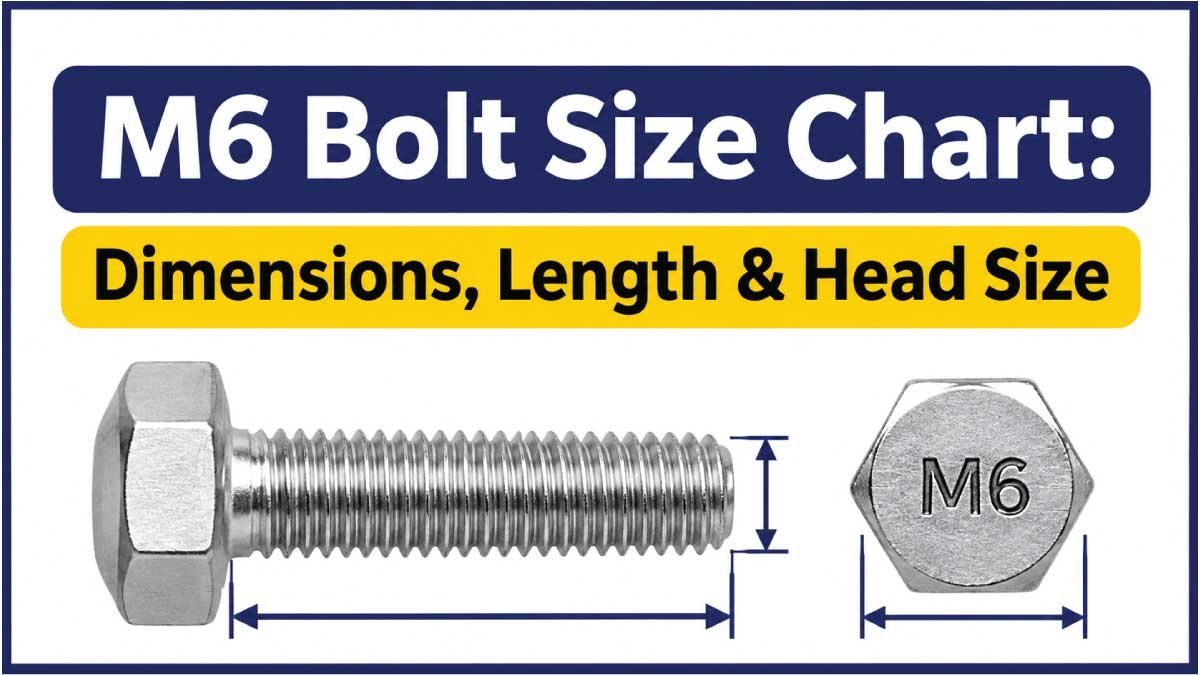
An M6 bolt is a metric fastener with a nominal thread diameter of 6 mm. It is widely used in machinery, automotive assemblies, furniture, construction equipment, electrical enclosures, brackets, and general mechanical work. However, knowing that a bolt is M6 is only the starting point. The correct fastener also depends on its length, thread pitch, head dimensions, strength grade, material, and bolt style.
This M6 bolt size chart explains the most important dimensions in one place and shows how to identify and select an M6 bolt correctly. You will find standard thread information, common lengths, head sizes for hex bolts, measurement instructions, coarse versus fine threads, strength grades, and practical selection tips.
M6 Bolt Dimensions at a Glance
The designation M6 refers to the bolt’s nominal outside thread diameter, not its length or head size. A standard coarse-thread M6 bolt normally uses a 1.0 mm thread pitch, making it one of the most common metric fastener sizes.
For a conventional hex-head M6 bolt, the commonly encountered nominal dimensions include a 6 mm thread diameter and a 10 mm across-flats head size. Exact dimensions can vary according to the applicable product standard, head style, and manufacturer.
| M6 Bolt Dimension | Typical Value | Unit |
|---|---|---|
| Nominal thread diameter | 6 | mm |
| Standard coarse pitch | 1.0 | mm |
| Common fine pitch | 0.75 | mm |
| Common hex head width across flats | 10 | mm |
| Nominal thread radius | 3 | mm |
| Common lengths | 10–100+ | mm |
The table is a practical reference rather than a substitute for a specific fastener standard. Head height, wrenching dimensions, thread tolerances, and other details can differ between ISO, DIN, manufacturer, and specialized bolt specifications.
What Does M6 Mean on a Bolt?
The letter M indicates that the bolt uses a metric thread, while the number 6 identifies the bolt’s nominal thread diameter in millimeters.
Therefore:
- M6 = approximately 6 mm nominal thread diameter
- M6 × 1.0 = 6 mm nominal diameter with a 1.0 mm pitch
- M6 × 0.75 = 6 mm nominal diameter with a 0.75 mm pitch
The number following the diameter is particularly important. An M6 × 1.0 bolt and an M6 × 0.75 bolt are both M6 bolts, but their threads are different and they should not be treated as interchangeable.
M6 Bolt Size vs. Actual Thread Measurement
When measured with a caliper, a threaded M6 bolt may not show exactly 6.00 mm across the thread crests. Manufacturing tolerances mean the measured major diameter can be slightly different.
For identification purposes, a measurement close to 6 mm combined with the appropriate thread pitch is a strong indication that the fastener is M6.
The 6 mm designation describes the nominal size, rather than guaranteeing an exact measurement at every point.
M6 Bolt Size Chart by Length
Bolt length is one of the most important dimensions when replacing or selecting an M6 fastener. M6 bolts are manufactured in many lengths, and the appropriate length depends on the thickness of the materials being joined, washers used, nut engagement, and whether the bolt is threaded fully or partially.
Common nominal lengths include:
| M6 Bolt Size | Nominal Diameter | Length | Typical Use |
|---|---|---|---|
| M6 × 10 | 6 mm | 10 mm | Thin brackets |
| M6 × 12 | 6 mm | 12 mm | Small assemblies |
| M6 × 16 | 6 mm | 16 mm | General fastening |
| M6 × 20 | 6 mm | 20 mm | Panels and brackets |
| M6 × 25 | 6 mm | 25 mm | Medium assemblies |
| M6 × 30 | 6 mm | 30 mm | General mechanical work |
| M6 × 40 | 6 mm | 40 mm | Thicker components |
| M6 × 50 | 6 mm | 50 mm | Multi-layer assemblies |
| M6 × 60 | 6 mm | 60 mm | Deeper assemblies |
| M6 × 80 | 6 mm | 80 mm | Long fastening applications |
| M6 × 100 | 6 mm | 100 mm | Deep or spaced assemblies |
These are common nominal lengths, not a statement that every length is available in every bolt type or standard.
How Is M6 Bolt Length Measured?
For a conventional hex-head bolt, length is generally measured from underneath the bolt head to the end of the threaded shank.
The head itself is normally not included in the stated bolt length.
For example, an M6 × 30 bolt generally has:
- 6 mm nominal thread diameter
- 30 mm nominal length measured under the head
- A head dimension determined by the bolt’s head style and standard
This measurement method is important when replacing an existing bolt because measuring from the very top of the head can make the bolt appear longer than its stated size.
M6 Bolt Head Size Chart
The head size depends heavily on the type of M6 bolt. A standard hex-head bolt does not have the same head dimensions as an M6 socket-head cap screw, button-head screw, countersunk screw, or flange bolt.
For a typical ISO-style M6 hex bolt, the across-flats dimension is commonly 10 mm.
| M6 Fastener Head Type | Typical Wrench/Drive Size | Identification |
|---|---|---|
| Hex head | 10 mm across flats | External hexagonal head |
| Socket-head cap screw | 5 mm hex socket | Cylindrical head with internal hex |
| Button-head socket screw | 4 mm hex socket, commonly | Rounded head with internal drive |
| Countersunk socket screw | 4 mm hex socket, commonly | Flat/conical top |
| Flange-head bolt | Varies by design | Integral flange beneath head |
The values above are useful for identification, but drive size should always be checked against the specific fastener standard or manufacturer specification.
M6 Hex Bolt Head Dimensions
For a standard external hex M6 bolt, the head is commonly designed for a 10 mm wrench or socket across the flats. The head height and corner dimensions depend on the applicable standard.
This distinction matters because an M6 bolt does not automatically mean that every M6 fastener takes a 10 mm wrench.
For example, an M6 socket-head cap screw uses an internal hex drive rather than an external hex head.
M6 Thread Pitch and Thread Dimensions
Thread pitch is the distance from one thread crest to the next, measured parallel to the bolt’s axis.
The most common coarse M6 thread is:
M6 × 1.0
This means:
- Nominal diameter: 6 mm
- Thread pitch: 1.0 mm
- Distance between adjacent thread crests: 1.0 mm
An M6 fine thread may use a smaller pitch, such as 0.75 mm, depending on the applicable standard and application.
| Thread Designation | Nominal Diameter | Pitch | Thread Type |
|---|---|---|---|
| M6 × 1.0 | 6 mm | 1.0 mm | Common coarse thread |
| M6 × 0.75 | 6 mm | 0.75 mm | Fine thread |
A finer pitch provides more threads over a given length, but it is not automatically better. Thread selection should match the application, mating nut or tapped hole, available engagement, and engineering requirements.
M6 Coarse Thread vs. Fine Thread
The difference between coarse and fine M6 threads is primarily the thread pitch.
An M6 × 1.0 bolt advances 1.0 mm per full revolution under ideal conditions, while an M6 × 0.75 bolt advances 0.75 mm per revolution.
M6 × 1.0 Coarse Thread
The standard coarse thread is popular because it is widely available and practical for general mechanical applications.
Advantages include:
- Easy identification
- Broad availability
- Good general-purpose performance
- Less sensitivity to minor damage and contamination
- Common compatibility with standard M6 nuts and threaded holes
M6 × 0.75 Fine Thread
Fine-thread M6 fasteners have more threads per unit length.
They may be useful where the design specifically calls for a finer pitch, but they require the correct matching nut or tapped hole.
Never force an M6 × 1.0 bolt into an M6 × 0.75 threaded hole. The diameters are the same, but the pitches are different.
How to Measure an M6 Bolt
Correct measurement is useful when the original fastener is unidentified or when you need to purchase an exact replacement.
1. Measure the Thread Diameter
Use a digital or vernier caliper to measure across the threaded portion near the outside of the thread crests.
A measurement around 6 mm indicates an M6 nominal diameter.
2. Measure the Bolt Length
For a standard hex-head bolt, measure from underneath the head to the end of the bolt.
Do not normally include the head in the stated length.
3. Identify the Thread Pitch
Use an M6 thread pitch gauge if available. Alternatively, compare the bolt with a known M6 nut or use a carefully measured distance across several thread peaks.
For an M6 × 1.0 bolt, ten thread pitches span approximately 10 mm.
4. Measure the Head
If the bolt has an external hex head, measure across the flats rather than from corner to corner.
For an M6 hex bolt, a commonly encountered across-flats dimension is 10 mm.
5. Identify the Bolt Type
Look at the head shape and drive:
- External hex head
- Internal hex/socket head
- Button head
- Countersunk head
- Flange head
- Other specialized designs
This prevents the common mistake of identifying a bolt only by its thread diameter.
Also Read:
M6 Bolt Grade and Strength
Size alone does not determine how much load a bolt can safely withstand. Material and strength class are equally important.
Metric steel bolts may carry markings such as 8.8, 10.9, or 12.9, depending on the fastener type and applicable specification.
The marking provides information about the bolt’s mechanical properties. It should not be interpreted as a simple “size rating.”
For example, an M6 bolt in one strength class can have substantially different mechanical characteristics from an M6 bolt in another class.
When selecting an M6 fastener for a structural or safety-critical application, consider:
- Required preload
- Tensile loading
- Shear loading
- Bolt grade
- Nut grade
- Joint design
- Material compatibility
- Temperature
- Corrosion environment
- Applicable engineering standard
For critical applications, use the specified engineering documentation rather than choosing a bolt based only on diameter.
Also Read:
M6 Bolt Materials and Finishes
M6 bolts are available in various materials and surface finishes.
Steel M6 Bolts
Steel is widely used for general mechanical fastening. Different steel grades provide different strength and environmental performance.
Stainless Steel M6 Bolts
Stainless steel fasteners are commonly selected where corrosion resistance is important.
However, stainless steel should not automatically be considered a direct mechanical equivalent to a high-strength steel bolt. Mechanical properties vary by stainless grade and product specification.
Zinc-Plated M6 Bolts
Zinc plating can provide additional corrosion protection for steel fasteners. The performance depends on the plating system, environment, and coating thickness.
Black Oxide M6 Bolts
Black oxide finishes are commonly associated with certain machine screws and high-strength fasteners. They provide a particular surface finish but should not be confused with the corrosion protection offered by more substantial protective coatings.
Also Read:
Where Are M6 Bolts Used?
M6 fasteners are common because they provide a useful combination of compact size and mechanical strength for many applications.
Typical uses include:
- Machinery and equipment
- Automotive components
- Motorcycle assemblies
- Metal brackets
- Electrical cabinets
- Industrial enclosures
- Furniture hardware
- Computer and equipment frames
- Fabricated metal assemblies
- Mechanical guards
- Mounting brackets
- General maintenance and repair
The appropriate M6 bolt depends on the joint. A short stainless bolt may be suitable for an enclosure, while a high-strength M6 fastener may be specified for a mechanically loaded assembly.
How to Choose the Correct M6 Bolt Length
Choosing the right length is more than simply selecting the longest bolt that fits.
First, determine the total thickness of the components being joined. Then account for washers, spacers, and the required thread engagement.
A bolt that is too short may not provide adequate thread engagement. A bolt that is excessively long may interfere with surrounding components or create unnecessary protrusion.
Practical Selection Checklist
Before purchasing an M6 bolt, confirm:
- Nominal diameter: M6
- Thread pitch: Usually M6 × 1.0 unless otherwise specified
- Length: Appropriate for the joint
- Head style: Hex, socket, button, countersunk, etc.
- Strength class: Suitable for the application
- Material: Steel, stainless steel, or another specified material
- Finish: Appropriate for the environment
- Thread coverage: Fully or partially threaded as required
- Mating nut or threaded hole: Must have the same diameter and pitch
The correct bolt is therefore a combination of size, geometry, material, and application requirements.
Common M6 Bolt Selection Mistakes
Even experienced DIY users can select the wrong fastener when only the diameter is considered.
Using the Wrong Thread Pitch
An M6 × 1.0 bolt is not interchangeable with an M6 × 0.75 bolt.
Measuring Bolt Length Incorrectly
Including the head in the length measurement can result in purchasing a bolt that is longer or shorter than intended.
Assuming Every M6 Bolt Uses a 10 mm Wrench
A 10 mm across-flats head is common for an M6 hex bolt, but socket-head and other designs use different drive systems.
Ignoring Strength Class
Two M6 steel bolts can have different mechanical properties because their strength classes differ.
Mixing Incompatible Materials
Fastener material should be considered alongside the mating materials and environmental conditions, especially where corrosion is a concern.
Forcing a Bolt Into a Threaded Hole
If an M6 bolt does not start smoothly by hand, stop and check the diameter, pitch, alignment, and condition of the threads.
M6 Bolt vs. Other Common Metric Bolt Sizes
M6 is part of the metric fastener sizing system. Comparing it with nearby sizes helps illustrate where it fits.
| Metric Size | Nominal Diameter | Typical Coarse Pitch | Relative Size |
|---|---|---|---|
| M4 | 4 mm | 0.7 mm | Smaller |
| M5 | 5 mm | 0.8 mm | Smaller |
| M6 | 6 mm | 1.0 mm | Reference |
| M8 | 8 mm | 1.25 mm | Larger |
| M10 | 10 mm | 1.5 mm | Larger |
These sizes should not be selected solely according to diameter. The required size is determined by the joint design, loading, available space, thread engagement, and applicable specifications.
M6 Bolt and Nut Compatibility
An M6 bolt needs a mating nut or threaded hole with the same nominal diameter and thread pitch.
For example:
- M6 × 1.0 bolt → M6 × 1.0 nut
- M6 × 0.75 bolt → M6 × 0.75 nut
The material and strength class of the nut should also be appropriate for the bolt and application.
A high-strength bolt should not simply be paired with any random nut. For engineered joints, the complete fastener combination should meet the relevant requirements.
Frequently Asked Questions About M6 Bolts
Is an M6 bolt 6 mm?
Yes. M6 refers to a nominal metric thread diameter of 6 mm. The actual measured major diameter can differ slightly because of manufacturing tolerances.
What is the standard M6 thread pitch?
The commonly used coarse M6 thread has a 1.0 mm pitch, designated M6 × 1.0.
What size wrench fits an M6 bolt?
A typical standard hex-head M6 bolt commonly uses a 10 mm wrench or socket across the flats. Other M6 head styles can require different drive sizes.
What does M6 × 30 mean?
It generally means an M6 metric bolt with a nominal 6 mm diameter and 30 mm nominal length. For a conventional hex-head bolt, the length is measured from underneath the head.
Are all M6 bolts the same?
No. M6 identifies the nominal thread diameter, but bolts can differ in pitch, length, head style, material, strength class, finish, and thread coverage.
Can M6 × 1.0 and M6 × 0.75 be used together?
No. Their thread pitches are different. The bolt and mating nut or threaded hole must have matching thread specifications.
How do I know if a bolt is M6?
Measure the outside thread diameter and check the pitch. A diameter around 6 mm, combined with a 1.0 mm pitch for the common coarse version, indicates an M6 × 1.0 fastener.
Does M6 describe the bolt head size?
No. M6 describes the nominal thread diameter. Head dimensions depend on the particular bolt style and standard.
M6 Bolt Size Chart: Quick Reference
For everyday identification, the following condensed chart provides the most useful information.
| Specification | M6 Reference |
|---|---|
| Metric designation | M6 |
| Nominal diameter | 6 mm |
| Common coarse pitch | 1.0 mm |
| Example fine pitch | 0.75 mm |
| Common hex-head across flats | 10 mm |
| Common lengths | 10, 12, 16, 20, 25, 30, 40, 50, 60, 80, 100 mm |
| Typical applications | Machinery, brackets, automotive, equipment, enclosures |
| Length measurement for conventional hex bolt | Under head to bolt end |
Always verify the exact product specification when the fastener is being used in a safety-critical, structural, pressure, high-temperature, or otherwise engineered application.
Final Takeaway
The M6 bolt size chart provides a useful starting point for identifying and selecting metric fasteners, but M6 alone does not describe the complete bolt. The designation tells you that the bolt has a 6 mm nominal thread diameter.
For the common coarse version, M6 × 1.0 is the key thread specification. Common hex-head M6 bolts often have a 10 mm across-flats head, while lengths are selected according to the thickness and design of the joint.
Before ordering an M6 bolt, check diameter, pitch, length, head style, material, strength class, finish, and mating thread. For exact engineering dimensions, always confirm the applicable fastener standard or manufacturer’s technical documentation.