
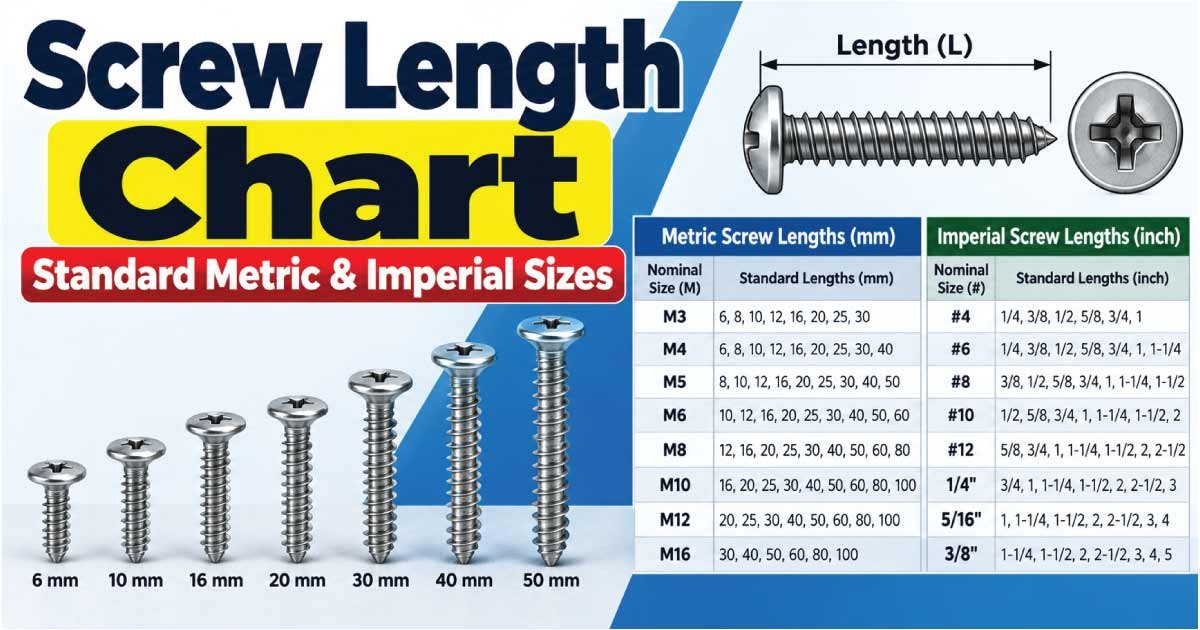
Choosing the correct screw length is just as important as selecting the right diameter, thread, and head style. A screw that is too short may not provide enough thread engagement, while one that is too long can protrude through the material, interfere with components, or create an installation problem.
A screw length chart makes it easier to compare commonly available metric and imperial sizes before purchasing or installing fasteners. However, screw length is measured differently depending on the head design, so understanding the measurement method is essential.
This guide covers standard metric and imperial screw lengths, common size ranges, measurement techniques, conversions, countersunk screws, and practical tips for choosing the correct screw for wood, metal, machinery, construction, and general repairs.
What Is Screw Length?
Screw length is the distance used to describe how long a screw is from its specified measuring point to the end of the threaded or unthreaded shank. The exact measuring point depends on the screw’s head design.
For many non-countersunk screws, such as pan head, round head, hex head, and button head screws, length is generally measured from directly underneath the head to the tip.
For countersunk or flat-head screws, the head sits flush with the material. Their length is normally measured from the top of the head to the tip because the entire screw, including the head, enters the countersunk hole.
This distinction is important when comparing fasteners. Two screws with the same nominal length can have different overall appearances and installation depths because their head styles differ.
Why Screw Length Matters
The correct length affects:
- Thread engagement
- Joint strength
- Material holding power
- Clearance behind the workpiece
- Installation depth
- Flushness of the finished surface
- Compatibility with nuts, inserts, and threaded holes
A good screw selection considers diameter, length, thread type, head style, material, and application together rather than relying on length alone.
Standard Metric Screw Length Chart
Metric screw dimensions are normally specified in millimeters. A metric fastener designation such as M6 × 40 mm indicates an M6 nominal thread diameter and a 40 mm nominal screw length.
The following chart provides commonly encountered metric screw lengths. Availability varies according to screw type, diameter, material, thread standard, and manufacturer.
| Metric Length (mm) | Approx. Imperial Length (in) | Common Use |
|---|---|---|
| 6 mm | 0.24 in | Small assemblies |
| 8 mm | 0.31 in | Light-duty fastening |
| 10 mm | 0.39 in | General assembly |
| 12 mm | 0.47 in | Hardware and machinery |
| 16 mm | 0.63 in | General fastening |
| 20 mm | 0.79 in | Equipment and fixtures |
| 25 mm | 0.98 in | General-purpose fastening |
| 30 mm | 1.18 in | Deeper material |
| 35 mm | 1.38 in | Hardware and construction |
| 40 mm | 1.57 in | Machinery and assemblies |
| 45 mm | 1.77 in | Longer joints |
| 50 mm | 1.97 in | Construction and fabrication |
| 60 mm | 2.36 in | Deep fastening |
| 70 mm | 2.76 in | Structural and heavy-duty applications |
| 75 mm | 2.95 in | Long fastening |
| 80 mm | 3.15 in | Construction and fabrication |
| 90 mm | 3.54 in | Long assemblies |
| 100 mm | 3.94 in | Deep fastening |
| 120 mm | 4.72 in | Long structural applications |
| 150 mm | 5.91 in | Specialized long fastening |
These are length references rather than universal recommendations. A 50 mm screw, for example, can be appropriate in one application and completely unsuitable in another depending on material thickness and thread requirements.
Common Metric Screw Lengths by Diameter
Metric screw size is usually written as diameter × length. For example, M5 × 30 mm means an M5 screw with a nominal length of 30 mm.
The table below shows common combinations as examples rather than a complete catalog.
| Screw Diameter | Common Lengths (mm) | Typical Applications |
|---|---|---|
| M2 | 4–20 | Electronics and small components |
| M2.5 | 5–25 | Small equipment and assemblies |
| M3 | 5–30 | Electronics, hardware, machinery |
| M4 | 6–40 | General hardware and equipment |
| M5 | 8–50 | Machinery and general fastening |
| M6 | 10–60 | Equipment, brackets, machinery |
| M8 | 12–80 | Machinery and construction |
| M10 | 16–100 | Heavy-duty assemblies |
| M12 | 20–120 | Machinery and structural applications |
| M16 | 25–150 | Heavy machinery and structural fastening |
The available lengths can be much broader for particular screw families. Always check the manufacturer’s dimensional table when a precise size is required.
Standard Imperial Screw Length Chart
Imperial screws are commonly specified in inches, with shorter fasteners often expressed as fractions such as 1/2, 3/4, or 1 inch.
Longer screws are commonly specified in whole-inch or fractional-inch increments. Actual availability depends on the fastener type and supplier.
| Imperial Length (in) | Approx. Metric Length (mm) | Common Use |
|---|---|---|
| 1/4 in | 6.35 mm | Small assemblies |
| 3/8 in | 9.53 mm | Light-duty fastening |
| 1/2 in | 12.70 mm | General hardware |
| 5/8 in | 15.88 mm | General fastening |
| 3/4 in | 19.05 mm | Hardware and machinery |
| 7/8 in | 22.23 mm | Medium-depth fastening |
| 1 in | 25.40 mm | General-purpose fastening |
| 1-1/4 in | 31.75 mm | Deeper joints |
| 1-1/2 in | 38.10 mm | Machinery and construction |
| 1-3/4 in | 44.45 mm | Longer assemblies |
| 2 in | 50.80 mm | Construction and fabrication |
| 2-1/2 in | 63.50 mm | Deep fastening |
| 3 in | 76.20 mm | Construction and structural work |
| 3-1/2 in | 88.90 mm | Long fastening |
| 4 in | 101.60 mm | Construction and heavy assemblies |
| 5 in | 127.00 mm | Specialized long fastening |
| 6 in | 152.40 mm | Long structural applications |
Imperial screw lengths should not automatically be treated as direct substitutes for metric sizes. A nominally similar length can still produce a different result when combined with a different diameter or thread specification.
Metric to Imperial Screw Length Conversion
Converting screw lengths between metric and imperial systems is useful when replacing fasteners or working with imported equipment.
The basic conversion is:
1 inch = 25.4 mm
To convert millimeters to inches:
Inches = millimeters ÷ 25.4
To convert inches to millimeters:
Millimeters = inches × 25.4
| Metric Length | Exact Imperial Equivalent | Approximate Imperial |
|---|---|---|
| 6 mm | 0.2362 in | 1/4 in |
| 8 mm | 0.3150 in | 5/16 in |
| 10 mm | 0.3937 in | 3/8 in |
| 12 mm | 0.4724 in | 1/2 in |
| 16 mm | 0.6299 in | 5/8 in |
| 20 mm | 0.7874 in | 3/4 in |
| 25 mm | 0.9843 in | 1 in |
| 30 mm | 1.1811 in | 1-3/16 in |
| 40 mm | 1.5748 in | 1-9/16 in |
| 50 mm | 1.9685 in | 2 in |
| 60 mm | 2.3622 in | 2-3/8 in |
| 75 mm | 2.9528 in | 3 in |
| 100 mm | 3.9370 in | 4 in |
| 150 mm | 5.9055 in | 6 in |
The imperial value in the middle column is the mathematical conversion. The final column shows a nearby commonly recognized fractional length and should not be interpreted as an interchangeable replacement.
How to Measure Screw Length Correctly
Measuring an existing screw is often the fastest way to identify its approximate replacement length. A ruler can work for basic identification, but a caliper provides greater precision.
Measuring a Non-Countersunk Screw
For a conventional screw with a head that remains above the surface:
- Place the screw on a flat surface.
- Identify the underside of the head.
- Measure from the underside of the head to the screw tip.
- Record the measurement in millimeters or inches.
- Measure the diameter separately if you also need to identify the complete screw size.
For example, if the distance from underneath the head to the tip is approximately 40 mm, the screw would generally be described as a 40 mm long screw.
Measuring a Countersunk Screw
Countersunk screws use a different measurement method.
Measure from the top surface of the screw head to the tip. This reflects the installed length because the head is designed to sit within the countersunk recess.
Confusing these two methods can lead to ordering a screw that is effectively too long or too short for the application.
Tools for Measuring Screws
Useful measuring tools include:
- Steel ruler
- Tape measure for longer screws
- Vernier or digital caliper
- Thread pitch gauge
- Screw or bolt thread gauge
- Diameter measuring tool
A caliper is particularly useful when you need to distinguish between nearby metric sizes.
How Screw Length Is Specified
A complete screw designation usually contains more information than length alone.
For example:
M8 × 50 mm
Here:
- M8 = nominal metric thread diameter
- 50 mm = nominal screw length
A designation may also include thread pitch, material, strength class, head style, and finish.
For an imperial machine screw, a designation might include a size such as 1/4-20 × 1 in.
In this example:
- 1/4 in = nominal diameter
- 20 = threads per inch
- 1 in = screw length
This demonstrates why two screws having the same length are not necessarily interchangeable.
Discover More:
How to Choose the Correct Screw Length
Selecting the right length starts with understanding what the screw must pass through and how much material it needs to engage.
Measure the Material Thickness
Add together the thicknesses of the materials being joined.
For example, if two components are 8 mm and 12 mm thick, the combined material thickness is 20 mm.
The screw needs to pass through the first component and provide appropriate engagement in the second component without creating unwanted interference.
Consider Thread Engagement
Thread engagement is the portion of the screw that actually engages with the mating material, nut, insert, or threaded hole.
More length is not automatically better. The goal is to achieve the appropriate engagement for the fastener and application.
For a machine screw entering a threaded hole, excessive length can bottom out before the joint is properly clamped. For a screw going through a component into a nut, excessive length can leave unnecessary thread protruding beyond the nut.
Account for Washers
If a washer is used beneath the screw head, its thickness effectively increases the distance between the head and the material.
For example:
Material thickness + washer thickness + required engagement = approximate required screw length
The final size should then be checked against the screw manufacturer’s available lengths and the requirements of the application.
Consider the Head Style
Head design can change how length is measured and how deeply the screw enters the material.
Common head types include:
- Pan head
- Button head
- Hex head
- Socket head
- Flat or countersunk head
- Oval head
- Truss head
Always confirm the dimensional convention for the specific screw type.
Discover More:
Screw Length for Different Applications
There is no single screw length that is appropriate for every material or job. Application requirements determine the correct dimensions.
Wood Screws
Wood screws are often selected based on the thickness of the material being attached and the amount of penetration required into the supporting material.
A screw that barely enters the supporting piece may provide insufficient holding power, while an excessively long screw can penetrate through the back of the assembly.
When selecting wood screws, consider:
- Thickness of the attached material
- Thickness of the supporting material
- Desired penetration
- Risk of breakthrough
- Screw diameter
- Wood type and condition
Machine Screws
Machine screws are commonly used with nuts, threaded holes, or threaded inserts.
Length selection should account for:
- Component thickness
- Washer thickness
- Nut or threaded-hole requirements
- Required thread engagement
- Clearance behind the assembly
For precision machinery, use the manufacturer’s or engineering drawing’s specified fastener dimensions rather than selecting length by guesswork.
Self-Tapping Screws
Self-tapping screws create or form threads in the receiving material. Their required length depends on the thickness of the material and the depth needed for reliable engagement.
Avoid assuming that a longer self-tapping screw automatically produces a stronger connection.
Construction Screws
Construction and structural applications can require significantly longer fasteners. In these situations, screw length must be selected according to the materials being joined, the fastener design, and applicable installation requirements.
Where structural performance matters, follow the manufacturer’s installation instructions and specified fastener requirements.
Discover More:
Common Screw Length Mistakes
Several simple mistakes can result in the wrong fastener.
Using Overall Length for Every Screw
One of the most common errors is measuring every screw from the top of its head. This is not the correct convention for many non-countersunk screws.
Always identify the head style first.
Choosing a Screw Only by Length
A 50 mm screw is not defined completely by its length. Diameter, thread pitch, material, strength, head style, and application can all affect compatibility.
Assuming Metric and Imperial Screws Are Interchangeable
A metric screw and an imperial screw may look similar but have different diameters or thread forms.
For example, a metric thread and a Unified thread can have different pitches even when their diameters are relatively close.
Never force a screw into a threaded hole simply because it appears to fit.
Ignoring the Washer or Nut
The thickness of washers, brackets, spacers, and other components affects the amount of screw length available for thread engagement.
Using Excessive Length
A screw that is substantially longer than necessary may:
- Bottom out in a blind hole
- Contact internal components
- Protrude through the assembly
- Interfere with moving parts
- Create an installation or safety problem
Screw Length vs. Screw Diameter
Length and diameter describe two different dimensions.
Screw diameter refers to the nominal width of the threaded portion, while screw length describes how long the fastener is according to its measurement convention.
For example:
M6 × 40 mm
means:
- M6 = nominal thread diameter
- 40 mm = nominal length
Changing the length does not change the nominal diameter. Similarly, increasing diameter does not automatically mean the screw should be longer.
A correct fastener selection requires both dimensions to match the application.
Metric and Imperial Screw Length Comparison
Metric and imperial systems can both provide suitable fasteners, but they should be treated as separate sizing systems.
| Feature | Metric Screws | Imperial Screws |
|---|---|---|
| Length unit | Millimeters | Inches |
| Typical designation | M6 × 40 mm | 1/4-20 × 1 in |
| Thread measurement | Metric pitch in mm | Threads per inch |
| Length conversion | 1 mm = 0.03937 in | 1 in = 25.4 mm |
| Common use | International machinery and equipment | Equipment and hardware using Unified threads |
| Interchangeability | Not automatically compatible | Not automatically compatible |
The most important rule is simple: match the complete fastener specification, not just the approximate length.
How to Read a Screw Size Chart
A screw size chart becomes easier to use once the notation is understood.
Suppose you see:
M10 × 60 mm
Read it as:
- M = metric thread designation
- 10 = nominal diameter in millimeters
- 60 = nominal screw length in millimeters
For an imperial designation:
5/16-18 × 2 in
the basic interpretation is:
- 5/16 in = nominal diameter
- 18 = threads per inch
- 2 in = nominal length
Additional markings may identify thread class, material, strength grade, coating, or manufacturing standard.
Tips for Buying the Right Screw Length
Before purchasing replacement screws, verify the complete specification rather than relying on appearance.
Use this checklist:
- Measure the existing screw correctly.
- Identify whether the head is countersunk or non-countersunk.
- Measure the screw diameter.
- Identify metric or imperial threading.
- Check thread pitch or threads per inch when applicable.
- Measure the material thickness.
- Account for washers, spacers, and brackets.
- Confirm the required thread engagement.
- Check the screw material and strength requirements.
- Verify the manufacturer’s dimensions when precision is important.
If an existing screw is available, use it as a reference but do not assume its length is correct simply because it was previously installed. The original fastener may itself have been incorrectly selected.
Frequently Asked Questions About Screw Length
How is screw length normally measured?
For many non-countersunk screws, length is measured from the underside of the head to the tip. For countersunk screws, length is generally measured from the top of the head to the tip.
What does M6 × 40 mean?
M6 × 40 indicates a metric screw with a nominal 6 mm thread diameter and a nominal 40 mm length. Thread pitch may be specified separately when needed.
Is a 1-inch screw the same length as a 25 mm screw?
Not exactly. One inch equals 25.4 mm, so a 1-inch screw is 0.4 mm longer than a 25 mm screw. Whether that difference matters depends on the application.
Can I replace an imperial screw with a metric screw of similar size?
Not automatically. Diameter, thread pitch, thread form, head dimensions, and other specifications must be compatible. Similar-looking threads can still be incompatible.
How do I know what screw length I need?
Start by measuring the material or components being joined. Then account for washers and other components and determine the required thread engagement. For critical applications, follow the relevant fastener manufacturer’s specifications or engineering documentation.
Should a screw always extend completely through the material?
No. The appropriate length depends on the application. A screw may be intended to enter a threaded hole, engage a nut, penetrate a supporting material, or stop within a blind hole. Unnecessary protrusion can create problems.
Are longer screws stronger?
Not necessarily. Strength depends on the complete fastener and joint design, including diameter, material, grade, thread engagement, installation, and the loads involved. Excessive length can actually create clearance or interference problems.
Final Takeaway
A screw length chart is a useful starting point when selecting or replacing fasteners, but length should never be considered in isolation. Metric screws are normally specified in millimeters, while imperial screws use inches, and the two systems are not automatically interchangeable.
The most important steps are to measure the screw correctly, identify the head style, determine the diameter and thread specification, calculate the material thickness, and provide appropriate thread engagement.
For ordinary repairs, a reliable size chart can quickly narrow down your options. For machinery, structural fastening, pressure equipment, or other critical applications, use the exact fastener specification provided by the manufacturer or applicable engineering standard. This ensures that the selected screw is not only the correct length but also suitable for the loads and conditions of the joint.